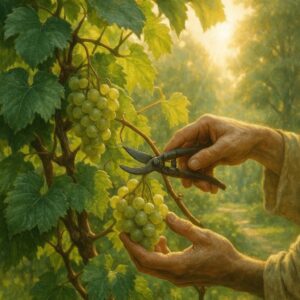
If you have ever spent time in a garden or watched a skilled vinedresser at work, you know that pruning is not a gentle activity. It involves sharp tools, careful cuts, and the removal of living tissue. At first glance, it looks like harm. But anyone who understands plants knows the truth: pruning is the secret to a stronger, more fruitful plant.
The Bible uses this powerful image again and again. From the Old Testament prophets to the words of Jesus Himself, pruning appears as a divine act of love, not punishment.
But what does pruning actually mean in the Bible? And more importantly, what does it mean for your daily life, your struggles, and your spiritual growth?
In this guide, we will walk through every major passage on biblical pruning, uncover its original meaning in Hebrew and Greek, and show you how to recognize when God is pruning you. You will also learn practical ways to respond to seasons of cutting back, so you can bear lasting fruit.
Let us begin.
1. The Core Meaning: Pruning as Divine Care
At its simplest level, pruning in the Bible refers to the act of cutting back a plant to improve its health and fruit production. But spiritually, it takes on a much deeper meaning.
Pruning is God’s intentional process of removing anything in your life that hinders spiritual growth, so you can become more like Christ and bear more fruit for His kingdom.
Notice what pruning is not. It is not punishment. It is not abandonment. And it is not random suffering. Biblical pruning is always purposeful, always loving, and always aimed at a better future harvest.
“I am the true vine, and my Father is the vinedresser. Every branch in me that does not bear fruit he takes away, and every branch that does bear fruit he prunes, that it may bear more fruit.” — John 15:1-2 (ESV)
This verse is the cornerstone of biblical pruning. It tells us three essential truths:
-
God is the vinedresser — He is skilled, intentional, and never reckless.
-
You are the branch — Your connection to Jesus (the vine) is your source of life.
-
Pruning leads to more fruit — Not less. The goal is always increase.
So if you are going through a difficult season right now, do not jump to the conclusion that God is angry with you. You may simply be in the pruning process.
2. Pruning in the Old Testament: God’s Judgment and Restoration
Before Jesus used the vineyard image in the New Testament, the Old Testament prophets had already established pruning as a metaphor for God’s dealings with Israel.
Isaiah’s Vineyard
In Isaiah 5, the prophet sings a song about a beloved vineyard. The owner (God) does everything right: he clears stones, plants choice vines, builds a watchtower, and waits for grapes. But the vineyard produces only wild, sour grapes.
So what does the owner do? He removes the hedge, breaks down the wall, and commands the clouds not to rain. This is severe pruning — almost total removal.
But here is the hard truth: sometimes God allows external circumstances to be cut away because internal change has failed. Israel’s pruning came through exile, invasion, and loss. Yet even then, God promised a remnant would survive and flourish again.
Jeremiah and the Replanting
Jeremiah 24 shows us a different kind of pruning. God shows the prophet two baskets of figs: one very good, one very bad. The good figs represent the exiles sent to Babylon.
“I will set my eyes on them for good, and I will bring them back to this land. I will build them up, and not tear them down; I will plant them, and not uproot them.” — Jeremiah 24:6
Here, pruning (uprooting and replanting) becomes a reset button. God removes His people from a corrupt environment so He can plant them again in purity.
Key takeaway from the Old Testament: Pruning can look like loss, but when God does it, the long-term goal is always restoration and greater faithfulness.
3. The Ultimate Pruning Passage: John 15
No article on biblical pruning would be complete without spending real time in John 15. This is where Jesus gives us the clearest, most practical teaching on the subject.
Let us break down the passage verse by verse.
Verse 1: The True Vine
“I am the true vine, and my Father is the vinedresser.”
Jesus contrasts Himself with the nation of Israel, which had been called God’s vineyard (Isaiah 5). Israel failed to bear fruit. Jesus is the true, faithful vine. If you want spiritual life, you must connect to Him — not to a system, a tradition, or a nationality.
Verse 2: Two Kinds of Branches
“Every branch in me that does not bear fruit he takes away, and every branch that does bear fruit he prunes, that it may bear more fruit.”
This verse distinguishes between:
-
Unfruitful branches: Removed entirely (judgment)
-
Fruitful branches: Pruned carefully (discipline for growth)
If you are already bearing some fruit for God — kindness, patience, evangelism, service — do not expect to be left alone. Expect the vinedresser’s shears.
Verse 3: Already Clean
“Already you are clean because of the word that I have spoken to you.”
Jesus uses a wordplay here. The Greek word for “prunes” (kathairei) is closely related to the word for “clean” (katharoi). In other words, the pruning process makes you clean. And His word is the instrument.
Verses 4-5: Abide or Die
“Abide in me, and I in you. As the branch cannot bear fruit by itself, unless it abides in the vine, neither can you, unless you abide in me.”
This is the non-negotiable condition. Pruning only makes sense if you are connected to the vine. A cut branch thrown on the ground is just dead wood. But a branch that remains in the vine, even while being cut back, will explode with new growth.
Verses 6-8: The Danger of Separation
Branches that do not abide are gathered, thrown into the fire, and burned. This is not a comfortable image. But it reminds us that pruning is not the worst thing that can happen to you. Being cut off from the vine is.
So what does pruning mean in John 15?
It means God actively works on fruitful believers to make them even more fruitful. The process hurts, but the result is glorious.
4. Why Does God Prune? Four Biblical Reasons
Let us move from the “what” to the “why.” The Bible gives us at least four clear reasons God prunes His children.
Reason 1: To Increase Fruitfulness
This is the primary reason. God is not interested in just a little bit of fruit. He wants abundant fruit (John 15:8). A branch left to itself grows wild — many leaves, many tangles, but few grapes. Pruning redirects energy from leaves to fruit.
Reason 2: To Remove Dead or Harmful Growth
Sometimes we carry habits, relationships, or mindsets that look alive but are actually dead or diseased. Hebrews 12:1 calls this “every weight, and sin which clings so closely.” Pruning cuts those away before they infect the whole branch.
Reason 3: To Shape Us Into Christ’s Likeness
Romans 8:29 says God predestined us “to be conformed to the image of his Son.” That process is rarely comfortable. Pruning chips away at pride, selfishness, fear, and control. It leaves behind humility, love, and trust.
Reason 4: To Test and Strengthen Faith
1 Peter 1:6-7 compares trials to fire that refines gold. Pruning is a form of testing. It reveals what you are really made of. Will you curse the vinedresser? Or will you trust His hands?
“For the moment all discipline seems painful rather than pleasant, but later it yields the peaceful fruit of righteousness to those who have been trained by it.” — Hebrews 12:11
Notice the word “trained.” Pruning is not just about removal. It is about training you to produce righteousness.
5. How to Recognize When God Is Pruning You
Not every difficult situation is pruning. Sometimes we suffer because of our own foolish choices (Galatians 6:7). Sometimes we suffer because we live in a fallen world (Romans 8:22). And sometimes the enemy attacks (1 Peter 5:8).
So how can you tell the difference? Here is a helpful comparison.
| Type of Difficulty | Source | Purpose | Your Response |
|---|---|---|---|
| Pruning | God (the Vinedresser) | Greater fruitfulness | Repentance, trust, patience |
| Consequences | Your own sin | Correction and warning | Confession and change |
| Attack | Satan | Destruction, fear, isolation | Resist and stand firm |
| General suffering | Fallen world | Unknown; can be redeemed | Endurance, compassion, hope |
Signs You Are Being Pruned
-
You are already a believer trying to follow Jesus.
-
You have seen some spiritual fruit in your life, but growth has stalled.
-
God has been exposing a specific area — pride, a bad habit, a toxic relationship, a misplaced priority.
-
The difficulty is producing greater dependence on God, not less.
-
After the initial pain, you sense a deeper peace and clarity.
Signs You Are Not Being Pruned (But Something Else)
-
You have no relationship with Jesus at all (John 15:6).
-
You are actively living in unrepentant sin (1 John 1:6).
-
Your suffering is purely self-inflicted and you refuse to learn.
-
There is no spiritual growth — only bitterness.
Note for readers: Be honest with yourself. It is easy to call every hardship “pruning” to avoid admitting we made a mess. But it is equally dangerous to dismiss every difficulty as punishment. Ask God for wisdom (James 1:5). He will show you.
6. The Emotional Side of Pruning: What It Feels Like
Let us be real. Pruning hurts. If you have ever had a dream die, a relationship end, a job disappear, or a long-held comfort removed, you know the sting of the shears.
The Bible does not pretend otherwise. Jesus wept at Lazarus’s tomb (John 11:35). Paul begged three times for his thorn to be removed (2 Corinthians 12:7-9). The psalmist cried out, “My God, my God, why have you forsaken me?” (Psalm 22:1).
Pruning can feel like:
-
Rejection — “Does God still love me?”
-
Confusion — “Why is this happening?”
-
Grief — “I miss what I lost.”
-
Fear — “What if it gets worse?”
-
Loneliness — “No one understands.”
All of these emotions are valid. God is not offended by your honest pain. But here is what you must remember: the vinedresser never prunes for fun. He prunes for a future harvest that you cannot yet see.
A Personal Word
If you are in the middle of a pruning season right now, I want to encourage you. The branch does not understand the cut. All it feels is the sharp blade. But the vinedresser sees the whole tree. He sees next spring. He sees the cluster of grapes that will one day weigh down the branch.
Hold on. The pain is not pointless. The best fruit comes from the most pruned branches.
7. Practical Steps to Respond Well to Pruning
Knowing what pruning means is one thing. Living through it is another. Here are seven practical, biblical steps to respond well when God cuts back your life.
Step 1: Stay Connected to the Vine
The worst thing you can do during pruning is pull away from Jesus. That is like a branch jumping off the table and screaming, “I’ll show you!” You will only dry up.
Do this: Increase your time in prayer and Scripture. Even five minutes of honest prayer is better than an hour of religious performance.
Step 2: Ask “What, Not Why”
Instead of asking “Why me?” ask “What do You want me to remove?” The Bible says, “Search me, O God, and know my heart” (Psalm 139:23). Let God show you the specific thing He is cutting.
Step 3: Confess and Repent Quickly
If God reveals sin, do not bargain. Do not defend. Just agree with Him and turn away. “If we confess our sins, he is faithful and just to forgive us” (1 John 1:9).
Step 4: Trust the Vinedresser’s Skill
You have never pruned a vineyard. God has. He knows exactly where to cut, how deep, and when to stop. Your job is not to understand the plan but to trust the Person.
“Trust in the Lord with all your heart, and do not lean on your own understanding.” — Proverbs 3:5
Step 5: Find a Pruning Partner
Isolation magnifies pain. Find one mature believer who can pray with you, speak truth to you, and sit with you in the waiting. “Two are better than one” (Ecclesiastes 4:9).
Step 6: Keep Serving Others
Pruning can make you self-focused. Fight that. Look for one small way to serve someone else each day. It reorients your heart toward love instead of pain.
Step 7: Wait for the Fruit
You will not see results overnight. After pruning, a vine looks smaller, weaker, and uglier. But give it time. New growth will come. The harvest will come. Do not give up before the fruit appears.
8. Common Misunderstandings About Biblical Pruning
Because pruning is such a rich metaphor, it is also easily misunderstood. Let us clear up a few common errors.
Misunderstanding 1: “Pruning means God is punishing me.”
Truth: Punishment is for sin. Pruning is for growth. If you are in Christ, your sin has already been punished on the cross (Romans 8:1). Pruning is discipline, not wrath.
Misunderstanding 2: “If I am being pruned, I must be doing something wrong.”
Truth: In John 15, the branches that get pruned are the ones already bearing fruit. Pruning is a sign of health, not disease. If you are never pruned, you should be worried.
Misunderstanding 3: “Pruning is always painful.”
Truth: The initial cut hurts. But the long-term result is joy. Hebrews 12:11 admits that discipline is painful “for the moment” but yields peaceful fruit later.
Misunderstanding 4: “I can avoid pruning by being a good Christian.”
Truth: Actually, the more fruit you bear, the more pruning you will receive. God prunes productive branches to make them more productive. Good Christians get pruned often.
Misunderstanding 5: “Pruning means God wants me to do less.”
Truth: Pruning reduces the quantity of activity so you can increase the quality of fruit. You may say no to good things so you can say yes to the best things.
9. Pruning vs. Judgement: A Crucial Difference
One of the most important distinctions in the Bible is between pruning (for believers) and judgment (for unbelievers). Let us compare them side by side.
| Aspect | Pruning | Judgment |
|---|---|---|
| Recipient | Believers who bear fruit | Unbelievers (or fruitless professors) |
| Purpose | Growth, cleansing, more fruit | Removal, punishment, destruction |
| Emotion of God | Love, patience, hope | Wrath, justice, finality |
| Result | More fruit, more joy | Separation, fire, loss |
| Duration | Temporary season | Eternal (for the unrepentant) |
| Example | John 15:2 | John 15:6 |
“There is therefore now no condemnation for those who are in Christ Jesus.” — Romans 8:1
If you belong to Jesus, you will never face judgment for your sins. But you will face pruning. And that is good news — because it means God is treating you as a beloved child (Hebrews 12:7-8).
10. Biblical Characters Who Experienced Pruning
The Bible is filled with people who went through severe pruning and came out bearing more fruit. Their stories give us hope.
Joseph: The Dreamer Pruned for a Throne
Joseph had dreams of greatness. Then he was thrown into a pit, sold as a slave, falsely accused, and forgotten in prison. That is not just pruning — that is heavy pruning.
But God was removing Joseph’s pride, his naivety, and his dependence on human favor. By the time he stood before Pharaoh, Joseph was humble, wise, and ready to save two nations.
Lesson: Your prison might be your preparation.
David: The Shepherd King Cut Down
David was anointed king as a teenager. Then he spent years running from Saul, living in caves, and watching his men lose hope. God was pruning away David’s self-reliance, his impatience, and his need for public approval.
The result? A man after God’s own heart.
Lesson: The cave seasons produce psalms that last forever.
Paul: The Thorn That Became a Gift
Paul asked three times for a “thorn in the flesh” to be removed. God said no. Instead, He said, “My grace is sufficient for you, for my power is made perfect in weakness” (2 Corinthians 12:9).
Paul stopped fighting the pruning and started boasting in his weaknesses.
Lesson: Sometimes God leaves the thorn so you can experience more of His power.
Jesus: The Pruned Vine (Yes, Even He Suffered)
Hebrews 5:8 says Jesus “learned obedience through what he suffered.” The Son of God was not exempt from the pruning process. His suffering prepared Him to be the perfect high priest.
Lesson: If the Master was pruned, the servant should not expect an easier path.
11. How Long Does Pruning Last?
This is one of the most common questions believers ask. “How long, O Lord?” (Psalm 13:1).
The Bible does not give a formula. Pruning seasons vary. Some last weeks. Some last years. Some come in waves — a cut, a season of growth, another cut.
But here is what Scripture promises:
-
Pruning has a purpose (Romans 8:28)
-
Pruning has a limit (1 Corinthians 10:13)
-
Pruning has an end (Psalm 30:5)
“Weeping may tarry for the night, but joy comes with the morning.” — Psalm 30:5
Do not focus on the clock. Focus on the Vinedresser. He knows when the cut is complete. Your job is to abide and trust.
12. The Fruit That Comes After Pruning
What kind of fruit does God want to produce through your pruning? The Bible mentions several specific fruits.
The Fruit of the Spirit
“But the fruit of the Spirit is love, joy, peace, patience, kindness, goodness, faithfulness, gentleness, self-control.” — Galatians 5:22-23
Pruning often targets the opposite of these — anger, anxiety, harshness, impatience, selfishness. As those are cut away, the Spirit’s fruit grows larger.
The Fruit of Righteousness
“For the moment all discipline seems painful rather than pleasant, but later it yields the peaceful fruit of righteousness.” — Hebrews 12:11
Righteousness means right living. Pruning aligns your actions, thoughts, and words with God’s will.
The Fruit of Evangelism
“You did not choose me, but I chose you and appointed you that you should go and bear fruit and that your fruit should abide.” — John 15:16
Pruned believers become more effective witnesses. Their lives carry weight. Their words carry authority. Others see the difference and ask why.
The Fruit of Praise
“That you may proclaim the excellencies of him who called you out of darkness into his marvelous light.” — 1 Peter 2:9
A pruned heart produces genuine worship — not performance, but real, costly praise.
13. A Prayer for Seasons of Pruning
If you are currently in a pruning season, pray this prayer slowly and honestly.
Father, You are the Vinedresser. You know what You are doing, even when I do not understand. I trust Your hands more than I trust my feelings.
If You are cutting something away, show me what it is. Give me the courage to let it go. I do not want to cling to dead branches.
Help me to stay connected to Jesus, the true vine. I cannot bear fruit on my own. I need Your life flowing through me every second.
Thank You that You only prune because You love me. Thank You that this pain has a purpose. Thank You that the morning is coming.
Until then, give me patience. Give me peace. And give me eyes to see the fruit You are growing.
In Jesus’ name, Amen.
14. Frequently Asked Questions (FAQ)
Q1: Does God prune unbelievers?
No. Pruning in the biblical sense applies to branches that are “in” the vine (John 15:2). Unbelievers are not connected to Christ. They experience general trials and sometimes judgment, but not the loving, fruit-producing pruning of the Father.
Q2: Can pruning be caused by the enemy?
The enemy attacks to steal, kill, and destroy (John 10:10). God prunes to give more life. Sometimes the same event (like a job loss) can be intended by Satan for harm but used by God for pruning. Joseph told his brothers, “You meant evil against me, but God meant it for good” (Genesis 50:20).
Q3: How do I know if a loss is pruning or just life?
Ask three questions: (1) Am I closer to God because of this? (2) Is God revealing something specific He wants me to change? (3) Is there potential for greater fruit on the other side? If yes, you are likely being pruned.
Q4: What if I resist the pruning?
Resisting prolongs the pain. You can ignore God’s promptings, harden your heart, or run to distractions. But the Vinedresser is patient. He will keep working. It is far better to surrender early.
Q5: Will I ever be fully done with pruning?
Not in this life. As long as you are bearing fruit, you will be pruned. The goal is not a final state of “no more cuts.” The goal is to become so accustomed to the Vinedresser’s hand that you welcome the shears.
Q6: Does pruning mean I have sin in my life?
Not always. Sometimes God prunes away good things (like busyness or comfort) to make room for better things. But often, pruning reveals hidden sin. Let God be the judge.
Q7: Can a church or community be pruned?
Yes. In Revelation 2-3, Jesus warns several churches to repent or face removal of their lampstand. Entire congregations can experience pruning through loss of influence, members, or resources.
15. Additional Resource
For a deeper study on how suffering and spiritual growth connect, we recommend:
“Spiritual Pruning: How God’s Cuts Lead to Your Greatest Harvest”
By Dr. Alan Wright
Available at: www.ChristianBook.com/SpiritualPruning (example link — replace with actual resource)
You can also explore the free Bible study guide on John 15 provided by The Bible Project — search “The Bible Project John 15” on their official website or YouTube channel.
16. Conclusion (Three Lines)
Biblical pruning is God’s loving, intentional process of cutting away anything in your life that limits spiritual growth. Although it feels painful and confusing, pruning always aims for one outcome: more lasting fruit for God’s glory. Stay connected to Jesus, trust the Vinedresser’s hands, and remember — the best harvest comes from the most pruned branches.