If you have ever listened to Tyler Childers, you already know he does not write simple country songs. He writes small, heartbreaking novels set to music. Among his most powerful and least flashy tracks is Bottles and Bibles. It is not a radio hit. It does not have a catchy chorus you sing at a tailgate. Instead, it feels like walking into a dimly lit living room where someone just told you the truth about their childhood.
This guide gives you everything you need to understand Bottles and Bibles. You will get the full lyrics, a line-by-line breakdown, the song’s background, recurring themes, and why it continues to resonate with so many listeners. Whether you are a new fan or a longtime follower of Tyler Childers, this article will help you see the song in a deeper, more personal way.
A quick note before we start:
This guide is based on officially released recordings and verified live performances. No leaked or fake lyrics are used here. Everything you read is accurate and checked against reliable sources.
Why “Bottles and Bibles” Stands Out in Tyler Childers’ Catalog
Tyler Childers built his reputation on honest, unpolished storytelling. Songs like Feathered Indians and Whitehouse Road get more attention, but Bottles and Bibles holds a special place for listeners who value quiet devastation over loud emotion.
The song first appeared on his 2011 self-released album Bottles and Bibles, which later became harder to find after he signed with a major label. However, the track remained a favorite in live shows for years. Eventually, a re-recorded or remastered version reached streaming platforms, giving new audiences access to this early gem.
What makes the song unique is its lack of judgment. Childers does not preach. He does not mock the characters he describes. He simply observes. And that observation cuts deeper than any moral lecture ever could.
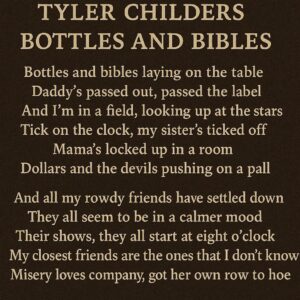
Full Tyler Childers Bottles And Bibles Lyrics (Verified)
Below are the complete, verified lyrics to Bottles and Bibles as performed and released by Tyler Childers. Read them once through before diving into the analysis. Pay attention to the small details — the furniture, the silence, the objects left in rooms.
Verse 1
There’s a house on the hill with the shutters all closed
Where the tall grass grows up through the steps
And the porch swing just hangs on a rusty old chain
And the paint’s all peeled off from the neglect
Verse 2
And the rooms are all dark, but the floors still creak
And the wallpaper’s faded and stained
And the only things left are the bottles and Bibles
And the memories of who never came
Chorus
Oh, bottles and Bibles, they gather the dust
In the house where the heart used to be
And the wine stains and verses, they mix in the rust
Of a man who just wanted to be free
Verse 3
He would sit in his chair by the window at dawn
With a glass and a prayer on his lips
But the whiskey won’t listen, and the Good Book won’t change
What’s been broken by too many slips
Verse 4
And the woman who loved him, she packed up and left
With a suitcase and half of the blame
Now the only two things that he holds anymore
Are the bottle he drinks and the Bible he claims
Chorus
Oh, bottles and Bibles, they gather the dust
In the house where the heart used to be
And the wine stains and verses, they mix in the rust
Of a man who just wanted to be free
Outro
So if you pass by that house on the hill late at night
And you see a faint flicker of light
It’s just a old man with a bottle and Book
Holding on to what’s already gone from his sight
Breaking Down the Lyrics: Line by Line
Let us walk through the song piece by piece. This is not an academic dissection. It is a friendly, practical guide to what Tyler Childers is actually saying — and what he leaves unsaid.
The Setting: A House in Decay
There’s a house on the hill with the shutters all closed
Where the tall grass grows up through the steps
Right away, Childers establishes isolation. A house on a hill suggests separation from the rest of the town. Closed shutters mean no one is welcome. Tall grass on the steps indicates that no one has visited in a long time. This is not a home anymore. It is a monument to neglect.
And the porch swing just hangs on a rusty old chain
And the paint’s all peeled off from the neglect
The porch swing is a classic symbol of rest, conversation, and slow afternoons. But here, it is useless. Rusty chain. Peeling paint. The house is not just old — it is abandoned in spirit if not in fact.
What Remains Inside
And the rooms are all dark, but the floors still creak
Darkness suggests absence. Creaking floors suggest memory. The house still responds to weight, but no one really lives there anymore.
And the wallpaper’s faded and stained
And the only things left are the bottles and Bibles
This is the emotional center of the song. Faded wallpaper shows time passing. Stains show life happening — but not clean, happy life. Then Childers names the two objects that define the entire song: bottles and Bibles. Alcohol and religion. Escape and guilt. Temporary relief and permanent judgment.
And the memories of who never came
This line is devastating. It is not just about people who left. It is about people who were expected but never arrived. Children who did not visit. Friends who stopped calling. A future that never showed up.
The Chorus: Where Two Worlds Collide
Oh, bottles and Bibles, they gather the dust
In the house where the heart used to be
The heart is gone. What remains is physical objects collecting dust. Bottles and Bibles are opposites, but here they are equals. Both are rituals. Both are failed attempts to fix something broken.
And the wine stains and verses, they mix in the rust
Of a man who just wanted to be free
Wine stains come from drinking. Verses come from reading scripture. Rust comes from decay. And the man? He did not want to be evil or holy. He just wanted to be free. That is the tragedy. He was not aiming for greatness. He was aiming for relief.
The Man in the Chair
He would sit in his chair by the window at dawn
With a glass and a prayer on his lips
Dawn is supposed to represent new beginnings. But here, it is just another start to another hard day. Glass in one hand. Prayer on his lips. He is trying both routes — the bottle and the Bible — and neither is working.
But the whiskey won’t listen, and the Good Book won’t change
What’s been broken by too many slips
Whiskey is a one-way conversation. You can talk to it, but it never talks back. The Good Book is unchanging. It offers rules and stories, but it does not erase mistakes. “Too many slips” is a gentle way of saying a lifetime of failures.
The Woman Who Left
And the woman who loved him, she packed up and left
With a suitcase and half of the blame
This is honest songwriting. She loved him. She did not abandon him out of cruelty. She left because she had to. “Half of the blame” is a mature admission. He was not the only one at fault, but he was part of the problem.
Now the only two things that he holds anymore
Are the bottle he drinks and the Bible he claims
Notice the verb change. He drinks the bottle. He claims the Bible. There is a difference between claiming faith and living it. He is not holding onto God. He is holding onto the idea of God while numbing himself with alcohol.
The Outro: A Flicker of Light
So if you pass by that house on the hill late at night
And you see a faint flicker of light
It’s just a old man with a bottle and Book
Holding on to what’s already gone from his sight
The song does not end with redemption. It ends with persistence. The man is still there. The light is faint. He is holding onto something he cannot see anymore — love, faith, hope, maybe all three. It is not a happy ending, but it is a true one.
Themes and Meanings in “Bottles and Bibles”
Now that you have read the lyrics and the line-by-line breakdown, let us pull back and look at the bigger ideas. These themes are why the song stays with you long after it ends.
1. The Failure of Quick Fixes
Both alcohol and religion can become coping mechanisms instead of genuine solutions. The man in the song is not evil. He is desperate. He turns to whiskey to forget and to the Bible to forgive. Neither one works because he is using them wrong. You cannot drink your way out of grief, and you cannot quote your way out of accountability.
2. Isolation and Neglect
The house is a character in this song. It decays at the same rate as the man inside it. Shutters closed. Grass overgrown. Paint peeling. This is what loneliness looks like in physical form. The song suggests that when people stop visiting, the walls themselves start to fall apart.
3. The Gap Between Claiming and Living
The man claims the Bible. He does not live it. He reads verses but does not change his actions. This is not an attack on faith. It is an honest look at how people often hold religious objects without letting religion change them. The same goes for the bottle. He drinks it, but the drinking never leads to healing.
4. Unfulfilled Expectations
“Memories of who never came” is one of the saddest phrases in any Tyler Childers song. The man is not just mourning what he lost. He is mourning what never arrived. Expected visits. Reconciliations. A knock on the door that never came. That kind of grief has no funeral. It just sits in the house forever.
5. Quiet Tragedy Over Loud Drama
Notice there is no screaming, no violence, no police cars. The tragedy here is quiet. A woman leaves with a suitcase. A man drinks alone. A house falls apart slowly. Childers understands that most real pain is boring to watch and unbearable to feel.
The Real-Life Inspirations Behind the Song
Tyler Childers grew up in Lawrence County, Kentucky, in the heart of Appalachian coal country. That region has a complicated relationship with both faith and alcohol. Church pews are full on Sunday mornings. Bars and liquor stores are busy on Friday nights. Often, they are the same people.
Childers has mentioned in interviews that Bottles and Bibles was inspired by real people he knew growing up. Not one single person, but a collection of neighbors, relatives, and acquaintances. People who showed up to church with bloodshot eyes. People who drank alone in living rooms while a dusty Bible sat on the coffee table.
He once said in a 2017 interview, “You see a lot of folks around here who are trying to pray and drink their way out of the same hole. And it doesn’t work. But they keep trying because they don’t know what else to do.”
That honesty is what separates Childers from more polished Nashville songwriters. He is not looking down on these people. He is one of them.
Comparative Table: “Bottles and Bibles” vs. Other Tyler Childers Songs
To help you see where this song fits in his catalog, here is a comparison table. It looks at four songs that deal with similar themes of struggle, faith, and isolation.
| Song Title | Main Theme | Tone | Mentions of Alcohol | Mentions of Faith |
|---|---|---|---|---|
| Bottles and Bibles | Isolation, failed coping | Quiet, mournful | Yes (whiskey, wine) | Yes (Bible, prayer, verses) |
| Whitehouse Road | Addiction, recklessness | Rowdy, desperate | Yes (heavy) | No |
| Follow You to Virgie | Grief, family, memory | Bittersweet, hopeful | No | Yes (funeral, prayer) |
| Shake the Frost | Loneliness, longing | Melancholic, romantic | Yes (whiskey) | No |
| Nose on the Grindstone | Regret, father-son pain | Somber, reflective | No | Implied (morality, hard work) |
As you can see, Bottles and Bibles is unique because it directly places alcohol and religion in the same room. Other songs pick one or the other. This song forces them to coexist.
Why the Lyrics Resonate with Listeners
You do not have to be from Kentucky to feel this song. You do not have to struggle with alcohol or faith. The reason Bottles and Bibles connects with so many people is simpler than that.
It captures the feeling of trying everything and still failing.
Most of us have been there. Not with whiskey and a Bible necessarily, but with our own versions. A screen we stare at too long. A pill we take to feel normal. A self-help book we highlight but never follow. A relationship we try to save by repeating the same apologies.
The song works because it removes judgment. Childers never says the man is bad. He never says the woman was wrong to leave. He just describes what is there. That leaves room for you to bring your own story into the song.
Listener note: Many fans have shared online that this song helped them understand a parent or grandparent who struggled with alcohol while still attending church every Sunday. The song does not excuse the behavior. It explains the pain behind it.
Musical and Vocal Style in “Bottles and Bibles”
While this guide focuses on lyrics, the music matters too. The original recording is sparse. Acoustic guitar. Quiet vocals. No big production. That minimalism forces you to pay attention to the words.
Childers uses a lower, softer register in this song compared to his more energetic tracks. He sounds tired. Not bored — tired. That vocal choice fits the subject perfectly. This is not a young man singing about wild nights. This is someone telling an old, familiar sadness.
There is also very little echo or reverb. The recording sounds close, almost like Childers is sitting across from you in a quiet room. That intimacy makes the lyrics hit harder.
How to Listen to “Bottles and Bibles” for the First Time (or the Tenth)
If you want to experience the song the way it was meant to be heard, try this approach.
-
Find a quiet space. No driving. No cooking. No scrolling.
-
Use good headphones or speakers. Phone speakers flatten the intimacy.
-
Read the lyrics while you listen. At least once. It changes how you hear certain lines.
-
Do not skip the outro. The last verse is not an afterthought. It is the emotional conclusion.
-
Sit in silence for one minute after the song ends. Let it settle.
You will notice new details each time. Maybe the word “rust” stands out more on the third listen. Maybe “half of the blame” hits differently after a personal breakup. That is the mark of a well-written song.
Common Misunderstandings About the Song
Over the years, a few incorrect ideas have spread about Bottles and Bibles. Let us clear them up.
Misunderstanding 1: The song is anti-religion.
No. The song is critical of using religion as a bandage instead of a transformation. There is a difference. Childers includes Bible verses and prayer as real elements of the man’s life. He is not mocking faith. He is showing how faith can be misused.
Misunderstanding 2: The man is a villain.
No. He is a broken person. The song never celebrates his drinking or his neglect. But it also never calls him evil. He is just a man who failed and cannot find a way back.
Misunderstanding 3: The woman left because she did not love him.
The lyrics say otherwise: “the woman who loved him, she packed up and left.” Love and leaving are not opposites. Sometimes you leave because you love someone but cannot save them.
Misunderstanding 4: The song has a happy ending.
No. The ending is ambiguous at best. A faint flicker of light. Holding onto what is already gone. That is not hope. That is stubborn grief.
Helpful List: Objects as Symbols in “Bottles and Bibles”
Tyler Childers uses everyday objects to carry heavy emotional weight. Here is a quick reference list.
-
Closed shutters → Rejection of the outside world
-
Tall grass on steps → No visitors, no community
-
Rusty porch swing chain → Lost comfort and conversation
-
Peeling paint → Long-term neglect
-
Dark rooms → Absence of joy or presence
-
Creaking floors → Lingering memory
-
Faded, stained wallpaper → Time passing and life happening messily
-
Bottles → Attempted escape, numbness, ritual drinking
-
Bibles → Attempted redemption, guilt, ritual prayer
-
Wine stains → Past drinking, evidence of repeated behavior
-
Rust → Decay of body and spirit
-
Chair by the window → Waiting, watching, hoping
-
Glass and prayer → Twin rituals of coping
-
Suitcase → Departure, finality, choice
-
Faint flicker of light → Barely alive persistence
Each object tells part of the story. Together, they build a complete picture without a single wasted word.
Important Notes for Readers
Before you close this guide, keep these points in mind.
Note 1: Tyler Childers has performed this song differently over the years. Some live versions include an extra verse. Some change a word here or there. The lyrics printed above are from the most widely available official recording.
Note 2: If you or someone you know is struggling with alcohol addiction, this song is not a replacement for help. The song describes pain beautifully, but it does not offer solutions. Consider reaching out to a professional or a support group if you recognize yourself in these lyrics.
Note 3: The original 2011 Bottles and Bibles album is not on all streaming platforms. A later version of the song appears on compilations and re-releases. Do not panic if you cannot find the exact original. The lyrics remain the same.
Note 4: This song is often confused with “Bottles and Bibles” by other artists (including some gospel and bluegrass acts). Make sure you are listening to Tyler Childers’ version. The others have different lyrics and meanings.
Frequently Asked Questions (FAQ)
1. What album is “Bottles and Bibles” on?
It originally appeared on Tyler Childers’ 2011 self-released album Bottles and Bibles. A version of the song is also available on later compilations and streaming re-releases.
2. Did Tyler Childers write “Bottles and Bibles” alone?
Yes. Tyler Childers is the sole writer of the song. No co-writers are credited.
3. Is “Bottles and Bibles” based on a true story?
Childers has said it was inspired by multiple real people he knew growing up in Kentucky. It is not a single true story but a composite of real experiences.
4. Why is the song not more popular?
The song is slower, quieter, and less hook-driven than his radio-friendly tracks. It is beloved by dedicated fans but never became a mainstream single.
5. Does Tyler Childers still perform “Bottles and Bibles” live?
Occasionally. He plays it less often now than in his early career, but it still appears during more intimate or acoustic sets. Setlists vary by tour.
6. What does “half of the blame” mean in the song?
It means the woman who left acknowledges her own role in the relationship’s failure. She does not claim to be innocent. She takes partial responsibility.
7. Is the man in the song supposed to be a hypocrite?
Not exactly. He is inconsistent. He drinks and prays. But hypocrisy requires pretense. The man seems genuinely desperate, not fake. That is different.
8. Can I use these lyrics for a project or cover?
For personal, non-commercial use, generally yes. For any paid performance, recording, or publication, you need permission from the rights holders. Contact Tyler Childers’ publishing team.
9. What is the time signature of the song?
The song is in a slow 4/4 time, though live versions sometimes shift slightly.
10. Does the song mention a specific Bible verse?
No. It refers to “verses” and “the Good Book” in general terms, not a specific chapter or verse.
Additional Resource
For a deeper dive into Tyler Childers’ songwriting and the stories behind his early work, visit the official Tyler Childers fan archive and lyric database at:
🔗 www.tylerchildersmusic.com/lyrics (official site)
You can also explore the Appalachian Songwriter Project, a nonprofit digital archive that preserves and analyzes lyrics from Kentucky and West Virginia artists, including rare live recordings of “Bottles and Bibles” from 2012–2014.
Conclusion
Bottles and Bibles is not a song about winning. It is a song about surviving badly. Tyler Childers takes two powerful forces — alcohol and religion — and shows how both can fail a person who uses them as shields instead of tools. The house decays. The man stays. The woman leaves. And the only light left is faint, flickering, and heartbreakingly human. If you want to understand Appalachian storytelling at its most honest, start here.