Life has a way of testing the very core of who we are. In difficult moments, most of us look for something solid to hold onto. For millions of people around the world, that anchor is found in three simple but powerful words: faith, hope, and love.
These three qualities appear together in some of the most memorable passages of the Bible. They are not abstract ideas. They are practical, everyday tools that help people get through loss, uncertainty, fear, and even ordinary stress.
In this guide, we will explore the most important biblical verses on faith hope and love. You will learn what each verse means, how to apply it to your life, and why these three virtues work best when they grow together.
Whether you are new to the Bible or have read it for years, this article will give you fresh insights. No complex theology. No confusing language. Just clear, honest, and useful information.
Let us begin.
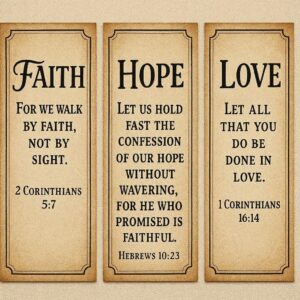
Why Faith, Hope, and Love Appear Together in Scripture
Before we look at individual verses, it helps to understand why the Bible often links faith, hope, and love. They are not separate topics. They form a chain.
Faith looks back or upward. It trusts what God has done and who God is.
Hope looks forward. It expects good things in the future.
Love connects everything. It turns belief and expectation into action.
When you have faith without love, you become rigid.
When you have hope without love, you become impatient.
When you have love without faith or hope, you burn out quickly.
The Bible teaches that all three work together. That is why the most famous verse on this topic says that love is the greatest — but it never says to ignore faith or hope.
Let us now go through the most important passages, one by one.
The Most Famous Biblical Verses on Faith Hope and Love
1 Corinthians 13:13 – The Great Trio
“And now these three remain: faith, hope and love. But the greatest of these is love.” (NIV)
This is the verse most people think of when they search for biblical verses on faith hope and love. It comes at the end of a beautiful chapter that describes what love really looks like.
What it means:
Paul, the writer of this letter, says that many spiritual gifts will one day disappear. Prophecy, special knowledge, and even miracles will no longer be needed. But faith, hope, and love? They last forever. Among the three, love stands out because love is the very nature of God.
How to use it today:
-
When you argue with someone, ask yourself: Am I acting with love?
-
When you feel hopeless, remember that hope remains.
-
When your faith feels weak, hold on. It will not vanish.
Reader note: This verse is often read at weddings. But it was originally written to a church that was fighting with each other. Paul was teaching them how to get along.
Hebrews 11:1 – The Definition of Faith
“Now faith is confidence in what we hope for and assurance about what we do not see.” (NIV)
This is the Bible’s clearest definition of faith. It connects faith directly to hope.
What it means:
Faith is not blind guessing. It is confidence. When you sit on a chair, you have faith it will hold you. You do not see the wood fibers holding together, but you trust them. In the same way, faith trusts God’s promises even when you cannot see the result yet.
How to use it today:
-
When you pray for healing, act in faith by taking positive steps.
-
When you wait for an answer, use hope to keep your mood steady.
-
When you feel afraid, remind yourself: Faith is confidence, not certainty of outcome.
Simple list: Three signs your faith is growing
-
You worry less about things you cannot control.
-
You act on what you believe, even when it is uncomfortable.
-
You forgive yourself and others more easily.
Romans 5:1-5 – The Chain Reaction
“Therefore, since we have been justified through faith, we have peace with God through our Lord Jesus Christ. Through whom we have gained access by faith into this grace in which we now stand. And we boast in the hope of the glory of God. Not only so, but we also glory in our sufferings, because we know that suffering produces perseverance; perseverance, character; and character, hope. And hope does not put us to shame, because God’s love has been poured out into our hearts.” (NIV)
This passage shows exactly how faith, hope, and love work as a process.
What it means:
Faith gives you peace and access to God’s help. That peace leads to hope. Then, when difficulties come (and they will), your hope does not vanish. Instead, suffering builds perseverance. Perseverance builds tested character. And character strengthens hope even more. Finally, God’s love fills your heart so hope never disappoints you.
How to use it today:
-
Stop seeing hard times as punishment. See them as training.
-
Every time you endure a difficult situation, your hope muscle gets stronger.
-
Let love be the fuel. When you feel unloved, remind yourself that God’s love is already poured into your heart.
Comparison table: How faith, hope, and love respond to problems
| Situation | Faith says | Hope says | Love says |
|---|---|---|---|
| You lose your job | God still provides | Something better is coming | Help others who are also struggling |
| A relationship ends | God heals broken hearts | You will love again | Forgive and let go |
| You feel sick | Healing is possible | Your body can recover | Rest and care for yourself |
| You feel alone | God is with you | Community will find you | Reach out to one person today |
Old Testament Verses on Faith, Hope, and Love
The Old Testament does not always use the exact words “faith, hope, and love” together. But the ideas are everywhere. Here are some of the best examples.
Habakkuk 2:4 – The Righteous Shall Live by Faith
“See, the enemy is puffed up; his desires are not upright—but the righteous person will live by his faithfulness.” (NIV)
This verse became very important in the New Testament. Paul quoted it several times.
What it means:
The prophet Habakkuk was confused. He saw bad people succeeding and good people suffering. God told him: Trust my timing. The person who is right with God does not need to see everything now. They keep living faithfully, step by step.
How to use it today:
-
Stop comparing your behind-the-scenes to someone else’s highlight reel.
-
Keep doing the next right thing, even when results are slow.
-
Let faith be your daily rhythm, not just a feeling.
Lamentations 3:21-24 – Hope in the Darkest Book
“Yet this I call to mind and therefore I have hope: Because of the Lord’s great love we are not consumed, for his compassions never fail. They are new every morning; great is your faithfulness.” (NIV)
The book of Lamentations is about suffering. Jerusalem had been destroyed. But in the middle of this sad book, hope appears.
What it means:
The writer says: I choose to remember something. God’s love is the reason you are still alive. Every morning, God’s compassion is fresh. You have not been completely destroyed. That is why hope exists.
How to use it today:
-
When you wake up feeling hopeless, say out loud: Today’s mercies are new.
-
Make a list of small ways you have been “not consumed” — food, shelter, a friend’s text, a breath of air.
-
Let hope be a daily decision, not just an emotion.
Psalm 33:18-22 – Waiting in Hope
“But the eyes of the Lord are on those who fear him, on those whose hope is in his unfailing love, to deliver them from death and keep them alive in famine. We wait in hope for the Lord; he is our help and our shield. In him our hearts rejoice, for we trust in his holy name. May your unfailing love be with us, Lord, even as we put our hope in you.” (NIV)
This psalm connects hope directly to God’s unfailing love.
What it means:
God pays attention to people who put their hope in His love. This hope is not passive. It is active waiting — the kind of waiting a servant does, ready to move when the master gives a signal.
How to use it today:
-
Replace anxious waiting with hopeful waiting. One makes you stressed. The other makes you alert.
-
Remind yourself: God sees me. My hope is not invisible.
-
Use a simple prayer: Lord, let your love be with me today as I put my hope in you.
The Gospels: Jesus Teaches Faith, Hope, and Love
Jesus rarely used the word “hope” directly. Instead, He talked about trust (faith) and the Kingdom (the reason for hope). And everything He did was love in action.
Matthew 17:20 – Faith as Small as a Mustard Seed
“He replied, ‘Because you have so little faith. Truly I tell you, if you have faith as small as a mustard seed, you can say to this mountain, “Move from here to there,” and it will move. Nothing will be impossible for you.’” (NIV)
What it means:
A mustard seed is tiny — about the size of a pinhead. Jesus says that even the smallest amount of real faith is powerful. The problem is not the size of your faith. The problem is whether you use what you have.
How to use it today:
-
Do not wait until you feel “full of faith.” Start with what you have.
-
Speak to your “mountains” (big problems) with confidence, not yelling.
-
Remember: faith grows by being used, not by being stored.
John 3:16 – The Love Verse
“For God so loved the world that he gave his one and only Son, that whoever believes in him shall not perish but have eternal life.” (NIV)
This may be the most famous verse in the entire Bible. It is pure love, and it requires faith, and it produces hope.
What it means:
God’s love is not a feeling. It is action. God gave something precious. The result is that anyone who believes (faith) receives eternal life (the ultimate hope).
How to use it today:
-
When you doubt God’s love, read this verse slowly three times.
-
Let this verse shape how you love others: give something precious, ask for nothing in return.
-
Use this verse as a hope anchor: your future is secure, regardless of today’s problems.
Mark 12:28-31 – The Greatest Commandments
“One of the teachers of the law came and heard them debating. Noticing that Jesus had given them a good answer, he asked him, ‘Of all the commandments, which is the most important?’
‘The most important one,’ answered Jesus, ‘is this: “Hear, O Israel: The Lord our God, the Lord is one. Love the Lord your God with all your heart and with all your soul and with all your mind and with all your strength.” The second is this: “Love your neighbor as yourself.” There is no commandment greater than these.’” (NIV)
What it means:
Jesus summarizes the entire moral law into two loves: love for God and love for neighbor. Notice that loving God involves your whole self (heart, soul, mind, strength). That includes faith and hope.
How to use it today:
-
Every morning, ask: How can I love God today with my time, energy, and thoughts?
-
Every time you see another person, ask: How can I love them as I love myself?
-
Let love be the filter for all your decisions.
Paul’s Letters: The Deepest Teaching on Faith, Hope, and Love
The apostle Paul wrote most of the New Testament letters. He is the one who gave us the famous phrase “faith, hope, and love.” Let us explore his other key passages.
Galatians 5:5-6 – Faith Expressing Itself Through Love
“For through the Spirit we eagerly await by faith the righteousness for which we hope. For in Christ Jesus neither circumcision nor uncircumcision has any value. The only thing that counts is faith expressing itself through love.” (NIV)
What it means:
Paul says that religious rules (like circumcision) do not matter anymore. What matters is faith that works through love. Faith is not just a belief you hold in your head. It is a belief that shows up in loving actions.
How to use it today:
-
Check your faith: does it lead to kind actions? If not, it may be only mental agreement.
-
Let hope keep you patient while you wait for God to make things right.
-
Remember: love is the proof of real faith.
Colossians 1:4-5 – The Trinity of Virtues
“Because we have heard of your faith in Christ Jesus and of the love you have for all God’s people—the faith and love that spring from the hope stored up for you in heaven and about which you have already heard in the true message of the gospel.” (NIV)
What it means:
Paul hears good news about the Colossian Christians. They have faith in Jesus. They have love for other believers. Where do these come from? They spring from hope. Hope is the source. When you truly believe your future is secure in heaven, you can afford to have faith and love today.
How to use it today:
-
Strengthen your hope by reminding yourself of what is waiting for you.
-
Let your hope make you generous. People who have nothing to lose are the most loving.
-
See faith, hope, and love as a garden: hope is the root, faith is the stem, love is the fruit.
1 Thessalonians 1:3 – The Work Trio
“We remember before our God and Father your work produced by faith, your labor prompted by love, and your endurance inspired by hope in our Lord Jesus Christ.” (NIV)
What it means:
Paul describes three activities:
-
Work produced by faith
-
Labor prompted by love
-
Endurance inspired by hope
Faith works. Love labors. Hope endures. Each virtue produces a different kind of action.
How to use it today:
-
When you do your job or chores, do them as an act of faith.
-
When you go out of your way to help someone, see it as love’s labor.
-
When you want to quit, let hope give you one more step of endurance.
Helpful list: How to grow each virtue this week
| Virtue | One small action |
|---|---|
| Faith | Read one Bible verse and act on it within an hour |
| Hope | Write down one good thing you expect to happen tomorrow |
| Love | Do one kind thing for someone without telling anyone |
Practical Ways to Apply Biblical Verses on Faith Hope and Love
Reading verses is good. Living them is better. Here are practical, everyday ways to put biblical verses on faith hope and love into action.
Morning Routine (5 minutes)
-
Faith: Say out loud, “Today, I trust that God is with me even when I cannot see it.”
-
Hope: Name one specific good thing you are hoping for today.
-
Love: Choose one person you will treat with extra kindness.
When You Feel Anxious
-
Faith: Remind yourself of Hebrews 11:1. You do not need to see everything.
-
Hope: Say, “This feeling will not last forever.”
-
Love: Do something physical to help someone else. It breaks anxiety loops.
When You Feel Angry
-
Faith: Trust that God sees the injustice.
-
Hope: Believe that things will be made right, even if not immediately.
-
Love: Pause before speaking. Ask: “Will this help or hurt?”
When You Feel Hopeless
-
Faith: Remember Lamentations 3:22-23. New mercies come every morning.
-
Hope: Make a tiny hope list. Example: “I hope to drink coffee tomorrow. I hope to see the sun.”
-
Love: Let someone love you. Receive a kind word without pushing it away.
Common Misunderstandings About Faith, Hope, and Love
Many people get these three virtues wrong. Let us clear up some confusion.
Misunderstanding 1: Faith means believing without evidence.
Truth: Biblical faith is based on evidence. The Bible says faith comes from hearing (Romans 10:17). You trust because you have good reasons.
Misunderstanding 2: Hope is just wishful thinking.
Truth: Biblical hope is confident expectation. The Greek word elpis means a sure hope, not a “maybe.”
Misunderstanding 3: Love is a feeling.
Truth: Biblical love is action. Feelings come and go. Love stays and serves.
Misunderstanding 4: You only need love. Faith and hope are optional.
Truth: Paul says all three remain. You cannot skip two and keep one healthy.
Comparison table: Biblical meaning vs. common meaning
| Term | Common meaning | Biblical meaning |
|---|---|---|
| Faith | Blind belief | Confident trust based on relationship |
| Hope | Wishful thinking | Certain expectation of future good |
| Love | Romantic feeling | Self-giving action for another’s good |
Verses for Specific Situations
Sometimes you need a verse for a specific moment. Here is a quick guide.
For when your faith is weak
-
Mark 9:24 – “I do believe; help me overcome my unbelief!”
-
Luke 17:5 – “Increase our faith!” (It is okay to ask for more)
For when you have lost hope
-
Romans 15:13 – “May the God of hope fill you with all joy and peace as you trust in him, so that you may overflow with hope by the power of the Holy Spirit.”
-
Psalm 42:5 – “Why, my soul, are you downcast? Put your hope in God.”
For when you struggle to love
-
1 John 4:19 – “We love because he first loved us.”
-
Romans 12:10 – “Be devoted to one another in love. Honor one another above yourselves.”
For when you need all three at once
-
1 Peter 1:21-22 – “Through him you believe in God, who raised him from the dead and glorified him, and so your faith and hope are in God. Now that you have purified yourselves by obeying the truth so that you have sincere love for each other, love one another deeply, from the heart.”
How to Memorize Biblical Verses on Faith Hope and Love
Memorizing verses helps you carry them with you. Here is a simple method.
Step 1: Pick one short verse.
Start with 1 Corinthians 13:13. It is only 12 words in some translations.
Step 2: Write it on a note card.
Put it where you will see it every day — bathroom mirror, desk, phone lock screen.
Step 3: Say it five times in a row.
Morning and evening. Repetition works.
Step 4: Use the first-letter method.
Write the first letter of each word. Example for 1 Corinthians 13:13 (NIV):
A n t t r: f, h a l. B t g o t i l.
Then try to recall the full words.
Step 5: Apply it within 24 hours.
Use the verse in real life. Action locks memory.
A 30-Day Plan to Grow Faith, Hope, and Love
You can grow these virtues like muscles. Here is a simple one-month plan.
Week 1: Faith
-
Day 1: Read Hebrews 11. Write down one person from the list who inspires you.
-
Day 2: Do one thing that requires faith (share a struggle, start a conversation, give a small gift).
-
Day 3: Memorize Hebrews 11:1.
-
Day 4: Pray using only statements of faith, not requests. Example: “God, You are good.”
-
Day 5: Thank God for three things you cannot see but trust are true.
-
Day 6: Read Matthew 17:20. Act as if your small faith is enough.
-
Day 7: Rest. Reflect on how faith grew this week.
Week 2: Hope
-
Day 8: Read Romans 5:1-5. Write down one hard thing that built your character.
-
Day 9: Make a “hope list” of ten things you expect in the next year.
-
Day 10: Memorize Lamentations 3:21-23.
-
Day 11: Encourage someone else by telling them what you hope for them.
-
Day 12: Read Psalm 33:18-22. Pray: “I put my hope in your unfailing love.”
-
Day 13: Do something that requires waiting (bake bread, garden, write a letter). Practice hopeful waiting.
-
Day 14: Rest. Thank God for one hope that came true.
Week 3: Love
-
Day 15: Read 1 Corinthians 13:1-8. Circle every action word.
-
Day 16: Do one loving act for someone who cannot repay you.
-
Day 17: Memorize 1 John 4:19.
-
Day 18: Forgive someone (including yourself) for a small offense.
-
Day 19: Read John 13:34-35. Ask: “How can I love like Jesus today?”
-
Day 20: Give a sincere compliment to three different people.
-
Day 21: Rest. Let someone love you without you doing anything in return.
Week 4: All Three Together
-
Day 22: Read 1 Corinthians 13:13. Write it on a card. Carry it with you.
-
Day 23: Find a person who embodies all three virtues. Thank them.
-
Day 24: Read Colossians 1:4-5. Identify your hope source.
-
Day 25: Do one action that requires faith, hope, and love at the same time.
-
Day 26: Share this guide with one friend. Discuss it.
-
Day 27: Write your own short prayer using the words faith, hope, and love.
-
Day 28: Review your 30-day journey. Celebrate growth, not perfection.
-
Day 29: Choose one verse to keep memorizing long-term.
-
Day 30: Rest and give thanks.
Frequently Asked Questions (FAQ)
1. What is the main Bible verse for faith, hope, and love?
The main verse is 1 Corinthians 13:13: “And now these three remain: faith, hope and love. But the greatest of these is love.” It is the only verse that lists all three together explicitly.
2. Where in the Bible does it say faith, hope, and love?
The phrase “faith, hope, and love” appears most clearly in 1 Corinthians 13:13. Other passages that contain all three ideas include Colossians 1:4-5, 1 Thessalonians 1:3, and Hebrews 6:10-12.
3. Why is love the greatest of faith, hope, and love?
Love is the greatest because it lasts forever and it is the nature of God. Faith and hope will eventually be fulfilled. When we see God face to face, faith becomes sight and hope becomes reality. But love continues forever because God is love.
4. Can you have faith without love?
Yes, you can have faith without love, but the Bible says that kind of faith is empty. 1 Corinthians 13:2 says that even if you have faith to move mountains but do not have love, you are nothing.
5. How do I increase my hope when I feel depressed?
Start small. Read Lamentations 3:21-23. Write down one tiny hope for tomorrow, like “I hope to drink a warm cup of tea.” Ask a friend to hope for you when you cannot hope for yourself. And seek professional help if depression is severe — hope includes using doctors and counselors.
6. Are there specific prayers for faith, hope, and love?
Yes. Here is a simple one:
“God, give me faith to trust You when I cannot see. Give me hope to wait for Your promises. Fill me with love that acts for others. Let all three grow in me today. Amen.”
7. What is the difference between biblical hope and regular hope?
Regular hope says, “I hope it doesn’t rain tomorrow” — it might or might not happen. Biblical hope says, “I hope in God’s promise” — it is certain because God is faithful.
8. Can I read these verses in different translations?
Absolutely. The New International Version (NIV) is clear and popular. The King James Version (KJV) is beautiful and traditional. The English Standard Version (ESV) is very accurate. The New Living Translation (NLT) is very easy to read. Choose the one that speaks to you.
Additional Resource
For deeper study, visit BibleGateway.com.
This free website lets you read every verse mentioned in this article in over 200 translations and languages. You can also listen to audio versions, compare side-by-side translations, and set up a daily verse email.
👉 Go to BibleGateway.com (opens in new tab)
Final Conclusion
Biblical verses on faith, hope, and love give us a complete guide for living well. Faith trusts God in the present. Hope expects good things in the future. Love connects both to real action toward others. Together, these three virtues remain forever, and love stands as the greatest because it never ends.