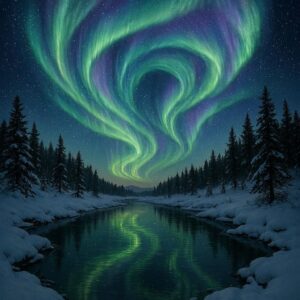
Have you ever looked up at the night sky and seen the sky itself begin to dance? The Northern Lights, or Aurora Borealis, are one of nature’s most breathtaking spectacles. Curtains of green, purple, and pink ripple across the heavens as if painted by an invisible hand. For centuries, people have looked up at this display with a mixture of awe, fear, and wonder.
But for those of us who walk by faith, a natural question arises: what does the Bible say about this? Does the Aurora Borealis have a spiritual meaning? Is it a sign from God?
The truth is, the word “Northern Lights” does not appear in the Bible. The authors of scripture lived in a geographic region where this phenomenon was rarely, if ever, visible. However, the Bible speaks extensively about light, the heavens, the glory of God, and the signs in the sky. While we cannot point to a specific verse that says, “The Aurora Borealis means X,” we can understand this phenomenon through the lens of biblical principles.
In this guide, we will explore the biblical meaning of the Northern Lights. We will look at the relevant scriptures, compare them to what we know about the Aurora, and help you understand how a Christian might interpret this beautiful display of nature. We aim to be honest, realistic, and deeply rooted in scripture.
Let’s begin our journey into the light.
What Are the Northern Lights? A Quick Natural Overview
Before we dive into the spiritual side, it helps to understand what we are actually looking at. The Northern Lights are not magic, and they are not random. They are a scientific reality that showcases the incredible order of God’s creation.
The Aurora Borealis occurs when charged particles from the sun (solar wind) collide with gases in Earth’s upper atmosphere. These collisions release energy in the form of light. The color depends on the type of gas and the altitude of the collision.
| Gas | Altitude | Common Color |
|---|---|---|
| Oxygen | High (up to 200 miles) | Red |
| Oxygen | Low (up to 60 miles) | Green (most common) |
| Nitrogen | Varies | Blue, Purple, Pink |
This process happens constantly, but we only see it near the magnetic poles. From a biblical perspective, this is not a random accident. It is a mechanism built into the fabric of the earth by the Creator. It is a testament to the complexity and beauty of the world God has made.
Understanding this natural foundation helps us avoid superstition. We don’t have to be afraid of the lights, nor do we have to assign them secret meanings that contradict scripture. Instead, we can appreciate them as a unique part of God’s handiwork.
The Heavens Declare the Glory of God
When we ask about the biblical meaning of the Northern Lights, the first place to start is not with a hidden code but with a clear statement found in Psalm 19.
“The heavens declare the glory of God; the skies proclaim the work of his hands.” — Psalm 19:1 (NIV)
This is the foundational verse for understanding any celestial phenomenon from a Christian perspective. Whether it is a sunrise, a star, a comet, or the Aurora Borealis, the primary purpose of the sky is to declare glory to its Maker.
The Northern Lights do exactly that. They are a visual sermon. They speak of power, because they are generated by the immense energy of the sun and the earth’s magnetic field. They speak of artistry, because they move in organic, fluid patterns that no human artist can replicate. They speak of majesty, because they stretch across the entire sky, reminding us of our smallness.
When you see the Aurora, you are witnessing a direct declaration of God’s glory. It is not a message about you, your future, or a secret event. It is a message about Him. It is an invitation to worship.
God’s Creative Power
The Bible often uses the imagery of God stretching out the heavens like a tent.
“He sits enthroned above the circle of the earth, and its people are like grasshoppers. He stretches out the heavens like a canopy, and spreads them out like a tent to live in.” — Isaiah 40:22 (NIV)
If God is powerful enough to stretch out the entire universe, is He not also powerful enough to orchestrate a light show in the upper atmosphere? The Northern Lights are a microscopic detail in the vastness of creation, yet they are breathtaking. This shows a God who cares about beauty, even in the details.
A Natural Revelation
Theologians often speak of “general revelation”—the idea that God reveals Himself through nature. This is different from “special revelation,” which is the Bible and Jesus Christ.
The Northern Lights are a form of general revelation. They tell everyone, regardless of language or culture, that there is a Creator who values beauty, order, and light. As Paul writes in Romans:
“For since the creation of the world God’s invisible qualities—his eternal power and divine nature—have been clearly seen, being understood from what has been made…” — Romans 1:20 (NIV)
The Aurora Borealis makes visible the invisible qualities of God. The raw power of the solar wind, harnessed and transformed into gentle light, mirrors the power and gentleness of God.
Light as a Symbol of God’s Presence
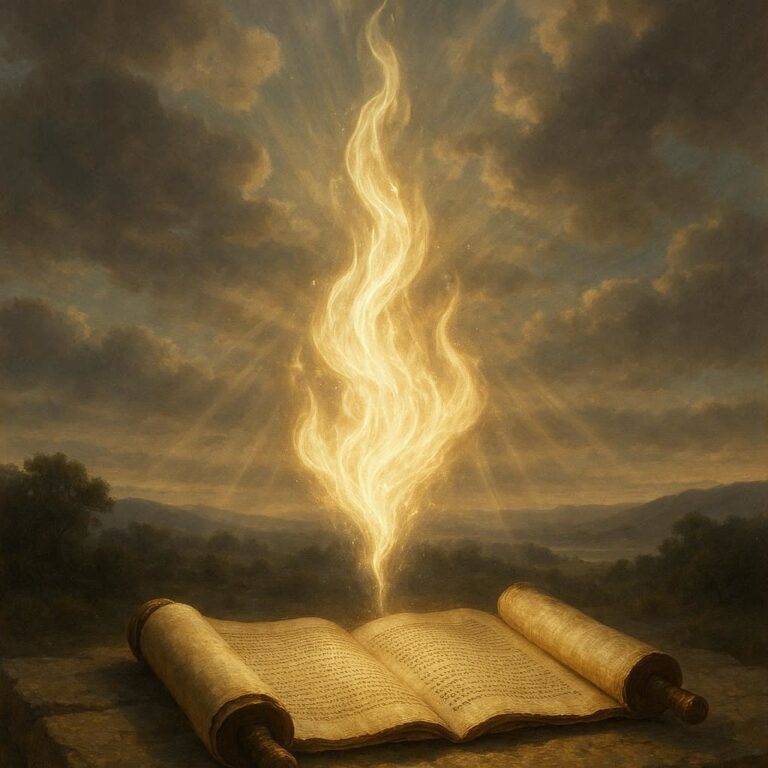
The word “light” is one of the most important symbols in the entire Bible. From the very first page of Genesis to the last page of Revelation, light represents holiness, truth, and the presence of God.
When we consider the Northern Lights, we are dealing with a specific type of light. It is not the steady, predictable light of the sun. It is a moving, dynamic, and ethereal light. How does this fit with scripture?
The First Command: Let There Be Light
In Genesis, before the sun and moon were created, God spoke light into existence.
“And God said, ‘Let there be light,’ and there was light.” — Genesis 1:3 (NIV)
This was the first act of creation. Light is the foundation of order. The Northern Lights, being a form of light, are a continuation of that original command. Every time the Aurora shimmers in the night, it is a reminder that God spoke order into chaos. In our own lives, He brings light into our darkness.
God Dwells in Unapproachable Light
Paul describes God as the one who dwells in light that is unapproachable.
“…who alone is immortal and who lives in unapproachable light, whom no one has seen or can see.” — 1 Timothy 6:16 (NIV)
The Northern Lights are often described as a veil or a curtain. They are a visible representation of “unapproachable light.” You can see the light, but you cannot touch it. You can approach the edge of it, but you cannot enter into it without being overwhelmed by forces you cannot control (the cold, the radiation). This mirrors our relationship with God: we can see His glory from afar, but we can only enter His presence through the sacrifice of Jesus Christ.
Jesus: The Light of the World
Jesus applied the symbol of light directly to Himself.
“When Jesus spoke again to the people, he said, ‘I am the light of the world. Whoever follows me will never walk in darkness, but will have the light of life.’” — John 8:12 (NIV)
The Northern Lights, as a light in the darkness of the night, can serve as a beautiful metaphor for Christ. Just as the Aurora illuminates a dark, cold landscape, Christ illuminates a dark, fallen world. He brings color, hope, and beauty where there was only black and white despair.
Signs in the Sky: Prophecy and Context
One of the reasons people search for the “biblical meaning of Northern Lights” is because of the prophetic passages in the Bible that talk about “signs in the sky.” The most famous of these are found in the book of Joel and in Jesus’s teachings.
“The sun will be turned to darkness and the moon to blood before the coming of the great and dreadful day of the Lord.” — Joel 2:31 (NIV)
“There will be signs in the sun, moon and stars.” — Luke 21:25 (NIV)
It is crucial to handle these verses with care. Many people want to immediately equate the Northern Lights with these “signs.” However, we must be realistic and honest about the text.
What the Bible Actually Describes
When the Bible speaks of signs in the sky, it generally refers to celestial disturbances that are immediately recognizable and often terrifying: the sun going dark, the moon turning red (like blood), stars falling from the sky. These are typically associated with great judgment or the end of the age.
The Northern Lights, while spectacular, do not fit this description. They do not turn the sun dark. They do not make the moon red (though a lunar eclipse does that). They are not a sign of judgment in the biblical context.
A Word of Caution
It is tempting to look at every unusual weather event or celestial phenomenon and declare it a “sign of the end times.” However, Jesus warned us about this.
“Jesus answered: ‘Watch out that no one deceives you… You will hear of wars and rumors of wars, but see to it that you are not alarmed. Such things must happen, but the end is still to come.’” — Matthew 24:4, 6 (NIV)
The appearance of the Northern Lights in lower latitudes (places where they are rarely seen) often sparks this kind of speculation. But historically, the Aurora appears in lower latitudes during periods of high solar activity. This has happened many times throughout history without marking the end of the world.
Important Note for Readers:
While it is healthy to be watchful and aware of prophecy, we must be cautious about setting dates or claiming specific natural events as direct signs. The primary sign the Bible gives us is the Gospel being preached to all nations (Matthew 24:14). The Aurora is a magnificent creation, but it is not a replacement for scripture.
God’s Covenant with Creation
Another beautiful biblical theme that connects to the Northern Lights is the idea of God’s covenant with creation. After the flood, God made a promise not only to humanity but to the earth itself.
“Whenever the rainbow appears in the clouds, I will see it and remember the everlasting covenant between God and all living creatures of every kind on the earth.” — Genesis 9:16 (NIV)
The rainbow is a sign of God’s mercy. It appears after the storm. It is a reminder that God will not destroy the earth by flood again.
The Aurora as a “Sky Covenant”?
While the Northern Lights are never mentioned in this context, we can draw a parallel. If God uses a colorful phenomenon in the sky (the rainbow) to speak of His mercy and faithfulness, could the Aurora not serve a similar purpose for those who witness it?
The Aurora does not come after a flood, but it often appears in the cold, dark winter. It is a reminder that even in the darkest and coldest seasons of life, God is still present. He is still creating beauty. He is still upholding the universe by His power.
The Unchanging Creator
The existence of the Aurora Borealis points to a consistent Creator.
“I the Lord do not change.” — Malachi 3:6 (NIV)
The solar wind has been blowing for billions of years. The earth’s magnetic field has been functioning for billions of years. The Northern Lights have been occurring long before humans ever saw them. This consistency speaks to the faithfulness of God. The same God who set these forces in motion is the same God who watches over you today.
The Northern Lights and the New Heaven
Finally, we look forward. The Bible promises a future where creation itself is renewed. The book of Revelation describes a new heaven and a new earth. In that new creation, there is a striking detail: there is no need for the sun or moon.
“The city does not need the sun or the moon to shine on it, for the glory of God gives it light, and the Lamb is its lamp.” — Revelation 21:23 (NIV)
If the glory of God is the source of light in the new creation, what will that light look like? Will it be a steady, white light? Or will it be something far more dynamic and beautiful than anything we can imagine?
Perhaps the Northern Lights are a preview. They are a hint of what light looks like when it is not filtered by the sun, but emanates from a source of pure power and glory. They are a foretaste of the beauty we will experience when we are in the direct presence of God.
A Hope Beyond the Horizon
When you stand under the Aurora, you are standing under a light that is not the sun. It is a light that comes from interaction and energy. In the new heaven, we will stand under a light that is not the sun, but the glory of the Creator Himself.
This should fill us with hope. The Northern Lights are beautiful, but they are temporary. They last for minutes or hours. The light of God’s glory in the new creation will be eternal.
Comparative Table: Aurora Borealis vs. Biblical Light Symbols
To help summarize the spiritual connections, here is a table comparing the characteristics of the Northern Lights with key biblical symbols of light.
| Characteristic | Northern Lights (Aurora Borealis) | Biblical Light Symbol |
|---|---|---|
| Source | Interaction of solar wind and Earth’s magnetic field. | God Himself is the source of all light (1 John 1:5). |
| Appearance | Dynamic, moving, fluid. | The Holy Spirit moves like the wind (John 3:8). |
| Color | Multicolored (green, red, purple, pink). | God’s glory is associated with brilliant, colorful gemstones (Revelation 21:19-21). |
| Reach | Visible in the far north, often in remote places. | God’s presence is often found in quiet, remote places with Moses and Elijah. |
| Message | Declares the power and artistry of the Creator. | The heavens declare the glory of God (Psalm 19:1). |
| Duration | Temporary, fleeting. | God’s light is eternal (Psalm 136:7-9). |
A Helpful List: What the Northern Lights Are NOT (Biblically)
To ensure we remain grounded, it is just as important to clarify what the Northern Lights are not from a biblical perspective.
-
They are NOT a direct prophecy. The Bible does not mention the Aurora Borealis. While we can derive principles from scripture, we cannot use the Aurora to predict the date of Christ’s return.
-
They are NOT a form of angelic activity. Angels are spiritual beings. The Aurora is a physical phenomenon governed by the laws of physics established by God. While angels may marvel at it, they are not creating it.
-
They are NOT a judgment from God. The Aurora is generally a peaceful, awe-inspiring sight. It does not cause destruction or death. It is not a plague or a punishment.
-
They are NOT a sign to worship creation instead of the Creator. It is easy to be so mesmerized by the lights that we forget the One who made them. We must always worship the Artist, not the art.
-
They are NOT a replacement for the Bible. God speaks primarily through His Word. The Aurora is a beautiful supplement to that revelation, but it is not a source of new doctrine or commands.
How to Respond as a Christian
So, you’ve seen the Northern Lights, or you are planning a trip to see them. How should you, as a believer, respond? Here is a practical, spiritually healthy approach.
1. Worship
Let your first response be worship. Not a vague sense of awe, but a directed thanksgiving to God.
-
Pray aloud: “Lord, thank you for this display of your power.”
-
Sing a hymn: Many hymns about creation, such as “How Great Thou Art,” are perfect for this moment.
-
Reflect: Consider the greatness of the God who orchestrates these forces.
2. Humility
The Northern Lights make you feel small. That is a good thing. The Bible says:
“Humble yourselves before the Lord, and he will lift you up.” — James 4:10 (NIV)
Let the vastness of the sky remind you of your dependence on God. You are a small part of a vast universe, yet He cares for you personally. That is the miracle of the Gospel.
3. Evangelism
The Northern Lights are a powerful conversation starter. People who might never step into a church will travel hundreds of miles to see the Aurora.
-
Use it as a bridge to talk about the Creator.
-
Share Psalm 19:1.
-
Explain that just as the Aurora is beautiful but temporary, we need something eternal—a relationship with Jesus.
4. Photography as Stewardship
Many people photograph the Northern Lights. If you are one of them, consider it an act of stewardship. You are capturing a moment of God’s glory.
-
Share your photos with a caption that gives glory to God.
-
Use the images to encourage others who may be going through dark times, reminding them that light still shines in the darkness.
Conclusion
The biblical meaning of the Northern Lights is not found in a single verse of prophecy, but woven into the entire tapestry of scripture. These magnificent lights are a testament to God’s creative power, a declaration of His glory, and a beautiful symbol of Jesus Christ, the Light of the World. They are not a sign of judgment to be feared, but a display of artistry to be admired.
As you gaze upon the dancing curtains of green and purple, remember that you are looking at the work of the same God who parted the Red Sea, who raised Jesus from the dead, and who promises to make all things new. Let the Aurora point you upward in worship, outward in wonder, and inward toward a deeper gratitude for the God who is light, and in whom there is no darkness at all.
Frequently Asked Questions (FAQ)
1. Does the Bible specifically mention the Northern Lights?
No, the Bible does not specifically mention the Aurora Borealis. The authors of the Bible lived in the Middle East, where this phenomenon is rarely visible. However, the Bible speaks extensively about the heavens, light, and the glory of God, which we can apply to the Northern Lights.
2. Are the Northern Lights a sign of the end times?
While the Bible speaks of signs in the sky, the Northern Lights are not specifically identified as an end-times sign in scripture. They are a natural phenomenon that has occurred for millennia. It is wise to be watchful but to avoid declaring every celestial event as a definitive prophetic marker.
3. What does “Aurora Borealis” mean?
The name “Aurora Borealis” is not biblical; it comes from Latin and Greek. “Aurora” means “dawn,” and “Borealis” means “northern.” It was named by Galileo in 1619. The phenomenon itself, however, predates this name by billions of years.
4. Can the Northern Lights be considered a “rainbow” of the north?
In a symbolic sense, yes. Just as the rainbow is a sign of God’s covenant and mercy after a storm, the Northern Lights can serve as a reminder of God’s presence and beauty in the cold, dark “winters” of our lives. However, the Aurora is not a covenant sign in the same way the rainbow is described in Genesis.
5. Is it wrong for Christians to go see the Northern Lights?
Not at all. Enjoying God’s creation is a spiritual act. As long as we remember to honor the Creator rather than worship the creation, seeking out and marveling at the Northern Lights can be a deeply enriching and worshipful experience.
6. What is the best Bible verse to read while watching the Northern Lights?
Psalm 19:1-4 is a perfect choice. “The heavens declare the glory of God…” You might also read Job 37:21-24, which speaks of God’s majestic power in the skies, or John 1:1-5, which speaks of Jesus as the light that shines in the darkness.