Have you ever been reading a passage in the Bible and noticed a number that seemed to pop out at you? Perhaps it was the number 40 appearing during a time of testing, or the number 7 showing up in a moment of perfection. You are not alone. For centuries, scholars, theologians, and curious readers have explored the fascinating world of biblical numerology.
This guide is designed to be your comprehensive, reliable companion on that journey. We will explore the biblical meaning of numbers from 1 all the way to 1000. We won’t just list definitions. We will look at how these numbers function in the biblical text, how they connect to the overarching story of Scripture, and why they matter for us today.
Think of this as a roadmap. We will start with the foundational numbers (1-10), move through the significant building blocks (11-100), and then explore the powerful meanings of larger, symbolic numbers up to 1000. Our goal is to provide clarity, depth, and a realistic perspective—avoiding wild speculation while embracing the rich, intentional symbolism woven into the Word of God.
Let’s begin.
Understanding Biblical Numerology: A Foundation
Before we dive into specific numbers, it’s important to set a proper foundation. Not every number in the Bible carries a hidden, symbolic meaning. Sometimes, a number is just a number. However, in many key instances, biblical authors used numbers with clear symbolic intent to convey deeper theological truths.
The Difference Between Literal and Symbolic Numbers
The Bible contains both literal and symbolic numbers.
-
Literal Numbers: These are used for straightforward historical or factual details. For example, when Luke writes that Jesus was “about thirty years of age” (Luke 3:23), it is a literal detail about his life.
-
Symbolic Numbers: These are used to communicate an idea or a spiritual principle. For instance, the number 7 is consistently used to represent completeness or perfection, from the seven days of creation to the seven churches in Revelation.
A wise approach to biblical numerology is to look for patterns. When a number is used repeatedly in a specific context, it often points toward a consistent symbolic meaning.
A Note on Interpretation
It is crucial to approach this topic with humility and honesty. We must avoid “reading into” the text what isn’t there. The primary purpose of Scripture is to reveal God’s character and His plan of salvation through Jesus Christ, not to function as a cryptic puzzle book.
When exploring numbers, always ask:
-
Does the immediate context support a symbolic meaning?
-
Is this number used consistently with the same symbolism elsewhere?
-
Does this interpretation point me toward the central message of the Bible?
With these principles in mind, let’s begin our journey through the biblical meaning of numbers 1-1000.
The Foundational Numbers: 1 to 10
The numbers from 1 to 10 form the bedrock of biblical numerology. They introduce core concepts like unity, separation, divinity, and human imperfection that will echo throughout the rest of Scripture.
The Number 1: Unity and Primacy
The number 1 in the Bible is powerfully associated with God Himself. It represents absolute unity, primacy, and the singular nature of the one true God.
-
Key Scripture: “Hear, O Israel: The LORD our God, the LORD is one.” (Deuteronomy 6:4). This foundational creed, known as the Shema, establishes the oneness of God.
-
Symbolism: The number 1 signifies beginnings, leadership, and the source of all things. There is no division in God; He is complete and sovereign. It reminds us that there is one God, one faith, and one mediator between God and mankind (1 Timothy 2:5).
The Number 2: Union, Division, and Witness
The number 2 carries a dual symbolism. It can represent union and partnership, but also separation and division. Its most consistent use, however, is to establish truth through the principle of witness.
-
Key Scripture: “By the mouth of two witnesses or three witnesses shall the one who is to die be put to death.” (Deuteronomy 17:6). The law required two witnesses to establish a legal fact.
-
Symbolism:
-
Union: In marriage, two become one flesh (Genesis 2:24). Jesus sent his disciples out two by two (Mark 6:7), showing partnership in ministry.
-
Division: The number can also represent a division, such as the two natures of humanity (Jew and Gentile) which are united in Christ (Ephesians 2:14).
-
Witness: The most common symbolic use is to confirm truth. Jesus, as the ultimate witness, sent the Holy Spirit as a second witness (John 14:16).
-
The Number 3: Divine Completeness and Resurrection
The number 3 is one of the most significant numbers in Scripture. It points directly to the triune nature of God—Father, Son, and Holy Spirit—and symbolizes divine completeness, resurrection, and the fullness of a thing.
-
Key Scripture: The resurrection of Jesus on the third day (Luke 24:46) is the central event of the Christian faith.
-
Symbolism:
-
The Trinity: The threefold mention of God’s holiness in Isaiah 6:3 (“Holy, holy, holy”) hints at the triune nature.
-
Resurrection: Jesus rose on the third day, making this number a symbol of new life, hope, and victory over death.
-
Divine Action: Many key events happen in three: Jonah was in the fish for three days, Paul was blind for three days, and Jesus prayed three times in Gethsemane.
-
The Number 4: Creation and the Earth
The number 4 is consistently associated with the earth and the physical creation. It speaks of universality and the completeness of the created order.
-
Key Scripture: “The four winds of heaven” (Zechariah 2:6, Daniel 7:2) and the “four corners of the earth” (Isaiah 11:12) represent the entire world.
-
Symbolism:
-
Four Directions: North, South, East, and West represent totality.
-
Four Elements: While not explicitly biblical, the ancient world often saw the earth as comprised of four elements, aligning with this symbolism.
-
Four Seasons: The cycle of time on earth is marked by four seasons.
-
Four Living Creatures: In Ezekiel and Revelation, four living creatures surround God’s throne, representing the pinnacle of earthly creation (Ezekiel 1, Revelation 4).
-
The Number 5: Grace and God’s Goodness
The number 5 is often associated with grace, God’s unmerited favor, and His goodness toward humanity. It is connected to the Torah (the first five books of the Bible) and the structure of sacred spaces.
-
Key Scripture: The Tabernacle in the wilderness had dimensions and items built around the number five. There were five curtains, five pillars, and five bars (Exodus 26).
-
Symbolism:
-
Grace: The number is often seen as representing God’s gracious provision.
-
Pentateuch: The five books of Moses (Genesis, Exodus, Leviticus, Numbers, Deuteronomy) form the foundational law, which itself was a gift of grace from God to His people.
-
Gifts: The five loaves used to feed the 5,000 (Matthew 14:17) point to God’s grace in providing for His people.
-
The Number 6: Human Imperfection and Incompleteness
The number 6 falls short of 7, the number of divine perfection. Therefore, it symbolizes human imperfection, incompleteness, and the weakness of man. Its ultimate representation is in the “number of a man,” 666.
-
Key Scripture: “This calls for wisdom: let the one who has understanding calculate the number of the beast, for it is the number of a man, and his number is 666” (Revelation 13:18).
-
Symbolism:
-
Humanity: Man was created on the sixth day, signifying his connection to the earthly creation.
-
Labor: Man is commanded to work for six days (Exodus 20:9), highlighting his earthly labor and its limitations.
-
Incompleteness: Six is the number of striving, toil, and falling short of God’s perfect rest and standard.
-
The Number 7: Divine Perfection and Completion
The number 7 is perhaps the most prominent symbolic number in the Bible. It signifies divine perfection, completion, and spiritual fullness. From the very first chapter of Genesis, it sets the rhythm for God’s perfect work.
-
Key Scripture: “And on the seventh day God finished his work that he had done, and he rested on the seventh day from all his work that he had done” (Genesis 2:2).
-
Symbolism:
-
Creation: The seven-day creation week establishes a pattern of completion and rest.
-
Ritual: The Old Testament is filled with sevens: the seventh year was a sabbatical year (Leviticus 25:4); the Feast of Unleavened Bread lasted seven days; and the walls of Jericho were marched around seven times (Joshua 6:4).
-
Revelation: The Book of Revelation is structured around sevens: seven churches, seven seals, seven trumpets, and seven bowls.
-
Oaths: The Hebrew word for “to swear an oath” (shaba) is related to the word for seven (sheba), linking an oath to the idea of completeness and commitment.
-
The Number 8: New Beginnings and Resurrection
Following the number 7 (completion), the number 8 represents a new beginning, a fresh start, and resurrection. It is the number of moving beyond the completed cycle into something new.
-
Key Scripture: Eight people were saved in the ark through the great flood (1 Peter 3:20), representing a new beginning for humanity.
-
Symbolism:
-
Circumcision: A male child was to be circumcised on the eighth day (Genesis 17:12), marking his entry into the covenant community and a new life of faith.
-
Resurrection: Jesus rose from the dead on the first day of the week, which is the “eighth day,” symbolizing a new creation.
-
New Creation: The number 8 points to the ultimate new beginning we have in Christ—being a new creation (2 Corinthians 5:17).
-
The Number 9: Finality and Judgment
The number 9 often symbolizes finality, divine judgment, or the culmination of a period of testing. It is the last of the single-digit numbers and carries a sense of completeness in judgment.
-
Key Scripture: The darkest moment in the crucifixion narrative occurred at the ninth hour (Matthew 27:46), when Jesus cried out, “My God, my God, why have you forsaken me?”
-
Symbolism:
-
Judgment: The ninth hour was the time of the evening sacrifice, and Jesus’ death at this hour signifies the final, perfect sacrifice and the judgment upon sin.
-
Fruit of the Spirit: There are nine fruits of the Spirit (Galatians 5:22-23), which represent the complete character of a believer living in the Spirit.
-
Gifts: There are nine spiritual gifts listed in 1 Corinthians 12:8-10, representing the fullness of the Spirit’s empowering for the church.
-
The Number 10: Law, Order, and Responsibility
The number 10 symbolizes human responsibility, law, and a complete set of order. It is the number of the Ten Commandments, which form the foundation of God’s moral law.
-
Key Scripture: “And he wrote on the tablets the words of the covenant, the Ten Commandments” (Exodus 34:28).
-
Symbolism:
-
Law: The Decalogue (Ten Commandments) is the standard of righteousness.
-
Testing: The number 10 can also represent a test of responsibility, as seen in Daniel and his friends who were tested for ten days (Daniel 1:12-15).
-
Completeness of Order: Tithing involves giving a tenth (10%) of one’s income, acknowledging God’s complete ownership over everything (Malachi 3:10).
-
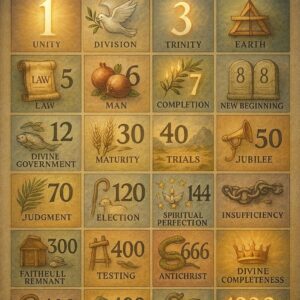
Summary Table: Numbers 1-10
Building Blocks: Numbers 11 to 100
Now, let’s explore the numbers between 11 and 100. Many of these are either combinations of the foundational numbers or hold specific significance in key biblical stories.
11: Disorder and Transition
The number 11 is often viewed as representing disorder, incompleteness, or a transition from one state to another. It falls short of 12, the number of divine government.
-
Examples: The 11th hour workers in Jesus’ parable (Matthew 20:6) represent those who come late but still receive grace. The number can symbolize a time of waiting or a period of incompleteness before divine order is established.
12: Divine Government and Authority
The number 12 is a cornerstone of biblical numerology, representing God’s authority, His chosen people, and perfect governmental foundation.
-
Examples:
-
Israel: The 12 sons of Jacob formed the 12 tribes of Israel, the foundation of God’s covenant people.
-
The Church: Jesus chose 12 apostles, establishing the foundation of the new covenant church.
-
Heavenly City: The New Jerusalem has 12 gates, 12 angels, and its foundation has 12 precious stones (Revelation 21).
-
20: A Period of Waiting or Expectation
The number 20 often signifies a complete period of waiting, expectation, or redemption.
-
Examples: Jacob waited 20 years to gain his wives and possessions (Genesis 31:38). Israel waited 20 years for deliverance from Jabin (Judges 4:3). It can be seen as a cycle of testing before a major breakthrough.
30: Maturity and Dedication
The number 30 is frequently associated with the age of maturity, readiness for ministry, and a time of dedication.
-
Examples:
-
Priestly Service: Priests began their service at the age of 30 (Numbers 4:3).
-
Jesus: Jesus began his public ministry at about 30 years of age (Luke 3:23).
-
Judas: Judas Iscariot betrayed Jesus for 30 pieces of silver (Matthew 26:15), signifying the price of a servant.
-
40: Testing, Trial, and Preparation
The number 40 is one of the most recognizable symbolic numbers, representing a period of testing, trial, probation, or preparation that leads to a new beginning.
-
Examples:
-
Moses: Moses spent 40 years in Pharaoh’s court, 40 years in Midian, and then 40 years leading Israel in the wilderness.
-
Israel: The nation wandered for 40 years in the wilderness as a period of testing.
-
Jesus: Jesus was tempted in the wilderness for 40 days before beginning his ministry (Matthew 4:2).
-
Rain: The flood lasted for 40 days and 40 nights (Genesis 7:12).
-
50: Jubilee, Freedom, and Empowerment
The number 50 is tied directly to the Year of Jubilee and the Feast of Pentecost, symbolizing freedom, deliverance, and the outpouring of the Holy Spirit.
-
Examples:
-
Jubilee: Every 50th year was a Jubilee, when land was returned to its original owners, slaves were freed, and debts were forgiven (Leviticus 25:10).
-
Pentecost: The Feast of Weeks (Shavuot) was celebrated 50 days after Passover. This is the day the Holy Spirit was poured out on the early church (Acts 2), empowering them for mission.
-
60: Pride and Human Achievement
While less common, the number 60 can sometimes symbolize pride or human achievement, often in a negative context.
-
Examples: King Nebuchadnezzar erected a golden statue that was 60 cubits high (Daniel 3:1), an act of pride and self-glorification that led to his judgment.
70: Leadership and International Judgment
The number 70 often signifies leadership, a council of elders, or judgment upon nations.
-
Examples:
-
Elders of Israel: Moses appointed 70 elders to help lead the people (Numbers 11:16).
-
The Sanhedrin: The Jewish ruling council was made up of 70 members.
-
Exile: The 70 years of Babylonian exile (Jeremiah 25:11) represented a period of judgment and completion.
-
80: Renewal and New Strength
The number 80 often follows a period of testing (40+40), symbolizing a time of renewal, new strength, and a fresh season of life and ministry.
-
Examples: Moses was 80 years old when he confronted Pharaoh and led Israel out of Egypt (Exodus 7:7). It marks the beginning of his major life’s work after 40 years of preparation.
90: Promise and Fulfillment
The number 90 is associated with the fulfillment of a long-standing promise, often given in advanced age when hope seems lost.
-
Examples: Sarah was 90 years old when God fulfilled His promise and she gave birth to Isaac (Genesis 17:17). It symbolizes that God’s promises are not limited by human constraints.
100: God’s Chosen People and a Complete Unit
The number 100 represents a complete unit or a full measure of God’s people. It can also signify a standard of complete responsibility or blessing.
-
Examples:
-
Parables: Jesus spoke of a shepherd with 100 sheep, representing the completeness of his flock (Matthew 18:12).
-
Military Units: David’s mighty men were organized into units of hundreds (1 Chronicles 12:14).
-
The Parable of the Sower: The seed that fell on good soil yielded a hundredfold, representing an abundant, complete harvest (Matthew 13:23).
-
Milestones: Numbers 101 to 999
As we move into the hundreds, numbers often become more specific in their context, but they also build upon the foundational meanings of the digits within them.
120: The Age of Humanity and Divine Patience
The number 120 is a significant milestone, representing the divinely appointed lifespan for humanity and a period of grace before judgment.
-
Key Scripture: “Then the LORD said, ‘My Spirit shall not abide in man forever, for he is flesh: his days shall be 120 years.’” (Genesis 6:3)
-
Symbolism: This number marks the limit of God’s patience before the flood. Later, 120 priests were present at the dedication of Solomon’s Temple (2 Chronicles 5:12), and the early church had 120 disciples gathered in the upper room before Pentecost (Acts 1:15).
144: A Foundation of Divine Government
The number 144 is a combination of 12 (divine government) multiplied by itself. It represents a perfect, foundational structure of God’s authority.
-
Key Scripture: 144,000 servants of God are sealed from the 12 tribes of Israel in Revelation 7:4.
-
Symbolism: This number is not literal but symbolic of the complete number of God’s redeemed people—a perfect, unbreakable foundation built on the 12 tribes and the 12 apostles.
153: A Miraculous Catch
The number 153 is famous for the miraculous catch of fish recorded in John 21:11. Many scholars have suggested this specific number points to the totality of all nations or the completeness of the church’s mission.
-
Key Scripture: “Simon Peter went up and drew the net to land, full of large fish, 153 of them.” (John 21:11)
-
Symbolism: Ancient scholars noted that there were 153 known species of fish at the time, suggesting that the net represents the church’s mission to gather people from every nation, tribe, and tongue.
300: Divine Victory and Overcoming
The number 300 is often associated with a remnant achieving a great victory through God’s power, emphasizing that success comes not by numbers but by the Lord.
-
Key Scripture: Gideon defeated the vast army of the Midianites with only 300 men (Judges 7:7).
-
Symbolism: It shows God’s ability to bring deliverance through a seemingly insignificant and outnumbered force, ensuring that the glory belongs to Him alone.
400: A Complete Period of Testing
The number 400 signifies a complete, often long, period of testing, affliction, or servitude.
-
Key Scripture: God told Abraham that his descendants would be strangers in a land and be afflicted for 400 years (Genesis 15:13).
-
Symbolism: This number marks the full duration of Israel’s bondage in Egypt. It is a period of profound testing that precedes a great act of deliverance.
666: The Number of a Man
The number 666 is the infamous “number of the beast” from Revelation, representing the ultimate expression of human imperfection and rebellion against God.
-
Key Scripture: “This calls for wisdom: let the one who has understanding calculate the number of the beast, for it is the number of a man, and his number is 666.” (Revelation 13:18)
-
Symbolism: It falls short of 777 (divine perfection), repeatedly emphasizing human fallenness. It represents a counterfeit trinity (the dragon, the beast, and the false prophet) that seeks to mimic and oppose the Father, Son, and Holy Spirit.
The Ultimate Number: 1000 – Divine Completeness and Immensity
We now arrive at the pinnacle of our journey: the biblical meaning of numbers 1-1000. The number 1000 is not just a large number; it is a potent symbol of divine completeness, immensity, and the limitless scope of God’s power, glory, and sovereignty.
The Millennial Reign
The most prominent appearance of the number 1000 is in Revelation 20, where it speaks of a “thousand-year” reign of Christ. This “millennium” is the ultimate expression of the number’s symbolism.
“They came to life and reigned with Christ for a thousand years.” (Revelation 20:4)
This period represents a complete and perfect era of peace, justice, and the direct rule of God. It is not necessarily meant to be calculated as a literal 365,000-day period, but rather as a perfect, complete, and finite period in which God’s purposes are fulfilled before the final eternal state.
God’s Sovereignty Over All
The number 1000 is used throughout Scripture to convey the idea of an immense, incalculable quantity. It is the number of divine completeness in the realm of time, space, and authority.
-
Key Scripture: “For every beast of the forest is mine, the cattle on a thousand hills.” (Psalm 50:10)
-
Symbolism: This verse doesn’t mean God only owns the cattle on 1,000 hills. It uses the number to represent totality—He owns everything. The number signifies a vast, complete, and all-encompassing ownership.
A Day is Like a Thousand Years
Another profound use of the number 1000 is found in the New Testament, linking the immensity of God’s perspective with His patience and the completion of His plan.
-
Key Scripture: “But do not overlook this one fact, beloved, that with the Lord one day is as a thousand years, and a thousand years as one day.” (2 Peter 3:8)
-
Symbolism: This shows that God is not constrained by time as we are. A thousand years, a complete span of human history, is like a single day to Him. It speaks of His timelessness, patience, and the certainty that His promises (like the return of Christ) will be fulfilled in His perfect timing.
The Number of an Uncountable Multitude
Finally, 1000 is used to describe the strength of God’s people and the vastness of His heavenly hosts.
-
Key Scripture: “The chariots of God are twice ten thousand, thousands upon thousands; the Lord is among them; Sinai is now in the sanctuary.” (Psalm 68:17)
-
Symbolism: The phrase “thousands upon thousands” (or “thousands of thousands”) indicates an innumerable, complete, and overwhelmingly powerful army. It points to the perfect and complete order of the heavenly realm.
In summary, the number 1000 is the capstone of biblical numerology. It gathers up the threads of completeness (7), new beginnings (8), government (12), and testing (40) into one vast, awe-inspiring symbol of God’s absolute sovereignty, His control over time, and the ultimate fulfillment of His eternal plan.
Practical Application and Important Notes
As we conclude this extensive guide, it’s important to reflect on how to use this information wisely and realistically.
Important Note for Readers
This guide is a tool for deeper understanding, not a magical codebook. The Bible is primarily a book of redemption, not a collection of hidden numbers to be decoded for secret knowledge. When you encounter numbers in Scripture, ask yourself: “How does this number’s symbolism enhance my understanding of God’s character, His plan, or my own relationship with Him?”
A Balanced Approach to Biblical Numerology
To maintain a healthy and honest approach, consider these three principles:
-
Look for Patterns, Not Codes: Instead of trying to assign a symbolic meaning to every number, look for where the Bible itself creates a pattern. If a number is used in a specific way repeatedly, that pattern is worth studying.
-
Context is King: Always prioritize the immediate literary and historical context. A number’s meaning in one part of the Bible may be different in another. The story, the audience, and the author’s intent matter more than any numerical formula.
-
Focus on Christ: The ultimate goal of all Scripture is to point us to Jesus. If a numerical interpretation does not ultimately draw you closer to the person and work of Christ, it is likely off track or unhelpful.
Conclusion
Our journey through the biblical meaning of numbers 1-1000 has revealed a rich tapestry of symbolism woven into the fabric of Scripture. We started with the foundational unity of the number 1, passed through the divine perfection of 7, the new beginning of 8, and the law of 10. We explored the periods of testing in 40, the freedom of Jubilee in 50, and the governmental structure of 12. Finally, we arrived at the immensity and completeness of 1000, a number that encapsulates God’s sovereignty over all time, creation, and history. This guide serves as a realistic and reliable resource, demonstrating how these numbers deepen our understanding of God’s consistent, intentional, and beautiful work throughout His Word.
Frequently Asked Questions (FAQ)
1. Is it important to know the biblical meaning of numbers?
Understanding biblical numerology is not essential for salvation, but it can significantly enrich your Bible study. Recognizing these patterns can help you see deeper connections, appreciate the literary artistry of the biblical authors, and grasp the theological weight behind certain events and prophecies.
2. Does every number in the Bible have a symbolic meaning?
No. Many numbers in the Bible are used literally (e.g., ages, census counts, measurements). The symbolic meanings we’ve discussed are associated with numbers that are used in a patterned, intentional way by the biblical authors. It is important to avoid forcing a symbolic meaning onto every number you see.
3. What is the most powerful number in the Bible?
While “powerful” is subjective, many scholars would point to the number 7 as the most prominent and significant symbolic number. It represents divine perfection and completeness, appearing from the very first chapter of Genesis to the final chapters of Revelation.
4. How can I start studying biblical numbers on my own?
A great way to start is by using a concordance or a digital Bible study tool. Look up a number you’re interested in (like “seven” or “forty”) and see how it is used across different books and contexts. Notice the patterns. Always start with the text itself before consulting outside resources.
5. What is the meaning of the number 777?
The number 777 is not directly mentioned in the Bible, but it is derived from the meaning of 7. If 7 is divine perfection, then 777 is often seen as the ultimate or superlative expression of that perfection—a “perfect perfection” often associated with the complete and holy nature of God, in contrast to 666, which is the ultimate expression of human imperfection.