If you’ve ever flipped through the pages of the Bible, a tapestry of ancient names greets you: Abraham, Moses, David, Paul. It’s natural to wonder, among all these towering figures, whose name echoes the loudest and most often through the chapters of this foundational text. The answer is both profoundly simple and deeply significant, pointing us to the very core of the biblical message.
This isn’t just a trivia question. Understanding the most mentioned name unlocks a deeper comprehension of the Bible’s central theme, its narrative arc from Genesis to Revelation, and the identity of its main character. Let’s embark on a journey to uncover this name, explore its meaning, and understand why its repetition is far more than a statistical curiosity.
The Unveiling: A Clear Answer with Deep Meaning
After a careful count across both the Old and New Testaments in their original languages, the most frequently mentioned name in the Bible is God Himself. However, to be more precise, we must look at the specific names and titles used for Him. In the original Hebrew of the Old Testament, the personal, covenant name of God—YHWH, often rendered as “the LORD” in English translations—appears over 6,800 times. No other personal name comes close to this number.
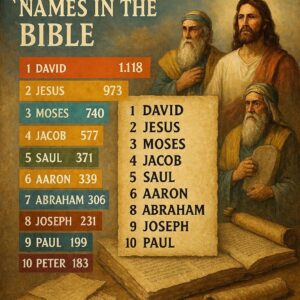
For comparison, the next most-mentioned individuals are:
-
David: Appears approximately 1,100 times.
-
Moses: Appears approximately 800 times.
-
Abraham: Appears approximately 250 times.
This staggering difference isn’t a coincidence. It is a deliberate, thematic drumbeat throughout Scripture. The Bible is, first and foremost, the story of God—His character, His plan, and His relationship with humanity. The pervasive mention of His name serves as a constant reminder of that central reality.
“Hear, O Israel: The LORD our God, the LORD is one.” – Deuteronomy 6:4 (ESV). This central declaration of faith, known as the Shema, highlights the singular focus on YHWH.
A Note on Methodology and Translation
It’s important to understand how we count. In English Bibles, the divine name YHWH is typically translated as “the LORD” (with small capitals). So, every time you read “the LORD” in the Old Testament (e.g., “The LORD is my shepherd”), it represents the Hebrew tetragrammaton YHWH. Other titles like “God” (translating the Hebrew Elohim) or “Lord” (translating Adonai) are also incredibly frequent, but YHWH stands as the distinct, personal name revealed to Moses at the burning bush.
Beyond the Count: The Power of the Name YHWH
Why does this matter? In ancient Semitic culture, a name was not just a label; it conveyed essence, character, and authority. The revelation of God’s name was a revelation of His very being.
When Moses asked God for His name in Exodus 3:14, the response was profound: “I AM WHO I AM” (Hebrew: Ehyeh Asher Ehyeh). The name YHWH is intrinsically linked to this concept. It signifies:
-
Self-Existence: God is the uncaused cause, the one who depends on nothing, the eternal present.
-
Covenant Faithfulness: This is the name by which He enters into relationship with Israel, promising to be their God and they His people.
-
Dynamic Presence: He is not a distant deity but the “I AM” who is actively present with His creation.
The relentless repetition of YHWH throughout the Old Testament continually calls readers back to these truths: the God of the Bible is personal, present, and powerfully committed.
A Comparative Lens: Key Names in the Biblical Narrative
To appreciate the dominance of God’s name, it helps to see the landscape of other key figures. The table below outlines the approximate frequency of major names and titles, highlighting the central focus of Scripture.
| Name / Title | Language of Origin | Approximate Number of Appearances | Primary Significance |
|---|---|---|---|
| YHWH (the LORD) | Hebrew | 6,800+ | The personal, covenant name of God in the OT. |
| Elohim (God) | Hebrew | ~2,600 | A generic term for God, often emphasizing His power as Creator. |
| Jesus | Greek (from Hebrew Yeshua) | ~950 | The central figure of the New Testament, the incarnate Son of God. |
| David | Hebrew | ~1,100 | The archetypal king of Israel, a man after God’s own heart. |
| Moses | Hebrew | ~800 | The great lawgiver and prophet who delivered Israel from Egypt. |
| Lord (Kyrios) | Greek | ~700 (for Jesus) | The NT title for Jesus, often directly linking Him to the OT YHWH. |
| Abraham | Hebrew | ~250 | The father of the covenant and of all who believe. |
This comparison makes the narrative priority clear. While human figures are crucial to the story, they are not the Storyteller. They are instruments and witnesses to the activity of the primary actor: YHWH.
The New Testament Shift: The Name Above All Names
The New Testament introduces a seismic shift that builds upon, rather than replaces, the Old Testament foundation. Here, the name Jesus (Greek Iēsous, from the Hebrew Yeshua meaning “YHWH saves”) becomes the focal point.
The Apostle Paul writes in Philippians 2:9-11:
“Therefore God has highly exalted him and bestowed on him the name that is above every name, so that at the name of Jesus every knee should bow… and every tongue confess that Jesus Christ is Lord, to the glory of God the Father.”
Crucially, the title “Lord” (Kyrios) used here for Jesus is the very same word used in the Greek Old Testament (the Septuagint) to translate the sacred name YHWH. This is not subtle theology. The New Testament authors are declaring that the God who revealed Himself as YHWH in the Old Testament has now been fully and finally revealed in the person of Jesus Christ. The name “Jesus” embodies the saving action promised in the name YHWH.
The Unifying Thread
Therefore, we can see a beautiful, consistent thread:
-
The Old Testament relentlessly emphasizes the name YHWH—the eternal, covenant-keeping God.
-
The New Testament reveals that this same God has acted decisively for salvation in Jesus, who now bears the name above all names.
-
The most mentioned “name” in the complete biblical canon is, in essence, the name of the Divine: revealed as YHWH in the Old Testament and incarnate as Jesus in the New.
Why This Repetition Matters for Readers Today
You might wonder, “This is an interesting linguistic study, but what does it mean for me?” The emphasis on God’s name transforms how we read the Bible and understand faith.
-
It Corrects Our Focus: We are prone to making biblical stories about the human heroes—their faith, their failures, their triumphs. The repetition of God’s name is a constant editorial note: “This story is about what God is doing.” It’s His narrative.
-
It Reveals a Relational God: A deity with a personal name is unprecedented in ancient pantheons. This signals a God who wants to be known, addressed, and intimately related to, not just feared from a distance.
-
It Provides Assurance: The covenant name YHWH is a promise of presence. From the Exodus to the Exile to the incarnation, the biblical message is “I AM with you.” This assurance reaches its climax in Jesus, whose name is “Immanuel” (God with us).
-
It Unifies Scripture: Seeing YHWH and Jesus as the central character of one unified story saves us from reading the Bible as disjointed moral fables or a strict rulebook. It becomes a coherent drama of redemption.
Helpful Lists: Where to See This Theme in Action
To see the centrality of God’s name for yourself, here are key passages that highlight its importance:
In the Old Testament:
-
Exodus 3:13-15 & 6:2-3: The foundational revelation of the name YHWH.
-
Exodus 20:2-7: The Ten Commandments begin with YHWH and prohibit misusing His name.
-
Psalm 8:1 & 9:10: Psalms of praise that exalt the name of the LORD.
-
Isaiah 42:8: “I am the LORD; that is my name; my glory I give to no other.”
-
Ezekiel 36:22-23: God acts for the sake of His holy name.
In the New Testament:
-
Matthew 1:21: “You shall call his name Jesus, for he will save his people from their sins.”
-
John 8:58: Jesus declares, “Before Abraham was, I AM,” directly claiming the divine name.
-
John 17:6, 26: Jesus says He has manifested the Father’s name to His disciples.
-
Acts 4:12: “There is salvation in no one else, for there is no other name under heaven given among men by which we must be saved.”
-
Revelation 19:11-16: The victorious Christ wears a robe dipped in blood, and “the name by which he is called is The Word of God… and he has a name written that no one knows but himself.”
Conclusion
The most mentioned name in the Bible is not a patriarch, prophet, or king, but the name of God Himself—YHWH in the Old Testament, fully revealed in Jesus Christ in the New. This overwhelming repetition is the key that unlocks the Bible’s central theme: a relational, covenant-keeping God on a mission to redeem His creation. Understanding this transforms our reading from a search for human examples to an encounter with the Divine Author of salvation.
Frequently Asked Questions (FAQ)
Q: Is the name “God” or “Lord” counted as the most mentioned?
A: Technically, “God” (Elohim) and the title “Lord” (Adonai) are used thousands of times. However, the personal name YHWH (rendered as “the LORD”) is the single most frequent specific name. In the New Testament, the name Jesus becomes central.
Q: Why do English Bibles write “LORD” in all caps?
A: This is a centuries-old convention to distinguish the translation of the personal name YHWH from the generic title “Lord” (Adonai). When you see “LORD” with small capitals, you know the underlying Hebrew text has the sacred tetragrammaton YHWH.
Q: Does the high number for YHWH include the book of Psalms?
A: Yes, the count is across the entire Old Testament. The book of Psalms, a book of worship, uses the name YHWH extensively (e.g., “Praise the LORD!”), which contributes significantly to the total count, reinforcing that the central act of faith is calling upon and praising God’s name.
Q: What about the name “Jesus” in the whole Bible?
A: While Jesus is undeniably the central human figure of the New Testament (~950 mentions), His name does not outnumber YHWH in the complete biblical canon. Theologically, however, Christians believe Jesus is the embodiment of YHWH, so the revelation is continuous and culminating in Him.
Additional Resources
For those interested in a deeper academic and theological dive into the names of God, we recommend the scholarly resource provided by the Biblical Archaeology Society: The Names of God in the Bible. This article provides excellent historical and linguistic context.