Have you ever picked up a Bible, started reading in Genesis, and felt a little lost by the time you got to Leviticus? Or wondered how stories about ancient kings, minor prophets, and letters to distant churches all fit together?
You are not alone. The Bible is not a single book. It is a library of 66 books, written by about 40 authors over nearly 1,500 years. It contains history, poetry, law, prophecy, and personal letters. With so many moving parts, it is easy to miss the forest for the trees.
That is where the concept of the metanarrative comes in.
The word “meta” means “above” or “overarching.” A metanarrative is the “big story” that holds all the smaller stories together. So, when we ask, “What Is The Metanarrative Of The Bible?” we are asking: What is the one unified story that the whole Bible is telling?
The answer is both simple and beautiful. The Bible’s metanarrative is the story of God’s plan to redeem His creation and His people through Jesus Christ.
Think of it as a classic play with four major acts: Creation, Fall, Redemption, and Restoration. Once you understand these four acts, the entire Bible makes sense. Every psalm, every prophecy, and every letter points to this grand story.
In this guide, we will walk through each part of that story. We will connect the dots between Adam and Abraham, Moses and Messiah, and the Cross and the New Creation. By the end, you will have a clear map to navigate the Scriptures and understand why this story matters for your life today.
Understanding the Concept of a Metanarrative
Before we dive into the biblical text, it helps to understand what we mean by “story.” We live by stories. Our families have stories. Our nations have stories. Even our own lives are stories we are writing every day.
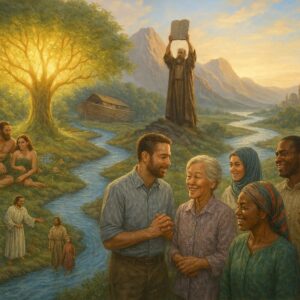
The Bible as a Unified Story
The Bible insists that history is going somewhere. It is not an endless loop of meaningless events. It is a linear progression with a definite beginning (Genesis), a defined problem (sin), and a promised resolution (Revelation).
If you read the Bible without looking for this overarching plot, you might walk away thinking it is a collection of moral lessons:
-
Be like David (but ignore the Bathsheba part).
-
Be like Daniel (and don’t eat the king’s food).
-
Try to be as wise as Solomon.
But moral lessons are not the point of the story. The point is the Hero.
Why the “Big Picture” Matters
Imagine picking up a novel and only reading every other chapter. You would meet interesting characters and see exciting events, but you would have no idea why those events mattered. You would miss the plot twists, the character development, and the final resolution.
Similarly, when we only focus on small chunks of the Bible (a practice called “proof-texting”), we risk missing the intention of the Author. The metanarrative gives us the context. It helps us answer the “Why?” questions:
-
Why did God choose Abraham?
-
Why did Israel need the Law?
-
Why did Jesus have to die?
-
What is the point of the Church?
When we grasp the metanarrative, the Bible transforms from a confusing rulebook into a breathtaking epic.
Act 1: Creation – The Perfect Beginning
Every good story starts with “once upon a time.” But the Bible starts even further back: “In the beginning, God…” (Genesis 1:1). The first act sets the stage for everything that follows. It answers the fundamental questions: Where did we come from? And why are we here?
God’s Good Design
The first thing we learn about God is that He is a Creator. He speaks, and things come into being: light, sky, land, plants, stars, fish, and animals. The Bible uses a poetic rhythm to describe this—”And God saw that it was good” is repeated like a refrain.
This is important. The material world is not evil or an illusion. God made it, and He declared it good. He built order into creation: the sun rules the day, the moon rules the night, the seasons cycle, and life multiplies according to its kind. It was a world of peace, purpose, and beauty.
The Creation of Humanity (Imago Dei)
The creation story reaches its climax on the sixth day. God does not speak humanity into existence the same way He spoke light. Instead, we see a shift in the text:
“Then God said, ‘Let us make mankind in our image, in our likeness…’ So God created mankind in his own image, in the image of God he created them; male and female he created them.” (Genesis 1:26-27)
This is the theological heavy-weight concept known as the Imago Dei (Latin for “Image of God”).
What does it mean to be made in God’s image?
It does not mean we look like God physically. Instead, it means we are God’s representatives on earth.
-
Relationship: We were made for relationship—with God and with each other.
-
Responsibility: God gave Adam and Eve the job of ruling over creation, tending the garden, and naming the animals. This was the first “job description”—to cultivate the world and unlock its potential.
-
Reflection: We were designed to reflect God’s character—His love, justice, creativity, and goodness—to the rest of creation.
The Purpose of Humanity: Relationship and Rule
God placed Adam and Eve in a perfect garden called Eden. He walked with them in the cool of the day. There was no shame, no fear, and no death. Their purpose was simple: to live in loving relationship with God, to love each other, and to steward the earth.
This original state is often called “Shalom”—a Hebrew word meaning complete peace, wholeness, and harmony in every relationship: with God, with self, with others, and with nature.
The story starts with a perfect symphony. But a discordant note is about to be played.
| Element of Creation | Description | Purpose in the Metanarrative |
|---|---|---|
| The Creator | The Triune God (Father, Son, Spirit) | The source of all life and the standard of goodness. |
| The Cosmos | The physical universe (sky, land, seas, life) | Declared “good.” The stage for God’s glory and human activity. |
| Humans | Male and Female made in God’s Image | God’s representatives. Designed for relationship, rule, and reflection. |
| The Garden (Eden) | A perfect dwelling place | The intersection of Heaven and Earth. The template for what the world should be. |
| Shalom | Universal peace and harmony | The original “very good” state of reality. |
Act 2: The Fall – The Problem of Evil and Sin
If Act 1 ended with a perfect world, Act 2 introduces the conflict. Without this act, we wouldn’t understand why the world is so broken, or why we need a Savior. The Fall explains the “problem” that the rest of the Bible seeks to solve.
The Temptation and the Choice
The serpent, described as crafty, approaches Eve in the Garden. He sows a seed of doubt regarding God’s goodness. He asks, “Did God really say…?” (Genesis 3:1).
God had given Adam and Eve one rule: they could eat from any tree in the garden except one—the Tree of the Knowledge of Good and Evil. If they ate from it, they would surely die. This was not a random test. It was a recognition of their role as creatures. They were to trust God to define good and evil, not decide for themselves.
The serpent tempted them with a promise: “You will be like God, knowing good and evil” (Genesis 3:5). Adam and Eve chose to take the fruit. They chose to define reality on their own terms rather than trusting God’s word. This is the essence of sin: deciding that we know better than God.
The Consequences: Broken Relationships
The fallout was immediate and catastrophic. The perfect harmony (Shalom) shattered into a million pieces.
-
Broken Relationship with God: When they heard God walking in the garden, they hid. The intimate friendship was replaced by fear and shame. They were expelled from the garden to prevent them from eating from the Tree of Life and living forever in a broken state.
-
Broken Relationship with Self: They felt shame for the first time and tried to cover themselves with fig leaves.
-
Broken Relationship with Each Other: When God questioned Adam, Adam blamed Eve (and by extension, God: “The woman you put here with me…”).
-
Broken Relationship with Creation: The ground was cursed. Work, which was meant to be a joyful act of cultivation, became toil, sweat, and thorns.
The Spread of Sin and the Universal Need
The tragedy of the Fall is not just one bad decision. It is the infection of the entire human race. In Romans 5:12, the Apostle Paul explains that sin entered the world through one man, and death through sin, and in this way, death came to all people.
The chapters following Genesis 3 show this decay accelerating:
-
Cain murders Abel: The first murder, born from jealousy and anger (Genesis 4).
-
The line of Lamech: Violence and polygamy become normalized (Genesis 4).
-
The Tower of Babel: Humanity collectively rebels against God’s command to fill the earth, choosing instead to build a tower to “make a name for ourselves” (Genesis 11).
By the time we get to Genesis 6, the situation is so dire that the Bible says, “The Lord regretted that he had made human beings on the earth, and his heart was deeply troubled” (Genesis 6:6).
The situation seems hopeless. Humanity, made to reflect God’s glory, is instead reflecting chaos and evil. The story could end here in tragedy, but it doesn’t. In the very moment of the curse, God plants the seed of redemption.
Important Note: In Genesis 3:15, God speaks to the serpent: “And I will put enmity between you and the woman, and between your offspring and hers; he will crush your head, and you will strike his heel.” This is often called the Protoevangelium—the first announcement of the Gospel. It is a promise that one day, a descendant of Eve will come to defeat the serpent, though He Himself will be wounded in the process. This is the first flicker of hope in the darkness.
Act 3: Redemption – God’s Plan to Save
The rest of the Old Testament and the entire New Testament are the working out of God’s redemption plan. If the Fall was humanity ruining God’s world, Redemption is God’s mission to fix it and bring His wayward children home. This act is long and complex, but it follows a clear pattern: God chooses a people, rescues them, and makes a covenant with them.
The Call of Abraham: A New Beginning
After the disaster of Babel, God does not give up on humanity. Instead, He starts with one man. He calls Abram (later renamed Abraham) to leave his home and go to a new land.
God makes a stunning promise to Abraham in Genesis 12:2-3:
“I will make you into a great nation, and I will bless you; I will make your name great, and you will be a blessing. I will bless those who bless you, and whoever curses you I will curse; and all peoples on earth will be blessed through you.”
This is God’s redemption strategy in a nutshell. He chooses one man to build a nation (Israel), so that through that nation, He can bless all the families of the earth. The goal was never just to save Abraham; it was to save the world.
The Exodus: The Ultimate Old Testament Rescue
Abraham’s family grows into a nation, but they end up as slaves in Egypt. For 400 years, they cry out for deliverance. God raises up Moses to be their deliverer.
The Exodus (the departure from Egypt) becomes the defining moment of the Old Testament. God sends plagues to confront the gods of Egypt and to show His power. He leads His people through the Red Sea on dry ground, drowning the Egyptian army. He provides food (manna) and water in the wilderness.
This story is a physical picture of a spiritual reality. It shows us that God is a Redeemer—He hears the cries of His people and acts powerfully to set them free. The Exodus becomes the template for hope: just as God saved Israel from Egypt, He will one day save His people from sin and death.
The Law, the Temple, and the Prophets
After rescuing Israel, God enters into a covenant with them at Mount Sinai. He gives them the Law (the Torah).
What was the purpose of the Law?
It was not a way to earn salvation. They were already saved from Egypt. The Law was a gift that showed them how to live as God’s holy people.
-
Moral Law (The 10 Commandments): Taught them how to love God and neighbor.
-
Civil Law: Governed their society and set them apart from other nations.
-
Ceremonial Law (Sacrifices): Showed them that sin requires a payment and that God was willing to provide a way for forgiveness (through animal sacrifice). This system constantly pointed forward to a perfect, ultimate sacrifice.
God also gave them instructions for a Tabernacle (and later a Temple). This was the place where God’s presence (His glory) dwelled in the midst of His people. It was a mini-Eden, a spot where heaven and earth met.
However, Israel failed to keep the Law. Again and again, they turned away to worship other gods. So, God sent Prophets—men like Isaiah, Jeremiah, and Hosea—to call the people back to covenant faithfulness.
-
The prophets warned of judgment (exile) if the people did not repent.
-
But they also spoke of a future hope: a coming King from David’s line, a “New Covenant” where God would write His law on people’s hearts (Jeremiah 31), and a suffering servant who would bear the sins of many (Isaiah 53).
The Arrival of Jesus: The Hero Enters
After 400 years of silence following the last Old Testament prophet, the stage was set. The Roman Empire provided peace and roads. The Greek language provided a common tongue. The Jewish people were waiting for their Messiah.
Then, in a small town called Bethlehem, the Hero of the story was born.
The Gospels (Matthew, Mark, Luke, and John) are not just biographies. They are the announcement that the King has arrived. Jesus is the fulfillment of the entire Old Testament story.
-
He is the last Adam, succeeding where the first Adam failed (Romans 5).
-
He is the true seed of Abraham, through whom all nations are blessed (Galatians 3).
-
He is the ultimate Prophet, speaking God’s very words.
-
He is the final High Priest, offering not the blood of animals, but His own blood.
-
He is the promised King from the line of David.
Jesus preached the arrival of the “Kingdom of God”—the long-awaited time when God would begin to rule and reign, setting the world right. He healed the sick, cast out demons, and welcomed outcasts. He showed what life looks like when God is truly King.
The Cross and the Empty Tomb: The Climax of History
The religious leaders rejected Jesus’ claims. They had Him arrested and crucified. From the outside, it looked like the story had failed. The Romans executed criminals; the Messiah was not supposed to die.
But this was the plan all along. The Cross was the cosmic rescue mission.
-
It was the ultimate sacrifice. John the Baptist declared, “Look, the Lamb of God, who takes away the sin of the world!” (John 1:29). Just as the Passover lamb’s blood saved Israel from death in Egypt, Jesus’ blood saves all who trust in Him from the death of sin.
-
It was the crushing of the serpent’s head. On the Cross, Jesus took the full force of evil and sin upon Himself. He absorbed it. And then He shouted, “It is finished.”
Three days later, the tomb was empty. The Resurrection is God’s stamp of approval on Jesus’ work. It proved that:
-
Jesus was who He said He was (the Son of God).
-
The payment for sin was fully accepted.
-
Death itself had been defeated.
The Birth of the Church
Before ascending to heaven, Jesus told His followers to wait for the “gift my Father promised”—the Holy Spirit. On the day of Pentecost, the Spirit descended on the disciples, and the Church was born (Acts 2).
The Church is not a building or an institution. In the metanarrative, the Church is the community of redeemed people—both Jews and Gentiles—who are united by faith in Christ.
-
They are the new humanity, living out what it means to be restored in God’s image.
-
They are the Temple of the Holy Spirit, with God’s presence dwelling in them collectively.
-
They are commissioned to take the story to the ends of the earth.
The rest of the New Testament (the Epistles) are letters written to these early churches, teaching them how to live out the Gospel while they wait for the final act of the story.
| Stage of Redemption | Key Figure / Event | Significance in the Metanarrative |
|---|---|---|
| Selection | Abraham / The Patriarchs | God creates a covenant people through whom the whole world will be blessed. |
| Deliverance | Moses / The Exodus | A physical salvation from slavery that prefigures spiritual salvation from sin. |
| Instruction | The Law & The Prophets | Reveals God’s holy standard, exposes human sin, and promises a coming Savior. |
| Fulfillment | Jesus Christ | The hero arrives. He lives the perfect life, dies the sacrificial death, and conquers death. |
| Proclamation | The Apostles / The Church | The community of the redeemed is sent out to announce the good news to the world. |
Act 4: Restoration – The Happy Ending (and New Beginning)
We have seen the perfect world lost, the problem of sin, and the solution provided in Christ. But the story isn’t over. If it ended with the book of Acts or the letters of Paul, we would be left with a world still full of pain, sickness, and death. The final act of the metanarrative is the one we are still waiting for: the complete restoration of all things.
The Return of the King
The Bible promises that Jesus will return. He left physically (the Ascension), and He will return physically. This is not a metaphor. It is the blessed hope of every Christian. When He returns, it will be as a conquering King, not a suffering servant. He will come to judge the world in righteousness and to fully establish His Kingdom.
The New Heaven and the New Earth
This is one of the most misunderstood parts of the Bible. Many people think the goal is to “go to heaven when you die”—to float away as disembodied spirits in some ethereal realm.
But that is not the biblical hope. The biblical hope is resurrection—a new, glorified body on a restored, perfect Earth.
Revelation 21 gives us a stunning picture:
“Then I saw ‘a new heaven and a new earth,’ for the first heaven and the first earth had passed away… I saw the Holy City, the new Jerusalem, coming down out of heaven from God, prepared as a bride beautifully dressed for her husband. And I heard a loud voice from the throne saying, ‘Look! God’s dwelling place is now among the people, and he will dwell with them. They will be his people, and God himself will be with them and be their God.’” (Revelation 21:1-3)
Notice: Heaven (God’s space) comes down to Earth (our space). They are united. Eden is restored and expanded. The city has the Tree of Life in it. The curse is gone.
The End of Suffering and Death
In this restored creation, everything broken by the Fall is fixed.
-
No more death: The last enemy is destroyed.
-
No more mourning or crying: The pain of the past is gone.
-
No more sin: We will finally be free from the temptation and selfishness that plague us now.
-
Intimate relationship restored: We will see God face to face. We will walk with Him, not in a garden, but in a city—the New Jerusalem.
This is the ultimate “Shalom.” It is not just the absence of conflict, but the presence of perfect wholeness, joy, and peace forever. The throne of God and of the Lamb will be at the center of this new world, and we will reign with Him forever.
The story that began in a garden ends in a garden city. It is a happy ending that never, ever ends.
Putting It All Together: How to Read Your Bible in Light of the Metanarrative
Now that you understand the four-act structure of the Bible, you have a new lens for reading Scripture. Here is how to apply it.
Reading the Old Testament Through a Jesus Lens
Jesus Himself taught this. After His resurrection, He walked with two disciples on the road to Emmaus. They were downcast, not understanding what had happened. Luke 24:27 says:
“And beginning with Moses and all the Prophets, he explained to them what was said in all the Scriptures concerning himself.”
Jesus read the Old Testament as a book about Him. When you read the Old Testament, you can ask:
-
How does this point to my need for a Savior? (The Law shows us our sin).
-
How does this prefigure the work of Christ? (The Passover lamb, the bronze serpent lifted up in the wilderness, the High Priest entering the Holy of Holies).
-
How does this promise look forward to the King? (The prophecies of a coming ruler from David’s line).
Reading the New Testament as the Fulfillment
When you read the Gospels, you are reading about the climax. Watch how Jesus fulfills the roles of Prophet, Priest, and King. Notice how He reinterprets the Law and establishes a New Covenant.
When you read the Epistles (Romans through Jude), you are reading the “application” section. The writers are telling the early churches (and us) how to live in the “already and not yet.”
-
Already: We are already saved, already forgiven, already indwelt by the Spirit, already citizens of heaven.
-
Not Yet: We are not yet glorified, we still struggle with sin, the world is still broken, and we wait for the final restoration.
The Epistles teach us how to live faithfully in this tension, between the Cross and the Coming King.
Why This Story is Your Story
The metanarrative of the Bible is not just ancient history or abstract theology. It is the story of the entire universe, and it demands a response from you. It answers the deepest questions of your life.
-
Who am I? You are not an accident or a cosmic mistake. You are an image-bearer of God, created with dignity, purpose, and a capacity for relationship with Him. (Creation)
-
What is wrong with the world? The world is broken because of sin—humanity’s collective and personal rebellion against God. This explains the evil, suffering, and death we see everywhere. (Fall)
-
Is there any hope? Yes. God Himself has entered history in the person of Jesus Christ to do for us what we could not do for ourselves. He died to pay the penalty for sin and rose again to conquer death. (Redemption)
-
Where is this all going? History is moving toward a glorious conclusion. Jesus will return, and God will make all things new. Suffering will end, and we will live in perfect joy with Him forever. (Restoration)
The Bible’s story is the true story of the world. And the incredible news is that you are invited to be a part of it. You enter this story not by being perfect, but by admitting that you are part of the problem (the Fall) and trusting in the Hero who provided the solution (Redemption). When you do that, you become a citizen of God’s Kingdom, and you can live with hope, looking forward to the final day of Restoration.
Comparative Table: The Four Acts of the Metanarrative
| Act | Biblical Scope | Key Themes | God’s Role | Humanity’s Role | The Status of Creation |
|---|---|---|---|---|---|
| 1. Creation | Genesis 1-2 | Goodness, Order, Relationship, Shalom | The Sovereign Creator | Beloved Image-Bearers & Stewards | Perfect & “Very Good” |
| 2. The Fall | Genesis 3-11 | Temptation, Sin, Shame, Death, Exile | The Righteous Judge | Rebel Fugitives | Cursed & Broken |
| 3. Redemption | Genesis 12 – Revelation 20 | Promise, Covenant, Exodus, Sacrifice, Grace, Faith | The Deliverer & Redeemer | A people being saved & restored | Groaning in hope of liberation |
| 4. Restoration | Revelation 21-22 | New Creation, Healing, Presence of God, Eternal Life | The King on the Throne | Heirs of the Kingdom | Made New & Perfect |
Practical Tips for Reading the Bible Contextually
To avoid getting lost in the details, keep these tips in mind:
-
Look for the Thread: Before you read a passage, ask yourself: Where does this fit in the four-act structure? Is this a story about the Fall? A prophecy about Redemption? A promise of Restoration?
-
Connect to Christ: Ask how the passage points to Jesus. Even the “boring” parts (like genealogies) show God’s faithfulness in preserving the line that leads to the Messiah.
-
Read Whole Books: Try reading entire books of the Bible in one sitting (like the Gospel of Mark, which takes about 90 minutes). This helps you see the argument the author is making.
-
Use a Study Bible: A good study Bible (like the ESV Study Bible or NIV Zondervan Study Bible) will have introductions and footnotes that explain how each book fits into the larger story.
Conclusion
In summary, the metanarrative of the Bible is the sweeping story of God’s love for His creation. It begins with a perfect world in Creation, which is tragically broken by humanity’s sin in the Fall. The rest of Scripture details God’s relentless mission of Redemption through Israel and ultimately through Jesus Christ, culminating in the future hope of complete Restoration where God will dwell with His people forever in a new heaven and new earth.
Frequently Asked Questions (FAQ)
1. What is the simplest way to explain the Bible’s metanarrative?
The simplest way is to use four words: Creation, Fall, Redemption, Restoration. God made a good world. Humanity broke it. God is fixing it through Jesus. One day, He will make it perfectly new.
2. Is the metanarrative the same as the “Gospel”?
The Gospel (the “good news”) is the center of the metanarrative. The Gospel is the announcement that Jesus died for our sins and rose again. The metanarrative is the larger story that explains why we needed Jesus to die (the Fall) and what the final result of His work will be (Restoration).
3. Why is it important to understand the “Fall”?
Without the Fall, the story of Jesus makes no sense. If the world isn’t broken, why would we need a Savior? The Fall explains the human condition—our guilt, our shame, and our mortality. It diagnoses the sickness so we can appreciate the cure.
4. How does the story of Israel fit into the metanarrative?
Israel is God’s chosen instrument of redemption. They were supposed to be a “light to the nations,” showing the world what God is like. When they failed, they also demonstrated humanity’s need for a perfect King, preparing the way for Jesus, the true Israelite who was faithful where the nation was not.
5. What is the “New Covenant” mentioned in the Bible?
The New Covenant is God’s promise, prophesied by Jeremiah (Jeremiah 31:31-34), to write His law on people’s hearts, forgive their wickedness, and have a deep, personal relationship with them. Jesus inaugurated this covenant through His blood at the Last Supper.
6. Will we live in heaven or on earth for eternity?
According to the Bible’s ending, we will live on Earth—but a restored, perfect Earth free from sin and death. The “New Heaven” and “New Earth” are joined together, with the New Jerusalem coming down out of heaven. Our destiny is not an ethereal heaven, but a physical resurrection in a renewed creation.
Additional Resource
To dive deeper into this topic, we highly recommend the book “According to Plan: The Unfolding Revelation of God in the Bible” by Graeme Goldsworthy. It is a fantastic resource for understanding biblical theology and how the whole Bible fits together.