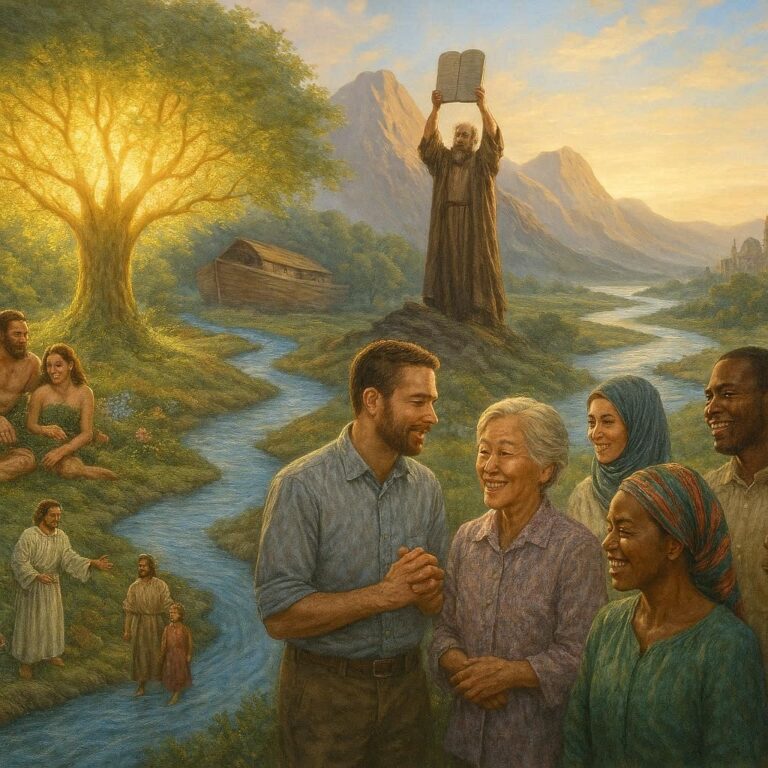
In a world that often feels divided by race, culture, socioeconomic status, and politics, the question of how we should treat one another is more relevant than ever. Prejudice—preconceived opinions not based on reason or actual experience—creates barriers. It fosters misunderstanding and pain. For millions of people, the Bible serves as the ultimate moral compass, the guide for navigating these complex human interactions.
So, if you have ever wondered, “What does the Bible say about prejudice?” you are asking a question that sits at the very heart of the Christian faith. The answer is not hidden in obscure verses; it is woven into the fabric of the entire biblical narrative, from Genesis to Revelation.
This comprehensive guide will walk you through the scriptures, stories, and teachings that address partiality, judgment, and love. We will explore how God views humanity and what that means for how we should view one another.
Understanding the Heart of God: Impartiality
Before we look at specific verses, we must understand the character of God as presented in the Bible. The core message is clear: God does not show favoritism.
This concept is known as divine impartiality. It means that God’s love, justice, and offer of salvation are extended equally to every person, regardless of their background, ethnicity, or social standing. Prejudice is a human construct; it has no place in the kingdom of God.
The Nature of God’s Love
God’s love is not like human love. Human love is often conditional. We love people who are like us, who agree with us, or who can do something for us. God’s love, however, is agape love—an unconditional, self-sacrificing love for all of creation.
Key Verse: “For God so loved the world that he gave his one and only Son, that whoever believes in him shall not perish but have eternal life.” (John 3:16, NIV)
Notice the scope: “the world.” Not a specific nation, not a specific race, not a specific class. The world. This single verse lays the foundation for a faith that is meant to be inclusive and universal.
A God Who Sees the Heart
Prejudice is almost always based on external appearances. We judge based on the color of skin, the style of clothing, or the accent in a voice. The Bible explicitly tells us that God operates differently.
Key Verse: “But the Lord said to Samuel, ‘Do not consider his appearance or his height, for I have rejected him. The Lord does not look at the things people look at. People look at the outward appearance, but the Lord looks at the heart.'” (1 Samuel 16:7, NIV)
This is a crucial principle. If God, the creator and judge of the universe, refuses to judge by outward appearances, how can we, His creation, feel justified in doing so?
Old Testament Foundations: One Humanity Under God
The Old Testament might seem, at first glance, to be primarily about God’s chosen people, Israel. However, even within this specific covenant relationship, God constantly reminds the Israelites that they were chosen to be a blessing to all nations.
The Creation of One Blood
The very origin story of humanity establishes our shared identity. We are not a collection of different species or unrelated groups. We are one family.
Key Verse: “From one man he made all the nations, that they should inhabit the whole earth…” (Acts 17:26, NIV)
While this verse is in the New Testament, it refers back to the creation account in Genesis. Scientifically and theologically, the Bible asserts that every human being is a descendant of the same original parents. This shared lineage makes prejudice not just unkind, but illogical. It is a form of family dysfunction.
Laws Protecting the Foreigner
As God established the nation of Israel, He gave them laws that were revolutionary for their time. These laws were designed to create a society that reflected His character—and that included protecting the most vulnerable and marginalized, specifically the “foreigner” or “alien.”
God reminds the Israelites of their own history: they were once strangers in Egypt. They knew the pain of being outsiders, and they were commanded never to inflict that pain on others.
Key Verse: “When a foreigner resides among you in your land, do not mistreat them. The foreigner residing among you must be treated as your native-born. Love them as yourself, for you were foreigners in Egypt. I am the Lord your God.” (Leviticus 19:33-34, NIV)
This is a powerful and direct command. It calls for:
-
Equal Treatment: The foreigner must be treated as a native-born citizen.
-
Emotional Empathy: “Love them as yourself.”
-
Historical Remembrance: “for you were foreigners.”
The Story of Ruth: A Picture of Inclusion
The book of Ruth is a beautiful narrative that directly challenges ethnic prejudice. Ruth was a Moabite—a member of a nation that was often in conflict with Israel and worshipped other gods. By all accounts, she was an outsider.
Yet, she chooses to cling to Naomi, her Israelite mother-in-law, and to Naomi’s God. She is accepted into the community, not despite her origin, but because of her character and faithfulness. She goes on to marry Boaz and becomes the great-grandmother of King David, placing her directly in the lineage of Jesus Christ.
| Character | Background | Role in the Story | Significance |
|---|---|---|---|
| Ruth | Moabite (Foreigner) | The protagonist; displays loyalty and faith. | Shows that God accepts people from all nations based on faith. |
| Naomi | Israelite | The grieving mother-in-law. | Represents God’s people who can offer refuge and belonging. |
| Boaz | Israelite | The kinsman-redeemer; shows kindness to Ruth. | Foreshadows Christ, who redeems all people, regardless of origin. |
Ruth’s inclusion is a direct contradiction of the ethnic prejudice that could have easily kept her on the margins of society. Her story is a testament to the fact that God’s family has always been bigger than we think.
Jesus and the Radical Act of Crossing Boundaries
When we turn to the New Testament and the life of Jesus, we see the ultimate example of how to treat people. Jesus consistently and intentionally broke down the social and cultural barriers that divided people.
The Parable of the Good Samaritan
This is perhaps the most famous story Jesus told to answer the question, “Who is my neighbor?” (Luke 10:25-37). To understand its power, you have to understand the historical context. Jews and Samaritans despised each other. They had deep-seated religious and ethnic prejudice that spanned centuries.
In the story, a Jewish man is beaten and left for dead. A priest and a Levite—the religious elite of Jewish society—pass by without helping. But a Samaritan, the “enemy,” stops. He has compassion, tends to the man’s wounds, and pays for his care.
Jesus uses this story to shatter prejudice. He makes the hero the one the audience was conditioned to hate. His message is radical:
-
Prejudice is a barrier to compassion. The priest and Levite were likely more concerned with ritual purity than with human need.
-
True neighborliness transcends social labels. The Samaritan acted as a neighbor because he showed mercy.
-
We are called to emulate the “enemy.” Jesus tells the expert in the law, “Go and do likewise.” He commands us to imitate the one we might be prejudiced against.
Important Note: The point of the parable is not just to be nice. It is a direct challenge to the deeply ingrained prejudices of the heart. It calls us to see the image of God in everyone, especially those we are tempted to view as “other.”
Jesus and the Samaritan Woman
In John chapter 4, Jesus again crosses a cultural chasm. He is tired and thirsty, sitting by a well in Samaria. A Samaritan woman comes to draw water. The text notes the barriers:
-
Ethnicity: He was a Jew; she was a Samaritan. “Jews do not associate with Samaritans” (John 4:9).
-
Gender: A rabbi speaking publicly to an unknown woman was frowned upon.
-
Moral Reputation: The woman had a complicated marital history. She was likely an outcast in her own community (which is why she came to the well alone at noon).
Jesus ignores all these man-made barriers. He speaks to her, asks her for a drink, and offers her “living water.” He reveals His identity as the Messiah to her—something he had not done so openly with others. He sees her not as a Samaritan, not as a woman with a past, but as a soul in need of salvation.
The result? She becomes the first evangelist to her people, and many Samaritans believe because of her testimony. Jesus’s lack of prejudice led to a spiritual awakening in a whole community.
Jesus and the Roman Centurion
In Matthew 8:5-13, a Roman centurion, a symbol of the oppressive occupying force, comes to Jesus asking for healing for his servant. Jesus doesn’t hesitate. He offers to go to the centurion’s house.
The centurion, showing incredible faith, says Jesus doesn’t need to come; He can just say the word. Jesus is amazed.
Key Verse: “Truly I tell you, I have not found anyone in Israel with such great faith. I say to you that many will come from the east and the west, and will take their places at the feast with Abraham, Isaac and Jacob in the kingdom of heaven.” (Matthew 8:10-11, NIV)
Jesus holds up a foreigner, a member of the enemy army, as an example of faith for all of Israel to follow. He then paints a picture of the kingdom of heaven as a diverse banquet, with people coming from every direction. This is a direct affront to any notion that God’s favor is limited to one ethnic group.
The Early Church: Breaking Down the Dividing Wall
After Jesus’s resurrection and ascension, the early church grappled with how to apply His teachings. The most significant conflict they faced was the issue of Jewish-Gentile relations. How could a movement born within Judaism fully include non-Jews?
The Vision of Peter (Acts 10)
This chapter is pivotal. Peter, a devout Jew, would not normally enter the home of a Gentile or eat with them. It was against his cultural and religious training. God gives him a vision of a sheet filled with animals considered unclean by Jewish law, and a voice tells him, “Get up, Peter. Kill and eat.”
Peter refuses, saying he has never eaten anything impure. The voice replies with a revolutionary statement:
Key Verse: “Do not call anything impure that God has made clean.” (Acts 10:15, NIV)
While Peter was puzzling over the vision, messengers arrive from Cornelius, a Roman centurion who was a God-fearing man. The Holy Spirit tells Peter to go with them. Peter goes to Cornelius’s house and says:
Key Verse: “You are well aware that it is against our law for a Jew to associate with or visit a Gentile. But God has shown me that I should not call anyone impure or unclean.” (Acts 10:28, NIV)
The vision was about more than food. It was about people. God was dismantling the wall of prejudice in Peter’s heart. As Peter preaches, the Holy Spirit falls on Cornelius and all those listening, just as it had on the Jewish believers at Pentecost. The conclusion was undeniable: God’s gift of salvation was for everyone.
The Council at Jerusalem (Acts 15)
The inclusion of Gentiles caused a major controversy. Some believers insisted that Gentiles must first become Jews (be circumcised and follow the Law of Moses) to be saved. This was a form of religious and cultural prejudice, assuming their own background was superior and necessary for salvation.
The apostles and elders gathered in Jerusalem to settle the matter. After much discussion, Peter stood up and reminded them that God had chosen to give the Holy Spirit to the Gentiles just as he had to them.
Key Verse: “He did not discriminate between us and them, for he purified their hearts by faith.” (Acts 15:9, NIV)
James, the leader of the church, agreed, citing the prophets. Their final decision was that Gentile believers did not need to adopt Jewish customs. They affirmed that salvation was by grace through faith alone, for everyone. This was a monumental decision that protected the early church from being consumed by prejudice and exclusivity.
Paul’s Declaration of Unity (Galatians 3)
The Apostle Paul became the great champion of this truth. In his letter to the Galatians, he confronts the prejudice head-on and declares the new reality for those who are in Christ.
Key Verse: “So in Christ Jesus you are all children of God through faith, for all of you who were baptized into Christ have clothed yourselves with Christ. There is neither Jew nor Gentile, neither slave nor free, nor is there male and female, for you are all one in Christ Jesus.” (Galatians 3:26-28, NIV)
This is one of the most powerful statements on human equality in all of scripture. Paul is not saying these distinctions (ethnicity, social status, gender) don’t exist in daily life. He is saying they are utterly irrelevant when it comes to our identity and standing in Christ.
-
Jew/Gentile: The deepest ethnic and religious division of the time is erased.
-
Slave/Free: The deepest social and economic division is erased.
-
Male/Female: The deepest gender division is erased.
In the body of Christ, there is a new identity that transcends all human categories. Prejudice, therefore, is not just a social problem; it is a theological error. It denies the reality of our unity in Christ.
Practical Wisdom from the Epistles
The letters in the New Testament don’t just give us theology; they give us practical application for daily living. They directly address how believers should treat one another, leaving no room for prejudice.
Don’t Show Favoritism
The book of James is particularly blunt. In James chapter 2, he gives a real-world example that is just as relevant today as it was 2,000 years ago.
Key Verse: “My brothers and sisters, believers in our glorious Lord Jesus Christ must not show favoritism. Suppose a man comes into your meeting wearing a gold ring and fine clothes, and a poor man in filthy old clothes also comes in. If you show special attention to the man wearing fine clothes and say, ‘Here’s a good seat for you,’ but say to the poor man, ‘You stand there’ or ‘Sit on the floor by my feet,’ have you not discriminated among yourselves and become judges with evil thoughts?” (James 2:1-4, NIV)
James calls prejudice based on wealth or status for what it is: evil thinking. It is a contradiction of the faith. He argues that God has chosen the poor to be rich in faith, and by showing favoritism to the rich, we are dishonoring the very people God honors.
The Royal Law
James connects this back to the core teaching of Jesus. He calls the command to “Love your neighbor as yourself” the “royal law.” Showing favoritism breaks this royal law. It is not a minor infraction; it is a fundamental failure to love.
If we are judging people based on their clothes, their skin color, or their background, we are setting ourselves up as judges with wrong standards. We are failing to love them as we love ourselves.
A New Commandment
The Apostle John emphasizes that love is not optional; it is the defining mark of a Christian.
Key Verse: “Dear friends, let us love one another, for love comes from God. Everyone who loves has been born of God and knows God. Whoever does not love does not know God, because God is love.” (1 John 4:7-8, NIV)
Prejudice is the opposite of love. It is a form of judgment and rejection. If we claim to know God, but our hearts are full of prejudice, our claim is empty. Our love for God is demonstrated by our love for people, all people.
Why Do We Struggle with Prejudice? A Biblical Perspective
The Bible doesn’t just give us the “what” (what to do), it also gives us the “why” (why we struggle). Understanding the root of prejudice helps us fight it effectively.
1. The Sin of Pride
At its core, prejudice is often a form of pride. It is the belief that my group (ethnicity, nation, social class) is superior to yours. It is the sin of elevating myself by diminishing others. Proverbs 16:18 warns that “Pride goes before destruction, a haughty spirit before a fall.” Prejudice is a haughty spirit that places itself in judgment over God’s creation.
2. Fear of the “Other”
Humans are naturally inclined to fear what they don’t know. This fear can easily morph into suspicion, distrust, and eventually prejudice. The Bible consistently commands us, “Do not be afraid.” Fear is not from God (2 Timothy 1:7). When we allow fear of someone different to dictate our behavior, we are not walking in the Spirit.
3. A Tribal Mentality
Since the Tower of Babel (Genesis 11), humanity has been scattered and divided. We naturally form tribes—groups where we feel safe and understood. While community is good, our tribalism becomes sinful when we see our tribe as the only “right” one and view other tribes as enemies or inferiors. The gospel calls us into a new, multi-ethnic family that transcends our biological and cultural tribes.
4. Ignorance and Lack of Exposure
Sometimes prejudice is simply the result of ignorance. We hold stereotypes because we have never truly known someone from another group. We believe the caricatures we hear because we lack real relationships that challenge those views. The Bible encourages us to seek wisdom and understanding (Proverbs 4:7). Getting to know people is one of the most powerful ways to dismantle prejudice.
Practical Steps to Overcome Prejudice
Knowing what the Bible says is the first step. The next step is allowing that truth to transform our hearts and actions. Here are practical, biblical ways to overcome prejudice in our own lives.
1. Examine Your Own Heart (Psalm 139:23-24)
Begin with honest prayer. Ask God, “Search me, God, and know my heart; test me and know my anxious thoughts. See if there is any offensive way in me…” (Psalm 139:23-24). Be willing to let God reveal hidden prejudices. It can be uncomfortable, but it is necessary for healing.
2. Immerse Yourself in Scripture
Let the Word of God renew your mind (Romans 12:2). Meditate on the verses we’ve discussed. Write them down. Let the truth of our unity in Christ, God’s impartiality, and the command to love become the dominant narrative in your mind, overriding the world’s narrative of division.
3. Build Genuine Relationships
You cannot learn to love someone from a distance. Make a conscious effort to build friendships with people who are different from you. Invite someone from a different cultural background to lunch. Listen to their story. Share your life. It is in the context of relationship that stereotypes crumble and genuine love grows.
4. Practice Empathy
Put yourself in someone else’s shoes. Seek to understand their experiences, including their pain. If a friend from a different background shares an experience of prejudice or discrimination, resist the urge to be defensive or dismissive. Instead, listen and seek to understand. “Rejoice with those who rejoice; mourn with those who mourn” (Romans 12:15).
5. Speak Up
When you hear prejudiced jokes or comments, don’t stay silent. Your silence can be interpreted as agreement. You can speak up graciously but firmly. You might say, “I don’t feel comfortable with that kind of joke,” or “I see things differently.” Speaking up can be a powerful act of love for the person being targeted and a witness to the speaker.
6. Pray for Unity
Pray for the body of Christ to be a model of unity and diversity. Pray for your own heart. Pray for people and groups that you might be tempted to view with prejudice. It is hard to hate someone you are praying for regularly.
| Step to Overcome Prejudice | Biblical Principle | Practical Action |
|---|---|---|
| Self-Examination | “Search me, God…” (Psalm 139:23) | Regularly ask God to reveal hidden biases. |
| Renew Your Mind | “Be transformed by the renewing of your mind.” (Romans 12:2) | Study scriptures on unity and impartiality. |
| Build Relationships | “Love your neighbor as yourself.” (Mark 12:31) | Intentionally befriend people different from you. |
| Practice Empathy | “Mourn with those who mourn.” (Romans 12:15) | Listen to and seek to understand others’ experiences. |
| Speak Up | “Speak up for those who cannot speak for themselves.” (Proverbs 31:8) | Graciously challenge prejudiced speech or jokes. |
| Pray | “Pray for each other.” (James 5:16) | Pray for unity in your community and for those you are tempted to judge. |
Conclusion
So, what does the Bible say about prejudice? It speaks clearly, consistently, and powerfully. From the laws of the Old Testament that commanded love for the foreigner, to the life of Jesus who radically crossed every social boundary, to the teachings of the apostles who declared our unity in Christ—the message is unmistakable.
Prejudice is a sin that stands in direct opposition to the heart of God. It denies our shared humanity, breaks the royal law of love, and contradicts our new identity in Christ. God is no respecter of persons. He looks at the heart, not the outward appearance.
As followers of Christ, we are called to do the same. We are called to be agents of reconciliation in a divided world, to build bridges where others build walls, and to love people—all people—not because they are like us, but because they are made in the image of God, just as we are.
Frequently Asked Questions (FAQ)
Q: Does the Bible support slavery?
A: This is a complex question. The Bible does not condone the race-based chattel slavery of recent centuries. The slavery in biblical times was often a form of economic servitude or debt repayment, with laws protecting the rights of servants (e.g., required release in the Jubilee year). However, the overarching biblical narrative points towards freedom and equality. The Apostle Paul’s statement in Galatians 3:28 (“neither slave nor free… you are all one in Christ Jesus”) planted a seed that would eventually grow into a full-blown rejection of slavery as incompatible with Christian brotherhood. The biblical principles of love, justice, and equality ultimately undermine any system of oppression.
Q: What is the difference between discernment and prejudice?
A: Discernment is the God-given ability to judge between right and wrong, truth and error, based on wisdom and the Word of God. It is about evaluating ideas, actions, and spirits. Prejudice is a pre-judgment of a person or group of people based on an external characteristic, often without knowledge or reason. Discernment assesses behavior; prejudice assesses being.
Q: How can I talk to my children about prejudice from a biblical perspective?
A: Start early by modeling love for all people. Read them Bible stories like Ruth and Jonah that show God’s heart for the nations. Teach them that every person is made in God’s image (Genesis 1:27). When they notice differences (like skin color), affirm them positively and explain that God loves diversity—just look at the variety in flowers, animals, and people! Most importantly, create opportunities for them to have friends from different backgrounds.
Q: Is it a sin to notice that people are different?
A: Not at all. God created diversity. Noticing different skin colors, cultures, or languages is simply observing reality. The sin of prejudice begins when we attach a negative value judgment to those differences—when we use them as a reason to exclude, demean, or mistreat someone.
Q: What if I realize I have prejudiced thoughts?
A: Confess it to God honestly. 1 John 1:9 assures us, “If we confess our sins, he is faithful and just and will forgive us our sins and purify us from all unrighteousness.” Don’t wallow in guilt. Receive His forgiveness, and then ask Him to help you change your thinking. Replace the prejudiced thought with a truth from Scripture, such as “This person is made in God’s image” or “In Christ, we are one.”