Choosing a name for your son is one of the first and most significant gifts you give as a parent. It’s an identity, a blessing, and a piece of his story. For many, the Bible serves as a profound source of inspiration, offering names steeped in history, faith, and powerful meaning. While names like David, James, and John are timeless classics, the scriptures are filled with lesser-known gems—names that are both distinctive and rich with significance.
This guide is dedicated to uncovering those unique biblical boy names. We’ll move beyond the familiar to explore the names of prophets, warriors, scholars, and unsung heroes, each carrying a legacy that can inspire a child’s path. If you’re searching for a name that is both spiritually grounded and wonderfully uncommon, you’ve come to the right place.
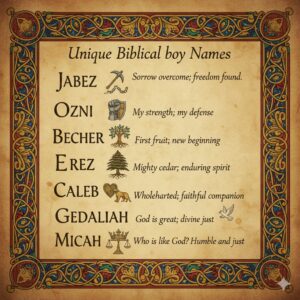
Why Choose a Unique Biblical Name?
Biblical names have endured for millennia for good reason. They connect a child to a grand narrative of faith, resilience, and purpose. Opting for a unique name from this source offers a special blend of qualities:
-
Deep Meaning: Every name we’ll explore has a concrete meaning—often a verb or attribute like “God has heard,” “lion of God,” or “gift.” This can serve as a lifelong anchor and aspiration.
-
Historical & Spiritual Legacy: These names tie your child to a specific story or virtue from scripture, providing a built-in narrative of character.
-
Distinctiveness: In a world of many Liams and Noahs, a unique biblical name offers individuality while standing on a solid foundation of tradition.
-
Cross-Cultural Appeal: Many biblical names have variants in multiple languages (Hebrew, Greek, Latin, English), making them versatile and globally recognizable.
As one theologian aptly put it, “In biblical tradition, a name was never merely a label. It was seen as a reflection of character, destiny, or divine grace bestowed upon an individual.” Choosing such a name is an act of hope and intention.
Unveiling the Gems: Categories of Unique Biblical Names
To help you navigate this rich landscape, we’ve organized these unique names into meaningful categories based on their origins and the virtues they represent.
H2: Names of Lesser-Known Prophets & Witnesses
These names belong to figures who spoke truth, delivered messages, and stood firm in their faith, often without the widespread recognition of an Isaiah or Elijah.
Micah: Who is Like the Lord?
Origin & Meaning: Hebrew, מִיכָה (Mikha), a rhetorical question meaning “Who is like Yahweh?”
Biblical Figure: A prophet of the 8th century BC, author of the Book of Micah. He famously prophesied the birthplace of the Messiah (Micah 5:2) and championed justice, mercy, and humility.
Why It’s Unique: While familiar, Micah remains less common than Michael (which shares a similar meaning). It feels both gentle and strong, carrying a profound sense of awe and wonder at God’s incomparable nature.
Modern Appeal: Short, easy to spell, and carries a thoughtful, artistic vibe.
Malachi: My Messenger
Origin & Meaning: Hebrew, מַלְאָכִי (Mal’akhi), meaning “my messenger” or “my angel.”
Biblical Figure: The last prophet of the Old Testament, who called the people back to faithfulness and foretold the coming of Elijah.
Why It’s Unique: It has a melodic, almost musical quality and a very direct, powerful meaning. It’s distinctive without being obscure.
Modern Appeal: The “chi” ending gives it a contemporary edge, and it offers the cool nickname “Kai.”
H3: Nehemiah: Comforted by Yahweh
Origin & Meaning: Hebrew, נְחֶמְיָה (Nechemyah), meaning “Yahweh has comforted.”
Biblical Figure: A cupbearer to the Persian king who became a revolutionary leader, rebuilding the walls of Jerusalem against great opposition (Book of Nehemiah).
Why It’s Unique: It’s a substantial, four-syllable name packed with history and meaning. It tells a story of resilience, leadership, and divine comfort in the face of challenges.
Modern Appeal: The nickname “Neo” or “Nemi” makes it more accessible, while the full name commands respect.
Names of Strength & Valor from the Scriptures
These names belong to warriors, leaders, and men of action whose stories echo with courage and determination.
Gideon: Mighty Warrior
Origin & Meaning: Hebrew, גִּדְעוֹן (Gid’on), possibly meaning “feller” or “hewer,” i.e., a mighty warrior.
Biblical Figure: A judge of Israel who, though initially doubtful, led a tiny army to a miraculous victory against the Midianites (Judges 6-8).
Why It’s Unique: It perfectly blends strength with a relatable narrative of overcoming fear. It’s a powerful name that acknowledges human frailty transformed by faith.
Modern Appeal: Strong and distinctive, with a modern, almost sci-fi feel to some ears.
Cyrus: The Lord Bestows
Origin & Meaning: Persian, though used in the Bible; related to the sun or “throne.” In a biblical context, he is seen as anointed by God (Isaiah 45:1).
Biblical Figure: Cyrus the Great, the Persian emperor who decreed that the Jewish exiles could return to Jerusalem and rebuild the Temple.
Why It’s Unique: It’s a rare example of a non-Israelite held in high esteem in the Bible. It represents God’s sovereignty over all nations and a figure of liberation.
Modern Appeal: A classic, regal name that is both historical and sleekly modern.
Asher: Happy & Blessed
Origin & Meaning: Hebrew, אָשֵׁר (Asher), meaning “happy,” “blessed,” or “fortunate.”
Biblical Figure: One of the twelve sons of Jacob, founder of one of the tribes of Israel. His birth was considered a moment of great happiness for his mother, Leah (Genesis 30:13).
Why It’s Unique: In a category of strong, warrior names, Asher stands out for its unequivocally positive and joyful meaning. It’s a name that speaks of contentment and good fortune.
Modern Appeal: Extremely popular in modern times for its wonderful meaning, soft sound, and connection to nature (“ash” tree).
Names with Beautiful & Poetic Meanings
These names are like hidden verses, carrying lovely imagery and deep, resonant meanings.
Boaz: In Him is Strength
Origin & Meaning: Hebrew, בֹּעַז (Bo’az), possibly meaning “in him is strength” or “swiftness.”
Biblical Figure: A wealthy, kind landowner from Bethlehem who becomes the husband of Ruth and great-grandfather of King David. He is a model of integrity, redemption, and generosity.
Why It’s Unique: It’s a name of quiet, steadfast strength rather than loud valor. It carries a beautiful story of loyalty, love, and providence.
Modern Appeal: The “z” ending gives it a zesty, contemporary feel, and the story of Ruth is perennially beloved.
Thaddeus: Heart or Courage
Origin & Meaning: Aramaic, possibly meaning “heart” or “courage.” Often associated with Judas Thaddeus, one of the twelve apostles.
Biblical Figure: An apostle, sometimes called Judas son of James or Lebbaeus, known for his questioning and faithful heart.
Why It’s Unique: It’s an ancient name that feels both gentle and scholarly. The meaning “heart” is profoundly tender and strong.
Modern Appeal: The adorable nickname “Thad” or “Tad” balances its old-world charm.
Ira: Watchful
Origin & Meaning: Hebrew, עִירָא (Ira), meaning “watchful.”
Biblical Figure: One of King David’s mighty men, known as a valiant warrior (2 Samuel 23:26).
Why It’s Unique: It’s incredibly short and punchy with a vigilant, protective meaning. It’s a name that has largely been overlooked in recent generations, making it truly unique.
Modern Appeal: Its brevity aligns with modern naming trends, and it’s easy to spell and pronounce.
Comparative Table: Unique Biblical Boy Names at a Glance
| Name | Origin | Core Meaning | Biblical Figure | Key Virtue/Story | Modern Nickname |
|---|---|---|---|---|---|
| Malachi | Hebrew | “My Messenger” | The final OT prophet | Calling, faithfulness | Kai, Mal |
| Gideon | Hebrew | “Mighty Warrior” | Judge who defeated Midianites | Strength from weakness | Gid |
| Cyrus | Persian | “The Lord Bestows” | Persian king who freed the exiles | Sovereignty, liberation | Cy |
| Asher | Hebrew | “Happy, Blessed” | Son of Jacob, tribe of Israel | Joy, good fortune | Ash |
| Boaz | Hebrew | “In Him is Strength” | Husband of Ruth, ancestor of David | Redemption, kindness | Bo, Boz |
| Ira | Hebrew | “Watchful” | One of David’s mighty men | Vigilance, courage | None needed |
How to Choose the Right Unique Biblical Name
Selecting a name is a personal journey. Here are some thoughtful steps to guide you:
-
Research the Full Story: Don’t just love the sound. Read the biblical passage where the name appears. Does the character’s story resonate with you? Are there aspects of their life you’d want to emphasize or perhaps downplay?
-
Consider Pronunciation & Spelling: Is the name intuitive to pronounce in your language and culture? While unique, you may want to avoid names that will constantly be mispronounced.
-
Think About Nicknames: Does the name naturally lead to a nickname you like? Conversely, if you prefer the full formal name, does it stand well on its own?
-
Say It Out Loud: Combine it with your last name. Say it as you would call your child for dinner, in a stern voice, in an encouraging tone. How does it feel?
-
Check Popularity Trends: If “unique” is a high priority, check your country’s official name rankings to ensure it’s not unexpectedly trending upward.
Important Note: Remember that every biblical character, like all humans, was multifaceted. Some had moments of great failure alongside their faith. This can add depth to a name, representing redemption and grace, but it’s something to be aware of as you choose.
A Curated List of More Unique Biblical Boy Names
For your consideration, here is an extended list of distinctive names, each with its own rich background.
-
Amos: Hebrew, “borne by God.” A shepherd called to be a prophet, advocating for social justice.
-
Barak: Hebrew, “lightning.” A military commander who, with the prophetess Deborah, led Israel to victory.
-
Caleb: Hebrew, “whole-hearted” or “dog” (symbolizing devotion). One of the twelve spies who trusted God to enter Canaan.
-
Enoch: Hebrew, “dedicated.” A man who “walked faithfully with God” and was taken to heaven without dying.
-
Jairus: Hebrew, “he will enlighten.” A synagogue leader whose daughter Jesus raised from the dead.
-
Jedidiah: Hebrew, “beloved of the Lord.” A name given to King Solomon by the prophet Nathan.
-
Lazarus: Hebrew, “God has helped.” The man Jesus raised from the dead in Bethany.
-
Silas: Latin form of Aramaic “Saul,” meaning “asked for.” A leading figure in the early church and companion of Paul.
-
Titus: Latin, “title of honour.” A Greek companion of Paul, to whom a New Testament epistle is addressed.
-
Zebulun: Hebrew, “exalted dwelling” or “honor.” A son of Jacob, founder of a tribe.
Conclusion
The world of biblical boy names is far deeper than the familiar classics. It is a trove of unique names like Malachi, Gideon, and Boaz, each carrying a powerful meaning, a compelling story, and a timeless legacy. From the watchful Ira to the joyful Asher, these names offer a beautiful way to connect your child’s identity to virtues of faith, strength, and purpose. By choosing a unique name from scripture, you give a gift of individuality rooted in eternal narrative.
FAQ
Q: Aren’t most biblical names very old-fashioned?
A: While many are ancient, their sounds and meanings often translate surprisingly well to the modern ear. Names like Asher, Levi, and Ezra are currently top-ranking names in many countries, proving their timeless appeal. The “unique” ones we’ve highlighted often have a fresh, distinctive quality.
Q: Is it appropriate to use a name from the Old Testament?
A: Absolutely. For Judeo-Christian traditions, the entire Bible is a source of spiritual heritage. The stories and virtues of the Old Testament are foundational to the New Testament. Many names are used freely across faiths and cultures.
Q: What if the biblical character associated with the name had a flawed life?
A: This is a common consideration. Almost every biblical figure had flaws—this is part of what makes their stories relatable and profound. The name can be chosen to emphasize the virtue they ultimately represented (like David’s heart for God) or the moment of redemption in their story. It can serve as a reminder of grace and growth.
Q: How can I verify the meaning and story of a name?
A: Start by reading the biblical passage directly. Then, consult reputable biblical dictionaries, commentaries, or scholarly name etymology websites. Be wary of sites that provide meanings without primary sources.
Additional Resource
For an in-depth look at the historical and linguistic origins of biblical names, we recommend visiting the Behind the Name: Biblical Names etymology database. It provides detailed breakdowns of name roots, variations, and scriptural references.