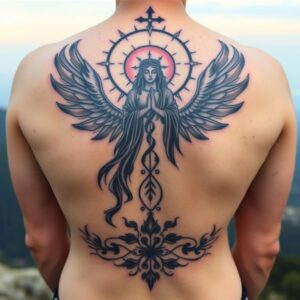
In the quiet hum of the tattoo studio, a transformation occurs that transcends the mere application of ink into skin. It is a ritual as old as humanity itself—a deliberate act of marking the body not for adornment, but for meaning. In an age of digital saturation and fleeting trends, the spiritual tattoo stands as a powerful counterpoint: a permanent, personal, and profound statement of one’s inner journey. It is a soul’s signature, a visual prayer, a map of the interior landscape etched onto the living canvas of the body. This is not simply about getting a “cool design”; it is about embedding a piece of your essence, a core belief, or a divine connection into your very being.
What drives a person to choose a symbol that has resonated for millennia? It is the search for identity, the commemoration of a transformation, the invocation of protection, or the aspiration for enlightenment. A spiritual tattoo is a constant companion and a silent teacher. It reminds you of your strength when you feel weak, your connection when you feel alone, and your purpose when you feel lost. This article is your deep dive into this sacred art form. We will journey through time to understand its ancient roots, traverse cultures to decode the world’s most powerful symbols, and delve into the energetic considerations of bringing spirit to skin. Whether you are contemplating your first spiritual piece or seeking to understand the one you already wear, prepare to explore the profound dialogue between the soul and the skin.
1. The Ancient Roots of Spiritual Body Art
To understand the spiritual tattoo of today, we must first journey back to its origins, where the line between body art and spiritual practice was nonexistent. For our ancestors, tattoos were not decorative choices; they were functional, ritualistic, and deeply symbolic acts that situated an individual within their community, their cosmology, and the spirit world.
From Ritual to Renaissance: A Historical Perspective
The oldest known tattooed human remains, Ötzi the Iceman, dating back to 3300 BCE, bore simple lines and crosses that scholars believe were therapeutic, possibly related to acupuncture or a form of spiritual healing. This suggests that from the very beginning, tattoos were intertwined with concepts of wellness and energy flow. In ancient Egypt, tattooed figurines and mummies, primarily women, show patterns of dots and lines on the abdomen and thighs, believed to be protective amulets for childbirth and fertility, invoking the power of deities like Bes. This establishes a recurring theme: the tattoo as a permanent talisman.
Across the globe, disparate cultures developed their own complex tattoo traditions independently, yet with striking philosophical parallels. The act of receiving a tattoo was often a rite of passage, marking the transition from childhood to adulthood, from life to the afterlife, or from layperson to spiritual adept. The pain endured during the process was not seen as a negative side effect, but as an integral part of the ritual—a sacrifice that purified the individual and cemented the symbol’s power.
Cultural Foundations: Polynesia, India, Japan, and Indigenous Traditions
-
Polynesia: The Etymology of “Tattoo”: The word “tattoo” itself is derived from the Polynesian word “tatau,” meaning “to strike” or “to mark.” In cultures like the Māori of New Zealand, the “Tā Moko” is a sacred art form. Unlike simple pigmentation, Moko is chiseled into the skin, creating grooves. Each pattern is a visual language, narrating the wearer’s genealogy (whakapapa), tribal affiliations, social status, and personal achievements. A Moko is considered the ultimate record of a person’s identity and spirituality; to wear it without the right is considered deeply offensive. It is not merely on the skin; it is the skin, and by extension, the soul.
-
India: Henna and Spiritual Adornment: While permanent tattoos (known as “Godna” among many tribes) have a long history in India, the more widespread spiritual skin art is Mehndi, the application of henna. Used for centuries in Hindu, Sikh, and Muslim weddings and festivals like Karva Chauth and Diwali, Mehndi is a temporary but profound adornment. The intricate patterns, often featuring solar symbols, lotus flowers, and peacocks, are believed to represent the sun’s energy, the awakening of spiritual love, and offering protection. The process is a meditative ritual for the bride, and the color of the stain is said to signify the depth of love between the couple.
-
Japan: Irezumi and Spiritual Protection: Japanese Irezumi has a complex history, ranging from spiritual protection to its association with the Yakuza. However, its roots are deeply spiritual. Horimono, the traditional form of tattooing, often featured motifs from Japanese folklore, Buddhism, and Shintoism. Dragons (Ryū) symbolized wisdom, strength, and the balance of opposites. Koi fish represented perseverance, courage, and the ability to overcome adversity, inspired by the legend of the koi swimming upstream to become a dragon. Foo dogs (Komainu) were guardian figures, warding off evil spirits. These full-body suits were not just art; they were a second skin of spiritual armor.
-
Indigenous North American Traditions: Many Native American tribes practiced tattooing for a variety of spiritual and cultural reasons. Tattoos could mark achievements in battle, signify a connection to a specific animal spirit guide, or serve as rites of passage. For the Haida, Tlingit, and other Pacific Northwest tribes, intricate crest tattoos displayed their clan lineage and mythical ancestry, connecting them directly to the supernatural world.
The Shaman’s Skin: Tattoos as a Bridge to the Spirit World
In many shamanic traditions, the shaman’s body itself becomes a tool for traversing the spirit world. Tattoos served as maps, guides, and power sources. Symbols of helping spirits, portals to other realms, and protective sigils were inscribed on the skin to aid the shaman in their journeys. The pain of the tattooing process could induce altered states of consciousness, facilitating the initial connection to the spirit realm. In this context, the tattoo is not a representation of power; it is the power, a permanent and activated conduit for spiritual energy.
2. Decoding the Symbols: A Lexicon of Spiritual Ink
The language of spiritual tattoos is written in symbols. These are not arbitrary shapes but archetypal forms that have resonated with the human psyche for centuries. They tap into a collective unconscious, carrying meanings that transcend culture and time. Understanding this lexicon is the first step in choosing a symbol that truly aligns with your spiritual path.
Sacred Geometry: The Blueprint of the Universe
Sacred geometry is the belief that geometric patterns and ratios are the foundational building blocks of the cosmos. From the spirals of galaxies to the structure of a snowflake, these forms are seen as a visual expression of a divine order. Tattoos based on sacred geometry are chosen to connect the wearer to this fundamental harmony and the intelligent design of the universe.
-
The Flower of Life: This ancient symbol, found in temples worldwide from Egypt to China, consists of multiple overlapping, evenly spaced circles that form a flower-like pattern. It is considered a symbol of creation, containing the patterns of everything that ever was, is, and will be. The Seed of Life, the Egg of Life, and the Fruit of Life are all derived from this one matrix. A Flower of Life tattoo symbolizes a deep connection to the interconnectedness of all life and the cyclical nature of existence.
[Image: A detailed, intricate blackwork tattoo of the Flower of Life on a person’s upper back.]
-
The Sri Yantra: Hailing from the Tantric traditions of Hinduism, the Sri Yantra is arguably the most powerful and complex yantra (a geometric diagram used for meditation). It consists of nine interlocking triangles—four pointing upward (representing the masculine, Shiva) and five pointing downward (representing the feminine, Shakti)—surrounded by two concentric circles of lotus petals, all enclosed within a cosmic gate. The central point (bindu) represents the unity from which all creation emanates. A Sri Yantra tattoo is not merely decorative; it is a potent tool for meditation, believed to generate a powerful energy field that can aid in manifestation, spiritual growth, and the realization of oneness.
-
Metatron’s Cube: Named after the archangel Metatron, this symbol is derived from the Fruit of Life. It contains every line that can be drawn between the 13 circles of the Fruit of Life, resulting in a complex structure that includes all five Platonic Solids. It is seen as a map of the fabric of reality, containing all the geometric forms that make up the physical world. A tattoo of Metatron’s Cube symbolizes a connection to divine wisdom, the underlying structure of the universe, and the role of consciousness in shaping reality.
-
The Platonic Solids: These five unique three-dimensional shapes (Tetrahedron, Cube, Octahedron, Dodecahedron, Icosahedron) have been known since antiquity. They are the only shapes with all faces being the same regular polygon and all vertices identical. Plato assigned each to a classical element:
-
Tetrahedron – Fire
-
Cube (Hexahedron) – Earth
-
Octahedron – Air
-
Icosahedron – Water
-
Dodecahedron – The Universe/Aether
A tattoo of a Platonic Solid is a direct invocation of that element’s energy, used for balancing one’s own energetic makeup or expressing a connection to a specific elemental force.
-
Eastern Spiritual Symbols
The spiritual traditions of Asia have given the world some of its most recognizable and deeply meaningful symbols.
-
Om (Aum): More than a symbol, Om is a sacred syllable and the primordial sound from which the entire universe was created, according to Hindu philosophy. It encompasses the past, present, and future, as well as the states of waking, dreaming, and deep sleep. The curve at the bottom represents the waking state, the upper curve represents the dream state, the curve emanating from the center represents deep sleep, and the crescent and dot represent Maya (illusion) and the transcendental state, respectively. An Om tattoo is a declaration of one’s connection to the divine source, a reminder of the vibration that underlies all of reality, and a tool for deepening one’s meditation practice.
-
The Lotus (Padma): The lotus flower is a quintessential symbol of spiritual awakening. It grows in muddy, murky water, yet it rises above the surface to bloom with astonishing beauty and purity. This journey is a perfect metaphor for the human spiritual path: emerging from the suffering and “mud” of material existence (Samsara) to achieve enlightenment and purity of spirit (Nirvana). The number of petals also holds meaning, often corresponding to the chakras. A lotus tattoo symbolizes resilience, purity, spiritual promise, rebirth, and the triumph of beauty over adversity.
-
The Mandala: Meaning “circle” in Sanskrit, a mandala is a complex, symmetrical geometric design that represents the universe. In Hindu and Buddhist traditions, they are used as tools for meditation, helping to focus the mind and symbolize the journey from the outer layers of reality to the inner, sacred center. Creating or meditating on a mandala is a spiritual practice in itself. As a tattoo, a mandala represents the wearer’s own universe—their psyche, their journey towards wholeness, and their search for a center of peace and balance amidst the chaos of life. It is a symbol of harmony, unity, and the cosmic order.
-
The Unalome: This elegant symbol, common in Buddhist tattooing (especially the Sak Yant tradition of Thailand), represents the path to enlightenment. It begins with a tangled, coiled line at the bottom, symbolizing the confusion, distractions, and suffering of life. The path then straightens out as it moves upward, representing the focused, disciplined practice of meditation and mindfulness. The straight line culminates in a dot, symbolizing the ultimate goal: enlightenment, Nirvana, the end of all suffering. A Unalome tattoo is a personal reminder of one’s spiritual journey, the challenges faced, the progress made, and the ultimate goal of liberation.
-
The Hamsa: Also known as the Hand of Fatima (in Islam) or the Hand of Miriam (in Judaism), the Hamsa is a universally recognized talisman against the evil eye. It is a symmetrical hand with an eye in the palm. The hand represents divine protection, while the eye reflects back negative intentions and ill will. It is a symbol of blessing, power, and strength. A Hamsa tattoo is worn as a permanent amulet, a shield against negativity, and an invitation for good fortune and happiness.
-
The Chakras: In Hindu and yogic traditions, the chakras are seven primary energy centers that run along the spine, from the base to the crown of the head. Each chakra governs specific physical, emotional, and spiritual aspects of our being. Tattoos of the chakra symbols—often depicted as lotus flowers with a specific number of petals, a geometric shape (yantra), and a color—are used for alignment, healing, and awareness.
-
Muladhara (Root): Red. Security, grounding, survival.
-
Svadhishthana (Sacral): Orange. Creativity, sexuality, emotion.
-
Manipura (Solar Plexus): Yellow. Personal power, will, confidence.
-
Anahata (Heart): Green. Love, compassion, connection.
-
Vishuddha (Throat): Blue. Communication, truth, expression.
-
Ajna (Third Eye): Indigo. Intuition, insight, perception.
-
Sahasrara (Crown): Violet/White. Spiritual connection, enlightenment.
A chakra tattoo, whether of a single chakra or the entire system, serves as a constant reminder to keep one’s energy flowing freely and in balance.
-
Western and Esoteric Symbols
The Western esoteric and Abrahamic traditions also offer a rich tapestry of spiritual symbols.
-
The Tree of Life (Kabbalah): In the Jewish mystical tradition of Kabbalah, the Tree of Life is a diagram of ten spheres (Sefirot) connected by twenty-two paths. It represents the process through which the infinite, unknowable God (Ein Sof) emanated the finite, physical universe. Each Sefirah represents a different divine attribute, such as Wisdom (Chokhmah), Understanding (Binah), and Beauty (Tiferet). The Tree is a map for spiritual ascent, a guide for understanding the nature of God and the soul. A Tree of Life tattoo symbolizes a quest for divine knowledge, the interconnectedness of all levels of creation, and the journey of the soul back to its source.
-
The Cross: The central symbol of Christianity, the cross represents the crucifixion of Jesus Christ and his subsequent resurrection. It is a profound symbol of faith, sacrifice, redemption, hope, and divine love. The meaning can vary with its form: the Latin Cross is the most common, the Celtic Cross incorporates a circle (representing eternity or the sun), and the Ankh is an Egyptian cross symbolizing eternal life. A cross tattoo is a public declaration of Christian faith, a reminder of Christ’s sacrifice, and a symbol of the wearer’s own personal salvation and hope.
-
The Eye of Providence/Horus: The “all-seeing eye” within a triangle, often surrounded by rays of light, is known as the Eye of Providence and is famously depicted on the US dollar bill. It symbolizes God’s omniscience and benevolent oversight of humanity. Its precursor, the Eye of Horus (Wedjat) from ancient Egypt, was a powerful symbol of protection, royal power, and good health. A tattoo of this symbol is often chosen for its connotations of divine guidance, protection, and the idea that a higher power is watching over the wearer’s path.
-
The Pentagram/Pentacle: A five-pointed star, the pentagram is one of the most misunderstood symbols. When enclosed in a circle, it is called a pentacle. In modern Paganism, particularly Wicca, it is a symbol of protection and represents the four classical elements (Earth, Air, Fire, Water) unified by the fifth element, Spirit (Aether). The single point-up position signifies spirit ruling over matter, a positive and balanced symbol. A pentagram tattoo is a declaration of a nature-based spirituality, a talisman for protection, and a representation of the wearer’s connection to the elemental forces and the spirit that animates them.
Animal Spirits and Totems
Animal symbols, or totems, connect us to the primal wisdom of the natural world. They represent qualities, instincts, and energies that we may wish to invoke or embody.
-
The Wolf: A symbol of loyalty, strong family ties (the pack), intelligence, and fierce instinct. The wolf is also a guide to the unknown, a creature of both the physical world and the spiritual wilderness. A wolf tattoo can represent a strong sense of community, a connection to one’s intuition, a free spirit, or a guiding presence through challenging times.
-
The Elephant: Revered in Asian cultures, particularly Hinduism and Buddhism, the elephant is a symbol of wisdom, strength, stability, and royal authority. Ganesha, the elephant-headed god, is the “Remover of Obstacles” and the lord of beginnings. An elephant tattoo, especially of Ganesha, is chosen to attract good luck, overcome life’s challenges, and invoke wisdom and mental strength.
-
The Owl: From ancient Greece (as a companion to Athena) to Native American traditions, the owl is a creature of the night, symbolizing wisdom, intuition, and the ability to see what others cannot—the hidden truths and secrets. It is a guide through the darkness of ignorance. An owl tattoo can signify a seeker of knowledge, a highly intuitive person, or a connection to the mysteries of life and death.
-
The Phoenix: A mythical bird that cyclically regenerates, the phoenix builds its own funeral pyre and is consumed by flames, only to rise again from the ashes, renewed and reborn. It is the ultimate symbol of resilience, transformation, victory over adversity, and the eternal cycle of life, death, and rebirth. A phoenix tattoo is almost always a marker of a significant personal transformation—the wearer has been through a “trial by fire” and emerged stronger, renewed, and reborn.
-
The Lion: Across cultures, the lion is the king of beasts, representing courage, majesty, strength, justice, and personal power. In Buddhism, the lion’s roar is the fearless proclamation of the Dharma (truth). In astrology, it is the symbol for the zodiac sign Leo. A lion tattoo is a powerful statement of leadership, courage, and the assertion of one’s own personal authority and strength.
Elemental Symbols
Connecting to the basic elements is a fundamental spiritual practice, and tattoos can serve as a permanent anchor for these energies.
-
Water: Represented by waves, the ocean, rivers, or raindrops, water symbolizes emotion, intuition, the subconscious mind, flow, purification, and healing. A water-themed tattoo can signify a deep emotional nature, a connection to one’s intuition, or a desire to go with the flow of life.
-
Fire: Depicted as flames, a sun, or a salamander, fire represents transformation, passion, creativity, purification, destruction of the old to make way for the new, and spiritual zeal. A fire tattoo can symbolize a passionate personality, a period of intense personal transformation, or a powerful creative drive.
-
Earth: Shown as mountains, trees, crystals, or the planet itself, earth symbolizes grounding, stability, nourishment, abundance, and the physical body. An earth-themed tattoo is often chosen by those seeking stability, a deeper connection to nature, or a reminder to stay grounded in the physical world.
-
Air: Represented by feathers, birds, clouds, or wind, air symbolizes the intellect, communication, freedom, ideas, and the mind. An air-themed tattoo can signify a free spirit, a sharp intellect, or a focus on clear communication and new perspectives.
Quick Reference Guide to Spiritual Tattoo Meanings
| Symbol | Origin/Culture | Core Spiritual Meaning(s) |
|---|---|---|
| Flower of Life | Ancient / Universal | Creation, Interconnectedness, Cosmic Blueprint |
| Om (Aum) | Hinduism / Buddhism | Primordial Sound, Universe, Consciousness |
| Lotus | Hinduism / Buddhism | Purity, Enlightenment, Rebirth, Resilience |
| Mandala | Hinduism / Buddhism | Universe, Wholeness, Journey to the Center |
| Unalome | Buddhism | Path to Enlightenment, Life’s Journey |
| Hamsa | Middle Eastern / Universal | Protection, Blessing, Warding off Evil |
| Chakras | Hinduism / Yoga | Energy Centers, Balance, Healing, Alignment |
| Tree of Life | Kabbalah (Judaism) | Divine Emanation, Interconnectedness, Soul’s Journey |
| Cross | Christianity | Faith, Sacrifice, Redemption, Hope |
| Phoenix | Greek / Global Mythology | Rebirth, Transformation, Resilience |
| Wolf | Global / Shamanism | Loyalty, Instinct, Freedom, Guidance |
| Elephant | Hinduism / Buddhism | Wisdom, Strength, Luck, Overcoming Obstacles |
3. The Modern Spiritual Tattoo: Personal Alchemy and Identity
In the contemporary world, the spiritual tattoo has evolved from strictly adhering to traditional canons to becoming a deeply personal form of alchemy. Individuals now feel empowered to blend symbols, create entirely new ones, or assign personal meaning to universal archetypes, crafting a unique spiritual language on their skin.
From Traditional to Fusion: Creating a Unique Spiritual Language
It is increasingly common to see tattoos that fuse different spiritual traditions. A sleeve might incorporate a Buddhist Unalome winding around a Celtic knot, symbolizing a personal path to enlightenment intertwined with the concept of eternal life and interconnectedness. A geometric Sri Yantra might be subtly integrated into the wings of a phoenix, representing the structured cosmic energy underlying a personal transformation. This fusion reflects a modern, globalized spirituality where individuals draw wisdom from multiple paths to create a belief system that is uniquely their own. The tattoo becomes a visual manifesto of this personal philosophy.
Memorial Tattoos: Honoring Ancestors and Spiritual Guides
One of the most powerful forms of modern spiritual tattooing is the memorial tattoo. These are not merely portraits or names; they are symbolic representations of a loved one’s spirit or their continued presence. This could be:
-
An animal they felt a connection to, serving as their spirit guide.
-
Their favorite flower, with its spiritual meaning (e.g., a rose for love, a lily for peace).
-
A symbol from their faith, like a cross or Star of David.
-
A quote from a spiritual text they lived by.
-
A simple date in a script that feels sacred.
These tattoos act as a permanent, energetic link to the deceased. They are a way to carry the person’s spirit with you, honoring their memory and affirming a belief in an ongoing connection that transcends physical death. The process of getting the tattoo can itself be a profound and healing ritual of remembrance.
Tattoos as Talismans: Activating Your Ink for Protection and Manifestation
Many people today approach their spiritual tattoos as active talismans or sigils. This goes beyond the traditional protective function of symbols like the Hamsa. It involves a conscious process of “charging” the tattoo with intention. This can be done through:
-
Setting a Clear Intention: Before and during the tattoo session, focusing intensely on the desired outcome—be it protection, courage, love, or abundance.
-
Meditation and Visualization: Regularly meditating on the tattoo, visualizing it glowing with a specific colored light and radiating its intended energy into your life and aura.
-
Affirmations: Using the tattoo as a physical anchor for affirmations. For example, touching a lotus tattoo and repeating, “I rise above challenges with grace and purity.”
-
Ritualistic Aftercare: Viewing the aftercare process not as a chore, but as a sacred ritual of consecration, anointing the healing tattoo with intention as well as balm.
In this context, the tattoo becomes a battery for spiritual energy, a focal point for the wearer’s will, and a constant, active participant in their spiritual practice.
The Journey of Healing: Tattoos Marking Recovery and Resilience
Perhaps one of the most poignant modern uses of spiritual tattoos is to mark a journey of healing. This could be recovery from illness, addiction, trauma, or a profound personal loss. The tattoo serves as a “warrior’s mark,” a testament to survival and the strength of the human spirit.
-
A person who has overcome cancer might get a phoenix rising from ashes on their chest, covering surgery scars.
-
Someone in recovery from addiction might choose a symbol of rebirth like the Ouroboros (a snake eating its own tail) or a powerful mantra like “I am enough.”
-
A survivor of trauma might choose a protective symbol like a guardian lion or a geometric shield pattern over the area of the body that holds the memory.
The process of receiving the tattoo—enduring the pain and actively participating in the marking of the body—can be a powerful act of reclaiming one’s body and one’s narrative. It transforms a site of pain or vulnerability into a site of power, beauty, and spiritual significance.
4. Beyond the Visual: The Energetics of Getting a Spiritual Tattoo
The decision to get a spiritual tattoo involves more than just selecting a design and an artist. It is an energetic event that can have a profound impact on your subtle body and your spiritual state. Approaching it with mindfulness can transform the experience from a simple transaction into a potent ritual.
Intention is Everything: Setting Your Purpose Before the Needle Hits
The single most important factor in a spiritual tattoo is your intention. Why are you choosing this symbol, now? Is it to remind you of a truth? To invoke a quality you wish to cultivate? To protect you? To honor a transition? Spend time in meditation and journaling to clarify this intention. Write it down. The more focused and heartfelt your intention, the more potent the tattoo will be as an energetic anchor. This intention becomes the “soul” of the tattoo, the programming that informs its energy long after the physical wound has healed.
The Artist as a Channel: Choosing the Right Conduit for Your Energy
For a spiritual tattoo, the artist is more than a technician; they are a channel through which this sacred mark enters your energy field. It is crucial to choose an artist whose energy resonates with you and your intention. Look for someone who is respectful of the symbol’s origins, who listens deeply to your reasons for choosing it, and who approaches their craft with a sense of reverence or at least professional integrity. An artist who is rushed, dismissive, or operating in a chaotic environment may impart that same energy into the work. The ideal artist becomes a collaborator in your spiritual practice.
The Pain and the Process: Tattooing as a Ritual of Sacrifice and Initiation
The pain of tattooing is unavoidable, but from a spiritual perspective, it is not something to merely endure or numb. It can be reframed as a crucial part of the ritual—a form of sacrifice and a rite of passage. Many traditions use pain and ordeal as a means of purification and initiation. By moving through the discomfort with conscious breath and a focus on your intention, you are actively participating in the embedding of that energy into your being. The pain becomes the fuel that forges the spiritual connection, making the symbol truly earned and integrated. Some people use the time under the needle as a deep meditation, repeating their intention like a mantra with each buzz of the machine.
Caring for Your Spiritual Tattoo: A Practice in Mindfulness
The healing period is a critical time energetically. The tattoo is an open wound, a gateway. How you care for it during this time sets the tone for its long-term energy. Treat the aftercare as a mindful practice. As you gently wash and moisturize the tattoo, do so with the same intention you set before the appointment. Visualize the healing skin being filled with light and the symbol’s power. Avoid exposing it to chaotic or negative environments while it is fresh and vulnerable. This period of dedicated care is the final act of the ritual, sealing the intention into the skin and ensuring the tattoo integrates healthily into your physical and energetic body.
5. Ethical and Cultural Considerations
As spiritual tattooing becomes more popular, a critical conversation about ethics and cultural respect is essential. Wearing a symbol permanently on your body carries a responsibility to understand its weight and context.
Appreciation vs. Appropriation: Honoring the Source
Cultural appropriation occurs when a dominant culture takes and uses elements from a marginalized culture without understanding, respect, or context, often stripping them of their original meaning and reducing them to mere aesthetics. This is a real concern in the world of tattooing.
-
Appreciation involves:
-
Deep Research: Understanding the history, meaning, and spiritual significance of the symbol.
-
Respect for Context: Acknowledging if a symbol is considered closed or sacred within its culture. For example, a traditional Māori Tā Moko is a specific lineage-based identifier; getting it without that lineage is deeply disrespectful.
-
Giving Credit: Acknowledging the cultural origin of the symbol.
-
Supporting Artists from that Culture: When possible, seeking out artists from the culture whose symbols you wish to wear.
-
-
Appropriation is:
-
Taking a sacred symbol because it “looks cool” with no regard for its meaning.
-
Mixing deeply sacred symbols from closed cultures into a collage purely for aesthetic effect.
-
Wearing symbols that are meant to be earned through specific rites of passage.
-
The Responsibility of Wearing Sacred Symbols
When you choose to wear a spiritual symbol, you are effectively becoming a walking representative of that energy and its culture. This is a responsibility. It means being prepared to answer questions about it with respect and knowledge. It means carrying yourself in a way that honors the symbol’s meaning. If you have a tattoo of Buddha, for instance, it would be incongruous to act in ways that are directly opposed to Buddhist principles like compassion and mindfulness. Your tattoo is a statement, and with that statement comes the responsibility to embody its highest meaning as best you can.
6. Conclusion: The Living Prayer on Your Skin
A spiritual tattoo is far more than ink; it is a living, breathing part of your identity. It is a map of your journey, a shield for your soul, a key to your consciousness, and a testament to your resilience. From the ancient rituals of the shaman to the modern fusion of global symbols, this art form remains a powerful means of expressing the inexpressible depths of the human spirit. Choose your symbols with intention, respect their origins, and wear them with the conscious understanding that they are not just on you, but are now a part of you—a permanent prayer etched into the temple of your body.
7. Frequently Asked Questions (FAQs)
1. I’m drawn to a symbol from a culture that isn’t my own. Is it okay for me to get it tattooed?
This requires careful consideration. The key is moving from appropriation to appreciation. Conduct thorough research into the symbol’s meaning and cultural context. Is it a closed, sacred practice? If so, it is best to avoid it. If it is more open, approach it with immense respect. Consider consulting with or hiring an artist from that culture, and be prepared to honor the symbol’s true meaning when people ask about it.
2. Do I need to believe in the specific religion associated with a symbol to get the tattoo?
Not necessarily, but you should have a deep, personal understanding and respect for its meaning. For example, you don’t need to be a Buddhist to appreciate the concepts of mindfulness and the path to enlightenment represented by a Unalome. However, getting a cross without any belief in or respect for Christianity could be seen as disingenuous. Your connection to the symbol should be authentic, even if it’s not strictly doctrinal.
3. Can the placement of a spiritual tattoo affect its meaning or power?
Yes, many people believe so. In traditions like yoga, different parts of the body are associated with different chakras. Placing a lotus tattoo over your heart (Anahata chakra) can strengthen its meaning of love and compassion. A third eye symbol placed on the forehead is a direct activation of that energy center. Consider what part of your body you want to empower with the symbol’s energy.
4. What if I regret a spiritual tattoo later in life as my beliefs evolve?
This is a valid concern. A spiritual tattoo marks a point in your journey; it doesn’t have to define your entire path forever. It can be seen as a beautiful reminder of who you were and what you believed at that time, a chapter in your story. If the regret is strong, cover-up tattoos and laser removal are options. Many skilled artists can transform an old symbol into a new one that better reflects your current beliefs.
5. How can I find a tattoo artist who specializes in spiritual or sacred designs?
Look for artists whose portfolios are rich in the style you desire (e.g., geometric, illustrative, blackwork, traditional). Read their bios and social media to understand their philosophy. Many artists who are drawn to these symbols have a personal interest in them. Don’t hesitate to ask them about their experience with and understanding of the specific symbol you want during a consultation.
8. Additional Resources
-
Books:
-
The Book of Symbols: Reflections on Archetypal Images by The Archive for Research in Archetypal Symbolism (ARAS).
-
Sacred Geometry: Philosophy & Practice by Robert Lawlor.
-
The Tattoo History Source Book by Steve Gilbert.
-
-
Documentaries:
-
Skins: The Tattoo Chronicles (Explores modern tattoo culture).
-
Voyage of Time (Touches on ancient rituals and human connection to symbols).
-
-
Online Databases:
-
Symbols.com: A large online encyclopedia of symbols.
-
The Met Museum’s Heilbrunn Timeline of Art History: For historical context on art and symbolism.
-