You’re in a quiet room, a moment of introspection, or perhaps a significant conversation, and it begins—an involuntary, rhythmic hic! that disrupts the flow. Conventional wisdom offers mundane causes: eating too fast, carbonated drinks, sudden excitement. But what if this seemingly random muscular glitch carried a deeper significance? Across millennia and myriad spiritual traditions, the human body has been revered not just as a biological machine, but as a finely tuned instrument of the soul, communicating through signs, sensations, and, yes, even hiccups. This article embarks on an exhaustive exploration into the spiritual landscape of hiccups, positing them not as mere annoyances, but as potential messengers—cryptic telegrams from our subconscious, our energy body, or the universe itself, urging us to pause, reflect, and realign.
We will journey through the lens of energy medicine, where hiccups signal blockages in the subtle body; through ancient folklore, where they might reveal secrets or the chatter of distant tongues; and through modern metaphysical thought, where they act as catalysts for presence and release. This is not a dismissal of medical science, but an expansion of perspective—a holistic inquiry into the rich, often overlooked dialogue between our physical and spiritual selves. Prepare to view this common phenomenon through an entirely new, profound, and fascinating dimension.
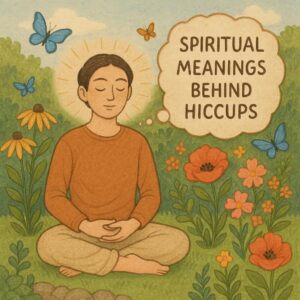
Chapter 1: The Bridge Between Body and Spirit – Understanding Energetic Anatomy
To comprehend the spiritual meaning of any physical symptom, we must first understand the frameworks that connect the tangible to the intangible. Several ancient systems provide this map.
The Chakras and the Diaphragm: In Yogic and Tantric traditions, the seven primary chakras are vortices of energy running along the spine. The diaphragm—the muscle whose spasms cause hiccups—sits in a critically powerful region. It is the physical demarcation between the lower three chakras (Root, Sacral, Solar Plexus), associated with survival, emotion, and will, and the upper three (Heart, Throat, Third Eye), associated with love, expression, and intuition. The fourth, the Heart Chakra (Anahata), is often visualized at its center. A hiccup can be seen as a sudden, involuntary shake-up at this crossroads. Is energy from the lower centers rising too quickly? Is the heart center processing an unexpressed emotion? The spasm may be the body’s way of jolting this energetic gateway.
The Meridian System and Qi: Traditional Chinese Medicine (TCM) operates on the flow of Qi (vital life force) through meridians. The diaphragm is a crucial hub. The Liver Meridian, responsible for the smooth flow of Qi and emotion, spreads across the diaphragm. Stagnant Liver Qi, often from repressed anger or frustration, can cause rebellions of Qi—manifesting as sighs, cramps, or hiccups. Similarly, the Stomach Meridian, which controls the descent of Qi (preventing rebellion upward), passes through. If Stomach Qi rebels upward instead of descending, it can cause nausea, belching, and hiccups. Spiritually, this translates to an inability to “digest” or assimilate an experience, idea, or emotion, causing it to literally and energetically come back up.
The Vagus Nerve: The Soul’s Information Superhighway: Modern polyvagal theory offers a fascinating bridge. The vagus nerve, the longest cranial nerve, wanders from the brainstem through the neck, heart, lungs, and diaphragm to the gut. It is the key component of the parasympathetic nervous system—our “rest and digest” state. It is also intimately linked to our social engagement system and our sense of safety. A hiccup is a direct stimulation of the phrenic and vagus nerves. Spiritually, this positions hiccups as a potential reset button for this critical nerve. When we are emotionally dysregulated, anxious, or spiritually “out of tune,” the vagus nerve’s tone can be affected. The hiccup’s spasm might be the body’s crude attempt to stimulate the vagus, nudging us back toward calm, presence, and connectedness—a physical prompt for a spiritual-mental reset.
Spiritual & Energetic Correspondences for Hiccups
| System/Framework | Key Area/Concept | Spiritual Interpretation of Hiccups | Potential Energetic Message |
|---|---|---|---|
| Chakra System | Diaphragm / Heart Chakra (Anahata) | A disruption at the bridge between lower (material) and upper (spiritual) selves; a jolt to the heart center. | “Attend to the balance between your earthly desires and higher aspirations. Is your heart processing something unspoken?” |
| TCM / Qi | Liver & Stomach Meridians; Rebellion of Qi | Stagnant emotional energy (Liver) or inability to digest experiences (Stomach) causing energy to rise violently. | “You are holding onto unresolved anger or an experience you haven’t processed. It’s time to release and let it move through you.” |
| Vagus Nerve Theory | The Vagus Nerve (“Soul Nerve”) | A physical reset button for the nerve governing safety, connection, and calm. A nudge back to parasympathetic state. | “You are out of your center, in ‘fight or flight.’ This is a mechanical prompt to breathe deeply, ground yourself, and return to presence.” |
| Folklore & Omens | General Superstition | An indicator that you are the subject of conversation, memory, or psychic attention from another person. | “Your energy is being pulled toward or by someone. Be mindful of your social and energetic connections.” |
Chapter 2: A Global Tapestry – Hiccup Lore Across Cultures and Histories
The spiritual interpretation of bodily functions is a human universal. Hiccups have attracted a colorful array of beliefs, painting a picture of how our ancestors sought meaning in the mundane.
European and Western Folklore: The most pervasive belief is that hiccups mean someone is talking about you. The variation often lies in how to identify the culprit. Common “cures” like holding one’s breath or drinking water backwards were not just physical acts but rituals to break the psychic link or force the talker to reveal themselves. In some Irish tales, hiccups were a sign a fairy was trying to steal your breath or your soul, and the spasm was the struggle against it. Medieval European medicine, blending with astrology, sometimes linked hiccups (then called “singultus”) to an imbalance of the “humours,” but also to bewitchment or divine displeasure.
Asian Perspectives: In some Japanese folk beliefs, hiccups could indicate that a distant acquaintance or relative is remembering you fondly (or not so fondly). In parts of India, especially within certain spiritual families, a sudden onset of hiccups during prayer or meditation might be interpreted as the awakening of Kundalini energy or a sign of a spirit guide attempting to communicate—a disruption in the practitioner’s own energy field as it interacts with a higher frequency. In Chinese folk culture, while TCM provided the medical framework, hiccups could also be seen as a minor clash with a “wind” element—an external pathogenic influence that is also metaphorical for sudden change or gossip.
Indigenous and African Traditions: Many indigenous cultures view the body as a direct reflection of community and environmental harmony. A persistent, unexplained bodily phenomenon like hiccups might be seen as a sign of discord—a broken taboo, an unresolved conflict with an ancestor, or an imbalance in one’s relationship with the natural world. The “cure” would then involve not just a physical act, but a spiritual one: prayer, a offering, or a consultation with a healer to restore holistic balance.
Ancient Philosophies: The great Roman naturalist Pliny the Elder documented numerous “cures” for hiccups, many of which carried a ritualistic, almost superstitious weight. The Stoic philosopher-Emperor Marcus Aurelius might have viewed a hiccup as a prime opportunity to practice acceptance of things outside one’s control—a tiny, involuntary training ground for the larger vicissitudes of fate.
This global mosaic shows that attributing spiritual meaning to hiccups is a deeply rooted human impulse. It reflects a worldview where nothing is truly random, and the body is in constant dialogue with the social, spiritual, and cosmic environment.
Chapter 3: The Spiritual Intruder – Hiccups as Disruptions in Energy Flow
Building on our understanding of energetic anatomy, we can now delve into the primary spiritual narrative: hiccups as signals of disruption. Imagine your subtle energy body as a calm, flowing river. A hiccup is a sudden, unexpected rock thrown into that river, causing a splash and ripples.
The Sudden Download: You are going about your day when a profound idea, a flash of intuition, or a wave of empathy for someone else hits you. This “download” of energy or information can be so sudden and potent that your physical vessel struggles to integrate it immediately. The energy, seeking a pathway, causes a tremor in your system—often at the sensitive diaphragm, the seat of emotional and energetic processing. The hiccup is the physical “glitch” as your system reboots to accommodate this new data. In this context, the remedy is not just to stop the hiccup, but to pause and acknowledge what just came to you. What were you thinking or feeling the moment before the hiccup started?
Emotional Energy in Transit: We often suppress emotions—a flash of anger in a meeting, a surge of grief we push down, unexpressed joy. Energy cannot be destroyed; it must go somewhere. Suppressed emotional energy can become trapped in the body, often around the solar plexus and diaphragm. A hiccup can be a release valve, a tiny, involuntary convulsion that loosens the grip of that stuck energy, allowing a small amount to escape. Persistent hiccups might indicate a significant backlog of unprocessed emotion that needs conscious attention, not just physical release.
Psychic or Environmental Cross-Talk: Some sensitive individuals report getting hiccups in crowded places, during intense emotional confrontations, or when thinking strongly of someone in turmoil. This aligns with the folk belief of being talked about, but through an empathic or psychic lens. The hiccup is a physiological reaction to picking up on, or being impacted by, the discordant or intense energy field of another person or environment. It’s your body’s alarm bell saying, “We are detecting strong external energies; shield or ground yourself.”
Chapter 4: Messages from Within – Interpreting the Frequency and Timing
A single hiccup spell differs meaningfully from chronic bouts. Timing and context are the decoders of the spiritual message.
-
A Single, Sudden Bout: Often linked to the “sudden download” or a momentary energetic disruption. It could be a spirit nudge—pay attention to your immediate surroundings, the conversation you’re having, or the thought you just had. It’s a quick, “Hey! Notice this!”
-
Chronic or Persistent Hiccups: This suggests a deeper, more systemic energetic issue. Spiritually, it screams of chronic emotional repression, a significant life experience that remains undigested, or a prolonged state of being out of alignment with one’s true path. It is the body’s persistent, and increasingly desperate, attempt to shake something loose. This is where spiritual practice must combine with medical insight.
-
Timing is Key:
-
During Meditation/Prayer: A common experience. It may indicate resistance—the ego/mind fighting the quiet. Alternatively, it could signal an energy shift or release as you deepen your practice. Notice if it happens when touching on a specific memory or intention.
-
During Important Conversations: Are you speaking your truth? Is the other person? Hiccups here could signal an energy of dishonesty (yours or theirs) moving through the field, or the rebellion of your own Qi against something being said that you inwardly disagree with.
-
Upon Waking/Falling Asleep: In the hypnagogic state, we are between worlds. Hiccups here could be related to astral travel, difficulty integrating dream experiences, or an energetic adjustment as consciousness shifts states.
-
When Thinking of a Specific Person: The classic folklore sign. Metaphysically, it could indicate a strong energetic cord or telepathic connection is active. Your systems are literally resonating with theirs.
-
Chapter 5: The “Hiccuped” Conversation – Are You Being Talked About?
This folklore staple deserves its own metaphysical examination. In a universe understood as an interconnected web of energy, thought and attention have weight. When someone focuses on you intensely—with love, malice, gossip, or longing—that directed energy has to land somewhere. For energetically sensitive people, this landing might create a subtle disturbance.
The hiccup, then, becomes a kind of psychic ping. It’s your body’s notification that your “energy” or “name” has been invoked in the field of another. The “cures” like holding your breath and counting to ten, or asking someone to guess the talker’s name, are folk rituals designed to break the connection or identify the source, thereby reclaiming your energetic autonomy.
From a modern, less superstitious viewpoint, it could be that you are subconsciously thinking of them, and the hiccup is the somatic marker of that subconscious thought breaking through. Either way, it points to the powerful, often subconscious, connections that bind us to our social world.
Chapter 6: A Call to Presence – Hiccups as Mindfulness Alarms
At its most fundamental spiritual level, a hiccup is an absolute, incontrovertible call to the present moment. It hijacks your breath, your rhythm, your focus. You cannot ignore it. In a world of constant mental chatter and distraction, the hiccup is a brutal but effective mindfulness master.
The Interrupted Breath: Breath is spirit (pneuma in Greek, prana in Sanskrit). A hiccup is a corruption of the breath pattern. Spiritually, this asks: Where in your life are you out of rhythm? Where are you forcing things, or where is the natural flow interrupted? The solution to hiccups often involves conscious, regulated breathing—a return to diaphragmatic control. Thus, the hiccup itself creates the conditions for its cure: mindful breathing. It is a self-solving spiritual puzzle designed to bring you back to your center, one spasmodic gasp at a time.
Chapter 7: Releasing the Old – Hiccups as Energetic Purges
Just as we purge toxins from the body, we must purge outdated beliefs, emotional attachments, and stagnant energies from our subtle body. A hiccup can mimic the physical act of vomiting—a sudden, violent expulsion. Energetically, it can represent the body trying to “throw up” a thought-form, an attachment, or a frequency that no longer serves you.
If a hiccup bout ends with a sigh of relief, it can feel like a mini-exorcism. You’ve released a build-up of pressure. In shadow work, involuntary bodily reactions are often seen as the shadow’s voice—the part of us we suppress literally making itself heard through the body. A hiccup could be the shadow’s cough, clearing its throat to speak. After a hiccup spell passes, take a moment of quiet. What feels lighter? What mental loop has stopped? This can provide a clue to what was purged.
Chapter 8: Practical Rituals – Spiritual Remedies for Physical Spasms
Beyond drinking water upside down, we can engage with hiccups as conscious spiritual practice.
-
The Mindful Pause: At the first hic, stop. Place a hand on your diaphragm. Close your eyes. Inhale deeply and ask inwardly, “What is this message? What needs my attention?” Listen for the first thought, image, or name that arises.
-
Energetic Grounding: If you suspect external or chaotic energy is the cause, immediately ground yourself. Visualize roots growing from your feet into the earth. Feel any disruptive energy flowing down and out. The hiccups often subside as your field stabilizes.
-
Conscious Release Breath: Instead of fighting it, use a hiccup as a trigger for a release. On the next involuntary inhale, consciously lean into it and make the exhale a long, intentional “haaaa” sound, as if releasing steam. Intend that you are releasing whatever energetic hitch is causing the spasm.
-
Cord-Cutting Visualization: If linked to the “being talked about” phenomenon, visualize a gentle, loving scissors cutting a glowing cord between you and the unknown talker. State, “I return your energy to you with love, and reclaim my own. Our connection is now in divine balance.”
-
Journaling Prompt: After a significant hiccup episode, journal. Note the time, what you were doing, thinking, and feeling. Over time, patterns may emerge that reveal your personal spiritual trigger.
Chapter 9: When to Listen, When to Heed – Differentiating Spiritual from Medical
This spiritual exploration must be tempered with profound wisdom and responsibility. The body is a spiritual instrument, but it is also a physical organism. While a brief hiccup spell can be a curiosity for metaphysical inquiry, persistent hiccups (lasting more than 48 hours) or incredibly violent bouts are a clear signal to seek medical attention. They can indicate serious underlying conditions ranging from gastroesophageal issues to neurological disorders.
The spiritual approach is for those fleeting, unexplained, contextually interesting hiccups that appear in the absence of obvious physical cause. Use the following rule: First, rule out the physical. Then, contemplate the metaphysical. The most spiritually evolved act is often to care for the physical vessel with practical, medical wisdom. The two approaches are not opposites; they are complementary layers of holistic care for the self.
Conclusion: Integrating the Message
Hiccups, in their awkward, interruptive simplicity, invite us into a deeper conversation with ourselves. They are potential whispers from the subconscious, ripples from the energetic field, or folkloric pings from the social web. By moving beyond annoyance to curiosity, we transform a biological glitch into an opportunity for awareness, realignment, and presence. Listen not just to stop the spasm, but to understand its origin in the symphony of your being.
Frequently Asked Questions (FAQs)
Q1: I got hiccups right after a strong premonition. Is this connected?
A: Very possibly. As discussed, a sudden “download” of intuitive information or empathic feeling can cause a temporary disruption in your energy system as it integrates, with the diaphragm being a common site for this physical manifestation.
Q2: Are some people more prone to spiritual hiccups than others?
A: Yes. Individuals who are naturally empathic, energetically sensitive, or deeply engaged in spiritual or introspective practices may be more attuned to these subtle messages and thus experience them as more frequent physical phenomena.
Q3: How can I tell if my hiccups are spiritual or just from drinking soda too fast?
A: Context is key. If you just chugged a fizzy drink, the cause is likely physical. If they arise during emotional moments, meditation, or out of the blue with no physical trigger, consider a spiritual interpretation. Always eliminate the simple, physical causes first.
Q4: Is there a way to prevent spiritually-triggered hiccups?
A: Regular grounding practices (meditation, time in nature), maintaining healthy emotional expression (not suppressing feelings), and general energetic hygiene (like visualizing yourself in white light) can help maintain a balanced system less prone to sudden disruptions.
Q5: The folklore says if I say a person’s name and the hiccups stop, they were talking about me. Is this real?
A: This is a folk magic ritual, not empirically provable. However, from an energetic perspective, the act of naming and intending to break a connection can be powerful for your own psyche. If it works for you, it works as a symbolic ritual of reclaiming your energy.