The natural world is a vast, unspoken language, and every creature is a word, a sentence, a story waiting to be deciphered. Among these living lexicons, few are as compelling and percussive as the woodpecker. Its distinctive staccato beat, echoing through forests and suburban neighborhoods alike, is more than just a search for food or a construction project; it is a primal drum, a coded message from the universe. To encounter a woodpecker is to be invited to listen—not just with your ears, but with your soul. This article delves deep into the rich tapestry of the woodpecker’s spiritual significance, exploring its role as a totem animal, its symbolism in global myths and dreams, and its potent lessons for our modern lives.
We will embark on a journey across continents and through time, from the sacred groves of the Celts to the dreamtime of Indigenous Australians, from the philosophical teachings of Ancient Greece to the personal synchronicities of your own backyard. The woodpecker, we will discover, is a master of rhythm, a revealer of hidden truths, a steadfast protector, and a powerful communicator. By understanding its symbolism, we can learn to tap into our own inner rhythms, discern the opportunities knocking at our door, and find the courage to proclaim our truth to the world.
1. Introduction: The Knock on the Door of Perception
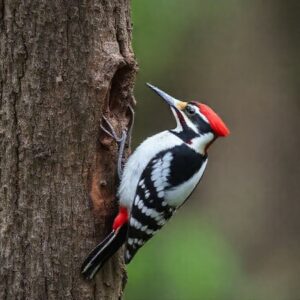
Imagine you are sitting in quiet contemplation, and suddenly, a sharp, persistent tapping disrupts the silence. Rat-a-tat-tat. Rat-a-tat-tat. You look up, and there it is—a flash of red, black, and white, a creature utterly focused on its task, hammering its beak against the bark of a tree. This is no random act. In the spiritual realm, there are no coincidences, only synchronicities. The woodpecker’s arrival is a deliberate signal, a cosmic knock on the door of your awareness. It demands that you stop, listen, and pay attention to the messages being drummed into the fabric of your reality.
This bird, with its unique anatomical adaptations and unwavering determination, serves as a powerful metaphor for the human journey. Its ability to thrive by drilling into the seemingly impenetrable surface of a tree teaches us that solutions and sustenance often lie beneath the surface of our immediate perceptions. It encourages us to be persistent, to find our own unique rhythm in a chaotic world, and to communicate our needs and truths with clarity and conviction. This article is your guide to understanding that knock, to interpreting the rhythm, and to unlocking the profound wisdom that the woodpecker spirit brings.
2. The Essence of the Woodpecker: A Biological and Symbolic Primer
To fully appreciate the woodpecker’s spiritual significance, one must first marvel at its physical form. Nature has crafted it as a perfect instrument for its purpose, and each biological feature is a key to its symbolic meaning.
-
The Beak: A powerful, chisel-like tool that can withstand repeated, high-impact blows. Symbolically, this represents focused action, breaking through barriers, and the ability to penetrate superficial layers to reach deeper truths or resources.
-
The Skull: Woodpeckers possess a unique shock-absorbing skull structure that protects their brain from the immense force of their pecking. Symbolically, this signifies mental resilience, the importance of protecting one’s mind and ideas, and the ability to engage in intense mental work without suffering “blows” to one’s psyche.
-
The Tongue: Incredibly long and barbed, it can extend deep into tree crevices to extract insects. Symbolically, this represents the power of discernment—reaching in and pulling out what is nourishing while leaving behind what is not. It is about extracting hidden knowledge and sustenance from the depths of our experiences.
-
The Feet: Zygodactyl feet (two toes facing forward, two backward) provide a viselike grip on vertical surfaces. Symbolically, this signifies stability, grounding, and the ability to hold one’s position even in challenging or precarious circumstances. It teaches us to stand our ground while we do our work.
-
The Drumming: The rapid pecking is not just for foraging; it is also a form of communication and territory marking. Symbolically, this is the most potent aspect—it is about creating your own rhythm, announcing your presence, and communicating your boundaries to the world.
This perfect synergy of form and function makes the woodpecker a living emblem of purposeful action, resilience, and effective communication.
3. Universal Spiritual Themes of the Woodpecker
Across diverse spiritual traditions, several core themes consistently emerge in connection with the woodpecker. These are the universal lessons this bird carries for humanity.
Rhythm and the Pulse of Creation
The woodpecker is the drummer of the forest. Its rhythmic pecking is a constant reminder that the universe itself is vibration and rhythm—from the orbiting of planets to the beating of our own hearts. When the woodpecker appears, it asks you: Are you in rhythm with your own life? Are you moving too fast, out of sync with your natural flow? Its medicine teaches us to find our cadence, to align our actions with our inner pulse, and to understand that progress often comes in a steady, persistent beat, not in frantic, sporadic bursts. It calls us to dance to the drum of our own soul, not to the noise of the world.
Opportunity and the Art of Discernment
The woodpecker does not peck randomly. It listens, taps, and discerns the exact location of its sustenance beneath the bark. This is a profound spiritual metaphor. The woodpecker spirit guide teaches us that opportunities are not always visible; they are often hidden beneath the surface of our everyday lives. It encourages us to “tap into” situations, relationships, and ideas to see what lies within. Is it nourishing or hollow? The woodpecker’s subsequent action—to drill in and extract the prize—teaches us to act decisively once we have discerned a true opportunity. It is the antithesis of passive waiting; it is active, intelligent seeking.
Protection and the Security of the Hearth
Many cultures view the woodpecker as a protector, particularly of the home and family. This stems from its behavior of carving out safe, secure nests in tree cavities, protecting its young from the elements and predators. When a woodpecker is drawn to your house, it can be a powerful sign to examine the security and sanctity of your own home and family life. Are you creating a safe emotional space for your loved ones? Is your “nest” in order? The woodpecker’s presence can be a warning to reinforce your boundaries or a blessing, affirming the strength and protection of your domestic sphere.
Communication and the Power of Your Voice
The woodpecker’s drumming is its voice. It is a non-vocal form of communication that carries over long distances to declare territory, attract mates, and signal alarm. Spiritually, the woodpecker empowers us to find our own unique “drum.” It asks us to consider how we are communicating our presence, our boundaries, and our desires to the world. Are we being heard? Are we communicating clearly and effectively? The woodpecker encourages us to be bold and unapologetic in making our “sound,” to announce our arrival, and to claim our space in the world with confidence.
Prophecy and Paying Attention
In numerous traditions, from Roman augury to Native American lore, the woodpecker was seen as a prophet. Its behavior, the direction from which it appeared, and the patterns of its drumming were all interpreted as omens. In a modern context, this translates to the concept of paying attention. The woodpecker is a master of noticing what others miss. Its appearance is a spiritual nudge to heighten your awareness. The universe is constantly sending you signs and messages; the woodpecker’s lesson is to sharpen your perception and to understand that seemingly mundane events can carry profound meaning.
4. The Woodpecker in World Mythology and Culture
The woodpecker’s symbolic power has been recognized for millennia, with its image woven into the myths, legends, and spiritual systems of cultures across the globe.
Native American Beliefs: A Diversity of Reverence
For many Native American tribes, the woodpecker holds a place of great respect, though its specific symbolism varies.
-
The Cherokee see the woodpecker as a rain-bringer and a protector. The red on its head is associated with the power and vitality of life. It is also linked to storytelling and the rhythm of dance drums.
-
The Hopi associate the woodpecker with the Ladder Clan, seeing its ability to climb vertically as a connection between the earthly and spiritual realms.
-
Plains Tribes, such as the Lakota, often view the woodpecker as a symbol of bravery and indomitable spirit due to its fearless pecking.
-
Western Tribes like the Chumash see the woodpecker as a creator figure or a cultural hero who brought fire to the people, often using its strong beak to create the first spark.
Celtic and European Lore: The Thunderbird and the Weathered Tree
In Celtic mythology, the woodpecker was often associated with thunderstorms. Its drumming was thought to mimic thunder, and its vibrant red head was a symbol of the lightning bolt. It was a bird sacred to the god Taranis, the god of thunder. It was also seen as a weather prophet and a bird of great wisdom, as it was believed to know the secrets of the trees. In some British folklore, a woodpecker knocking on your house was an omen of death, reflecting the culture’s more superstitious side and the bird’s role as a psychopomp, or guide to the afterlife.
Asian Symbolism: Auspicious Messengers and Filial Piety
In Chinese culture, the woodpecker is generally considered an auspicious bird. Its activity is seen as “knocking on the door of fortune,” and its presence can symbolize the arrival of good news or opportunities. However, it can also be a warning against being too gossipy or “pecking” into others’ affairs. In Japanese tradition, the woodpecker (kitsutsuki) is a symbol of perseverance and dedication. It is also celebrated in art and poetry for its beautiful, patterned plumage and its distinctive sound.
African and Aboriginal Traditions: The Connector and the Rain-Bringer
In various African myths, the woodpecker plays the role of a messenger between humans and the gods or between the living and the dead, thanks to its tree-dwelling nature, connecting the earth to the sky. Similarly, in Australian Aboriginal Dreamtime stories, the woodpecker (or similar birds like the treecreeper) is often a rain-bringer, its tapping mimicking the sound of falling rain and thus invoking the life-giving element.
Classical Antiquity: The Sacred Bird of Mars and Picus
In Roman mythology, the woodpecker was sacred to Mars, the god of war. This association stemmed from the bird’s aggressive, drumming behavior, which was likened to the sound of a soldier’s sword beating on a shield. The most famous woodpecker in Roman myth is Picus, a prophetic forest god who was transformed into a woodpecker by the sorceress Circe after he spurned her advances. As a woodpecker, Picus retained his prophetic powers, and the bird was therefore consulted for omens by Roman augurs.
5. The Woodpecker as a Spirit, Totem, and Power Animal
In animistic and modern spiritual practices, animal guides can manifest in different ways. Understanding these distinctions helps clarify your personal connection with the woodpecker.
Understanding the Distinctions
-
Spirit Animal: A guide that appears at specific crossroads in your life to deliver a message or lesson.
-
Totem Animal: An animal that you have a deep, lifelong connection with, representing your core personality and spiritual clan.
-
Power Animal: An energy you can call upon temporarily for a specific purpose, such as courage or focus.
Woodpecker Spirit Animal
If the woodpecker flies into your life as a spirit animal, it is likely bringing a message related to one of its core themes. You may be entering a period where you need to:
-
Seize new opportunities that are hidden from plain view.
-
Improve your communication and make your voice heard.
-
Establish a better rhythm in your work or personal life.
-
Pay attention to prophecies and omens in your daily routine.
-
Fortify your home and family life.
Woodpecker Totem Animal
If you are born with the woodpecker as your totem animal, you are likely a “Woodpecker Person.” Your innate characteristics may include:
-
Natural Rhythm: You have a strong sense of timing and may be drawn to music, dance, or any activity with a beat.
-
Persistence: You are determined and do not give up easily. You are willing to “peck away” at a problem until it is solved.
-
Perceptiveness: You have a keen eye for detail and can see beneath the surface of people and situations.
-
Protective Nature: You are fiercely protective of your family, home, and personal boundaries.
-
Effective Communication: You know how to get your point across, though you may need to learn the balance between proclamation and intrusion.
Woodpecker Power Animal
Call upon the woodpecker as a power animal when you need:
-
Focus and Determination to break through a challenging project.
-
The courage to speak your truth in a difficult meeting or conversation.
-
Enhanced intuition to discern the truth of a situation.
-
The energy to protect your home or personal space from negative influences.
6. Decoding the Encounter: When a Woodpecker Crosses Your Path
The context of your encounter with a woodpecker adds layers of meaning to its message.
Repeatedly Seeing a Woodpecker
This is a strong signal that you are not paying attention to a recurring message from the universe. The woodpecker is persisting because you are missing the point. Stop and ask yourself: What theme in my life keeps coming up? What opportunity am I ignoring? What truth am I refusing to communicate?
A Woodpecker Knocking on Your House
This is one of the most powerful and direct encounters. It is a loud, undeniable “knock” on your personal domain. Spiritually, this is a urgent call to examine your home life. It can indicate:
-
A need to strengthen family bonds.
-
A warning of discord or instability within the home.
-
An announcement that new opportunities (or guests) are literally “at your door.”
-
A call to make your home a more sacred and protected space.
Hearing a Woodpecker’s Drumming
If you hear the drumming but cannot see the bird, the message is more subtle and internal. It is about your inner rhythm and your internal voice. Are you listening to your own heart’s beat? Are you in tune with your personal needs and desires? The sound invites you to go inward and find your center.
Finding a Woodpecker Feather
A feather is a gentle gift, a tangible piece of the bird’s medicine. Finding a woodpecker feather is a blessing and an invitation to incorporate its energy into your life. It is a sign of encouragement, telling you that you are on the right path and that the woodpecker’s qualities of protection, opportunity, and communication are available to you. Keep the feather as a talisman.
The Rare and Powerful Sighting of a Dead Woodpecker
While unsettling, encountering a dead woodpecker is not necessarily negative. In the cycle of life, death signifies transformation and the end of a cycle. This could symbolize:
-
The end of an old way of communicating.
-
A need to stop a persistent but fruitless action (the “pecking” is no longer yielding results).
-
A profound transformation in your home or family structure.
-
A call to honor the past and release what no longer serves you.
7. The Woodpecker in Dreams: A Subconscious Symphony
Dreams are the language of the subconscious, and a woodpecker appearing in this realm is a potent symbol.
Common Woodpecker Dream Scenarios and Their Meanings
-
A Woodpecker Pecking at a Tree: Your subconscious is trying to draw your attention to a hidden opportunity or a truth buried within yourself or a situation. It’s time to dig deeper.
-
A Woodpecker Pecking at Your House: You are feeling that your personal boundaries, security, or family life are under attack. Alternatively, your psyche is urging you to “wake up” and pay attention to your domestic environment.
-
A Woodpecker Flying Around You: You are being offered the woodpecker’s protective and prophetic energy. You are being guided to see the opportunities around you.
-
Hearing a Woodpecker in a Dream: You are not listening to an important message or to your own inner voice. The rhythm of your life is off.
8. Integrating Woodpecker Medicine into Your Daily Life
To truly honor the woodpecker’s spirit, you can actively incorporate its lessons through practical exercises.
-
Drumming Meditation: Use a drum or simply tap a rhythm on your desk. Focus on aligning your heartbeat with the beat, centering yourself and finding your inner rhythm.
-
The “Opportunity Tap”: When faced with a decision, close your eyes and imagine yourself as a woodpecker. “Tap” on the different options. Which one feels solid? Which one feels hollow? Trust your intuition to discern the right path.
-
Boundary Ritual: Walk the perimeter of your property or home, visualizing a protective energy being “drummed” into the space by the woodpecker. Declare it a safe and sacred territory.
-
Journaling Prompt: “What opportunity is knocking on my door right now that I have been ignoring?” Write without filtering your thoughts.
9. A Comparative Table of Woodpecker Symbolism Across Cultures
The following table provides a clear overview of the woodpecker’s diverse spiritual roles.
| Culture / Tradition | Primary Symbolism | Key Associations & Deities |
|---|---|---|
| Native American (Cherokee) | Protection, Rain, Storytelling | Rain-bringer, Guardian, Rhythm of Life |
| Native American (Plains) | Bravery, Persistence | Warrior Spirit, Fearlessness |
| Celtic | Prophecy, Thunder, Wisdom | Taranis (Thunder God), Weather Omens |
| Roman | War, Prophecy, Transformation | Mars (God of War), Picus (Prophet) |
| Chinese | Good Fortune, Opportunity | “Knocking on Fortune’s Door,” News |
| General Spiritual | Rhythm, Opportunity, Communication | Spirit Guide, Totem Animal, Dream Symbol |
10. Conclusion: The Eternal Rhythm
The woodpecker is far more than a bird; it is a rhythmic philosopher, a percussive prophet, and a steadfast guardian. Its spiritual message is one of purposeful action, keen discernment, and bold communication. It teaches us that by finding our own unique rhythm, we can dance in harmony with the universe. By learning to tap into the world around us, we can uncover hidden opportunities and profound truths. And by drumming out our own song, we can announce our presence with confidence and protect the sanctity of our souls. The next time you hear that familiar rat-a-tat-tat, do not dismiss it as mere background noise. Pause, listen, and remember: the universe is knocking. Will you answer?
11. Frequently Asked Questions (FAQs)
Q1: Is a woodpecker pecking on my house a bad omen?
A: Not necessarily. While some old folklore interprets it as a bad sign, the primary spiritual meaning is a call to examine your home and family life. It’s a message about protection, boundaries, and opportunity. Check for practical issues, but also reflect on the spiritual message of security and attention.
Q2: What does it mean if I keep dreaming about a woodpecker?
A: Recurring woodpecker dreams are a strong signal from your subconscious that you are ignoring a persistent issue or opportunity. It’s likely related to the need for better communication, the discovery of a hidden truth, or establishing a healthier rhythm in your waking life.
Q3: How can I find out if the woodpecker is my totem animal?
A: Reflect on your innate personality. Are you persistent, protective, rhythmic, and a good communicator? Do you feel a deep, lifelong draw to this bird? You can also meditate with the intention of meeting your totem animal or recall which animals you were consistently fascinated by as a child.
Q4: The woodpecker’s drumming is annoying me. What does that mean spiritually?
A: Spiritually, your annoyance is a powerful mirror. It likely indicates that you are out of rhythm with yourself, and the woodpecker’s perfect rhythm is highlighting that dissonance. It may also be a sign that you are resisting a message or a truth that needs to be acknowledged. Listen to what irritates you; it often holds the key to your growth.