In a dusty attic, tucked away in a forgotten box, or hanging as a decorative pendant around a neck, the skeleton key holds a power that transcends its simple, functional form. It is an object that whispers of mystery, of secrets waiting to be unveiled, and of doors long since closed. Unlike a modern, specialized key that opens only one lock, the skeleton key, with its elegant, simple, and universal design, promises something far greater: universal access. It is a master not just of physical tumblers, but of metaphysical barriers. This article embarks on a deep, exploratory journey into the profound spiritual meaning of the skeleton key. We will delve beyond its historical utility to uncover why this ancient tool has captivated the human imagination for millennia, serving as a powerful symbol in dreams, myths, religions, and modern spiritual practices. We will unlock the secrets it holds about our own potential, our hidden depths, and the pathways to our ultimate liberation.
Chapter 1: The Anatomy of a Symbol—What is a Skeleton Key?
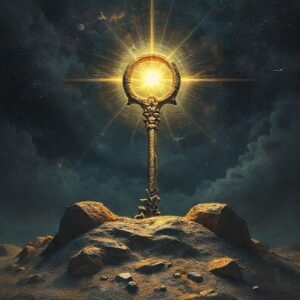
Before we can fully grasp its spiritual significance, we must understand its physical nature. A skeleton key, also known as a passkey, is a type of key that has been simplified to its essential components, allowing it to open a wide variety of warded locks—a common locking mechanism in the 18th and 19th centuries. Its anatomy is telling:
-
The Bow: The handle, often ornately designed. This is the part we grasp, representing our conscious intention and the application of our will.
-
The Shank: The long, slender stem. This is the conduit, the pathway that connects our intention (the bow) to the mechanism of change (the bit). It symbolizes the journey or the process one must undertake.
-
The Bit: The unique, often simple, end-piece that engages with the lock’s wards. Its simplicity is its power, representing the core, universal truth or action required to achieve access.
This tripartite structure—Intention (Bow), Journey (Shank), and Universal Truth (Bit)—mirrors the spiritual process of transformation. We form an intent, we embark on a path, and we apply a fundamental truth to unlock a new state of being. The very design of the skeleton key is a map for spiritual awakening.
Chapter 2: The Primordial Symbolism—The Key in Ancient Myths and Cultures
The symbolism of the key is not a modern invention. It is deeply rooted in the collective unconscious, appearing in the sacred stories and artifacts of nearly every ancient civilization.
2.1: The Egyptian ‘Ankh’: The Key of Life
Perhaps the most direct ancient parallel to the skeleton key is the Egyptian Ankh. Shaped like a key, the Ankh was the hieroglyph for “life” and “eternal life.” It was often depicted in the hands of gods and pharaohs, symbolizing their power to grant life or access to the afterlife. The loop represented the eternal soul, the crossbar represented the material world, and the shaft was the connection between them. The Ankh was, in essence, the ultimate skeleton key—the key that unlocks the mysteries of life, death, and rebirth, granting access to divine knowledge and immortality.
2.2: The Classical World: Janus, Hecate, and the Keys to Realms
In Roman mythology, Janus was the god of beginnings, gates, transitions, and doorways. He was depicted with two faces, one looking to the past and one to the future. While not always shown with a key, his domain is the very essence of what a key represents: the passage from one state to another. More directly, the Greek goddess Hecate, a deity of magic, crossroads, and the underworld, was often shown holding keys. Hecate’s keys granted her access to all realms—the heavens, the earth, and the underworld. She could unlock the secrets of fate and guide souls through transitions. This establishes the key as a symbol of ultimate spiritual authority and the power to navigate different planes of existence.
2.3: Eastern Traditions: The Key as a Spiritual Conduit
In Buddhism and Hinduism, the concept of unlocking or awakening is central. The goal is to achieve enlightenment—to unlock the chains of Maya (illusion) and Samsara (the cycle of rebirth). While not always represented by a physical key, the imagery is potent. Tantric practices involve “unlocking” the chakras (energy centers) along the spine to allow for the free flow of Kundalini energy, leading to spiritual liberation. The skeleton key, in this context, can be seen as a symbol for the disciplined practice (Yoga, meditation) that unlocks these inner gates.
Chapter 3: The Core Spiritual Meanings—Deciphering the Symbol
Having traced its historical roots, we can now synthesize the core spiritual meanings of the skeleton key.
3.1: Access and Opportunity: Unlocking New Doors
The most immediate meaning is that of access. Spiritually, this translates to new opportunities, pathways, and stages of life. When a skeleton key appears in your awareness—whether in meditation, as a gift, or in a dream—it can signify that you are on the verge of a significant breakthrough. A door that was previously locked to you, whether in your career, relationships, or personal growth, is now accessible. It calls you to be bold, to step forward, and to turn the key. It reminds us that we hold the power to open new chapters in our lives.
3.2: Liberation and Release: Freeing the Imprisoned Self
A key does not only open doors; it also unlocks shackles. The skeleton key is a powerful symbol of liberation from whatever confines us. This could be:
-
Self-imposed limitations: Fear, doubt, low self-esteem, and toxic thought patterns.
-
External oppressions: Toxic relationships, stifling jobs, or societal expectations.
-
Karmic or past traumas: Deep-seated wounds that hold us back.
The key represents the tool of self-awareness and conscious action that can set us free. It is the realization that we are not truly trapped; we simply haven’t found or used the right key yet.
3.3: Hidden Knowledge and Esoteric Wisdom
Throughout history, esoteric and occult knowledge has been considered “hidden” or “secret,” accessible only to those who have been initiated or who have discovered the key. The skeleton key symbolizes the pursuit and acquisition of this inner wisdom. It represents the gnosis—the direct, experiential knowledge of divine truths—that unlocks a deeper understanding of the universe and our place within it. It is the key to the mysteries of the self, the cosmos, and the interconnectedness of all things.
3.4: Personal Power and Agency
A key is an object of responsibility and control. To hold the key is to hold the power to grant or deny access. Spiritually, the skeleton key is a potent reminder of our own personal power and agency. It tells us that we are the custodians of our own lives. We hold the power to lock out negativity, toxic influences, and harmful habits. More importantly, we hold the power to unlock our potential, our creativity, and our destiny. It is an antidote to feelings of powerlessness and victimhood.
3.5: The Unconscious Mind and Shadow Self
In Jungian psychology, the key is a symbol for accessing the unconscious mind, particularly the Shadow Self—the parts of our personality that we repress and deny. The skeleton key, as a master key, is uniquely suited for this deep, introspective work. It represents the courage and the tool (often therapy, deep meditation, or shadow work) required to unlock the door to our inner basement, to confront what we have hidden away, and to integrate these aspects to achieve wholeness.
The Core Spiritual Meanings of the Skeleton Key
| Spiritual Meaning | Core Concept | Practical Application |
|---|---|---|
| Access & Opportunity | Opening new pathways in life | Embracing career changes, new relationships, or moving to a new place. |
| Liberation & Release | Freedom from confinement | Releasing addictions, leaving a toxic situation, forgiving oneself or others. |
| Hidden Knowledge | Acquiring esoteric wisdom | Committing to spiritual study, deep meditation, or intuitive development. |
| Personal Power & Agency | Taking control of one’s life | Setting firm boundaries, making confident decisions, owning one’s narrative. |
| The Unconscious & Shadow | Exploring the hidden self | Engaging in journaling, therapy, and dream analysis to integrate the whole self. |
Chapter 4: The Skeleton Key in Dreams—Messages from the Subconscious
Dreams are the royal road to the unconscious, and the appearance of a skeleton key is a significant and potent symbol. Its interpretation depends heavily on the context of the dream.
-
Finding a Skeleton Key: This often suggests that you are discovering a new solution or ability within yourself. You are uncovering the means to overcome a long-standing problem or to access a part of yourself you had forgotten.
-
Receiving a Key as a Gift: This can indicate that help or an opportunity is coming your way from an external source—a person, the universe, or your higher self. It is a sign of support and a nudge to accept the offering.
-
Using a Key to Open a Door: This is a classic symbol of transition. You are ready to move from one phase of your life to another. The nature of the room or space behind the door can offer further clues about what this new phase entails.
-
Losing a Key: This typically reflects anxiety about missing an opportunity or feeling powerless in a situation. It may indicate that you feel you’ve lost the means to access your own potential or to escape a confining circumstance.
-
A Rusty or Broken Key: This can symbolize a missed opportunity, a talent that has been neglected, or a solution that is no longer viable. It may be a call to revisit an old problem with a fresh perspective or to “oil” your skills and passions.
Chapter 5: The Skeleton Key in Modern Spirituality and Magic
In contemporary spiritual practices, the skeleton key has found a vibrant new life as a tangible tool for energy work and manifestation.
5.1: A Tool for Meditation and Journeying
Holding a physical skeleton key during meditation can serve as a powerful focal point. One can visualize the key glowing with light, then mentally use it to “unlock” the heart chakra to release love, the third eye chakra to enhance intuition, or a symbolic door to a past life or a higher plane of existence. It acts as an anchor for the intention of gaining access and insight.
5.2: A Talisman for Protection and Psychic Shielding
As a symbol of agency, a skeleton key can be worn or carried as a protective talisman. The intention here is that you hold the power to “lock out” negative energy, psychic attacks, or harmful influences. It serves as a constant reminder that you have control over your personal energetic boundaries. Placing a key above a doorway in the home is a modern folk magic practice for protecting the household and allowing only positive energy to enter.
5.3: Ritual Uses in Spellcraft and Manifestation
The key is a dynamic component in spell work. Its uses are limited only by the practitioner’s intention.
-
Spell for New Opportunities: Write down a desired opportunity on a piece of paper. Fold it and tap it three times with a key, visualizing a door opening. Keep the key and paper together on your altar.
-
Spell to Release a Habit: Attach a key to a black cord (representing binding and release). Name the habit you wish to be free from and state, “I hold the key to my liberation. I now unlock myself from [habit].” Bury the cord or dispose of it far from your home.
-
Spell for Wisdom: Place a key under your pillow to encourage dreams that offer solutions and hidden knowledge.
Chapter 6: The Skeleton Key as a Personal and Cultural Archetype
The power of the skeleton key extends into our collective stories, where it functions as a powerful archetype.
6.1: In Literature and Film: Unlocking Narratives
From the key that unlocks the secret garden, revealing healing and transformation, to the key in “The Golden Compass” that unlocks the subtle knife, granting access to other worlds, the skeleton key is a staple of fantasy and mystery. It often represents the protagonist’s quest for truth and the pivotal tool that moves the plot forward. The 2005 film The Skeleton Key directly uses the symbol in a modern gothic context, exploring themes of belief, spiritual access, and the peril of unlocking doors without proper knowledge.
6.2: The “Master Key” Concept and Spiritual Hierarchy
The idea of a “master key” that opens many locks leads to the concept of a singular, ultimate truth or principle that can solve many problems. In mystical traditions, this is the pursuit of a unifying theory of existence—the one key that explains all mysteries. This can also relate to spiritual hierarchies, where a teacher or a deity holds the “master key” to enlightenment, which they can then bestow upon a dedicated student.
Chapter 7: Working with Skeleton Key Energy—A Practical Guide
If you feel drawn to the energy of the skeleton key, here is how you can incorporate it into your spiritual practice.
7.1: Choosing or Crafting Your Spiritual Key
You can use an antique skeleton key, a new decorative key, or even a simple drawing. What matters is the intention you pour into it. When selecting one, choose one that feels right to you. Its energy should resonate with your own. If you are craft-inclined, you can even make one out of clay or metal, imbuing it with your purpose from its very creation.
7.2: Consecration and Charging Rituals
Once you have your key, you must cleanse and dedicate it to its purpose.
-
Cleanse: Pass it through the smoke of sage or palo santo, or leave it in moonlight overnight to clear any residual energies.
-
Consecrate: Hold the key in your hands, close your eyes, and state your intention clearly. For example: “I consecrate this key as a tool of liberation and wisdom. May it serve my highest good and help me unlock my true potential.”
-
Charge: You can charge it by placing it on a selenite plate, exposing it to sunlight at dawn (for new beginnings), or simply holding it during your meditation to infuse it with your personal energy.
7.3: Daily Practices and Affirmations
-
Carry your key in your pocket as a reminder of your personal power.
-
Before a challenging meeting or conversation, hold the key and affirm: “I hold the key to this situation. I communicate with clarity and confidence.”
-
When feeling stuck, meditate with the key and ask: “What door is ready to be opened? What lock needs to be released?”
Conclusion: The Eternal Keyholder
The skeleton key is far more than a relic; it is a timeless emblem of the human spirit’s quest for freedom, knowledge, and power. It teaches us that the barriers we face are often illusions, and the solutions lie in simplicity, courage, and the application of our own innate will. We are both the lock and the key, the seeker and the finder. The journey of the soul is one of continuously finding the right keys to unlock the next level of understanding, love, and liberation. The ultimate secret it reveals is that you have always been, and will always be, the holder of your own skeleton key.
Frequently Asked Questions (FAQs)
Q1: I found a skeleton key. Is this a spiritual sign?
A: Often, yes. Finding a skeleton key can be a powerful synchronicity, suggesting that the universe is presenting you with a tool or an opportunity. Pay attention to what is happening in your life. Are you at a crossroads? Feeling stuck? The key’s appearance likely signifies that a solution is at hand and you have the innate ability to access it.
Q2: What does it mean if I dream of losing my skeleton key?
A: This commonly reflects anxiety about a missed opportunity or a feeling of powerlessness. It’s a signal from your subconscious to examine where in your life you feel you’ve lost control or the means to progress. The dream is an invitation to reclaim your agency and to remember that the “key” is an internal resource that cannot be truly lost, only forgotten.
Q3: Can I use a picture of a skeleton key for spiritual work, or does it have to be a physical object?
A: Absolutely. The power resides in the symbol and your intention. A clearly visualized or drawn key can be just as effective as a physical one. The focus of your mind and the clarity of your intent are the true sources of power.
Q4: Is there a negative or dangerous side to the skeleton key symbol?
A: Like any tool of power, intention is everything. The key symbolizes access, which can be used to lock as well as unlock. Spiritually, the “danger” lies in using this energy to manipulate others or to pry into places where you are not welcome or prepared (e.g., intense psychic realms without proper grounding). The principle of “right use” applies. Furthermore, the concept of a “skeleton key” can imply a bypass—a desire for a quick, easy solution to complex spiritual growth, which is often a gradual process.
Q5: Which chakra is most associated with the skeleton key?
A: While it can be used for any chakra, it has a strong resonance with the Third Eye Chakra (Ajna), the center of intuition, foresight, and inner vision. Unlocking the third eye allows for access to hidden knowledge and psychic abilities. It is also deeply connected to the Solar Plexus Chakra (Manipura), the seat of personal power, will, and agency.
Additional Resources
-
Books:
-
Man and His Symbols by Carl G. Jung
-
The Hero with a Thousand Faces by Joseph Campbell
-
The Dictionary of Symbolism by Hans Biedermann
-
-
Mythology Resources:
-
www.theoi.com (A comprehensive guide to Greek mythology, including Hecate)
-
The British Museum’s online collection for Egyptian artifacts like the Ankh.
-
-
Further Reading on Symbolism:
-
Explore academic papers on JSTOR or other databases regarding “key symbolism in medieval art” or “the key as a religious symbol.”
-