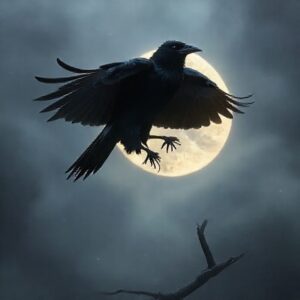
There is a presence in the wild that commands an immediate and primal response. It is not the roar of a lion nor the flight of an eagle, but something far more ancient and intellectually cunning. It is the raven. With plumage darker than a moonless night and a gaze that seems to pierce through veils of reality, the raven has perched on the human psyche for millennia. Its sharp, resonant caw does not merely echo through forests and mountains; it reverberates through our myths, our dreams, and the deepest chambers of our spiritual understanding.
To encounter a raven is to be presented with a riddle wrapped in an enigma, feathered in black. For some, it is a chilling omen, a harbinger of death and misfortune. For others, it is a welcome guide, a bringer of profound magic and the secret laws of creation. This duality is the very essence of the raven’s power. It does not reside in the simplistic realms of “good” or “evil”; it operates in the vast, grey, and potent landscape of truth, transformation, and the great mystery that binds life and death.
This article is an expedition into that mystery. We will embark on a detailed journey across cultures and epochs, unraveling the complex spiritual tapestry woven around Corvus corax. We will sit at the feet of Odin in the halls of Valhalla, listen to the prophecies of the Morrígan on Celtic battlefields, and witness the raven steal the sun to illuminate a world in darkness for the First Peoples of the Pacific Northwest. We will explore what it means to have the raven as a personal totem, how to interpret its appearances in our lives and dreams, and how we can ethically integrate its profound energy for personal and spiritual growth. Prepare to have your perception altered. The raven is not just a bird; it is a key.
Chapter 1: Primal Archetypes – The Universal Roles of the Raven
Before delving into specific cultural contexts, it is crucial to understand the overarching archetypes that the raven embodies across the globe. These are the universal, primal roles that form the core of its spiritual significance.
The Great Trickster and Catalyst for Change
Perhaps the most prevalent archetype associated with the raven is that of the Trickster. However, this is not merely a mischievous prankster. The spiritual Trickster is a cosmic agent of chaos whose primary function is to disrupt the status quo. It breaks rigid structures, challenges arbitrary rules, and through its often-outlandish behavior, exposes hypocrisy and folly. The raven, with its incredible intelligence and penchant for stealing shiny objects, perfectly embodies this role.
In a spiritual context, the Raven Trickster appears when our lives have become stagnant, predictable, or built upon false foundations. Its disruptive energy, while often uncomfortable, is a necessary catalyst for growth. It forces us to adapt, to think in new ways, and to abandon what no longer serves us. The lesson of the Trickster Raven is that creation often requires the destruction of the old. It teaches us not to take ourselves, or life, too seriously, and to find the humor and opportunity in chaos.
The Psychopomp: Guide Between the Worlds of Life and Death
The raven’s association with death is one of its most famous, and most misunderstood, attributes. The raven is not a symbol of death itself in the sense of finality or evil, but rather a Psychopomp (from the Greek psykhopompos, meaning “guide of souls”). A psychopomp is a creature or deity that safely escorts the souls of the deceased from the realm of the living to the realm of the dead.
Ravens are often seen on battlefields and in places of carnage, not because they cause death, but because they are its natural custodians. Their spiritual role is to mediate the greatest transition a soul will ever make. They understand the mysteries of the other side and offer their guidance. This makes the raven a powerful ally in shadow work—the process of confronting and integrating the hidden, suppressed, or “dead” parts of our own psyche. By working with raven energy, we can learn to navigate our inner darkness, face our personal “deaths” (the end of relationships, careers, identities), and emerge transformed.
The Creator and Cosmic Messenger
In a beautiful paradox, the same bird that guides souls to the land of the dead is also a famed creator figure. In the mythologies of many Native American tribes of the Pacific Northwest, Raven is the being who brought light, water, and fire to the world. He is a shapeshifter who steals the sun, moon, and stars from a greedy chief and releases them into the sky for all to enjoy.
This archetype positions the raven as a divine messenger and a bringer of fundamental knowledge. Its caw is not just a bird call; it is a communication from the cosmos, carrying secrets, warnings, and revelations. It is the bird that connects the human world to the divine, delivering the intelligence needed for survival, evolution, and enlightenment.
The Embodiment of Magic and the Unseen
The raven’s glossy black plumage is spiritually significant. Black is the color of the void, the potential from which all creation springs. It is the color of the night, a time of intuition, dreams, and hidden activities. The raven, cloaked in this color, is a master of the unseen realms. It is a creature deeply associated with magic, prophecy, and the manipulation of reality through will and intention.
In many shamanic traditions, the raven is a spirit guide for those practicing magic. It teaches how to shape-shift consciousness, to send intentions into the void, and to bring back wisdom from non-ordinary realities. Its ability to mimic human speech further enhances its reputation as a bridge between worlds and a keeper of esoteric secrets.
Chapter 2: A Tapestry of Feathers – The Raven in World Cultures and Mythologies
The universal archetypes of the raven manifest in uniquely powerful ways across different cultural landscapes. By examining these, we build a richer, more nuanced understanding of its spiritual depth.
Norse Mythology: Odin’s Eyes and Ears – Huginn and Muninn
In the Norse pantheon, the raven holds a position of paramount importance. The All-Father Odin, the god of wisdom, war, and poetry, is accompanied by two ravens: Huginn (Old Norse for “thought”) and Muninn (Old Norse for “memory” or “mind”). Each day, these two birds fly across the Nine Worlds. Each evening, they return to perch on Odin’s shoulders and whisper everything they have seen and heard into his ears.
This relationship is profoundly symbolic. Huginn and Muninn represent the power of conscious thought and the deep, accumulated wisdom of memory. They are the extensions of Odin’s perception, the means by which he gathers the intelligence required to rule the cosmos. Spiritually, this teaches us that wisdom is not a static possession but an active process. It requires the constant, fearless exploration of the world (Huginn) and the diligent, thoughtful integration of that experience into our being (Muninn). To work with raven energy is to cultivate a mind that is endlessly curious and a memory that learns from every experience.
Celtic Traditions: The Morrígan and the Battlefield’s Prophet
In Celtic mythology, the raven is inextricably linked to the Morrígan, a powerful and complex goddess of sovereignty, war, fate, and death. She often appears in the form of a raven or is accompanied by a flock of them. The Morrígan is not a goddess of mindless destruction; she is the embodiment of the fierce, inevitable cycle of life and death. On the battlefield, she decides the fate of warriors, and the raven is her agent, consuming the dead and carrying their souls.
The spiritual message here is one of fierce sovereignty and prophecy. The Morrígan’s raven represents the courage to face the inevitable transformations of life, to claim one’s personal power (sovereignty), and to accept the consequences of one’s actions. It is also a symbol of prophecy—the ability to see the outcome of events, the “fate” woven into the tapestry of life. A raven’s call in the Celtic context is a call to pay attention to the undercurrents of fate and to prepare for a significant shift in one’s personal power structure.
Native American Beliefs: The Bringer of Light, the Shapeshifter, the Culture Hero
For many Native American cultures, particularly among the Tlingit, Haida, Tsimshian, and other peoples of the Pacific Northwest, Raven is not merely an animal but a central, divine figure. He is the Creator Trickster, a being of immense power, appetite, and cunning who shapes the world.
In one of the most famous cycles of stories, the world is initially in darkness, with the sun, moon, and stars kept hidden by a greedy chief. Raven, through a series of clever shapeshifting tricks (often transforming into a hemlock needle to be swallowed by the chief’s daughter to be reborn as her child), manages to steal these celestial bodies and release them into the sky, bringing light to the world.
This myth encapsulates the raven’s core spiritual lessons:
-
Transformation: Raven is the ultimate shapeshifter, teaching that form is fluid and that we must be adaptable to achieve our goals.
-
Creation through Cunning: The world’s greatest gifts (light, knowledge) are often not given but must be won through intelligence, persistence, and a willingness to break unjust rules.
-
The Paradox of Nature: Raven is both a self-serving glutton and a benevolent cultural hero. He reflects the complex, amoral, yet creative force of nature itself.
Greek and Roman Lore: The Apollo Myth and the Sun God’s Curse
In Greco-Roman mythology, the raven’s story is one of fall from grace, which explains its black plumage. The raven was originally a bird of pure white, sacred to Apollo, the god of the sun, prophecy, and truth. Apollo sent his white raven to spy on his lover, Coronis. The raven returned with news that Coronis had been unfaithful. In a fit of rage, Apollo killed Coronis, but then, in a twist of guilt and anger, he punished the messenger. He scorched the raven’s feathers, turning them black, and banished it from the company of white birds.
This myth offers a different spiritual nuance. It positions the raven as a bearer of hard, unwelcome truths. The message is that the truth, no matter how painful, will always come to light. However, the consequences of delivering or receiving that truth can be severe. The raven’s black color becomes a symbol of this burden—a constant reminder of the price of knowledge and the danger of being the messenger. It teaches discernment in communication and the importance of compassion when dealing with difficult revelations.
Abrahamic Traditions: The Raven in the Bible and Quran – A Complex Herald
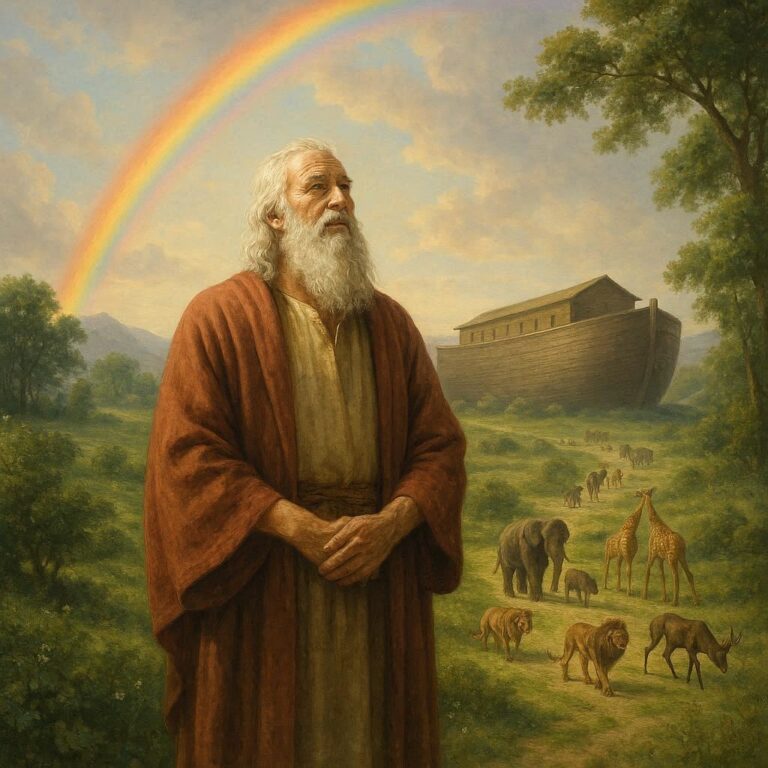
In the Bible, the raven is the first bird mentioned by name. In the story of Noah’s Ark, after the flood, Noah first sends out a raven to see if the waters have receded. The raven, however, “kept flying to and fro until the waters had dried up from the earth” (Genesis 8:7). It did not return. This has often been interpreted negatively, painting the raven as unreliable or unclean. However, a different reading suggests the raven was simply independent and capable of surviving in the new, post-diluvian world on its own.
Later, in the story of Elijah, ravens are commanded by God to bring the prophet bread and meat every morning and evening, sustaining him during a time of famine (1 Kings 17:4-6). Here, the raven is a divine provider, a miraculous agent of God’s mercy.
In the Quran, a similar story is told about Cain and Abel. After Cain kills his brother, Allah sends a raven to scratch the earth, to show Cain how to hide the shame of his brother’s naked body. Cain, seeing this, is remorseful, realizing he was less than a raven.
These stories create a complex portrait: the raven is a survivor, an independent spirit, a divine messenger of provision, and a teacher of practical and moral lessons. It is far from a one-dimensional symbol of evil.
Asian Symbolism: The Three-Legged Crow and Divine Messenger
In Asian cultures, the raven and crow hold positive, solar associations. In Chinese mythology, a three-legged raven or crow, known as the Sānzúwū (三足乌), is said to reside in the sun. It is a symbol of the yang principle—masculine, active, and celestial. The three legs are thought to represent the three phases of the sun: dawn, noon, and dusk.
In Shintoism, Japan’s indigenous religion, the Yatagarasu (八咫烏), a giant three-legged crow, is a divine messenger and an emblem of the will of Heaven. It is famously known for guiding the first Emperor Jimmu through the mountains on his quest to establish the Yamato dynasty.
This symbolism completely inverts the Western “omen of doom” trope. Here, the raven is a solar, auspicious guide, a bringer of divine intervention and imperial legitimacy. It represents illumination, guidance on a righteous path, and the direct support of heavenly powers.
The Raven’s Duality Across Cultures
| Culture / Tradition | Positive / Creative Associations | Challenging / Destructive Associations | Primary Archetype |
|---|---|---|---|
| Norse | Wisdom, Memory, Perception (Huginn & Muninn) | N/A (Neutral Messengers) | Messenger, Psychopomp |
| Celtic | Sovereignty, Prophecy, Transformation | Battle, Death, Fate | Psychopomp, Prophet |
| Native American | Creation, Light, Culture, Trickery | Gluttony, Deceit, Chaos | Creator, Trickster |
| Greco-Roman | Truth, Prophecy (pre-curse) | Punishment, Unwelcome News | Messenger |
| Abrahamic | Divine Provision, Survival, Moral Lesson | Uncleanliness, Independence | Survivor, Messenger |
| Asian | Solar Power, Divine Guidance, Illumination | N/A (Positively viewed) | Divine Guide, Solar Symbol |
Chapter 3: The Raven as a Personal Spiritual Ally and Totem
When the raven consistently appears in your life, whether in physical form, dreams, or through art and media, it may be signaling that it is your spirit animal or totem. Embracing this energy can be a profoundly transformative experience.
Core Characteristics of a Raven Totem Person
Those who resonate with the raven as a totem often share distinct traits:
-
Highly Intelligent and Curious: You have a nimble, analytical mind and are a lifelong learner.
-
Drawn to Mystery: You are naturally attracted to the occult, magic, psychology, and the hidden aspects of reality.
-
A Catalyst for Change: Your presence often disrupts stagnant situations, forcing necessary growth in yourself and others.
-
Comfort with the “Dark”: You are not afraid to explore topics of death, grief, trauma, and the shadow self. You understand that healing lies in integration, not avoidance.
-
A Powerful Communicator: You have a way with words, whether written or spoken, and understand the power of language to create and destroy.
-
A Shape-shifter: You can adapt to different social situations and roles with ease, though you may sometimes struggle with a stable sense of self.
The Raven’s Call: Embracing Transformation and Shadow Work
The primary call of the raven totem is to embrace personal transformation. This is not a gentle process. It often involves “the void”—a period of uncertainty, loss, or disintegration where the old self is dying. The raven teaches you to sit in this darkness without panic, trusting that, like the black void, it is full of creative potential.
This journey necessitates shadow work. The shadow, a concept from Jungian psychology, is the part of our psyche containing everything we repress or deny—our traumas, shameful desires, and perceived weaknesses. The raven, as a psychopomp, is the perfect guide for this inner journey. It encourages you to bring these hidden aspects into the light of consciousness, not to be rid of them, but to understand their power and integrate them, making you a whole, more authentic, and potent individual.
The Gift of Prophecy and Deep Insight (Muninn’s Power)
Raven people often possess a strong intuitive or psychic ability. This is the power of Muninn—deep memory that is not just personal, but ancestral and collective. It is the ability to perceive patterns that are invisible to others, to have “a feeling” about how events will unfold. This is not about predicting lottery numbers, but about understanding the deep undercurrents of cause and effect. To develop this gift, practice quieting the conscious mind (Huginn) through meditation and listen to the whispers of your deeper intuition (Muninn).
The Power of Creation Through Language (Huginn’s Power)
The raven also governs the power of thought and language. This is Huginn’s domain. Raven reminds you that your words and thoughts are not neutral; they are spells that shape your reality. Gossip, negative self-talk, and careless words create a toxic reality. Conversely, mindful speech, affirmations, poetry, and incantations can be used to manifest beauty, healing, and change. As a raven person, you are urged to wield this power with precision and responsibility.
Chapter 4: Omens, Encounters, and Dreamscapes
So, what does it mean when you have a specific encounter with a raven? Interpretation is key.
Is a Raven Sighting an Omen of Death? Context is Everything
The short answer is: rarely in a literal sense. The raven is an omen of transformation. Because death is the ultimate transformation, it has earned this association. However, a raven’s appearance is far more likely to signal the end of something—a job, a relationship, a belief system, a phase of life. It asks: What in your life is ready to die so that something new can be born? Are you clinging to a corpse of a situation? The raven offers to guide that part of you to its rest.
Interpreting Common Raven Encounters
-
A Raven Cawing at You: This is a direct message. Pay attention to your thoughts at that exact moment. The universe is trying to get your attention. It could be a confirmation of a thought, a warning, or a call to use your voice.
-
Seeing a Raven Circling: This often indicates a need for a higher perspective. You are too mired in the details of a situation. Like the circling raven, you need to rise above it to see the bigger picture and the patterns at play.
-
A Raven Crossing Your Path: This is a classic sign of imminent magic and transformation. You are at a crossroads, and the path you are on is about to change significantly. The raven assures you that this change, while potentially unsettling, is part of your soul’s journey.
-
Finding a Raven Feather: This is a powerful gift and a tangible connection to raven energy. It is an invitation to work with its magic. It can be used on an altar or kept as a reminder to embrace mystery and your own inner power.
The Raven in Dreams: A Dive into the Subconscious
Dreaming of ravens is a powerful experience, plunging you directly into the realm of the subconscious.
-
A Talking Raven: Pay close attention to what it says. This is a direct communication from your higher self or a spirit guide.
-
A Raven Attacking You: This can symbolize your own resistance to a necessary transformation. You are fighting the change, and it is causing you inner conflict. It’s time to surrender and trust the process.
-
A Friendly Raven: A guide is present in your life, offering wisdom and protection as you navigate a difficult transition.
-
A Flock of Ravens: This can indicate a collective or familial issue coming to a head. It may also represent powerful, collective magic at work.
Chapter 5: Integrating Raven Energy: Practical Spiritual Practices
If you feel called to the raven, here are some respectful ways to connect with its energy.
Meditation and Journeying with Raven
Find a quiet space. Close your eyes and visualize a dark, vast landscape. Call upon the spirit of Raven. Imagine it landing before you. Ask it a question. Then, in your mind’s eye, climb onto its back. Feel it lift you into the sky, carrying you over your life’s landscape, offering you a new perspective. Journey to the realms of memory (Muninn) or to the edges of your future possibilities (Huginn).
Creating a Raven Altar
Dedicate a small space with a black cloth. Place upon it items that honor the raven: a black feather (ethically sourced), obsidian or onyx crystals (for protection and shadow work), a small bowl of water (for intuition), and a dark-colored candle. You might include images of Odin, the Morrígan, or a three-legged crow. Use this space for meditation, setting intentions, and doing shadow work.
Raven-Inspired Divination
-
With Runes: As Odin’s bird, the raven is deeply connected to the runes. When casting runes, ask for Raven’s clarity to interpret the symbols.
-
With Tarot/Oracle Cards: The card most associated with the raven is often The Moon, which deals with illusion, subconscious, and intuition. When this card appears, consider it a “raven’s call.”
Ethical Considerations and Cultural Respect
As with any spiritual practice, approach with respect. Do not simply take closed cultural practices (like specific Native American rituals) for your own use. Instead, focus on the universal archetypes and develop a personal relationship with the raven’s energy. Never disturb wild ravens or their nests. Observe from a distance and with reverence.
Conclusion: The Eternal Mystery
The raven is the keeper of the great paradox, teaching that life springs from the void.
It is the guide through the darkest nights of the soul, promising transformation on the other side.
To welcome the raven is to embrace magic, intelligence, and the eternal dance of creation and destruction.
Frequently Asked Questions (FAQs)
1. What is the difference between a crow and a raven spiritually?
While closely related, ravens are generally considered the “older, bigger brother” in spiritual terms. Ravens are more associated with deep magic, prophecy, and the cosmos (Odin, the Morrígan), while crows are often linked to everyday magic, law, and ancestral memory. A crow’s message might be more immediate and practical, while a raven’s message is often more profound and life-altering.
2. Is seeing a raven a bad omen?
No, it is primarily an omen of change. While change can be challenging, it is necessary for growth. The raven appears to prepare and guide you through this transformation, not to curse you. Your perception and context determine whether this change feels “good” or “bad.”
3. How can I tell if the raven is my spirit animal?
You will feel a persistent, deep draw to it. You may see them frequently in physical life and in your dreams. You may find their feathers. The archetypes of the trickster, shapeshifter, and psychopomp will resonate powerfully with your life’s story and personality.
4. Can I ask the raven for help?
Yes. In meditation or through quiet intention, you can call upon the spirit of Raven for guidance, especially when you need clarity in a confusing situation, courage to face a ending, or creativity to solve a complex problem.
5. What does a dead raven symbolize?
This is a potent symbol. It can indicate that a powerful cycle of transformation in your life has completed. It may also be a stark warning that you are ignoring the raven’s calls for change, effectively “killing” the message and stagnating. Reflect deeply on what major shift you may be resisting.