Imagine a number so deeply woven into the fabric of existence that it appears as a silent, recurring motif from the macrocosm of the cosmos to the microcosm of the human soul. It is the number of celestial bodies visible to the naked eye, the number of days in a lunar cycle, and the number of notes in a musical scale that can move us to tears. This number is 7. More than a mere digit, it is a universal archetype, a spiritual code, and a key that has been used by mystics, scientists, and philosophers for millennia to unlock the mysteries of life, the divine, and our own consciousness. To encounter the number 7 is to hear a whisper from the universe itself—a call to look deeper, to seek truth, and to remember that we are part of a grand, intelligent, and perfectly ordered design. This article is an immersive journey into the heart of this sacred number. We will traverse the hallowed grounds of ancient religions, ascend the inner ladder of the chakra system, decipher the philosophical laws that govern reality, and explore the psychological underpinnings that make seven the number of the seeker, the mystic, and the sage. Prepare to discover why the number 7 has been, and continues to be, the supreme symbol of spiritual perfection, completion, and the relentless pursuit of inner wisdom.
The Archetype of Completion: Why Seven Feels Whole
At its core, the power of the number 7 lies in its role as the archetype of completion and cyclical perfection. An archetype, as defined by Carl Jung, is a universal, primordial symbol or pattern that resides in the collective unconscious of humanity. The number 7 is one of the most potent of these patterns. It represents a full cycle, a dynamic process that has a beginning, a middle, and an end, resulting in a state of integrated wholeness.
Consider the natural world: a rainbow manifests through seven distinct colors. While the spectrum of light is continuous, human perception and cultural consensus have settled on seven key hues—red, orange, yellow, green, blue, indigo, violet. This is not a random choice; it is a cognitive and symbolic recognition of a complete cycle of vibration, from the slow, dense frequency of red to the fast, ethereal frequency of violet. It is a whole, a perfect expression of light’s potential.
This pattern of a complete cycle is further evidenced in the temporal realm. The ancient Babylonians, keen astronomers, observed the seven celestial bodies that moved independently against the backdrop of the fixed stars: the Sun, the Moon, Mars, Mercury, Jupiter, Venus, and Saturn. This observation led them to create the seven-day week, a unit of time that has persisted for thousands of years across virtually all cultures. The week is a microcosm of a larger cycle, a complete unit of time that feels naturally whole. We intrinsically feel the closure of a week, a rhythm that structures our lives.
Furthermore, the number 7 often appears at the culmination of a process. In the Biblical creation story, God creates the world in six days and rests on the seventh, sanctifying it. The six days represent the process of manifestation, of building and doing. The seventh day is not an afterthought; it is the essential, culminating phase of rest, reflection, and integration. Without the seventh day, the cycle is incomplete. It is the point where action transforms into being, where the work is made holy through conscious appreciation. This establishes 7 not as the number of cessation, but of sacred completion—the point where a process achieves its full meaning and purpose.
This archetypal “wholeness” of 7 is what gives it its profound spiritual weight. It is the number that signifies that a phase of learning, a cycle of growth, or a period of challenge has reached its natural conclusion, and from this point of integration, a new beginning can emerge. It is the number of the seeker who has gathered the fragments of understanding and synthesized them into a cohesive truth.
Seven in World Religions: The Divine Signature
The reverence for the number 7 is perhaps most visibly enshrined in the world’s major religious and spiritual traditions. It acts as a divine signature, a repeated motif that underscores sacred narratives, rituals, and architectural principles, pointing to a truth that transcends any single doctrine.
Judaism and Christianity
The Abrahamic traditions are replete with symbolic sevens, establishing a foundational lexicon for Western spiritual thought.
-
Creation: The seven-day creation narrative in Genesis is the cornerstone, establishing the template for sacred time.
-
The Menorah: The seven-branched lampstand of the Tabernacle and Temple is a powerful symbol of the light of God, often interpreted as representing the seven spirits of God, the seven days of creation, or the tree of life.
-
Divine Forgiveness and Completion: In the Book of Joshua, the Israelites march around the city of Jericho for seven days, and on the seventh day, they march seven times, after which the walls fall. This story symbolizes the complete and divinely ordained fulfillment of a promise. Similarly, Jesus Christ instructs Peter to forgive not seven times, but “seventy-seven times” (Matthew 18:22), implying a perfect, limitless forgiveness that transcends mere tallying.
-
The Book of Revelation: This apocalyptic text uses the number 7 more than any other, describing the seven churches, seven seals, seven trumpets, and seven bowls of God’s wrath. Here, 7 represents the complete and final cycle of divine judgment and the establishment of a new, perfected order.
Islam
In Islam, the number 7 holds significant cosmological and ritual importance.
-
The Heavens: The Quran frequently mentions the seven heavens, layered realms of creation that demonstrate the majesty and order of Allah’s design.
-
Circumambulation: During the Hajj pilgrimage, pilgrims walk seven times around the Kaaba in Mecca (Tawaf) and seven times between the hills of Safa and Marwah (Sa’i). These rituals reenact sacred stories and symbolize the soul’s journey towards God, with the seven circuits representing a complete and devoted effort.
-
Creation: Similar to the Genesis account, some Islamic traditions hold that God created the universe in six periods and established His throne on the seventh.
Hinduism
The ancient Vedic texts of Hinduism present a sophisticated spiritual cosmology built upon the number 7.
-
The Chakras: While we will explore this in depth later, the seven primary chakras form the central energetic anatomy of the human being in Hindu tantra and yoga.
-
The Worlds (Lokas): Hindu cosmology describes seven upper worlds (heavenly realms) and seven lower worlds (netherworlds), with the Earth in the middle. This represents the multi-layered nature of reality and consciousness.
-
The Saptarishis: The “Seven Sages” are pivotal figures in Hindu mythology, the mind-born sons of Brahma who are entrusted with sacred knowledge and guide humanity through the ages.
Buddhism
In Buddhism, the number 7 signifies progression and stages on the path to enlightenment.
-
The Seven Factors of Enlightenment: These are mental qualities to be cultivated: mindfulness, investigation of phenomena, energy, joy, tranquility, concentration, and equanimity. They represent a complete set of attributes necessary for awakening.
-
The Buddha’s Steps: Legend states that after his birth, the infant Buddha took seven steps in each of the four cardinal directions, proclaiming his supreme status. This symbolizes his mastery over the world and the completeness of his being.
This cross-cultural and inter-religious prevalence is not a coincidence. It points to the number 7 as a fundamental metaphysical principle—a universal language describing the architecture of spiritual ascent, divine order, and the journey of the soul towards perfection.
The Chakras: The Seven Pillars of the Self
If the number 7 represents the map of spiritual ascent on a cosmic scale, then the chakra system is its most intimate and practical application within the human being. Originating in the spiritual traditions of India between 1500 and 500 BC, the chakras are conceived as spinning wheels or vortexes of energy aligned along the spine, from its base to the crown of the head. Each of the seven primary chakras governs specific aspects of our physical, emotional, psychological, and spiritual well-being. The journey from the first to the seventh chakra is the journey of consciousness itself—from earthly, material survival to spiritual, universal oneness.
The Seven Chakras – A Guide to Your Energetic Anatomy
| Chakra Number & Name | Location | Color | Key Themes & Functions | Element | State of Consciousness |
|---|---|---|---|---|---|
| 1. Root (Muladhara) | Base of Spine | Red | Survival, Grounding, Security, Stability, Foundation | Earth | “I Am” |
| 2. Sacral (Svadhisthana) | Lower Abdomen | Orange | Creativity, Sexuality, Emotion, Pleasure, Desire | Water | “I Feel” |
| 3. Solar Plexus (Manipura) | Upper Abdomen | Yellow | Personal Power, Will, Self-Esteem, Metabolism | Fire | “I Do” |
| 4. Heart (Anahata) | Center of Chest | Green | Love, Compassion, Forgiveness, Connection, Healing | Air | “I Love” |
| 5. Throat (Vishuddha) | Throat | Blue | Communication, Truth, Self-Expression, Integrity | Sound/Ether | “I Speak” |
| 6. Third Eye (Ajna) | Between Eyebrows | Indigo | Intuition, Insight, Imagination, Perception, Wisdom | Light | “I See” |
| 7. Crown (Sahasrara) | Top of Head | Violet/White | Spirituality, Enlightenment, Unity, Cosmic Consciousness, Bliss | Thought | “I Know” |
The progression through the chakras is a profound allegory for the spiritual meaning of 7. It is a sequential and cumulative process. One cannot truly express their highest truth (Throat Chakra) without first having a stable foundation (Root), a healthy emotional flow (Sacral), a strong sense of self (Solar Plexus), and an open heart (Heart). Each chakra builds upon the last, and the ultimate goal is to achieve a balanced flow of energy through all seven, culminating in the transcendent experience of the Crown Chakra.
The Seventh Chakra, the Crown or Sahasrara, is the pinnacle of this system. Its name translates to “thousand-petaled lotus,” symbolizing infinite expansion and connection to the divine. When this chakra is open and balanced, a person experiences a sense of unity with all that is, transcending the ego and its limitations. It is the embodiment of the number 7’s spiritual meaning: the completion of the individual journey and the merging with the universal source. It is the point where the seeker becomes the known, the perceived becomes the perception, and the soul remembers its inherent wholeness.
The Seven Hermetic Principles: The Fabric of Reality
Moving from Eastern internal maps to Western esoteric philosophy, we find the number 7 at the very foundation of Hermeticism, a spiritual, philosophical, and magical tradition stemming from the teachings of the mythical sage Hermes Trismegistus. The core of this wisdom is encapsulated in The Kybalion, a text published in the early 20th century, which outlines the Seven Hermetic Principles. These are not merely ideas but are presented as the fundamental, immutable laws that govern the entire Universe—from the physical to the mental and spiritual planes. Understanding these seven principles is to understand the operating system of reality itself.
-
The Principle of Mentalism: “THE ALL is MIND; The Universe is Mental.” This is the foundational principle. It states that the underlying reality of the universe is consciousness or mind. All matter, energy, and phenomena are manifestations of a universal, infinite mind. This principle aligns with modern quantum physics, which suggests that the observer influences the observed.
-
The Principle of Correspondence: “As above, so below; as below, so above.” This famous axiom declares that there is harmony, agreement, and correspondence between the different planes of existence—the physical, mental, and spiritual. The patterns we see in the cosmos (the macrocosm) are reflected in the human being (the microcosm), and vice versa. The seven chakras within correspond to the seven classical planets without.
-
The Principle of Vibration: “Nothing rests; everything moves; everything vibrates.” This principle states that everything in the universe, from the densest rock to the most ethereal thought, is in constant motion and vibrates at a specific frequency. The difference between manifestations of matter, energy, and spirit is solely a difference in their rate of vibration.
-
The Principle of Polarity: “Everything is Dual; everything has poles; everything has its pair of opposites…” This principle explains that opposites are identical in nature but different in degree. Hot and Cold, Light and Dark, Love and Hate are merely the two extremes of the same thing. Mastery comes from learning to “polarize” oneself at the desired point on the scale.
-
The Principle of Rhythm: “Everything flows, out and in; everything has its tides; all things rise and fall…” This principle observes that everything moves in rhythmic cycles, a pendulum-like motion between the poles established by the Principle of Polarity. There are tides in the ocean, seasons in the year, and ups and downs in our personal lives. The wise learn to rise above the swing of the pendulum through conscious will.
-
The Principle of Cause and Effect: “Every Cause has its Effect; every Effect has its Cause…” This principle states that nothing happens by chance; chance is merely a term for a cause not recognized or perceived. We live in a universe of absolute law, not chaos. By understanding the causes, we can master their effects and become conscious creators of our reality, rather than passive victims.
-
The Principle of Gender: “Gender is in everything; everything has its Masculine and Feminine Principles…” This principle manifests on all planes. It is not merely about biological sex but about the universal creative energies: the masculine (active, projective, “Yang”) and the feminine (receptive, creative, “Yin”). Both are necessary for any act of creation, whether it be birthing a child, an idea, or a galaxy.
The presentation of these as seven principles is deeply significant. It positions them as a complete and comprehensive framework for understanding the cosmos. Just as the seven days of creation represent a full cycle of manifestation, these seven principles represent the complete set of fundamental laws that describe all phenomena. To master them is to achieve a state of spiritual gnosis—a complete understanding of “that which is.” They are the ultimate expression of the number 7 as the symbol of cosmic order and intellectual-spiritual perfection.
Astrological and Cosmic Sevens: Cycles of Time and Space
The heavens have always been humanity’s first clock and calendar, and the number 7 is indelibly stamped upon our perception of the cosmos. This celestial connection provides a grand, observable canvas for the spiritual principle of cyclical completion and divine order.
The Seven Classical Planets: Before the invention of the telescope, the sky was defined by the seven wandering “stars” that moved independently of the fixed stars. These were the Sun, the Moon, Mars, Mercury, Jupiter, Venus, and Saturn. Each was associated with a deity and specific qualities, forming the basis of classical astrology. This septet was seen as the divine council influencing life on Earth. The seven-day week is a direct terrestrial reflection of this celestial system, with each day named for and dedicated to one of these seven bodies (e.g., Sunday (Sun), Monday (Moon), Saturday (Saturn)).
The Phases of the Moon: While the moon’s cycle is approximately 29.5 days, it is divided into four distinct phases, each lasting about 7 days: New Moon, First Quarter, Full Moon, and Last Quarter. This quarterly division creates a powerful weekly rhythm within the larger monthly cycle, intimately linking the number 7 with the feminine, the emotional tides, and the rhythm of growth and release.
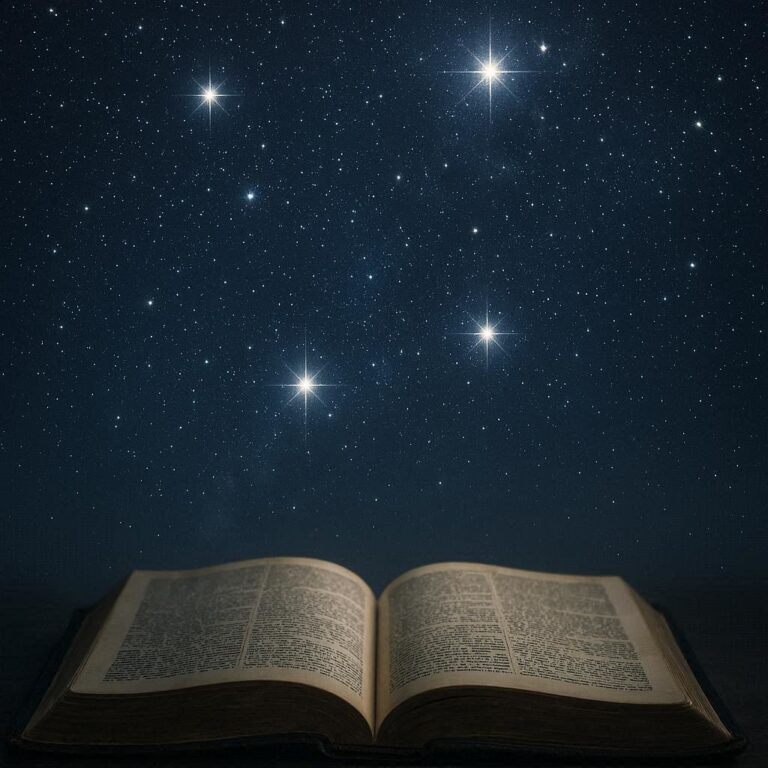
The Pleiades (Seven Sisters): Across countless cultures—from Greek mythology to Aboriginal Australian Dreamtime stories—the star cluster known as the Pleiades is identified as seven sisters. Though only six stars are easily visible to the naked eye, the lore of a seventh, lost sister is nearly universal. This celestial symbol reinforces the theme of a hidden or spiritual dimension completing a physically perceived six, echoing the creation story where the seventh day is the invisible, sanctifying principle that completes the six days of labor.
The Cosmic Ladder: In many mystical traditions, the journey of the soul after death or during spiritual ascent is described as a passage through seven heavens or seven spheres. Each sphere, often associated with one of the seven planets, represents a grade of purification and understanding that the soul must pass through to reach the ultimate, formless divine realm beyond. This is the cosmic equivalent of the chakra system—a step-by-step process of refinement and completion, guided by the archetypal power of 7.
These astronomical associations are not mere ancient superstitions. They represent humanity’s intuitive understanding that the patterns we observe in the heavens are reflections of the patterns of life and spirit. The number 7, recurring in these cosmic cycles, becomes a symbol of a universe that is not chaotic, but ordered, intelligible, and deeply meaningful. It connects our small, earthly lives to the grand, turning dance of the galaxies, assuring us that we are part of a complete and purposeful whole.
The Psychology of Seven: The Mind’s Mystical Limit
The power of the number 7 is not confined to the realms of spirit and cosmos; it has a firm footing in the empirical science of cognitive psychology. In 1956, psychologist George A. Miller published a landmark paper titled “The Magical Number Seven, Plus or Minus Two.” Through his research, Miller demonstrated that the average human being’s working memory can hold approximately 7 (ranging from 5 to 9) discrete pieces of information at one time.
This is the cognitive limit for unorganized data, such as a list of random numbers, letters, or words. This “channel capacity” of our conscious awareness has profound implications. It means that our immediate grasp of the world is structured around this number. When information exceeds this limit, we are forced to “chunk” it into larger units or we begin to forget.
From a spiritual perspective, this psychological limit is fascinating. It suggests that the number 7 represents a fundamental threshold of human consciousness. It is the boundary between what we can hold in our immediate, focused awareness and what lies beyond in the vast realms of the subconscious or superconscious.
This provides a potential scientific correlate for spiritual concepts:
-
The Seven Chakras: Could the chakra system be a symbolic map of the seven primary “channels” or “frequencies” through which consciousness processes different types of information (survival, emotion, power, love, etc.)?
-
The Seven Days of Creation: Could this be a narrative representation of the mind of God (or the Universal Mind) structuring reality in a way that is cognitively graspable by the human mind, which operates in units of seven?
-
The Pursuit of Transcendence: The spiritual path often involves seeking to go beyond the limitations of the individual mind. The number 7, in this context, can be seen as the final gate of the ordinary mind. To connect with the divine (the “eighth” or the infinite) is to move beyond the “magical number seven” and tap into the boundless awareness of the collective unconscious or universal mind.
Therefore, the number 7 is not just a spiritual symbol imposed upon reality; it appears to be a structural component of how we, as humans, perceive and interact with reality. It is the mind’s natural unit of measure, the cognitive container for experience. The spiritual journey, in many ways, is about filling that container with wisdom and then learning to transcend its limits altogether.
Seven in Dreams and Synchronicity: Messages from the Subconscious
When a number as potent as 7 begins to appear in our personal lives—in dreams, as recurring digits on clocks (11:11 is a different phenomenon, but 7:77, for instance), license plates, or page numbers—it moves from being a universal archetype to a personal message. In the realm of depth psychology, pioneered by Carl Jung, such occurrences are not coincidences but synchronicities: “meaningful coincidences” that reveal a connection between the inner world of the psyche and the outer world of events.
If you are consistently encountering the number 7, it is a powerful sign to pay attention. It is the universe, your higher self, or the collective unconscious tapping you on the shoulder. The specific meaning can vary based on context, but it generally points to the core themes we have explored:
-
A Call to Inner Wisdom: You are being prompted to look within. The number 7 is the number of the seeker and the mystic. Its appearance may indicate that you are entering a phase where introspection, study, and meditation will be highly fruitful. It’s time to trust your intuition and inner knowing.
-
Completion of a Cycle: You may be at the end of a significant phase in your life—a project, a relationship, a way of thinking. The number 7 is a confirmation that this cycle is coming to a natural and necessary conclusion. It is a signal to prepare for integration and rest before the next beginning.
-
Spiritual Awakening and Development: The frequent sighting of 7 can be a direct indicator of accelerated spiritual growth. Your consciousness is expanding, and you are becoming more attuned to the deeper, mystical layers of reality. You are being encouraged to continue on your path.
-
The Need for Analysis and Truth: The number 7 is analytical and truth-seeking. Its appearance might be a nudge to not take things at face value, to dig deeper, to research, and to seek the underlying truth of a situation or in your own beliefs.
When you see this number, pause. Take a breath. Ask yourself: What was I just thinking about? What phase of my life am I in? Where do I need to seek deeper understanding? The number 7 is a spiritual ally, a reminder that you are on a sacred journey of learning and that the universe is structured in a way that supports your growth towards wholeness.
Numerology of Life Path 7: The Seeker’s Journey
In numerology, the study of the mystical significance of numbers, your Life Path Number is considered the most important number in your chart. It is calculated from your full date of birth and reveals your core purpose, challenges, and lessons in this lifetime. Those with a Life Path 7 are the philosophers, analysts, and mystics of the world.
A person with a Life Path 7 is on a lifelong quest for truth and understanding. They are not satisfied with superficial answers or conventional wisdom. They are the natural researchers, scientists, detectives, and spiritual seekers who must peel back the layers of reality to discover what lies at the core. Their journey is an inward one. They require ample time alone to think, reflect, and recharge their energies. Solitude is not loneliness for the 7; it is a necessity.
Key Traits of a Life Path 7:
-
Deeply Analytical and Inquisitive: They possess a sharp, penetrating mind that questions everything.
-
Introverted and Contemplative: They draw energy from within and need quiet to process their experiences.
-
Spiritually Inclined: They have a natural pull towards the metaphysical, the mystical, and the unexplained.
-
Perfectionists and Idealists: They can see how things should be and may become frustrated when reality falls short.
-
Guarded with Emotions: They tend to live in their heads and may struggle to express their feelings openly, fearing vulnerability.
-
Natural Skeptics: They believe in what can be proven or intuitively sensed, not in what they are simply told to believe.
The challenge for the Life Path 7 is to balance their rich inner world with the demands of the outer world. They must learn to trust others and share their profound insights without feeling that their solitude is being invaded. They must also learn to trust their intuition as much as their intellect. When a Life Path 7 embraces their nature, they become beacons of wisdom, truth, and spiritual insight for others. They are the guides who have walked the inner path and returned to share the map. Their life is the ultimate expression of the number 7’s spiritual meaning: a dedicated journey from the question to the answer, from the known to the unknown, and from the self to the soul.
Practical Applications: Integrating the Energy of Seven into Your Life
Understanding the spiritual meaning of 7 is one thing; living it is another. Here are practical ways to harness the powerful, introspective, and wise energy of the number 7 in your daily spiritual practice.
-
Create a Seven-Day Spiritual Theme: Dedicate each day of the week to contemplating and working with one of the seven chakras or one of the seven Hermetic Principles. For example, Monday could be for the Sacral Chakra (emotions/creativity), Tuesday for the Solar Plexus (personal power), and so on.
-
The “Seven-Minute Sit”: In our busy world, long meditation sessions can be daunting. Commit to a daily seven-minute meditation. This is a manageable yet potent amount of time to turn inward, observe the mind, and connect with your breath. The number itself will help structure and sanctify the practice.
-
Engage in a Seven-Week Learning Cycle: Choose a topic you wish to master—a philosophical text, a spiritual concept, or a new skill. Structure your study over seven weeks, with each week dedicated to a different sub-topic or chapter. This utilizes the natural rhythm of completion associated with the number.
-
The Journal of Inquiry: Keep a special journal for deep, soul-searching questions. When faced with a dilemma, write down seven different questions about it. Then, over the following days, write down seven potential answers or insights for each question. This leverages the analytical and truth-seeking energy of 7 to gain profound clarity.
-
Nature’s Seven Walks: Go for a walk in nature with the intention of engaging each of your five senses, plus your intuition and your sense of connection to the whole (seven points of awareness). First, notice what you see. Then, what you hear. Then, smell, touch (the air on your skin), and taste (the air). Sixth, tune into your intuition—what is the “feeling” of this place? Seventh, feel your connection to the trees, the sky, the earth.
-
Digital Detox: The number 7 calls us away from the noise of the external world. Consider a digital detox for seven hours each week, or even for a full 24-hour period once a month. Use this time for the activities that nourish the 7 energy: reading, contemplation, being in nature, and deep conversation.
By consciously integrating the rhythm and meaning of 7 into your life, you align yourself with one of the universe’s most fundamental patterns of growth and completion. You become an active participant in your own spiritual journey, moving steadily from fragmentation to wholeness.
Conclusion: The Everlasting Whisper of the Seven
The number 7 is far more than a mathematical value; it is a universal constant of spiritual significance. It is the sacred rhythm of completion that structures our cosmos, our faiths, our minds, and our souls. From the seven days of creation to the seven pillars of the chakras, it maps the journey from manifestation to enlightenment. It calls us to seek truth beyond the surface, to trust the wisdom within, and to recognize the divine order in all things. When we listen to its whisper, we remember our own potential for perfect, conscious wholeness.
Frequently Asked Questions (FAQs)
Q1: I keep seeing the number 777 everywhere. What does this mean?
A: In numerology, triple numbers amplify the base number’s energy. 777 is an extremely powerful and positive spiritual sign. It is a strong message from your angels, spirit guides, or the universe that you are on the right path spiritually. It signifies that you are in alignment, your thoughts are in harmony with your soul’s purpose, and you are experiencing a significant period of spiritual growth and awakening. It’s a confirmation to trust the process and your inner wisdom.
Q2: Is the number 7 lucky in a general sense?
A: While many cultures do consider 7 a lucky number (e.g., in gambling and games of chance), its deeper spiritual meaning goes beyond mere luck. “Luck” implies random good fortune. The power of 7 is based on order, cycle, and spiritual law. When you align with the energy of 7—through introspection, seeking truth, and completing cycles—you naturally create positive outcomes in your life, which may appear as luck but are actually the result of being in sync with the universe’s fundamental rhythms.
Q3: What is the difference between the energy of 7 and 11 in spirituality?
A: This is an excellent question. The number 7 is the number of the mystic—it is analytical, introspective, and seeks to understand the universe through study and inner exploration. It is a path of the mind and soul seeking truth. The number 11 is a Master Number, known as the “Illuminator.” It is highly intuitive, inspirational, and connected to a collective, visionary consciousness. While the 7 seeks truth through analysis, the 11 often receives truth through channeling and spiritual revelation. The 7 builds knowledge step-by-step; the 11 is struck by lightning bolts of insight.
Q4: How can I calculate my Life Path Number to see if I am a 7?
A: Reduce your full birth date (MM/DD/YYYY) to a single digit, but do not reduce Master Numbers 11, 22, or 44 unless the final sum is 11, 22, etc.
-
Example: December 25, 1985.
-
Write it out numerically: 12/25/1985.
-
Add all digits: 1+2 + 2+5 + 1+9+8+5 = 33.
-
33 is a Master Number (33), so it is not reduced further. If you get 11 or 22, you also stop.
-
If you get a two-digit number that is not a Master Number, reduce it: e.g., 12/25/1986 -> 1+2+2+5+1+9+8+6=34 -> 3+4=7. This person would be a Life Path 7.