Look up at the night sky. For a night, perhaps two, the moon is absent. Its familiar, silvery glow has vanished, leaving a velvety black expanse dotted with distant stars. In our modern, perpetually illuminated world, this darkness can feel unsettling, a void to be filled. But what if this darkness is not an emptiness, but a fertile silence? What if this celestial event is not an ending, but the most potent beginning imaginable?
This is the spiritual invitation of the New Moon. It is the cosmic pause, the sacred husk at the start of every lunar cycle. It represents a moment of pure, unmanifested potential—a blank page in the book of your life. While the Full Moon is a time of outward celebration, illumination, and harvest, the New Moon turns our gaze inward. It calls us to quiet the external noise, to sit in the fertile darkness of our own being, and to listen to the whispers of our soul. This is the time for dreaming, for planting the seeds of future realities, and for initiating profound personal transformation. This article is your deep dive into that sacred space, a comprehensive guide to understanding and harnessing the immense spiritual power of the New Moon.
2. Beyond the Science: The Symbolism of Darkness
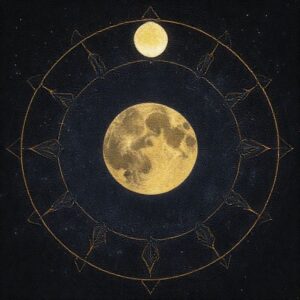
Scientifically, the New Moon occurs when the moon is positioned between the Earth and the Sun, with its illuminated side facing away from us. Astronomically, it is a precise alignment. Spiritually, however, it is so much more. Across cultures and spiritual traditions, darkness has never been merely the absence of light; it is the primal womb of creation.
-
The Fertile Void: Before a seed can sprout, it must rest in the dark, moist soil. Before a thought can form, it arises from the unconscious mind. The New Moon symbolizes this fertile void—the cosmic soil where all possibilities reside. It is the “no-thing” from which “every-thing” emerges.
-
Introspection and the Unconscious: Just as the moon itself is hidden from view, the New Moon invites us to explore the hidden realms of our own psyche. It is a time to delve into our dreams, our intuition, our fears, and our deepest desires—all aspects of ourselves that are not always visible in the bright light of day.
-
Rest and Receptivity: In a culture that glorifies constant doing and achieving, the New Moon sanctifies being. It is a celestial mandate to rest, to be receptive, and to allow ideas and inspirations to land within us, rather than aggressively chasing them.
This symbolic darkness is not something to be feared, but to be embraced as the source of all genuine creation.
3. A Cross-Cultural Tapestry: Historical Reverence for the New Moon
Humanity’s connection to the moon is ancient and profound. Long before electric lights, our ancestors lived by its rhythm, and the New Moon held a place of particular significance.
-
Ancient Mesopotamia: The Babylonians and Assyrians saw the New Moon (called Arhu) as a sacred time. The first sighting of the crescent moon after the dark period was a cause for celebration, marked by festivals and rest from labor. It was a time to make offerings to the gods and goddesses of the lunar pantheon, such as Sin (Nanna), to ensure favor and prosperity for the coming cycle.
-
Ancient Greece and Rome: In Greek tradition, the Noumenia was the festival of the New Moon, dedicated to all the gods but especially to Selene, the Titan goddess of the moon. It was a day for household purification, making offerings at home altars, and beginning new ventures. The Romans continued this tradition, with the Kalends (the first day of the month, originally tied to the New Moon) being a time for settling debts and seeking blessings from Juno and other deities.
-
Indigenous Traditions: Many Native American tribes tracked time by moons, not months. The New Moon was often seen as a time for renewal, vision quests, and community gatherings. Different tribes had unique names for each moon, reflecting the natural cycles of their environment—such as the “Wolf Moon” or “Strawberry Moon”—with the New Moon signaling the start of that new seasonal chapter.
-
Eastern Philosophies: In Hinduism, the New Moon (Amavasya) is considered a powerful time for honoring ancestors (Pitru Paksha) and performing rituals to appease their souls. It is also a potent day for spiritual practices, meditation, and letting go of negative karma. In Chinese tradition, the New Moon marks the beginning of each month in the lunar calendar and is central to festivals like the Chinese New Year, symbolizing family reunion and new beginnings.
This historical tapestry shows a universal understanding: the New Moon is a pivot point, a sacred moment of reset that has guided human spiritual and practical life for millennia.
4. The Spiritual Core: The New Moon as a Cosmic Reset Button
At its heart, the spiritual meaning of the New Moon can be distilled into a few core principles. It functions as a cosmic reset button, offering us a recurring opportunity to align with the natural rhythm of death and rebirth.
-
New Beginnings: Every 29.5 days, we are given a clean slate. The past cycle is complete; its lessons have been integrated or released. The New Moon is the unequivocal signal to start anew, to initiate projects, relationships, and habits that are in alignment with our highest good.
-
Intention Setting: This is the most widely recognized practice of the New Moon. An intention is not merely a goal; it is a seed of energy planted in the fertile soil of the unconscious. It is a statement of purpose and direction, infused with feeling. For example, a goal is “I want to lose 10 pounds.” An intention is “I intend to cultivate a loving and respectful relationship with my body, honoring it with nourishing food and joyful movement.” The New Moon provides the perfect energetic environment to plant these seeds.
-
Manifestation Engine: The lunar cycle is a perfect metaphor for the process of manifestation. It begins with the idea (New Moon), grows with effort and belief (Waxing Moon), culminates in a result (Full Moon), and then releases what is no longer needed (Waning Moon). The New Moon is the crucial first spark in this engine.
-
Deep Introspection: Before we can build anew, we must assess the foundation. The darkness of the New Moon provides the perfect cover for honest self-inquiry. It is a time to ask: What is no longer serving me? What patterns am I ready to release? What do I truly desire, beneath the surface-level wants?
5. The Phases of Inner Work: A Cyclical Approach to Growth
Understanding the New Moon is incomplete without seeing it as part of the larger lunar cycle. By aligning our inner work with the moon’s phases, we move with cosmic energy, not against it.
-
New Moon (Day 0-1): Seed. Set intentions, dream, plan, and go inward.
-
Waxing Crescent (Days 2-7): Sprout. Take the first, small actionable steps toward your intention. Build momentum.
-
First Quarter (Day 7-10): Action. Overcome obstacles, make decisions, and put in consistent effort.
-
Waxing Gibbous (Days 10-14): Refine. Fine-tune your approach, gather resources, and prepare for culmination.
-
Full Moon (Day 14-18): Bloom & Illuminate. Celebrate your progress, release what’s blocking you, and gain clarity. The results of your New Moon intention become visible.
-
Waning Gibbous (Days 18-22): Gratitude & Sharing. Disseminate what you’ve learned, express gratitude, and begin to let go.
-
Last Quarter (Days 22-25): Release. consciously release old habits, beliefs, and situations that no longer serve you.
-
Waning Crescent / Balsamic Moon (Days 25-29): Surrender & Rest. Let go completely, rest, and prepare for the next New Moon.
This cyclical approach transforms personal growth from a linear, often frustrating, struggle into a natural, flowing process.
6. Crafting Your Sacred Practice: A Guide to New Moon Rituals
A New Moon ritual is a conscious, dedicated act of aligning yourself with the energy of new beginnings. It need not be elaborate; its power lies in your focused intention. Here is a detailed framework you can adapt.
Step 1: Creating a Sacred Space
Begin by preparing your environment. This signals to your mind and spirit that you are entering a sacred container.
-
Cleanse: Smudge your space with sage, palo santo, or use sound from a singing bowl or bell to clear stagnant energy.
-
Gather Tools: You may want a journal and pen, a candle (white or black for new beginnings), crystals (like clear quartz for amplification or moonstone for intuition), and any other items that feel sacred to you.
-
Set the Mood: Dim the lights, play soft, instrumental music, and ensure you will not be disturbed.
Step 2: The Art of Going Inward – Meditation and Journaling
Sit comfortably, light your candle, and take several deep, cleansing breaths.
-
Meditate (10-15 minutes): Simply focus on your breath. You can visualize yourself sitting in the peaceful, dark night sky, cradled by the universe. Allow your mind to become still and receptive.
-
Journaling Prompts: After meditating, gently move to your journal. Ask yourself and write freely:
-
What energy am I ready to call into my life?
-
What is my heart truly longing for?
-
What would I love to create in the next 30 days? (Consider all areas: career, relationships, health, spirituality, creativity).
-
What is one limiting belief I am ready to release?
-
Step 3: The Power of Planting Seeds – Setting Intentions
From your journaling, distill your reflections into 1-3 clear, positive, and present-tense intentions.
-
Good Intention: “I am a magnet for abundant and joyful opportunities.”
-
Weak Intention: “I want more money.” (This is vague and future-oriented).
-
Good Intention: “I am embracing vibrant health and vitality with every choice I make.”
-
Weak Intention: “I need to stop eating junk food.” (This is framed negatively).
Write these intentions down on a fresh page in your journal. Speak them aloud into the space, infusing them with emotion.
Step 4: Embodying Your Intentions – Rituals and Actions
To root your intentions in the physical world, engage in a symbolic act.
-
Crystal Gridding: Place your written intentions under a clear quartz point and surround it with other supportive crystals.
-
Vision Board: Start a vision board for this lunar cycle, adding images and words that represent your intentions.
-
Anointing a Candle: Carve a symbol representing your intention into a candle and anoint it with oil, focusing on your desire as you do.
-
Take One Small Action: Before ending your ritual, commit to one tiny, tangible action you will take within 24 hours to bring your intention to life. If your intention is about creativity, that action could be buying a new sketchbook. If it’s about health, it could be a 10-minute walk.
Step 5: Release and Surrender – Trusting the Process
This is a critical, often overlooked step. Blow out your candle, symbolizing the release of your intentions to the universe. Trust that the seeds have been planted. Let go of the “how” and the “when.” Express gratitude for this new beginning and for the cycle that is about to unfold.
7. New Moon Manifestation: Weaving Your Dreams into Reality
Manifestation at the New Moon is a conscious co-creation with the universe. It moves beyond wishful thinking into the realm of embodied belief.
-
The Feeling is the Secret: The most powerful part of setting an intention is connecting to the feeling of it already being true. If your intention is “I am confident and articulate in my presentations,” close your eyes and vividly imagine yourself in the boardroom, feeling the confidence in your body, hearing your clear voice. Generate that emotion now. This emotional signature is the fuel that powers the manifestation.
-
Alignment: Your actions, thoughts, and beliefs must be in alignment with your intention. You cannot manifest financial abundance while constantly complaining about being broke. The New Moon is the time to consciously align your internal state with your desired outcome.
-
Inspired Action: The universe meets you halfway. After setting your intention, remain open to opportunities, ideas, and synchronicities that come your way. The action steps you take during the Waxing Moon are the physical component of manifestation.
8. Aligning with the Zodiac: Harnessing New Moon Energy by Astrological Sign
Each New Moon occurs in a specific zodiac sign, coloring its energy with the themes of that sign. Working with this astrological layer can add profound depth to your practice.
New Moon Energies by Zodiac Sign
| Zodiac Sign | Key Themes | Ideal Intentions & Rituals |
|---|---|---|
| Aries | New Beginnings, Courage, Action, Self | Starting projects, asserting yourself, personal goals. Ritual: A vigorous workout, planning a bold move. |
| Taurus | Security, Sensuality, Money, Values | Financial goals, self-worth, connecting with nature. Ritual: Gardening, budgeting, a luxurious bath. |
| Gemini | Communication, Learning, Connections | Writing, learning a new skill, social networking. Ritual: Starting a journal, a podcast, or a conversation course. |
| Cancer | Home, Family, Emotions, Nurturing | Home-related goals, family healing, self-care. Ritual: Cooking a nourishing meal, redecorating your space. |
| Leo | Creativity, Romance, Play, Self-Expression | Creative projects, dating, joy, hobbies. Ritual: Dancing, performing, buying something that brings you joy. |
| Virgo | Health, Routine, Service, Organization | Health regimens, organizing your life, helpful tasks. Ritual: Creating a workout plan, cleaning your closet. |
| Libra | Partnership, Beauty, Balance, Harmony | Relationship goals, creating beauty, finding balance. Ritual: A partnership agreement, art-making, mediation. |
| Scorpio | Transformation, Intimacy, Shared Resources | Releasing the past, deep emotional healing, intimacy. Ritual: Shadow work, therapy, sexual healing. |
| Sagittarius | Adventure, Expansion, Philosophy, Travel | Travel plans, higher education, publishing. Ritual: Planning a trip, enrolling in a course, studying philosophy. |
| Capricorn | Career, Ambition, Structure, Long-Term Goals | Career advancement, public reputation, long-term plans. Ritual: Updating your resume, 5-year planning. |
| Aquarius | Community, Innovation, Friendships, Humanity | Group projects, humanitarian efforts, social circles. Ritual: Attending a community meeting, brainstorming with friends. |
| Pisces | Spirituality, Dreams, Intuition, Compassion | Meditation practice, creative writing, spiritual connection. Ritual: Dream journaling, meditation, compassionate service. |
9. The Shadow Self: New Moon Work for Inner Healing
The darkness of the New Moon is the ideal time to compassionately confront your “shadow self”—the parts of you that you have repressed, denied, or deemed unacceptable. This is not about self-punishment; it is about integration and wholeness.
-
Acknowledgment: In the quiet of your New Moon meditation, ask: What part of me have I been unwilling to see? What emotion (anger, jealousy, fear) am I suppressing?
-
Compassionate Inquiry: Instead of judging these aspects, get curious. “Why is this jealousy here? What need is it pointing to? What is this anger protecting?”
-
Integration: Acknowledge that this shadow aspect is a part of you, and thank it for the role it has played in protecting you. Then, you can set an intention to integrate its energy in a healthy way. For example, the energy of repressed anger can be integrated as healthy boundaries.
10. Building a Consistent Practice: Weaving the Lunar Cycle into Your Life
You don’t need to perform an elaborate ritual every single month. Consistency is more important than perfection.
-
Lunar Journal: Dedicate a journal solely to tracking the moon cycles. Note the sign of each New and Full Moon, your intentions, your reflections, and any synchronicities.
-
Digital Reminders: Set a calendar reminder for the day of the New Moon. Even if you only have 10 minutes, use them to sit quietly and state an intention.
-
Moon App: Use a moon phase app to keep the cycle at the forefront of your awareness.
-
Community: Find a friend or group to share your New Moon intentions with. This creates accountability and shared energy.
11. Conclusion: Your Journey with the Dark Moon
The New Moon is a timeless, monthly invitation to co-create your reality.
It is the sacred dark canvas upon which you can paint the dreams of your soul.
By embracing its quiet power, you align with the universe’s natural rhythm of rebirth and endless possibility.
12. Frequently Asked Questions (FAQs)
Q1: How long after the New Moon can I set my intentions?
A: The most potent window is the first 48 hours after the exact moment of the New Moon. However, the entire “dark moon” period (the day before, of, and after) is considered highly effective. It’s better to do it a day late than not at all.
Q2: What if I don’t know what my intentions should be?
A: That’s a common and perfectly okay place to be. Your intention can be as simple as “I intend to be open to receiving clarity this cycle.” Use your ritual time for meditation and journaling with the specific question, “What does my soul need to focus on now?” The answer will emerge.
Q3: Can I do a New Moon ritual with others?
A: Absolutely. Gathering with like-minded people can amplify the energy beautifully. You can create a circle where each person shares their intentions, meditates together, or performs a group ritual.
Q4: I’m not spiritual/religious. Can I still benefit from this?
A: Yes. At its core, this is a practice of mindfulness, goal-setting, and aligning with natural cycles. Framing it as a monthly check-in with yourself, a time for planning and reflection, is just as valid and effective.
Q5: What’s the difference between an intention and an affirmation?
A: An intention is a seed you plant for the future—a direction you want to move in (e.g., “I intend to cultivate peace”). An affirmation is a statement you use to reinforce a belief in the present (e.g., “I am peaceful”). They work beautifully together. You set an intention at the New Moon, and then use related affirmations throughout the Waxing Moon to build the belief.
13. Additional Resources
-
Books:
-
Moonology: Working with the Magic of Lunar Cycles by Yasmin Boland
-
The Moon Book by Sarah Faith Gottesdiener
-
New Moon Astrology by Jan Spiller
-
-
Apps:
-
The Moon: Lunar Calendar & Phases
-
Time Passages (for astrological details)
-
Moonly (for rituals and reminders)
-
-
Websites:
-
Astrology.com: For forecasts and New Moon guides by sign.
-
Cafe Astrology: For in-depth astrological explanations of each New Moon.
-