What is it about the Joker that captivates us so intensely? Is it the maniacal laughter that sends shivers down our spine, the garish smile painted over a visage of profound pain, or the unsettling wisdom hidden within his chaotic acts? To dismiss the Joker as merely a comic book villain or a playing card is to miss the depth of one of the most potent and ancient spiritual archetypes known to humanity. The Joker is the Sacred Fool, the Divine Trickster, the Cosmic Jester—a multifaceted symbol that has danced on the fringes of consciousness, religion, and mythology for millennia. He is the embodiment of the unpredictable, the challenger of the established order, and the liberator of the repressed self.
This figure, in its many guises, serves a crucial spiritual function: to shatter our illusions, confront us with our shadow, and force us to question the very foundations of our reality. In a world often governed by rigid rules, societal expectations, and a desperate clinging to control, the Joker represents the wild, untamed spirit of freedom that resides within us all. He is the part of us that knows life is not a problem to be solved, but a mystery to be lived—a paradoxical game where the only way to win is sometimes to laugh at the absurdity of it all. This article is a deep dive into the labyrinth of this archetype. We will traverse the sacred landscapes of the Tarot, unpack the myths of trickster gods from across the globe, stare boldly into the abyss of our own shadow, and ultimately discover how embracing the spirit of the Joker can lead to a more authentic, liberated, and enlightened existence. Prepare to have your perceptions challenged, your comfort zone expanded, and your spirit awakened by the eternal echo of the Joker’s laugh.
Chapter 1: The Joker in the Tarot – The Fool’s Journey Begins
To understand the spiritual core of the Joker, one must begin with his most direct representation: The Fool in the Tarot. Card number 0, The Fool is the beginning and the end, the void of pure potential from which all other archetypes emerge. He is the quintessential Joker figure, and his imagery is a rich tapestry of spiritual symbolism.
The Symbolism of The Fool Card:
A typical depiction shows a young man, carefree and bright-eyed, standing at the edge of a cliff. He carries a small bundle of possessions on a staff slung over his shoulder, representing the experiences and lessons he has gathered—but they are few, for he travels light. In his other hand, he holds a white rose, symbolizing purity, innocence, and the beauty of the present moment. He is not looking at the cliff before him but upward, toward the sky, filled with faith and optimism. At his heels, a small dog barks, either in warning or as a faithful companion, representing the instincts and the remnants of the “real world” that nip at his heels.
This image is a masterclass in the Joker’s spiritual meaning:
-
The Number Zero (0): The Fool is unnumbered or given the zero, representing infinite potential, the void, the unmanifested. He is not yet defined by the duality and structure of the other cards. He is the cosmic joke itself—the nothingness from which everything springs.
-
The Precipice: The cliff edge symbolizes the leap of faith required in any spiritual journey. The Fool does not see life as a linear, safe path. He understands that true growth often requires stepping into the unknown, trusting that the universe will support him. This is the essence of the Joker’s chaos—it is not destructive for its own sake, but to create openings for new possibilities.
-
The Bundle (The Satchel): His few possessions signify that spiritual progress is not about accumulation but about release. The Joker archetype teaches us to let go of attachments—to identities, beliefs, and material security—that weigh us down. He travels light because he is free.
-
The White Rose: This signifies the purity of the Fool’s heart. His actions are not born of malice but of a naive, almost divine, trust in the process of life. The Joker’s laughter, at its highest vibration, is this pure, untainted joy, not the cynical cackle of the corrupted trickster.
The Fool’s Journey and Our Own:
In the narrative of the Tarot, The Fool embarks on a journey through all the other Major Arcana cards, meeting The Magician, The High Priestess, The Emperor, and so on, all the way to The World. This is the hero’s journey, the soul’s path toward integration and wholeness. The Fool is us at the start of this journey: open, naive, and full of potential. The Joker archetype, therefore, is not a state of being to be achieved and then discarded; it is the foundational energy of beginnings, the eternal childlike spirit that must be carried throughout the entire journey. It is the part of us that is always willing to start anew, to laugh at our mistakes, and to see every ending as a new beginning.
When The Fool appears in a reading, it is a powerful invitation from the universe to embrace the Joker within. It calls for a leap of faith, to trust in the process, and to approach life with a sense of wonder and adventure. It warns against excessive planning and control, reminding us that the most magical experiences often come from the unplanned, the spontaneous, and the “foolish.”
Chapter 2: The Archetypal Trickster – Divine Chaos in World Mythology
The Joker is not an invention of modern comics; he is a primordial archetype that appears in the mythologies of virtually every culture on Earth. Psychologist Carl Jung identified the “Trickster” as a fundamental archetype residing in the collective unconscious—a figure who breaks rules, plays pranks, and disrupts the established order, but in doing so, often brings about necessary change, new knowledge, and cultural transformation.
These divine troublemakers serve a crucial spiritual purpose: they are agents of sacred chaos. They disrupt stagnation and complacency, forcing gods and humans alike to adapt, evolve, and see the world from a new perspective. Let’s explore some of the most prominent trickster gods and their Joker-like qualities.
The Trickster Gods: A Cross-Cultural Pantheon of the Joker Archetype
| Trickster Figure | Culture/Mythology | Key Attributes & Spiritual Lesson |
|---|---|---|
| Loki | Norse Mythology | The shape-shifter, the boundary-crosser. Loki’s deceptions and chaotic schemes often lead to short-term trouble but long-term evolution (e.g., the creation of Thor’s hammer). He represents the ambiguous nature of chaos—both creative and destructive. |
| Coyote | Native American Traditions | The bungling yet clever creator and fool. Coyote stories often teach moral lessons through his failures and antics. He symbolizes the connection between folly and wisdom, showing that even mistakes are part of the Great Spirit’s plan. |
| Anansi | West African & Caribbean (Akan) | The spider god of stories and wisdom. Anansi uses his cunning and wit to outsmart stronger opponents, securing stories for humanity. He represents the power of intellect over brute force and the idea that narrative itself is a transformative, trickster-like power. |
| Eshu/Elegua | Yoruba (Santería, Ifá) | The messenger god of the crossroads. Eshu is a trickster who controls communication, chance, and opportunity. He must be appeased first in rituals, as he can open or block the path. He teaches that every beginning contains an element of the unpredictable. |
| Hermes | Greek Mythology | The messenger of the gods, guide of souls (Psychopomp), and god of thieves, commerce, and boundaries. Hermes’ quick wit and invention of the lyre show the trickster’s link to creativity and cleverness. He facilitates transitions, moving freely between the worlds of gods and mortals. |
| Krishna | Hinduism | The divine prankster. As a child, Krishna’s playful theft of butter and his mischievous flute-playing are celebrated as expressions of divine lila (play). He represents the truth that the cosmos is a playful, joyful expression of the Divine, not a stern, rigid system. |
The Common Thread: Disruption as a Catalyst for Growth
Across these diverse cultures, a consistent pattern emerges. The trickster:
-
Violates Norms: They break taboos, mock authority, and behave in socially unacceptable ways. Spiritually, this represents the need to question dogma and rigid belief systems that confine the soul.
-
Brings Forth Hidden Knowledge: Through their antics, they often accidentally (or intentionally) bring something vital into the world—fire, stories, a new tool, or a profound truth. The chaos they create is a crucible for innovation.
-
Embodies Paradox: They are both sacred and profane, creator and destroyer, wise and foolish. This reflects the paradoxical nature of reality itself, which cannot be neatly categorized by the rational mind. The Joker archetype forces us to hold these opposites within ourselves.
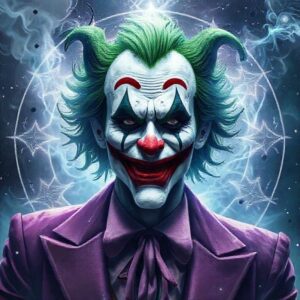
The modern Joker, from the Batman universe, is a dark, secularized reflection of these ancient gods. He is a trickster stripped of his divine context, operating in a world that has forgotten the sacred purpose of chaos, making him appear purely psychopathic. Yet, his core function remains: to expose the hypocrisy and fragile order of society (Gotham), forcing the “god” of that order (Batman) to continually evolve.
Chapter 3: The Shadow Self Unveiled – The Joker as Mirror and Liberator
Perhaps the most challenging and transformative aspect of the Joker archetype is its intimate relationship with the Shadow Self, a concept central to Jungian psychology. The Shadow is the part of our personality that we repress, deny, or ignore—our hidden desires, traumas, rage, jealousy, and all that we deem “unacceptable” to ourselves and society.
The Joker is the ultimate embodiment of the unintegrated Shadow. He acts out what the rest of us are too afraid to even acknowledge we feel. His maniacal laughter is the sound of repressed pain and rage erupting into consciousness. His chaotic violence is the physical manifestation of the inner turmoil we keep locked away. When we encounter the Joker, whether in a movie, a dream, or our imagination, he holds up a dark mirror, forcing us to confront the question: What part of me is like him?
The Spiritual Function of the Shadow:
The goal of spiritual work is not to eliminate the shadow but to integrate it. The energy we use to repress our dark side is immense, and its release through integration can be a source of tremendous creativity, vitality, and personal power. The Joker, as a shadow figure, performs this function on a cultural and personal level:
-
He Exposes Collective Hypocrisy: The Joker famously tells Harvey Dent, “You see, madness, as you know, is like gravity. All it takes is a little push.” He demonstrates how thin the veneer of civilization is, revealing the latent chaos and selfishness that lurks beneath the surface of “polite society.” Spiritually, this pushes us to acknowledge our own complicity in societal illusions and to cultivate genuine virtue, not just socially conditioned behavior.
-
He Forces Authenticity: By embodying the ultimate rejection of social masks, the Joker challenges us to ask: Who am I when I strip away my job title, my social roles, and my desire to be liked? The terror he inspires is, in part, the terror of our own potential for authenticity—an authenticity that might be messy, unconventional, and disruptive.
-
He is the Wounded Healer: Many interpretations of the Joker, especially in film, root his psychosis in profound trauma (“You wanna know how I got these scars?”). He is a symbol of the unhealed wound. Spiritually, he reminds us that our own shadow is often born from pain. To integrate it, we must approach our own wounds with compassion, not further repression. The Joker is what happens when the pain is never addressed, only weaponized.
Practical Shadow Work with the Joker Archetype:
Engaging with this archetype for healing, rather than fear, involves conscious reflection.
-
Identify the Trigger: What about the Joker disturbs or fascinates you the most? Is it his freedom from consequence? His lack of empathy? His chaotic humor? The traits that evoke the strongest reaction in you are likely pointing to a disowned part of your own shadow.
-
Dialog with the Joker: In a journaling exercise, imagine a conversation with your inner Joker. Ask him: What are you trying to show me? What part of me have I locked away that you represent? What freedom are you demanding? This can unveil profound insights about repressed desires for freedom, unexpressed anger, or a neglected sense of play.
-
Find Healthy Outlets: The integrated shadow energy of the Joker can be channeled into healthy rebellion (e.g., challenging unfair norms), creative expression (art, music, writing that pushes boundaries), and the courage to be authentically, unapologetically yourself in a world that often demands conformity.
The Joker is not a role model, but a stark warning and a powerful guide. He shows us the abyss of unintegrated shadow, and in doing so, illuminates the path toward wholeness. To deny the Joker within is to give him power over you; to acknowledge and understand him is to reclaim that power as your own.
Chapter 4: The Cosmic Jester – Laughter as a Spiritual Practice
If the Joker’s shadow aspect is his madness, then his highest spiritual expression is his laughter. This is not the laughter of cruelty or derision, but the Cosmic Laughter that arises from the direct perception of life’s ultimate absurdity. The Cosmic Jester is the one who sees the grand joke of existence—the paradox that we are infinite consciousness trapped in finite bodies, seeking meaning in a universe that may be inherently meaningless, and playing serious games with rules we made up ourselves.
This perspective is found at the heart of many spiritual traditions. In Zen Buddhism, the laughter of the enlightened master erupts upon realizing the futility of the seeking mind. In Hindu philosophy, the entire cosmos is seen as lila—the divine play of Brahman. The universe is not a grim, serious business but a spontaneous, joyful expression of the Absolute.
The Spiritual Power of Laughter:
-
The Great Relativizer: Laughter instantly shatters the illusion of self-importance. When we can genuinely laugh at our own failures, anxieties, and dramas, we loosen the ego’s tyrannical grip. The Joker’s laugh, in its pure form, is a weapon against the ego. It says, “You are not as important as you think you are, and that is the most liberating truth of all.”
-
A Portal to the Present Moment: Like the Tarot’s Fool, genuine laughter pulls us completely into the here and now. It is an involuntary reaction that bypasses the analytical mind. In this state, we touch a dimension of being that is free from past regrets and future anxieties—a state of pure, childlike presence.
-
Acceptance of Paradox: The highest wisdom often resides in the ability to hold two contradictory truths simultaneously. Life is both beautiful and terrible, meaningful and meaningless, sacred and profane. The Cosmic Jester doesn’t try to resolve this tension; he laughs with it. This laughter is the sound of acceptance, a profound “yes” to all of existence, exactly as it is.
Distinguishing the Laughs:
It is crucial to differentiate the vibrations of the Joker’s laughter:
-
Cynical Laughter: This is the laughter of the wounded Joker, the one who has seen the absurdity but has become bitter and nihilistic. It mocks and destroys but offers nothing in return. This is laughter as a weapon.
-
Cosmic Laughter: This is the laughter of the enlightened Jester. It arises from a heart that has fully embraced the absurdity and found not nihilism, but boundless joy and freedom within it. It laughs with existence, not at it. This is laughter as liberation.
To cultivate the spirit of the Cosmic Jester is to practice not taking yourself—or life—so seriously. It is to find the humor in your spiritual seeking, to laugh when you fall off the meditation cushion, and to hold your deeply held beliefs lightly. It is to understand that enlightenment is not a somber, stone-faced state, but a condition of perpetual, joyful wonder at the magnificent, ridiculous, and utterly inexplicable joke of being alive.
Chapter 5: The Agent of Chaos – Destroyer of Illusion and Status Quo
Chaos is often feared as the antithesis of spirit, which is commonly associated with order, peace, and harmony. However, the Joker archetype presents a more nuanced spiritual truth: Chaos is the womb of creation and the necessary fire of transformation. As an Agent of Chaos, the Joker’s spiritual role is to tear down rigid, outmoded structures—both internal and external—to make way for the new.
In the natural world, ecosystems require periodic fires to clear deadwood and allow for new growth. In the psyche, we require similar disruptive forces to break us out of our ruts, complacencies, and limiting beliefs. The Joker is that spiritual wildfire.
The Spiritual Necessity of Deconstruction:
-
Shattering the Ego’s Fortress: The ego constructs a stable identity based on past experiences, social conditioning, and a network of beliefs. This identity provides a sense of security but also walls us off from our true, fluid nature. The Joker archetype, when it activates in our lives (often through unexpected crises, losses, or disruptions), serves to blow up this fortress. While terrifying, this deconstruction is a sacred process. It forces us to find an identity that is not based on external forms but on the formless awareness within.
-
Challenging Dogma and Rigid Beliefs: Every spiritual tradition risks becoming dogmatic over time, mistaking the finger pointing at the moon for the moon itself. The Joker is the force that comes along and chops off the finger, forcing seekers to look directly at the truth, unmediated by tradition. He is the heretic, the skeptic, the revolutionary mystic who values direct experience over inherited doctrine.
-
The Catalyst for Evolution: On a societal level, the Joker exposes the “order” of society as often being a mask for control, injustice, and hypocrisy. His chaos reveals the cracks in the system, creating the tension necessary for social evolution and, eventually, a higher, more authentic order. He is the uncomfortable but essential catalyst for collective growth.
Navigating Personal and Collective Chaos:
When the Joker energy erupts in your life—as a sudden job loss, a relationship ending, a health crisis, or a period of profound disorientation—the spiritual response is not to panic and desperately try to restore the old order. Instead, it is an invitation to:
-
Surrender Control: Practice trusting the process, even when you cannot see the outcome. This is the Fool’s leap of faith.
-
Ask “What is being asked to die?”: Identify what attachments, identities, or beliefs are being dismantled.
-
Look for the New Potential: In the space cleared by chaos, what new possibilities are emerging? What parts of your authentic self, previously suppressed by the old structure, now have room to grow?
The Joker teaches that security is an illusion. True spiritual resilience comes not from building stronger walls against chaos, but from learning to dance within it, to find our center in the eye of the storm, and to recognize the destructive-creative power of chaos as an intrinsic aspect of the Divine itself.
Chapter 6: The Madness of Truth – Prophet, Psychopomp, and Philosopher
In many traditions, the line between madness and enlightenment is notoriously thin. The fool, the jester, and the “village idiot” were often thought to be touched by God, possessing a wisdom that bypassed conventional logic and spoke a deeper, more unsettling truth. The Joker archetype occupies this liminal space—he is the mad prophet whose insanity is a direct conduit to revelations that the sane mind cannot bear to confront.
The Joker as Prophet:
Prophets are not fortune-tellers; they are truth-tellers. They see through the lies of their culture and speak uncomfortable truths that those in power wish to ignore. The Joker performs this function perfectly. His famous monologues, such as the “society’s plan” speech in The Dark Knight, are not the ravings of a mere lunatic; they are brutal, prophetic critiques of modern civilization. He exposes the fact that without social contracts and the threat of punishment, many people’s morality would crumble. This is a terrifying spiritual truth about the nature of the unawakened ego. The prophet-Joker holds up a mirror to our collective face and shows us the monster we are capable of becoming, forcing a necessary crisis of conscience.
The Joker as Psychopomp:
A psychopomp (from the Greek for “guide of souls”) is a figure who leads the dead to the afterlife. In a psychological and spiritual sense, the Joker acts as a psychopomp who guides parts of our psyche through death and rebirth. He presides over the dissolution of the ego. His chaotic energy “kills” our old, limited self, our outdated stories, and our naive innocence. He is the gatekeeper at the threshold of major transformation. To encounter him is to be initiated into a darker, more complex, but ultimately more real understanding of oneself and the world. He guides us through the underworld of our own shadow so that we can return to the surface, reborn and integrated.
The Joker as Existential Philosopher:
At his core, the Joker is grappling with the same fundamental questions that have preoccupied existentialists and mystics for centuries: What is the meaning of life in an indifferent universe? What is the nature of identity? Is there any inherent order, or is it all a chaotic joke?
-
Nihilism vs. Absurdism: The Joker is often interpreted as a nihilist, believing in nothing and having no purpose. However, a closer look reveals him to be closer to an absurdist, in the tradition of Albert Camus. Absurdism acknowledges the conflict between the human desire for meaning and the universe’s silent indifference. The Joker doesn’t just succumb to this; he revels in it. His response to the absurdity is not suicide (as Camus ruled out) but rebellion and freedom. He creates his own meaning through chaos and the assertion of his own radical freedom, even if that meaning is, to others, meaningless. This is a stark, dark reflection of the spiritual seeker’s journey to find personal meaning in a cosmos that offers no easy answers.
The “madness” of the Joker, therefore, is a madness born from staring too long into the abyss of these unanswerable questions. While his response is destructive, it serves a spiritual function for the rest of us: it forces us to confront these questions for ourselves and to find our own, more life-affirming answers. He is the cautionary tale and the extreme example against which we can define our own path toward meaning.
Chapter 7: The Modern Joker – From Comic Book Villain to Cultural Shadow
The contemporary image of the Joker, popularized by DC Comics and blockbuster films, is a fascinating case study of how an ancient archetype manifests in a modern, secular context. Stripped of his divine context as a trickster god, the modern Joker becomes a purely psychological and sociological phenomenon—a dark reflection of our collective anxieties.
Evolution of a Cultural Icon:
-
The Clown Prince of Crime (Comics): Initially a gimmicky villain, the Joker evolved over decades into Batman’s moral and philosophical opposite. Where Batman represents order, control, and trauma channeled into a rigid code, the Joker represents chaos, freedom, and trauma unleashed as anarchy. Their eternal struggle is the internal battle of the human psyche played out on a grand, mythological scale.
-
The Anti-Hero (Film): Portrayals by actors like Jack Nicholson, Heath Ledger, and Joaquin Phoenix have deepened the character’s complexity. Heath Ledger’s Joker, in particular, is a pure agent of chaos and a dark prophet who wants to prove that everyone is as corruptible as he is. Joaquin Phoenix’s Arthur Fleck shows us the origin of the Joker—the abused, neglected, and mentally ill individual who is crushed by an indifferent society until he breaks and his shadow erupts in full force. This version makes him a sympathetic, albeit terrifying, figure—a victim of the very world his Joker persona seeks to destroy.
The Joker as a Symptom of Cultural Sickness:
The immense popularity and fascination with the Joker in the 21st century is not accidental. He is the embodiment of our Cultural Shadow.
-
He represents our repressed rage: In a world of political correctness, economic pressure, and social media performance, the Joker acts out the rage and frustration we all feel but are forced to suppress.
-
He mirrors our alienation: Arthur Fleck’s profound loneliness and cry of “I just don’t want to feel so bad anymore” resonates in an age of increasing isolation and mental health crises.
-
He challenges our fake positivity: The Joker’s grotesque, honest pain is a brutal antidote to the culture of “good vibes only.” He is the truth that we are not always okay, and that sometimes, the world is a cruel and unfair place.
Engaging with the modern Joker is a form of collective shadow work. He is a dark mirror held up to our society, showing us the consequences of neglect, inequality, and the suppression of authentic human emotion. He is a warning of what happens when the sacred trickster is denied his role and is driven into the darkest corners of the psyche, only to re-emerge as a monster.
Chapter 8: Inviting the Joker In – Practical Integration for Spiritual Growth
After exploring the dark and light aspects of this archetype, the crucial question remains: How do we consciously work with the Joker energy for our spiritual benefit, without being consumed by it? Integration, not possession, is the key. Here are practical ways to invite the wisdom of the Sacred Fool into your life.
1. Embrace Holy Foolishness:
-
Do something “foolish” once a week: This could be dancing in the rain, singing loudly in your car, wearing mismatched socks, or talking to a stranger. The goal is to consciously break a small, meaningless social rule to remind yourself that your worth is not dependent on others’ approval.
-
Practice beginner’s mind: In meditation or any daily activity, approach it as if for the first time. Let go of your expertise and see the world with the fresh, curious eyes of The Fool.
2. Work with Laughter as Meditation:
-
Laughter Yoga: Engage in a laughter yoga practice, either in a group or alone. The body does not know the difference between real and simulated laughter; the physiological and psychological benefits are the same.
-
Find the humor in your drama: When you find yourself in a stressful situation, ask yourself: “How will I look back on this in a year? Is there something absurd about this?” This simple shift in perspective can instantly dissolve anxiety.
3. Engage in Conscious Shadow Work:
-
Journaling Prompt: “If I had zero consequences for one day, what would I do?” Do not censor your answers. This list will reveal shadow desires. The next step is to find healthy, symbolic ways to express these energies. (e.g., a desire for chaos might be channeled into a spontaneous road trip; a desire to break rules could be expressed through innovative problem-solving at work).
-
Artistic Expression: Draw, paint, or write from the perspective of your inner Joker. Let him have a voice on the page. This is a safe container to express this energy without acting it out destructively.
4. Cultivate Healthy Rebellion:
-
Question Authority (Including Spiritual Authority): Don’t follow a guru, a doctrine, or a spiritual practice blindly. The Joker demands that you find your own truth. Ask tough questions. If an teaching doesn’t resonate with your direct experience, set it aside.
-
Challenge a Personal “Rule”: Identify one “should” or “must” that you live by that feels constricting. (e.g., “I must always be productive”). Consciously break it for a day and observe the feelings that arise.
5. Practice Non-Attachment to Outcomes:
-
The Fool’s Leap: Before starting a new project, set your intention but then release your attachment to exactly how it should unfold. Say to yourself, “I will take the first step with faith, and trust that the path will reveal itself.” This embodies the Joker’s trust in chaos and spontaneity.
By integrating the Joker in these ways, you harness his power for freedom, authenticity, and transformation without falling into nihilism or chaos for its own sake. You become a balanced, whole individual who can dance with chaos while remaining centered, who can laugh at the darkness while working to bring in the light.
Conclusion: The Eternal Echo of the Laugh
The Joker is the eternal symbol of the unpredictable spark of spirit that defies all systems and definitions. He is the Shadow that demands integration, the Fool who beckons us to the precipice of growth, and the Cosmic Jester whose laughter liberates us from the tyranny of the ego. To embrace this archetype is to accept the beautiful, terrifying, and absurd mystery of existence itself, and to find the ultimate freedom in choosing how we play our part in the divine, chaotic game of life.
Frequently Asked Questions (FAQs)
Q1: Is the Joker archetype inherently evil?
A: No, the archetype itself is neutral, a natural force like fire or wind. It is amoral, not immoral. Its expression depends on the consciousness of the individual or culture channeling it. In its healthy form, it is the spirit of innovation, freedom, and joy. In its wounded form, repressed and twisted, it manifests as nihilism and destructive chaos.
Q2: How is the Joker different from The Devil in the Tarot?
A: The Devil represents bondage, addiction, materialism, and the shadow we are enslaved by. It is about being trapped in illusion. The Joker (The Fool), in contrast, is about absolute freedom from all bonds. He is the energy that can liberate you from the Devil’s chains by showing you that the chains are an illusion to begin with.
Q3: I’m scared of the Joker character. What does this mean?
A: This is a healthy and common response. It likely means you are sensing the unintegrated shadow energy within yourself. The fear is a signal that a part of you recognizes its own potential for chaos, rage, or freedom, and is terrified of it. This is a perfect starting point for shadow work.
Q4: Can embracing the Joker lead to mental instability?
A: Consciously integrating an archetype is a process of bringing light to darkness, which leads to greater stability and wholeness. However, identifying with the archetype (“I am the Joker”) can be dangerous, as it can lead to inflation and a loss of grounding. The goal is to dialogue with and learn from the Joker, not to become him.
Q5: What is the positive message behind the Joker’s chaos?
A: The positive message is that our carefully constructed realities—our identities, our plans, our societies—are transient and ultimately not in our full control. Embracing this truth, rather than fighting it, leads to a life of greater spontaneity, resilience, and freedom. It encourages us to find security within ourselves, not in external circumstances.