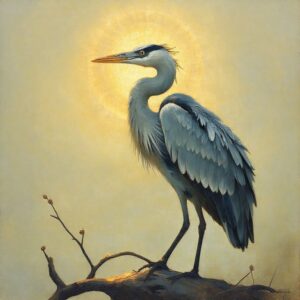
The heron stands in the liminal space between water and land, a statuesque sentinel of the marshes. Its long, graceful legs are rooted in the murky depths, while its gaze is fixed on the horizon, a picture of profound patience and poised potential. For millennia, this enigmatic bird has captured the human imagination, not merely as a creature of the wild but as a powerful spiritual emblem. Its sudden, decisive strike into the water is a lesson in timing; its solitary nature, a testament to self-reliance; and its ability to navigate different elements, a symbol of mystical versatility. To encounter a heron is to receive an invitation—a call to delve deeper into the waters of our own soul and to stand with unwavering focus on the path of our personal truth.
This article embarks on an extensive exploration of the heron’s spiritual significance. We will wade through the rich symbolism attributed to this bird across diverse cultures and spiritual traditions, from the ancient Egyptians and Celts to Eastern philosophies and Native American beliefs. We will dissect the core spiritual themes it represents, such as patience, stillness, self-determination, and boundary-crossing. Furthermore, we will provide a practical guide to interpreting heron encounters in your daily life, dreams, and spiritual practices. By the end of this journey, you will understand why the heron is not just a bird, but a profound spiritual teacher, guiding us toward a life of deeper meaning, purposeful action, and tranquil self-assurance.
The Heron in World Mythology and Cultural Symbolism
To fully grasp the spiritual weight of the heron, one must journey back through time and across continents, observing how various cultures have perceived and honored this majestic bird. Its universal appeal suggests that its lessons are fundamental to the human experience.
Ancient Egypt: The Bird of Creation and the Benu
In the rich cosmological tapestry of Ancient Egypt, the heron—specifically the Grey Heron or the similar-looking Sacred Ibis—is widely believed to be the inspiration for the Benu bird. The Benu was a divine, self-created being intimately linked to the sun god Ra, the cycles of time, and the very act of creation.
According to myth, the Benu burst into existence from a fiery heart at the top of the primordial mound, the first land to emerge from the waters of Nun (chaos). Its cry was said to have determined the destinies of all things. The Benu was thus the ba (soul) of Ra and a precursor to the Greek Phoenix, symbolizing resurrection and renewal. It was associated with the annual flooding of the Nile, which brought fertile silt and new life to the land, a direct parallel to the heron’s habitat in the life-giving marshes.
Spiritual Significance: The heron, as the Benu, embodies:
-
New Beginnings and Creation: It signals the moment of inception, the spark of an idea, or the start of a new cycle in one’s life.
-
Rebirth and Resurrection: It teaches that from stillness and apparent emptiness (the waters of Nun), new life and opportunities can erupt.
-
The Primordial Self: It represents the original, divine spark within each individual, the core of one’s authentic identity and purpose.
Celtic Lore: The Guardian of Mysteries and Hidden Knowledge
The Celts viewed the natural world as imbued with spirit and magic, and animals were seen as messengers from the Otherworld. The heron, or Corr in Gaelic, was a creature of profound mystery. It was often associated with the Celtic underworld, Annwn, and was considered a guide for souls transitioning between worlds. Its haunting cry was thought to carry secrets from beyond the veil.
In some tales, the heron was linked to druids and shamans, acting as a familiar that could traverse the boundaries of the seen and unseen. Its diet of fish, creatures hidden beneath the water’s surface, symbolized its ability to draw up hidden knowledge and subconscious truths. To harm a heron was believed to bring immense bad luck, a testament to the reverence in which it was held.
Spiritual Significance: In the Celtic tradition, the heron is a symbol of:
-
Thresholds and Transitions: It is a guide during times of change, death, and rebirth, both literal and metaphorical.
-
Secret Wisdom and Divination: It encourages the development of intuition and the ability to see beyond the obvious.
-
The Mysterious and Magical: It calls us to embrace the unknown and trust in the wisdom that comes from the unseen realms.
Native American Traditions: A Symbol of Wisdom, Patience, and Good Judgment
Across many Native American tribes, the heron is universally respected as a symbol of wisdom, patience, and good judgment. Its hunting technique—standing motionless for long periods before striking with lightning speed—was seen as the ultimate lesson in patience and timing. Different tribes have specific legends and associations.
For some Northwestern tribes, the Great Blue Heron is a creator figure in some stories. For others, like the Cherokee, the heron is associated with rain and water magic. The Iroquois tell a story of a heron who saved humanity from a great serpent, positioning it as a protective, benevolent force. Its ability to walk gracefully in shallow water without disturbing the bottom symbolized moving through life with tact and awareness, without stirring up unnecessary drama or conflict.
Spiritual Significance: For Native Americans, the heron teaches:
-
Tact and Diplomacy: The importance of moving through social and personal situations with grace and awareness.
-
Patient Vigilance: The wisdom of waiting for the right moment to act, rather than forcing outcomes.
-
Inner Stillness as a Source of Power: True strength is found not in constant action, but in calm, focused presence.
Eastern Philosophies (China and Japan): Longevity, Purity, and the Path of the Sage
In both Chinese and Japanese cultures, herons and their close relatives, the cranes, are potent symbols of longevity, good fortune, and purity. Their white plumage evokes cleanliness and elegance, while their long lifespan makes them natural emblems of long life and happiness.
In Chinese art, a heron often represents a path that leads to success and prosperity. It is sometimes depicted alongside lotus flowers, symbolizing purity and enlightenment emerging from muddy waters—a powerful spiritual metaphor. In Japanese culture, the heron (sagi) is admired for its beauty and grace. It is seen as a bird of the dawn, representing new beginnings and the promise of a new day. Its solitary nature is also associated with the archetype of the sage or recluse, who finds wisdom not in the bustling crowd but in quiet contemplation of nature.
Spiritual Significance: In Eastern thought, the heron embodies:
-
Elegance and Purity of Purpose: Maintaining one’s integrity and focus in a complex world.
-
A Prosperous and Long Life: Both in the physical and spiritual sense, suggesting a journey of enduring significance.
-
The Reclusive Sage: The value of solitude for gaining deeper insight and self-knowledge.
Greco-Roman and Christian Contexts: Curiosity, Asceticism, and Vigilance
In Greco-Roman mythology, the heron was sometimes associated with Athena, the goddess of wisdom, though its symbolism was more nuanced. Due to its inquisitive nature, it was also linked to curiosity. In Christian symbolism in Europe, the heron took on a dual meaning. Its solitary and fasting-like hunting style led to its association with asceticism, vigilance, and purity—a symbol of the pious Christian standing watch against the devil (often symbolized by the serpent or fish it eats). However, its supposed wariness was also sometimes negatively interpreted as a symbol of caution taken to an extreme.
Spiritual Significance: In these contexts, the heron represents:
-
Vigilance and Discernment: The need to be watchful of one’s thoughts and actions.
-
Asceticism and Self-Denial: The strength found in simplicity and focus, denying distractions to achieve a higher goal.
-
The Pursuit of Knowledge: A healthy curiosity that seeks to understand the world.
Core Spiritual Themes of the Heron
Having explored its cultural roots, we can now distill the heron’s presence into core, universal spiritual themes. These are the recurring lessons it brings to those who are open to its message.
The Power of Patience and Stillness
In a world that glorifies speed and constant activity, the heron is a masterclass in the power of stillness. It can stand unmoving for hours, its body a lesson in concentrated energy. This is not passive waiting; it is active patience. It is a state of heightened awareness where the heron is fully present, sensing the slightest vibration in the water, the most subtle shift in the light. It teaches us that the most profound actions are born from a foundation of deep calm.
Spiritually, this translates to the practice of mindfulness and meditation. The heron calls us to stop chasing, striving, and forcing. It invites us to root ourselves in the present moment, to become observers of our own lives. In this stillness, we gain clarity. We can see our “prey”—be it an opportunity, a solution, or a moment of insight—with perfect focus. The heron’s stillness is the antithesis of anxiety; it is a trust that what we need will present itself in the right time, and we must simply be ready.
Self-Reliance and the Path of Determination
Herons are predominantly solitary birds. They fish alone, fly alone, and nest in colonies that still respect individual space. This independence is a core aspect of their spiritual message. The heron as a spirit animal often appears to those who are learning to walk their own path, regardless of external validation or approval. It is the embodiment of self-determination.
This does not mean a life of loneliness, but one of empowered individuality. The heron person knows that their truth is their own to discover and live. They do not follow the flock blindly. They are capable and resourceful, trusting in their own skills and instincts to provide for their needs. When the heron appears, it may be a sign that you are being called to rely more on your own judgment, to make a decision that is true to yourself even if it goes against the grain, or to embrace the strength that comes from being comfortable in your own company.
Balance and the Ability to Navigate Worlds
The heron is a creature of balance in a literal and symbolic sense. It stands on one slender leg in unstable mud and flowing water, a feat of physical equilibrium. Symbolically, it moves effortlessly between three elements: it walks on the earth, wades in the water, and flies through the air. This makes it a powerful totem for navigating different aspects of life and consciousness.
-
Water: Represents the emotional body, the subconscious, intuition, and the flow of life.
-
Earth: Represents the physical body, grounding, stability, and manifestation.
-
Air: Represents the mental body, intellect, communication, and spirit.
The heron teaches us how to balance our emotions (water) with our logical mind (air), while staying grounded (earth) in reality. It is a guide for those who feel “in between” worlds—perhaps between careers, relationships, or stages of life. It shows us that we can be stable and fluid, emotional and intellectual, spiritual and practical, all at once.
Precision, Opportunity, and the Decisive Strike
After the long, meditative wait, the heron’s strike is a breathtaking display of precision and power. It is instantaneous, accurate, and effective. This is the second half of the heron’s lesson: the marriage of patient waiting with decisive action. The heron does not hesitate. When the moment is right, it commits fully.
Spiritually, this teaches us about recognizing and seizing opportunity. We can spend much time in contemplation and preparation, but there comes a moment when we must act. The heron’s energy helps us overcome paralysis by analysis. It gives us the courage to thrust our “beak” into the situation and claim what is ours. This could be speaking our truth, starting a project, leaving a toxic situation, or embracing a new love. The action is successful because it is built upon a foundation of deep awareness and timing.
Introspection and the Depths of the Subconscious
The heron’s primary food source is fish, creatures that dwell below the surface of the water. In nearly all spiritual symbology, water represents the subconscious mind, the realm of dreams, hidden emotions, memories, and intuition. Therefore, the heron is a master at delving into the depths to bring nourishment to the surface.
When the heron comes into your awareness, it is often a call to look within. What lies beneath the calm surface of your conscious mind? What hidden emotions or talents are swimming in the depths, waiting to be “caught” and integrated? The heron encourages practices like dream journaling, meditation, and shadow work. It teaches us that our greatest resources and our most profound truths are not found in the external world, but by having the courage to peer into our own inner waters.
The Heron as a Spirit, Totem, and Power Animal
In modern spiritual practices, animal guides are categorized in specific ways, each with a slightly different nuance. Understanding these distinctions can help you refine your relationship with the heron.
Heron as a Spirit Guide: What it Means for Your Spiritual Path
A spirit guide is a non-physical entity that offers wisdom, protection, and teaching on your spiritual journey. The heron as a spirit guide typically appears when you are ready to deepen your practice of introspection and self-reliance. It arrives to teach you the art of standing still in the chaos of your life, to help you discern the truth from the noise, and to guide you as you navigate major transitions.
If the heron is your spirit guide, you may find yourself naturally drawn to solitude for rejuvenation. You may experience a heightened sense of intuition and a desire to explore the mysteries of your own psyche. Your spiritual path will likely be unique to you; you will not be a follower of a single dogma but a seeker who gathers truth from many sources, much like the heron fishes in various parts of the water.
Heron as a Totem Animal: The Innate Qualities of the Heron Person
A totem animal represents an energy that you are born with; it is part of your core personality and life path. If the heron is your birth totem, you embody its characteristics from a young age.
Characteristics of a Heron Totem Person:
-
Independent and Self-Sufficient: You are comfortable being alone and are highly resourceful.
-
Patient and Methodical: You understand that good things take time and you are willing to wait for the right moment.
-
Perceptive and Insightful: You have a knack for seeing what others miss, reading between the lines in situations and people.
-
Graceful Under Pressure: You maintain your composure in challenging situations, appearing calm and collected even when internally processing a lot.
-
A Unique Path: Your life journey may not look like anyone else’s. You are here to follow your own rhythm and create your own traditions.
Heron people often excel in roles that require patience, precision, and independent work, such as researchers, artists, therapists, detectives, or spiritual counselors.
Heron as a Power Animal: Calling on its Energy for Specific Challenges
A power animal is an energy you can call upon for a specific period or challenge in your life. You do not need to have the heron as a totem or spirit guide to invoke its power.
Call upon the energy of the heron when you need:
-
Patience in a waiting period: When you are awaiting test results, a job offer, or the outcome of a situation beyond your immediate control.
-
Clarity and focus: When you feel scattered and need to zero in on what truly matters.
-
The courage to act decisively: When you have done all the preparation and the moment to act has arrived, but you feel fear or hesitation.
-
Balance during a transition: When you are moving between life phases and feel ungrounded or emotionally turbulent.
-
Access to deeper wisdom: When you need to understand a dream, a recurring pattern, or a deep-seated emotion.
To invoke the heron, you can meditate on its image, spend time near water, or simply affirm: “I call upon the spirit of the heron for its patience, clarity, and decisive power.”
Interpreting Heron Encounters: Omens, Dreams, and Daily Life
The universe often communicates with us through signs and synchronicities. A heron crossing your path is rarely a random event; it is a moment rich with potential meaning.
What Does it Mean When You See a Heron?
A heron sighting is generally a positive and significant omen. It is a reminder to slow down, be patient, and trust your journey. However, the context matters greatly.
-
A Heron Standing Still: This is a direct message to practice stillness. Are you being too hasty? Are you missing important details because you are not taking the time to observe? It’s a sign to pause and become more mindful.
-
A Heron in Flight: Seeing a heron take flight can symbolize a new perspective, rising above a challenging situation, or the beginning of a new journey. It encourages you to look at your life from a higher vantage point.
-
A Heron Hunting/Striking: This is a powerful sign that the time for waiting is over. An opportunity is presenting itself, and you must act now with precision and confidence.
-
Two Herons: This could symbolize a partnership that respects independence, a need for balance in a relationship, or a duality in your life that needs integrating.
-
A Heron Crossing Your Path: This is a classic sign that you are on the right path, but you must walk it with the heron’s qualities: independence, patience, and grace.
The Symbolism of Different Heron Behaviors
| Heron Behavior | Spiritual Meaning & Message |
|---|---|
| Standing on One Leg | The need for balance and grounding amidst emotional or unstable circumstances. A reminder to find your center. |
| Wading Slowly | Moving through your emotional life (or a specific situation) with care, tact, and awareness. Do not rush the process. |
| Grooming/Preening | A call to self-care and to attend to your own needs. It may also signal a time to present your true self to the world. |
| Catching a Fish | Success in bringing a subconscious truth or a hidden opportunity to light. A sign of fruitful introspection. |
| Building a Nest | Laying the foundation for a new project, family, or phase of life. A time for focused, diligent work on your “home.” |
| Emitting its Call | A wake-up call to pay attention. Your intuition is trying to communicate something important. Listen to your inner voice. |
Heron Dreams: A Dive into the Subconscious
Dreaming of a heron is a potent message from your deeper self, directly related to the themes of intuition and the subconscious.
-
A Calm Heron by Water: Your inner world is peaceful. You are in a phase of fruitful introspection and are connected to your intuition.
-
An Agitated or Scared Heron: You may be feeling a lack of balance or that your independence is being threatened.
-
A Heron Flying Away: You may be missing an opportunity or avoiding delving into your deeper feelings.
-
Feeding a Heron: You are nurturing your intuitive and independent nature.
-
Being a Heron: A powerful indication that you are fully embodying the heron’s qualities of self-reliance and perception.
Is the Heron Your Animal Guide? Key Reflective Questions
If you feel a persistent draw to the heron, ask yourself these questions:
-
Do I value my independence and solitude?
-
Am I patient, or do I need to cultivate more stillness in my life?
-
Do I often feel like I am navigating between different worlds (e.g., work and home, logic and emotion)?
-
Am I good at waiting for the right moment before I act?
-
Do I trust my ability to “fish” for my own solutions without relying on others?
-
Am I currently in a period of transition?
If you answer “yes” to many of these, the heron is likely a significant guide for you.
Comparative Symbolism: Heron vs. Crane, Egret, and Stork
It’s common to confuse herons with other long-legged wading birds. While their symbolism overlaps, key distinctions exist.
-
Heron vs. Crane: Cranes are more often associated with large, communal dances and are universal symbols of longevity, happiness, and marital fidelity (particularly in Asia). Herons are more solitary and are more strongly linked to introspection, patience, and the individual’s mystical path. Cranes are about communal celebration; herons are about personal wisdom.
-
Heron vs. Egret: Egrets are a type of heron, so their symbolism is almost identical. The pure white color of many egrets can emphasize themes of purity, light, and spiritual illumination even more strongly.
-
Heron vs. Stork: Storks are heavily associated with childbirth and new beginnings in Western folklore. They are also symbols of fidelity and family hearth. Herons carry a broader, more mystical meaning related to the soul’s journey, whereas the stork’s symbolism is more focused on the physical family unit and lineage.
Conclusion: Integrating the Heron’s Wisdom
The heron is a timeless emblem of tranquil power and self-possessed journeying. It teaches us that true strength is born from the marriage of profound stillness and decisive action. It is a guide for those who walk a unique path, reminding us that our greatest resources lie within the depths of our own being. By embracing the heron’s lessons of patience, self-reliance, and balance, we learn to navigate the waters of life with grace, purpose, and unwavering focus on our truth.
Frequently Asked Questions (FAQs)
1. Is seeing a heron a good omen?
Yes, overwhelmingly so. A heron sighting is generally considered a positive sign, indicating that you are on the right path and encouraging patience, self-reliance, and attentiveness to upcoming opportunities.
2. What does it mean spiritually when a heron visits your home?
A heron visiting your home or property is a powerful message to bring these qualities into your domestic life. It may be a sign to create a more peaceful, patient, and independent atmosphere within your family or to pay attention to the “emotional waters” of your home environment.
3. What is the difference between a heron and a crane in spiritual meaning?
While both represent longevity and good fortune, the crane is more associated with community, dance, joy, and marital happiness. The heron is more solitary, representing a personal, introspective spiritual path, patience, and the wisdom gained from quiet observation.
4. What does a dead heron symbolize?
Encountering a dead heron can be a jarring experience. Spiritually, it may not signify literal death, but rather the end of a cycle related to the heron’s energy. It could indicate that a long period of waiting is over, perhaps without the desired outcome, or that you are being called to let go of extreme independence and learn to accept help. It’s a potent sign to reflect on where you may need to resurrect the heron’s positive traits in your life.
5. How can I connect with the energy of the heron?
-
Spend time near water in quiet contemplation.
-
Meditate on an image of a heron, focusing on its qualities.
-
Practice mindfulness and patience in your daily activities.
-
Engage in solo activities that foster self-reliance.
-
Keep a dream journal to delve into your subconscious, your “inner waters.”