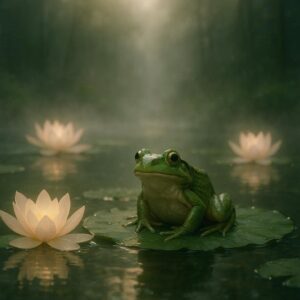
In the still of a twilight pond, a single sound slices through the silence—a deep, resonant croak. It is a sound that is both primal and familiar, a call that seems to echo from the very dawn of time. To some, it is merely the background music of a swamp. But to those who listen with more than just their ears, it is an invitation. The frog, this small, amphibious creature, is one of the most profound and ubiquitous spiritual symbols on our planet. It is a creature of two worlds, a master of transformation, and a herald of life-giving rains.
Why does this humble being hold such a revered place in the myths, legends, and spiritual practices of cultures spanning the globe? The answer lies in its unique life cycle and its intimate connection with the elements. The frog is a living testament to the possibility of radical change, a guide through emotional depths, and a promise of cleansing and abundance. This article is a deep dive into the spiritual essence of the frog. We will embark on a journey from the sun-baked Nile to the misty forests of the Pacific Northwest, from the pages of ancient texts to the landscapes of our own dreams, to unravel the rich tapestry of meanings woven around this remarkable creature. Prepare to see the frog not just as an animal, but as a spiritual teacher, urging us to cleanse our lives, embrace our transformations, and find our voice.
Chapter 1: A Global Leap – The Frog in World Mythology and Folklore
The frog’s spiritual significance is not the product of a single culture but a universal theme that has emerged independently across the world. This chapter explores how different civilizations have perceived and honored the frog, revealing a shared human recognition of its powerful symbolism.
The Frog in Ancient Egypt: Symbol of Life and Fertility
In the arid landscape of ancient Egypt, where life was dictated by the Nile’s annual inundation, the frog took on a role of supreme importance. The Egyptians observed that countless frogs would appear with the flooding of the Nile, a event that deposited rich, fertile silt onto the farmlands. This association made the frog an unequivocal symbol of life, fertility, and abundance.
The frog was intrinsically linked to the concept of creation itself. The Ogdoad, a group of eight primordial deities worshipped in Hermopolis, included four frog-headed gods representing the chaotic waters of Nun from which all life emerged. These frog-gods symbolized the potential for life in the primordial soup.
Most famously, the goddess Heqet (or Heket) was depicted as a woman with a frog’s head or simply as a frog. As a goddess of childbirth and fertility, Heqet was believed to be present at the creation of each new human in the womb. Egyptian midwives would invoke her name, and amulets of frogs were commonly worn by women seeking to conceive or to ensure a safe delivery. The frog, through Heqet, became the protector of new life, the divine midwife who breathed life and vitality into each newborn.
The Frog in Asian Traditions: Luck, Wealth, and Cosmic Harmony
In many Asian cultures, particularly in China and Japan, the frog is a powerful and positive symbol, primarily associated with good luck, prosperity, and safe journeys.
The Three-Legged Toad (Jin Chan or San Zu Chan): This is perhaps the most iconic frog symbol in the East. The Jin Chan, or “Money Toad,” is a mythical creature depicted as a three-legged frog, often with a coin in its mouth. It is believed to have the power to attract wealth and prosperity. Statues of the Jin Chan are commonly placed in homes and businesses, facing the door to draw money inward. According to legend, the Jin Chan comes out during the full moon, and finding one is considered an extremely fortunate omen.
Beyond wealth, frogs in Japanese folklore (where they are called kaeru) hold another beautiful meaning. The word kaeru also means “to return.” Because of this pun, frogs are considered talismans for safe return from journeys. Travelers would often carry frog amulets to ensure they would come back home safely. This duality—attracting wealth and ensuring safe return—cements the frog’s status as a benevolent and powerful guardian in Eastern philosophy.
The Frog in Native American Lore: Rain-Bringer and Healer
For many Native American tribes, the frog is a revered rain-bringer and a potent spirit of healing. Its distinctive croak is not just a sound but a prayer, a call to the spirits to release the life-giving rains upon the earth. In the dry, desert regions of the American Southwest, this association was a matter of survival.
Tribes such as the Hopi and Zuni perform ceremonial rain dances, often invoking the spirit of the frog. The frog is seen as a mediator between the people and the rain spirits, its voice a powerful form of communication with the divine.
Furthermore, the frog is also a healer. Its connection to water, the element of cleansing and purification, gives it the power to wash away illness and negative energy. In some traditions, frog medicine is called upon to cleanse the body and spirit, to heal emotional wounds, and to restore balance. The frog’s transformative life cycle also symbolizes the ability to heal and become a new version of oneself.
The Frog in European Folklore: From Fairy Tales to Omens
European folklore presents a more ambivalent view of the frog, often casting it as a creature of transformation, sometimes grotesque, sometimes noble. The most famous example is the fairy tale of The Frog Prince. In this story, a handsome prince is transformed into a frog by a witch’s curse and can only be returned to his human form by the kiss of a princess. This tale is a powerful allegory for the spiritual meaning of the frog: the idea that true worth and beauty can lie hidden beneath an unappealing exterior, and that love, acceptance, or a simple act of kindness can break the spell and reveal the inner prince.
In other parts of European folklore, frogs were sometimes seen as omens. They could be associated with witches as their “familiars,” or seen as harbingers of weather changes. However, the underlying theme of transformation—from tadpole to frog, from prince to frog and back again—remains the most potent and enduring spiritual lesson from the European tradition.
Chapter 2: The Alchemy of Transformation – From Tadpole to Frog
At the very heart of the frog’s spiritual symbolism lies its incredible metamorphosis. This biological process is a perfect, observable metaphor for profound spiritual and personal change. It provides a blueprint for our own journeys of growth and evolution.
The Biological Miracle as Spiritual Blueprint
A frog begins its life as an egg, hatches into a limbless, water-breathing tadpole, and through a remarkable process, grows limbs, absorbs its tail, and develops lungs to breathe air. This is not a simple growth; it is a complete anatomical and physiological overhaul. Spiritually, this represents:
-
Radical Change: The frog teaches us that change is not just possible; it can be total and magnificent. We are not bound to our current form, whether that form is a mindset, a lifestyle, or a self-image. The tadpole does not “try” to become a frog; it surrenders to the process encoded in its very being. Similarly, we have the potential for radical reinformation within us.
-
Evolution of Consciousness: The tadpole lives entirely in the aquatic world, a symbol of the subconscious and the emotional realm. The adult frog lives partly on land, the realm of conscious thought and material reality. The transformation, therefore, symbolizes the journey of elevating our consciousness, of bringing the wisdom of our subconscious (water) into our conscious awareness (land).
Embracing Life’s Different Stages
The frog’s life cycle validates the importance of each stage of our own lives. The tadpole stage is not inferior; it is a necessary period of development, nourishment, and learning in the “emotional waters.” The frog does not rush its transformation. It honors the process. This teaches us to be patient with our own growth. The struggles, the confusion, the feeling of being “in between” are all part of the sacred process of becoming.
The Call to Shed the Old: Frog Medicine and Spiritual Molting
Frogs molt their skin regularly, often eating it to recycle the nutrients. This is a powerful symbol of release and renewal. Spiritually, “Frog Medicine” is the energy that helps us shed old habits, outdated beliefs, past traumas, and emotional baggage that no longer serves us. We are encouraged to not just discard these old “skins,” but to integrate the lessons they taught us, just as the frog consumes its shed skin.
When the frog appears in your life, it may be a sign that you are being called to undergo a significant transformation. It is a call to leave the comfort of your “pond,” to shed what is holding you back, and to embrace the new identity that is waiting to emerge.
Chapter 3: The Elemental Bridge – Water and Earth
The frog is a master of two elements: Water and Earth. This dual citizenship grants it a unique and balanced spiritual power, making it a guide for navigating both our inner and outer worlds.
The Wisdom of Water: Emotion, Intuition, and the Subconscious
Frogs are born in water and remain intimately connected to it throughout their lives. Water is the universal symbol of the emotional body, intuition, dreams, and the subconscious mind. A frog’s comfort in water reminds us to:
-
Dive Deep into Our Emotions: Don’t be afraid to feel. The frog encourages us to explore the depths of our emotional landscape, to understand our fears, our joys, and our sorrows.
-
Trust Our Intuition: Just as a frog is sensitive to the slightest ripple in the water, we are encouraged to become more sensitive to the subtle ripples of our intuition. The frog’s energy can heighten our psychic and intuitive faculties.
-
Cleanse Our Emotional Waters: Stagnant water becomes toxic. The frog prompts us to keep our emotional body flowing and clean through practices like forgiveness, journaling, and therapy.
The Stability of Earth: Grounding, Manifestation, and Health
When the frog emerges from the water, it sits firmly on the earth. The Earth element represents stability, grounding, physical health, and manifestation. The frog teaches us that while it’s essential to explore our emotions, we must also be able to ground that energy into tangible reality.
-
Grounding Spiritual Insights: The frog helps us take our intuitive hits and spiritual downloads and “ground” them into practical action and real-world change.
-
Connection to the Physical Body: Its association with health and vitality (stemming from its link to the goddess Heqet) reminds us to care for our physical vessels. A healthy body supports a healthy spirit.
-
Manifestation: By bridging the world of emotion (water) and the world of form (earth), the frog is a powerful ally in manifestation work. It teaches us to feel the feelings of our desired outcome (water) and then take grounded action to bring it into being (earth).
The frog, therefore, is the ultimate symbol of balance. It does not get lost in its emotions, nor does it become overly rigid and unfeeling. It moves gracefully between both, teaching us to do the same.
Chapter 4: The Rain Singer – Frog as a Symbol of Cleansing and Abundance
The frog’s croak is not just a call for a mate; in the spiritual lexicon, it is a prayer for rain. This chapter explores the deep connection between the frog, cleansing, and the arrival of abundance.
The Scientific and Spiritual Link to Rain
Biologically, frogs are most vocal before and during rains, as the humid air is ideal for their delicate skin and for the dispersal of their calls. Our ancestors observed this correlation and concluded that the frogs were causing the rain. Spiritually, this establishes the frog as a creature with influence over the elements, a shamanic weather-worker.
Emotional and Spiritual Purification
Rain is a universal symbol of cleansing and washing away what is old and dusty. When we work with frog energy, we are invoking a “rain shower” for our soul. It helps to:
-
Purify Stagnant Emotions: Frog medicine can help clear grief, resentment, and fear, allowing for a renewal of the spirit.
-
Clean Our Energetic Field: Just as rain cleanses the landscape, the frog’s energy can wash away negative attachments and psychic debris we may have picked up.
-
Prepare the Ground for New Growth: A good rain makes the soil fertile and ready for seeds. Similarly, an emotional and spiritual cleansing makes us receptive to new ideas, new relationships, and new opportunities.
Inviting Abundance After the Storm
In nature, rain is followed by abundance. Plants grow, flowers bloom, and life thrives. The frog, as the rain-caller, is thus also a symbol of the abundance that follows cleansing. This is not just financial abundance, but an abundance of joy, love, creativity, and peace. The sequence is crucial: first comes the cleansing (the inner storm), then comes the growth. The frog teaches us that we cannot have one without the other. We must be willing to go through the process of release to make space for the new.
Chapter 5: Frog Totems, Power Animals, and Spiritual Guides
If you feel a persistent draw to the frog, it may be your totem animal or a power animal making its presence known. This chapter explores what it means to have the frog as a guide and how to work with its energy.
Is the Frog Your Totem Animal? Key Characteristics
You may have a frog totem if you identify with several of the following traits:
-
You are highly empathetic and sensitive to the emotions of others.
-
You have undergone, or are currently undergoing, a significant personal transformation.
-
You have a strong connection to water, either by loving to be near it or through your emotional nature.
-
You have a beautiful singing voice or are learning to “find your voice” and speak your truth.
-
You are skilled at cleansing your space and energy, perhaps through rituals, smudging, or other practices.
-
You have a strong intuition and often know things without knowing how you know.
-
You are able to adapt to different social and environmental situations with ease.
How to Work with Frog Energy
If you wish to consciously connect with frog medicine, you can:
-
Meditate with Frog Imagery: Sit quietly by a body of water if possible, and visualize a frog. Ask it for a message or simply feel its calming, transformative energy.
-
Create an Altar: Place a statue or image of a frog on your personal altar, along with symbols of water (a small bowl) and earth (a stone or crystal).
-
Use Affirmations: Repeat affirmations such as, “I embrace transformation with grace and ease,” “I cleanse my emotional body and welcome abundance,” or “I speak my truth with a clear and powerful voice.”
-
Spend Time in Nature: Visit ponds, lakes, or streams. Observe frogs in their natural habitat and learn from their behavior.
Meditations and Dream Interpretations
A guided meditation to connect with Frog Medicine could involve imagining yourself as a tadpole in a safe pond, then feeling the stirrings of change, growing limbs, and finally emerging onto the bank as a fully formed frog, feeling the sun on your new skin.
Dreaming of frogs is often a very positive sign, pointing to transformation, cleansing, and upcoming prosperity. (See Chapter 6 for more detail).
Chapter 6: The Frog in Modern Spirituality and Dreams
The frog’s symbolism is not confined to ancient texts; it is alive and well in contemporary spiritual practices and in the theater of our dreams.
Common Frog Dream Scenarios and Their Meanings
| Dream Scenario | Potential Spiritual Meaning |
|---|---|
| A frog jumping | A prompt to “take a leap” in some area of your life—a new job, relationship, or personal project. |
| A frog in water | A call to explore your emotions or subconscious mind. Pay attention to your intuition. |
| A frog on land | A sign to get grounded and practical. It’s time to manifest your ideas into reality. |
| A talking frog | Your inner voice or intuition is trying to get your attention. Listen carefully. |
| A dead frog | The end of a transformative cycle. It can also indicate blocked emotions or a feeling that your “voice” has been silenced. |
| Many frogs | A powerful omen of abundance—emotional, creative, or financial—on its way. |
| Catching a frog | You are trying to grasp an opportunity for transformation or a new idea. |
The Frog in Contemporary Witchcraft and Shamanism
In modern pagan traditions and witchcraft, the frog is a revered creature. Its spirit may be invoked in spells and rituals for:
-
Healing: Especially those related to the throat (voice) and reproductive systems (fertility).
-
Cleansing: Using frog imagery or symbols to “wash away” negative energy from a person or a space.
-
Prosperity Magic: Placing an image of a frog, particularly a three-legged money toad, in the wealth corner of a home or business.
-
Transformation Work: Calling upon frog energy to support major life changes, such as a career shift or a spiritual awakening.
In shamanic practices, the frog is a powerful spirit guide for soul retrieval—the process of recovering lost parts of the soul due to trauma—as it can navigate the waters of the subconscious and bring back what was lost.
Chapter 7: Cultural Echoes – The Frog in Art, Literature, and Pop Culture
The frog’s symbolic power ensures its continued presence in our cultural narrative. From ancient artifacts to children’s cartoons, the frog continues to leap through our collective imagination.
In art, frogs appear in everything from J.M.W. Turner’s romantic landscapes to surrealist paintings, often symbolizing transformation or the primal forces of nature. In literature, beyond The Frog Prince, we see frogs in George Orwell’s Animal Farm as followers of Napoleon, and in modern children’s books, they often retain their wise, earthy character.
In pop culture, Kermit the Frog from The Muppets is a quintessential example. His famous song, “It’s Not Easy Being Green,” perfectly encapsulates the frog’s spiritual lesson of self-acceptance and recognizing one’s unique beauty and worth, even when it feels difficult. He is a leader, a friend, and a voice of reason, embodying the frog’s role as a communicator and mediator.
Conclusion: Embracing the Leap
The frog is a timeless emblem of profound spiritual truths.
It is the promise of transformation, guiding us through life’s many metamorphoses.
It is the master of balance, teaching us to navigate our emotional waters while staying grounded on earth.
It is the herald of cleansing and abundance, reminding us that after the rain, new life always blooms.
Frequently Asked Questions (FAQs)
1. Is seeing a frog a good omen?
Generally, yes. Seeing a frog is most often considered a positive sign of transformation, cleansing, and upcoming abundance. It can be a message to pay attention to your emotions and to trust the process of change in your life.
2. What does it mean if a frog visits my home?
A frog entering your home is a powerful symbol. It can signify that a period of transformation is about to occur within your family or domestic life. It is also a strong indicator of impending good luck and prosperity entering your household. Spiritually, it can be a sign that your home needs energetic cleansing.
3. What is the difference between a frog and a toad spiritually?
While very similar, there are subtle distinctions. Frogs are more strongly associated with water, emotion, and cleansing. Toads, being more terrestrial, are often linked more intensely to the earth, grounding, and inner wisdom or secrets (partly due to the psychoactive secretions of some species, linking them to shamanic vision quests). However, their core themes of transformation are largely interchangeable.
4. How can I honor the frog as my spirit animal?
You can honor frog medicine by being mindful of your emotional health, embracing change instead of resisting it, using your voice to speak your truth, and keeping your physical and energetic environment clean. Supporting environmental causes that protect wetlands and amphibian habitats is also a profound way to honor the frog in the physical world.
5. What does a frog symbolize in the Bible?
In the Bible, frogs are primarily featured in the Book of Exodus as the second of the ten plagues upon Egypt. In this context, they symbolize impurity, uncleanliness, and divine judgment. This stands in contrast to the positive Egyptian view, showing how symbolism can shift based on cultural and narrative context. Here, the frog’s abundance becomes a curse rather than a blessing.