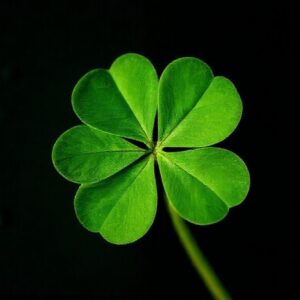
Imagine yourself in a sun-dappled field, the scent of damp earth and wildflowers filling the air. You are not just walking; you are searching. Your eyes scan a sea of green, a tapestry of countless three-leaf clovers. Then, you see it—a subtle anomaly, a break in the pattern. Your heart skips a beat as you bend down, gently pushing aside the surrounding leaves to reveal a singular, perfect, four-leaf clover. In that moment, a rush of exhilaration washes over you. It feels like a secret whispered from nature itself, a personal gift from the universe. You have not just found a plant; you have found a symbol, a token, a promise of good fortune.
But what is the true source of this profound feeling? Is it merely the anticipation of “luck”—a winning lottery ticket, a fortunate turn of events? Or does the four-leaf clover hold a much deeper, more ancient spiritual significance that resonates with the very core of our being? This article posits that the power of the four-leaf clover extends far beyond the superficial concept of chance. It is an Emerald Key, a sacred symbol encoded by nature, whose true value lies not in what it can bring to you, but in what it can reveal within you.
We will embark on a detailed journey, dissecting its botanical rarity, unearthing its origins in the misty groves of the Celtic Druids, and performing a deep exegesis of its four legendary components: Hope, Faith, Love, and Luck. We will explore its place in global cultures, its application in modern metaphysical practices, and provide practical guides for those wishing to integrate its powerful energy into their spiritual lives. This is not just a history of a folk symbol; it is an invitation to understand a universal archetype of divine alignment and personal power.
2. A Botanical Rarity: The Science of a Genetic Marvel
Before we ascend into the spiritual, we must first ground ourselves in the physical. The magic of the four-leaf clover begins with its tangible, biological improbability. The common clover we find in fields, Trifolium repens, is defined by its three leaves. The name itself is derived from the Latin trifolium, meaning “three-leaved.” This three-leaf structure is the genetic norm, the plant’s default setting.
The occurrence of a fourth leaf is primarily attributed to a combination of genetic and environmental factors.
-
Genetic Mutation: The primary cause is a recessive gene that manifests occasionally. Think of it as a hidden piece of code within the plant’s DNA that, under the right conditions, expresses itself.
-
Environmental Stress: Interestingly, the expression of this gene can be triggered or influenced by environmental conditions. Soil composition, pollution, temperature fluctuations, and even minor damage to the plant’s crown can increase the statistical likelihood of a four-leaf clover emerging. It is a beautiful metaphor: from pressure and challenge, something extraordinary is born.
The statistics are what cement its legendary status. It is commonly stated that for every 10,000 three-leaf clovers, you will find one four-leaf clover. This ratio is not absolute—some patches of clover are more genetically predisposed than others—but it effectively communicates the rarity. This scarcity is the foundational layer of its power. Humanity has always ascribed value and meaning to the rare and the difficult-to-obtain, from precious gems to unique natural formations. The four-leaf clover is a democratically rare treasure; it requires no wealth to acquire, only patience, awareness, and a touch of grace.
3. The Celtic Crucible: Druids, Fairies, and the Sacred Triad
To understand the spiritual meaning of the four-leaf clover, we must travel back over two millennia to the ancient Celtic lands of Ireland, Britain, and Gaul. Here, in a world where the veil between the physical and spiritual realms was considered thin, the Clover (and its three-leaf predecessor, the Shamrock) held immense sacred power.
The Druids, the learned priestly class of the Celts, were profound naturalists. They believed that the divine was immanent in all of nature—in sacred groves, in rushing rivers, and in the humble plants underfoot. The three-leaf clover, or Shamrock, was a potent symbol of the Celtic worldview. Its three leaves were believed to represent the Triadic Goddess (Maiden, Mother, Crone) and the three realms of Land, Sea, and Sky. More importantly, the Druids considered it a powerful charm against evil spirits. They would carry them for protection and incorporate them into rituals.
It is within this context that the four-leaf clover emerges as something truly extraordinary. If a three-leaf clover was powerful, a four-leaf clover was considered a magnification of that power, a rupture in the natural order that granted the bearer a glimpse into the supernatural. The Celts believed that a four-leaf clover had the unique ability to break fairy glamours and see the hidden world. Fairies in Celtic mythology were not benign, winged sprites; they were powerful, capricious, and often dangerous beings who could cast spells of illusion, leading travelers astray or making them see palaces where there were only ruins. Carrying a four-leaf clover was thought to grant the bearer the power of True Sight, allowing them to see through these deceptions, spot fairies in their true form, and avoid their tricks. It was, in essence, a key to perceiving true reality.
This association with sight and perception is the critical link between the ancient and modern spiritual meanings. The four-leaf clover was not just about attracting good things; it was about seeing clearly—seeing the truth, seeing opportunities, and seeing the hidden pathways of the spirit world.
4. Deconstructing the Quartet: Hope, Faith, Love, and Luck
The most widespread spiritual understanding of the four-leaf clover is that each leaf carries a specific virtue. This quartet—Hope, Faith, Love, and Luck—forms a powerful spiritual progression, a recipe for a blessed and aligned life. Let’s explore each leaf in depth.
The First Leaf: Hope – The Seed of All Possibility
Hope is the foundational leaf. It is the spark in the darkness, the unwavering belief that the future can be better than the present. In a spiritual context, Hope is not passive wishing; it is an active, energetic force. It is the decision to plant a seed in the frozen winter ground, trusting in the unseen promise of spring.
When you connect with the energy of the Hope leaf, you are tapping into the primal creative force of the universe. It is the virtue that allows us to envision a different reality, to set goals, and to dream. Without Hope, Faith has no object, Love has no future, and Luck has no doorway through which to enter. The first leaf reminds us that every journey, including the spiritual one, begins with the simple, courageous act of hoping for something more.
The Second Leaf: Faith – The Anchor in the Unseen
If Hope is the seed, Faith is the root system. Faith is the confident belief in something that cannot be proven with empirical evidence. It is the trust that the sun will rise, that the seasons will turn, and that there is a benevolent intelligence or order to the cosmos. Faith is what sustains Hope when circumstances are challenging.
Spiritually, the Faith leaf represents our connection to the Divine, the Universe, Source, or our Higher Power. It is the internal compass that guides us when the external path is obscured. While Hope looks forward, Faith provides a solid foundation in the present moment. It is the understanding that you are supported, even when you cannot see the hands that hold you. This leaf calls us to cultivate a deep, unshakeable trust in the flow of life.
The Third Leaf: Love – The Universal Binding Force
Love is the most powerful force in most spiritual systems. It is the energy of connection, compassion, unity, and selfless giving. The Love leaf in the clover represents not just romantic love, but Agape—universal, unconditional love. It is the binding agent that connects Hope to Faith, and humanity to the divine.
This leaf reminds us that our spiritual journey cannot be a solitary one undertaken for selfish gain. True spiritual alignment is achieved through love: love for oneself, love for others, love for nature, and love for the Creator. Love is the transformative power that heals wounds, bridges divides, and magnetizes positive experiences. It is the warmth that allows the seed of Hope to germinate and the soil in which the roots of Faith grow deep.
The Fourth Leaf: Luck – The Divine Synchronicity
And finally, we arrive at the famous fourth leaf: Luck. But what is luck, from a spiritual perspective? It is not a random, arbitrary force. Rather, it is the visible manifestation of alignment. When your internal state of Hope, Faith, and Love is in harmony, you vibrate at a frequency that attracts synchronous events, “chance” meetings, and favorable circumstances.
Luck is the universe’s “yes.” It is the natural consequence of being on the right path, with the right attitude. The fourth leaf, therefore, is not the cause of luck; it is the symbol of the luck that you are already generating through the cultivation of the first three virtues. It represents God’s Grace, the hand of Providence, or the Universe co-creating with you. It is the culmination of the spiritual process.
The following table summarizes this powerful symbiotic relationship:
| Leaf Number | Virtue | Spiritual Function | Energetic Quality |
|---|---|---|---|
| First | Hope | The initiator; the vision of potential. | Receptive, Forward-Moving, Visionary |
| Second | Faith | The sustainer; the trust in the unseen. | Grounding, Stabilizing, Trusting |
| Third | Love | The transformer; the power of connection. | Magnetic, Unifying, Healing |
| Fourth | Luck | The manifestation; the evidence of alignment. | Synchronistic, Expansive, Grace-Filled |
5. Cross-Cultural Perspectives: A Global Talisman
While the Celtic tradition provides the most direct lineage, the symbolism of the four-leaf clover finds echoes in other cultures and belief systems, suggesting a universal archetype.
-
Christian Symbolism: When St. Patrick famously used the three-leaf Shamrock to explain the Holy Trinity (Father, Son, and Holy Spirit) to the Irish, he sanctified the plant in the Christian consciousness. In this context, a four-leaf clover was sometimes interpreted as a symbol of God’s Grace, an extra blessing added to the divine formula. Another folk legend suggests that when Eve was cast out of the Garden of Eden, she took a four-leaf clover with her as a tangible piece of Paradise, making it a symbol of hope and a connection to a lost state of grace.
-
Asian Philosophies: In various Eastern traditions, the number four holds significant stability. It represents the Four Elements (Earth, Air, Fire, Water), the Four Cardinal Directions (North, South, East, West), and in some Buddhist thought, the Four Noble Truths. A four-leafed symbol, therefore, can be seen as an emblem of perfect balance, harmony, and cosmic order. It is a mandala of natural completeness, representing a universe in perfect, balanced operation.
6. The Four-Leaf Clover in Modern Spirituality and Psychology
In contemporary metaphysical practices, the four-leaf clover has evolved from a passive charm to an active tool for co-creation.
-
A Tool for Manifestation: Modern practitioners use the four-leaf clover as a focal point for setting intentions. The process involves holding a clover (or visualizing one) and consciously assigning a specific desire or goal to each leaf, following the Hope-Faith-Love-Luck model. For example:
-
Hope: “I hope for a new career that fulfills me.”
-
Faith: “I have faith that the universe is guiding me to the right opportunity.”
-
Love: “I will approach this journey with self-love and love for the process.”
-
Luck: “I am open and receptive to the lucky breaks and synchronicities that will lead me there.”
This process aligns the user’s energy with their desired outcome.
-
-
The Psychology of Luck: Psychologist Richard Wiseman conducted studies on “lucky” people and found that their luck had little to do with chance and everything to do with their mindset. Lucky people are more open to opportunities, notice chance possibilities that others miss, and maintain a positive outlook that allows them to turn bad situations around. The four-leaf clover functions as a tangible placebo or a cognitive anchor. Believing you are lucky because you carry one makes you more optimistic, more resilient, and more observant—thereby actively creating your own “luck.” The clover doesn’t change the world; it changes you, and you, in turn, change your experience of the world.
7. The Practical Seeker: How to Find, Attract, and Work with Four-Leaf Clover Energy
For those inspired to connect with this symbol in a hands-on way, here is a practical guide.
The Art of the Hunt: A Meditative Practice
Finding a four-leaf clover is a spiritual practice in itself. It cannot be done through frantic searching alone.
-
Set Your Intention: Before you begin, take a moment. Quiet your mind and state your intention—not just to find a clover, but to connect with the energy of nature and receive a gift.
-
Soft Gaze: Do not scan individual clovers. Instead, employ a “soft gaze” or a “distant focus.” Let your vision relax and blur slightly, and look for a break in the pattern, a spot that looks denser or different. You are looking for the anomaly, not the clover itself.
-
Follow Your Intuition: You may feel drawn to a particular area of the field. Trust this feeling. The hunt is a exercise in deepening your intuition and patience.
Consecrating Your Clover: From Find to Talisman
Once you find a clover, you can consecrate it to amplify its energy as a personal talisman.
-
Preserve It: Carefully press it between the pages of a heavy book for 1-2 weeks. Once flat, you can laminate it, place it in a locket, or dip it in clear resin to preserve it permanently.
-
Cleanse and Charge: Hold the pressed clover in your hands. You can pass it through the smoke of sage or palo santo to cleanse it of any stagnant energies. Then, place it in sunlight (briefly, to avoid fading) or moonlight (overnight, especially during a Full Moon) to charge it with celestial energy.
-
State Your Purpose: Hold your consecrated clover and verbally state what it represents for you. For example: “I charge this talisman with the energies of Hope, Faith, Love, and Luck. May it be a reminder of my connection to the divine and my power to create a blessed life.”
8. Distinguishing the Legends: Four-Leaf Clover vs. Shamrock vs. Five-Leaf Clover
It is crucial to distinguish between these commonly confused terms:
-
Shamrock: This is the Irish word for “little clover” (seamróg) and refers specifically to the three-leaf clover. It is a national symbol of Ireland and of St. Patrick’s teachings on the Trinity.
-
Four-Leaf Clover: A rare genetic variation of the shamrock plant, globally recognized as a symbol of good luck.
-
Five-Leaf Clover: Even rarer than the four-leaf clover, a five-leaf clover is sometimes called a “Money Clover” in folklore. While some consider it even luckier, others warn that it can bring misfortune, as it upsets the perfect balance of the four virtues. Spiritually, it could be interpreted as representing a fifth element—perhaps “Power” or “Magic”—but it exists outside the traditional, stable symbolism of the quartet.
9. Conclusion: The Luck You Create
The four-leaf clover is far more than a simple charm for good fortune. It is a complex spiritual symbol that has captivated humanity for centuries. Its power lies in its rarity, its deep Celtic roots of true sight, and its profound representation of the four pillars of a harmonious life: Hope to envision our path, Faith to walk it, Love to give it meaning, and Luck as the natural result of that sacred alignment. The true magic of the emerald key is not that it unlocks doors to external treasure, but that it unlocks the potential within the seeker, reminding us that the greatest luck is the luck we actively create through the quality of our spirit.
10. Frequently Asked Questions (FAQs)
Q1: What is the actual statistical probability of finding a four-leaf clover?
A: The commonly cited ratio is 1 in 10,000 three-leaf clovers. However, this can vary significantly. Some clover patches have a higher concentration of the recessive gene, and environmental factors can increase the chances. The key is persistence and the right method of searching.
Q2: Can I grow my own four-leaf clovers?
A: Yes! There are companies that sell seeds for clover genetically selected to produce a higher yield of four (and even five) leaf specimens. While finding one in the wild may feel more magically significant, growing your own can be a wonderful way to constantly have this symbol of hope and alignment in your garden or home.
Q3: What should I do if I find a four-leaf clover? Is it bad luck to keep it?
A: In almost all traditions, it is considered very fortunate to find and keep a four-leaf clover. The idea of it being bad luck is a very modern and superstitious inversion, not rooted in historical folklore. The key is to receive it with gratitude. You can preserve it, carry it with you, or even give it to someone you care about as a powerful blessing.
Q4: Does a dried/preserved four-leaf clover still hold its “power”?
A: From a spiritual perspective, yes. The physical plant is a symbol and a conduit. Once you have consecrated it and charged it with your intention, its energetic imprint remains. Its power is tied to the meaning you ascribe to it and the virtues it represents, which are not diminished by preservation.
Q5: How is the four-leaf clover different from a lucky rabbit’s foot or a horseshoe?
A: While all are considered lucky charms, their origins differ greatly. A rabbit’s foot often involves the harm of an animal, which carries a different, somewhat conflicting energy for many. A horseshoe’s luck comes from its iron content (historically repelling fairies and evil spirits) and its shape, which is said to hold luck inside like a cup. The four-leaf clover is unique in that its luck is born directly from nature’s grace and its symbolism is tied to universally positive spiritual virtues.