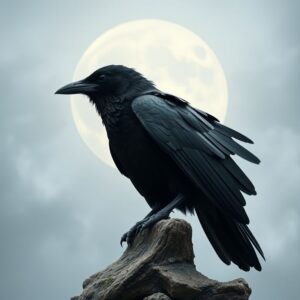
The crow cuts a stark figure against a twilight sky, its glossy black feathers absorbing the dying light, its caw a rasp that seems to echo from a world beyond our own. For millennia, this intelligent, adaptable, and often misunderstood bird has perched at the crossroads of the human psyche, simultaneously evoking fear, reverence, curiosity, and awe. It is a creature of paradox—a symbol of death and rebirth, a messenger of the gods and a trickster of the underworld, an omen of misfortune and a guide to life’s magic. To encounter the crow is to be invited into a deeper conversation with the unseen realms, with our own intuition, and with the shadowy parts of ourselves that yearn for transformation.
This article is a journey into the heart of that mystery. We will embark on an extensive exploration of the crow’s spiritual significance, tracing its footsteps through the mythologies and folklore of ancient civilizations, unpacking its potent symbolism in modern spirituality, and learning the practical language of its appearances in our daily lives. We will move beyond simplistic superstitions to appreciate the crow as a complex and powerful spiritual ally, one that challenges us to see the world, and ourselves, with clearer, more discerning eyes.
1. Introduction: The Enigmatic Ambassador of the Unseen
Why does the crow, among thousands of other bird species, hold such a tenacious and universal grip on our spiritual imagination? The answer lies in its very nature. Crows are not passive symbols; they are active participants in the landscape of meaning. Their jet-black plumage, which does not reflect light but absorbs it, naturally associates them with the void, the unknown, the realm of potential from which all creation springs. They are omnivorous and opportunistic, thriving in wilderness, farmland, and bustling city centers alike—a testament to their incredible adaptability, a trait we often seek in our own turbulent lives.
Perhaps most compelling is their intelligence. Scientific studies have repeatedly shown that crows possess cognitive abilities rivaling those of great apes. They use tools, recognize human faces, hold grudges, and teach their young complex tasks. This isn’t just animal behavior; to the spiritually attuned, this is evidence of a conscious, knowing mind. When a crow looks at you, it feels like it is seeing you—assessing your energy, your intentions, your place in the great web of life.
This article is designed to be a definitive guide for anyone who has felt the pull of this remarkable bird. Whether you have experienced a recurring crow encounter, feel a deep, inexplicable connection to them, or are simply fascinated by animal symbolism, what follows is a deep, nuanced, and exclusive exploration. We will leave no stone unturned, weaving together ancient wisdom, psychological insight, and practical guidance to help you understand the profound spiritual meaning of the crow.
2. The Crow in World Mythology and Ancient Beliefs
To understand the crow’s spiritual significance, we must first listen to the stories our ancestors told about it. Across continents and cultures, the crow appears again and again, its role shifting but its core essence as a creature of power, message, and mystery remaining constant.
The Celtic Morrígan: Goddess of War, Fate, and Sovereignty
In the Celtic pantheon, no figure is more intimately linked with the crow than The Morrígan. Often depicted as a trio of goddesses (Badb, Macha, and Anand), she is a complex figure of war, fate, death, and sovereignty. She frequently takes the form of a crow or raven, flying over battlefields, foretelling doom or victory, and influencing the outcome of conflicts.
-
Symbolism: The Morrígan’s association with the crow is multifaceted. The bird is her spy, her messenger, and an aspect of her terrifying power. She represents the inevitable cycle of life and death—the crow feasts on carrion, not out of malice, but as a necessary part of the ecosystem, transforming death into life for other creatures. She is also a goddess of sovereignty, determining the rightful king of the land. To see a crow in a Celtic context could be a call to embrace your own personal power, to confront a looming challenge, or to acknowledge the inevitable transformations that shape our destiny.
Norse Odin and His Ravens: Huginn and Muninn
In the Norse worldview, the All-Father Odin is accompanied by two trusted ravens (a close cousin to the crow, often conflated in symbolism): Huginn (Old Norse for “Thought”) and Muninn (“Memory”). Each day, they fly across the Nine Worlds, gathering all the information and news there is to know. Each evening, they return to perch on Odin’s shoulders and whisper everything they have learned into his ears.
-
Symbolism: Huginn and Muninn represent the power of the conscious mind and the subconscious memory. They symbolize the pursuit of knowledge, wisdom, and awareness. A crow encounter from a Norse perspective could be a powerful nudge to pay attention to your thoughts and to honor your memories. It asks: Are you thinking clearly? Are you learning from your past? Are you seeking out knowledge and wisdom, or are you accepting ignorance? The crow, in this sense, is a shamanic ally in the quest for inner and outer knowing.
Apollo’s Messenger: The Crow in Greek and Roman Lore
In Greek mythology, the crow was originally a sacred bird of Apollo, the god of prophecy, light, and truth. The birds were said to be white, or at least silver-feathered. One famous myth tells of a crow sent by Apollo to fetch water. The crow was delayed by a fig tree and waited for the fruit to ripen. To excuse its tardiness, it returned with a water snake (or a cup, in some versions), blaming the creature for the delay. Apollo, seeing through the lie, cursed the crow, turning its feathers black and banishing it from his service.
-
Symbolism: This myth encapsulates several key themes. The crow’s transformation from white to black symbolizes a fall from grace, the consequence of deceit, and the tarnishing of truth. It positions the crow as a figure associated with prophecy and divine message, but also with the potential for trickery and the consequences of irresponsible speech. It serves as a cautionary tale about honesty, accountability, and the importance of fulfilling one’s duties.
The Sacred Crow in Hinduism and Buddhism
In Hinduism, crows hold a significant, though ambivalent, place. They are considered to be connected to the ancestors (pitrs). During the Shraddha ceremony, a rite for honoring the dead, food offerings (pinda) are often left for crows. It is believed that the crows serve as messengers to the spirit world, and if they accept the offering, it signifies that the ancestors have accepted it and are at peace.
-
Symbolism: Here, the crow is a psychopomp—a guide for souls between the world of the living and the dead. It is a sacred link to our lineage and forebears. An encounter, especially around times of remembrance or grief, could be interpreted as a sign from an ancestor or a reminder to honor those who came before you. In some Buddhist Jataka tales, the crow appears as a clever, sometimes greedy character, reinforcing its trickster archetype and its connection to worldly attachment.
Native American Perspectives: The Trickster and the Keeper of Sacred Law
The crow’s symbolism in Native American traditions is incredibly diverse, varying from tribe to tribe. However, two major archetypes prevail.
-
The Trickster: In many Plains and Northwestern tribes, Crow is a classic trickster figure, akin to Coyote. He is clever, mischievous, and often gets into trouble by overreaching or using his intelligence for selfish purposes. These stories are not just entertainment; they are teaching tools about social norms, the consequences of foolishness, and the importance of balance.
-
The Keeper of Sacred Law: For other tribes, particularly some on the Northwest Coast, the Crow is a revered and wise figure. It is seen as a guardian of ceremonial magic and sacred law. Having witnessed the entire creation of the world, the Crow knows the original instructions given to humanity and can remind people of them. It is a symbol of fairness and justice.
-
Symbolism: This duality perfectly captures the crow’s essence. It can be a warning against cunning without wisdom, or it can be a call to align with a higher moral code and to remember the ancient truths that govern our existence.
African and Diasporic Traditions: The Messenger and the Wise One
In many West African traditions, birds are often seen as messengers between the human world and the spirit world. The crow, with its intelligence and observant nature, fits this role. In the diasporic traditions of the Americas, such as Hoodoo, the crow can be seen as a powerful sign. Its feathers, bones, or even its presence can be interpreted as a message from the other side or as an ingredient in workings related to luck, crossing, or uncrossing.
-
Symbolism: The crow here maintains its role as a messenger and a creature intimately aware of the spirit realm. Its appearance can signal that magic is afoot, that prayers are being heard, or that one needs to pay close attention to the signs being sent from the ancestors or the divine.
The Crow in Japanese and Shinto Mythology: The Divine Messenger Yatagarasu
In Japanese mythology, the three-legged crow, Yatagarasu (八咫烏), is a profoundly sacred creature. It is famously known for guiding the first Emperor Jimmu from Kumano to Yamato, helping him to establish his reign and, by extension, the Japanese imperial line. As a guide sent from Heaven (Takamagahara), Yatagarasu represents divine intervention and will.
-
Symbolism: Yatagarasu is the ultimate symbol of divine guidance. Its three legs are often interpreted as representing Heaven, Earth, and Humanity, or the three imperial regalia (the mirror, the jewel, and the sword). An encounter with a crow, especially during a time of confusion or important life transition, can be seen as a powerful sign that you are being guided from a higher plane. It encourages you to trust the path, even if the destination is not yet clear.
* The Crow in World Mythology – A Comparative Overview*
3. Core Spiritual Symbolism of the Crow: Deconstructing the Archetypes
Having traced the crow’s path through global mythology, we can now distill its presence into core spiritual archetypes. These are the fundamental energies and lessons that the crow embodies, regardless of cultural context.
Transformation and Life-Altering Change
The crow is the ultimate alchemist of the spirit. Its black color is not the absence of color, but the absorption of all colors—a symbol of pure potential. Just as the crow consumes decay and transforms it into energy for its own life, it teaches us to consume our own “decay”—our past traumas, outdated beliefs, and self-limiting patterns—and transform them into fuel for personal growth. It is the bird of the “dark night of the soul,” that painful but necessary period of breakdown that precedes a profound breakthrough. When the crow appears, it often signals that a major life change is imminent. It does not necessarily mean the change will be easy, but it assures you that you have the intelligence and adaptability to navigate it and emerge renewed.
The Magic of Creation and the Unseen World
Crows are deeply associated with magic, not as stage illusion, but as the fundamental ability to manipulate the fabric of reality through will, intention, and a deep understanding of natural law. In many traditions, they are seen as familiars to witches and shamans because they operate in the liminal spaces—the threshold between day and night, the forest and the field, the physical and the spiritual. The crow encourages us to see the magic in the mundane, to recognize the synchronicities that guide our path, and to understand that reality is far more malleable and mysterious than it appears. It calls us to become conscious co-creators of our lives.
Intelligence, Cunning, and Adaptability
This symbolism is rooted in undeniable biological fact. Crows have demonstrated problem-solving skills that astound scientists. They can craft hooks from twigs to extract grubs, drop nuts on roads for cars to crack open, and remember human faces for years. Spiritually, this translates to a powerful message: use your mind. The crow is the ally of the strategist, the innovator, and the survivor. It teaches us to think outside the box, to be resourceful with what we have, and to adapt to changing circumstances with grace and cleverness. If you are facing a complex problem, calling on crow energy can help you find a creative and effective solution.
The Messenger and the Omen: Bridging the Worlds
Perhaps the most universal role of the crow is that of the messenger. Because it moves freely between the worlds (the sky, the earth, and often, symbolically, the underworld), it is perfectly positioned to carry information. An encounter with a crow is rarely random; it is often a delivery of a specific message from the universe, your higher self, your spirit guides, or the ancestors. The nature of the message depends entirely on the context of the encounter (which we will delve into later). The key is to pay attention. The crow’s appearance is a tap on the shoulder from the cosmos, urging you to listen more closely to your intuition and to the signs around you.
Fear, Death, and the Shadow Self
This is the aspect of the crow that often causes unease. Its association with battlefields and carrion has branded it as an omen of death. However, in spiritual terms, “death” is rarely literal. It almost always symbolizes an ending—the death of a relationship, a job, an identity, or a phase of life. The crow does not bring this death; it announces its necessity. Furthermore, the crow is a master of “shadow work.” In Jungian psychology, the shadow is the part of our personality that we repress, deny, or deem unacceptable. The crow, fearless and comfortable in the dark, guides us to explore this shadow. It teaches us that by confronting and integrating our hidden fears, desires, and traumas, we can achieve profound wholeness and reclaim our personal power. The crow asks: What are you afraid to look at? What needs to “die” within you for you to be reborn?
Law and Justice, Truth and Morality
From the Native American Law-Keeper to the consequences faced by Apollo’s crow, there is a strong thread of justice in the crow’s symbolism. They are highly social birds with complex hierarchies and rules. They have been observed holding what appear to be “trials” for members who break social codes. Spiritually, the crow can appear when a truth needs to be exposed, when a moral line has been crossed, or when justice needs to be served. It can be a sign to stand up for what is right, to speak your truth even when it is difficult, or to trust that the universal laws of cause and effect are in motion, bringing balance to a situation.
4. The Crow as a Spirit Animal, Totem, and Power Animal
In contemporary spirituality, we often use the terms “spirit animal,” “totem,” and “power animal” to describe our connection with animal guides. While nuances exist, here’s a general framework for understanding the crow in this context.
-
Spirit Animal: An animal that resonates with your core personality and life path. It is a lifelong guide whose lessons are central to your soul’s journey.
-
Totem Animal: An animal that represents a clan, family, or group. It embodies the protective spirit and characteristics of that community.
-
Power Animal: An animal that comes to you for a specific period or situation to provide its unique energy and medicine.
Is the Crow Your Spirit Animal? Key Indicators
You don’t choose a spirit animal; it chooses you. However, there are common signs that the crow may be your spiritual companion:
-
Recurring Encounters: You see crows frequently and meaningfully, not just as background noise. They appear at pivotal moments in your life.
-
Fascination and Awe: You have always felt a deep, inexplicable draw to crows. You find them beautiful, intelligent, and captivating, not frightening or “dirty.”
-
Resonance with Crow Traits: You see crow-like qualities in yourself—you are adaptable, a keen observer, highly intelligent, misunderstood by others, or deeply interested in mystery and magic.
-
Dreams and Visions: Crows appear vividly in your dreams, often as guides, messengers, or protectors.
-
A Comfort with the “Dark”: You are not afraid to explore topics of death, shadow, and the unconscious. You understand that profound wisdom and transformation are found in these spaces.
The Personality of the Crow Totem: Traits and Characteristics
If the crow is your spirit animal or totem, you likely embody many of these traits:
-
Highly Perceptive: You notice details others miss. You are an excellent judge of character and can often sense people’s true intentions.
-
Adaptable and Resourceful: You can thrive in almost any environment. You are a natural problem-solver who can make something out of nothing.
-
A Natural Communicator: You have a way with words, but you also understand the power of silence. You know when to speak and when to listen.
-
Drawn to Mystery: You are fascinated by the paranormal, magic, psychology, and the unknown. You are a lifelong learner, always seeking deeper truths.
-
A Transformative Force: Your life may have been marked by significant upheavals and transformations. You have a knack for reinventing yourself.
-
A Bit of a Trickster: You have a mischievous or sarcastic sense of humor. You enjoy challenging conventions and pushing boundaries in a way that provokes thought.
The Power of the Crow: When You Need Its Energy
You can consciously call upon the power of the crow, even if it is not your primary spirit animal, in specific situations:
-
During Major Life Transitions: When moving, changing careers, or ending a relationship, ask the crow for guidance and the courage to transform.
-
When You Need a Creative Solution: If you’re stuck on a problem, meditate on the crow’s intelligence and cunning to find an innovative way forward.
-
When Doing Shadow Work: Call on the crow to help you bravely confront and integrate repressed aspects of yourself.
-
When You Need to Speak Your Truth: Ask the crow for the clarity and fearlessness to communicate an important message.
-
When You Feel a Need for Magic: Invite crow energy to help you see the synchronicities and re-enchant your world.
A Meditation to Connect with the Spirit of the Crow
-
Find a Quiet Space: Sit or lie down comfortably in a place where you won’t be disturbed.
-
Ground and Center: Take several deep breaths. Imagine roots growing from your feet deep into the earth, grounding you. Then, visualize a bright light at your core.
-
Set Your Intention: Silently state your desire to connect with the spirit of the crow.
-
Visualize a Landscape: In your mind’s eye, find yourself at the edge of a vast, open field at dusk. The sky is deep indigo, and the first stars are appearing.
-
The Call: In the distance, you hear the distinct caw of a crow. It doesn’t frighten you; it feels like an invitation.
-
The Meeting: You see a large, glossy black crow land on a gnarled branch a few feet from you. Its eyes are dark, deep, and intelligent. They hold a ancient knowing.
-
The Exchange: Sit with the crow in silence. You may ask a question in your mind. Listen not with your ears, but with your heart. What feelings, images, or knowings arise? The message may not be in words.
-
The Gift: The crow may leave a feather for you, or simply take flight. Thank it for its presence and guidance.
-
Return: Slowly bring your awareness back to your breath, to your body, and to the room. Wiggle your fingers and toes. Journal about your experience immediately.
5. Interpreting Crow Encounters, Omens, and Messages
While the core symbolism provides a foundation, the true art lies in interpreting the specific nature of your encounter. Context is everything.
Seeing a Single Crow vs. a Murder of Crows
-
Single Crow: A single crow often emphasizes a personal message. It is a call to independence, to rely on your own intelligence and intuition. It can signify a new idea, a message from a specific guide, or the need for solitary reflection.
-
Two Crows: Can symbolize joy, good news, or a harmonious partnership. In some traditions, it signals a positive change in fortune.
-
Three Crows: A powerful and often mystical number. Three crows can signify a major transformation is underway, a blessing from the divine, or a message that your body, mind, and spirit are coming into alignment. Pay close attention to events around you.
-
A Murder (Large Group): A large group of crows signals community, shared intelligence, and social dynamics. It could be a message about your role within your family, workplace, or social circle. Are you collaborating effectively? Is there gossip or a “pecking order” you need to be aware of? It can also be a powerful collective warning or announcement of a significant event.
The Meaning of a Crow Cawing: Context and Repetition
The crow’s call is its primary tool for communication.
-
A Single, Sharp Caw: A simple alert. “Pay attention!” It’s a nudge to be more present and observant of your immediate surroundings.
-
Rapid, Successive Cawing: This often indicates alarm, urgency, or a warning. The crow may have spotted a predator (like a cat or hawk) or be signaling a disturbance. Spiritually, this is a strong message to be on guard. Something in your life may require immediate attention or caution.
-
A Series of Calm, Spaced-Out Caws: This can be general communication within a murder or a more deliberate attempt to deliver a message. Listen to your intuition for the content.
-
A Crow Cawing at You: If a crow seems to be directing its calls specifically at you, the message is highly personal. Stand your ground, make eye contact (without aggression), and open your mind. What were you just thinking about? What question were you asking? The answer is often linked to your current mental state.
A Crow Crossing Your Path: Direction and Behavior
-
From Left to Right: In many traditions, this is considered a positive omen, suggesting that the message or change coming is aligned with your highest good and spiritual path.
-
From Right to Left: This can indicate a challenge or a message that requires you to look inward, perhaps at your shadow self or a past mistake. It’s not necessarily “bad,” but it may require more work to integrate.
-
Flying Overhead: A sign of overarching perspective. The crow is seeing the bigger picture of your life. This can be a message to rise above a petty situation, to gain a higher understanding, or that your prayers and intentions are being heard “from above.”
-
A Crow Staring at You: This is an intense and significant encounter. The crow is assessing you, reading your energy, and delivering a message directly to your soul. Do not look away out of fear. Meet its gaze and be open to the silent communication. It is a moment of deep spiritual connection.
Dreaming of Crows: A Dive into the Subconscious
Dreams are the realm of the subconscious, and a crow appearing there is a powerful symbol.
-
A Talking Crow: Pay very close attention to the words it speaks. This is direct communication from your higher self or a spirit guide.
-
A Crow Attacking You: This likely represents an internal conflict. Some part of your shadow self, a fear, or a repressed truth is “attacking” your conscious mind, demanding to be acknowledged.
-
A Friendly Crow: A sign that you are successfully integrating your shadow self and are in alignment with your spiritual path. The crow is a welcome ally.
-
A Dead Crow: Symbolizes the end of a transformative cycle or a feeling that your magic or personal power has been depleted. It may be time to rest and recuperate.
Unusual Encounters: A Crow Staring, Following, or Approaching You
These experiences feel particularly magical and personal.
-
A Crow Following You: This is a strong sign that the crow has a persistent message for you that you may be overlooking. It is also a sign of protection; the crow is watching over you on your journey.
-
A Crow Approaching You Closely: This is a gift of trust. The crow is making itself vulnerable to deliver its message. Remain calm and still. It may be investigating a shiny object you have, but more often, it is a profound spiritual moment. It may leave a gift, like a feather or a bone, as a token.
-
A Crow Bringing You a Gift: If a crow leaves a small, shiny object, a bone, or a feather near you, it is a tremendous honor. This is a sign of alliance and acceptance. The gift is a physical talisman of your connection. Keep it safe and use it in your spiritual practice.
The White Crow: A Rare and Potent Anomaly
A white crow (not an albino, but one with leucism) is an extremely rare sight and carries immense spiritual weight. It represents the ultimate unification of opposites: the magic of the black crow with the purity, divinity, and rarity of the white. It is a sign of a miraculous event, a powerful spiritual awakening, or a message from a very high-level guide. It signifies that the magic you are working with is of the highest order and that you are on the verge of a truly unique and profound understanding.
6. Crows in Modern Spirituality and Personal Practice
The crow is not just a figure of ancient myth; it is a vibrant and relevant ally in contemporary spiritual practice.
Working with Crow Energy in Shadow Work
Shadow work is the practice of acknowledging and integrating the disowned parts of ourselves. The crow is the perfect guide for this challenging but rewarding work.
-
Ritual: Create a quiet, sacred space. Light a black or dark purple candle. Hold a crow feather or a dark, smooth stone as a focus. Call upon the spirit of the crow for courage and clarity.
-
Journaling Prompt: Ask yourself, “What part of myself am I most afraid to show the world?” or “What trait in others triggers a strong negative reaction in me?” (This often points to a disowned part of yourself). Write without censorship. The crow helps you look at these things without judgment, seeing them simply as energy that can be transformed.
The Crow as a Familiar in Witchcraft and Paganism
In many pagan and witchcraft traditions, crows are considered excellent familiars—spiritual helpers in magical work. Their energy is particularly suited to:
-
Divination: Their connection to the unseen makes them powerful allies for tarot, scrying, and rune casting.
-
Weather Magic: In folklore, crows were often thought to predict weather changes.
-
Protection Magic: A crow’s feather or image can be used in spells and talismans for protection, as their watchful nature and loud alarm calls are naturally defensive.
-
Messenger Magic: Work with crow energy to send out intentions or prayers, trusting that they will be carried to the right destination in the spirit world.
Using Crow Symbolism for Manifestation and Problem-Solving
Harness the crow’s intelligence and adaptability in your daily life.
-
Define Your “Problem” or “Goal” Clearly: Be as specific as possible.
-
Channel Crow Cunning: Brainstorm at least five unconventional, “outside-the-box” solutions or paths to your goal. The first one or two will be obvious; push yourself to the creative, crow-like options.
-
Gather Your “Shiny Things”: What resources, skills, and people (your “treasures”) can you use to make this happen? The crow teaches us to be resourceful.
-
Take Action from a Higher Perspective: Before acting, imagine you are a crow flying high above the situation. What do you see from this vantage point? This can reveal the most efficient path forward.
7. Scientific Correlations: How Biology Informs Spirituality
The profound spiritual symbolism of the crow is powerfully echoed by its observed biology. This synergy between science and spirit deepens the validity of its message.
Unmatched Intelligence: Tool Use and Problem-Solving
Studies, particularly on New Caledonian crows, have shown they can not only use tools but make them—fashioning hooks from twigs and leaf stems to extract insects. They understand water displacement, dropping stones into a tube to raise the water level and reach a floating treat. This isn’t just instinct; it’s causal reasoning. Spiritually, this confirms the crow’s role as a master of innovation and practical magic. It shows us that the intelligence we attribute to it is not merely a metaphor but a observable, tangible reality.
Social Structures and “Funerals”: Echoes of Ritual
Crows live in complex social groups. They mate for life, raise their young cooperatively, and have distinct territorial calls. Most strikingly, they have been observed holding “funerals.” When a crow dies, other crows will gather around the body, cawing loudly. Research suggests they are learning about the cause of death and potential threats. From a spiritual perspective, this resonates deeply with their role as psychopomps and creatures concerned with death as a transition and a teacher. It shows a level of social intelligence and ritualistic behavior that feels deeply familiar to the human experience.
The Ecological Role of the Crow: Nature’s Cleanup Crew
As omnivorous scavengers, crows play a vital role as nature’s cleanup crew. They consume carrion, garbage, and pests, helping to prevent the spread of disease and recycle nutrients back into the ecosystem. This biological role is the literal manifestation of their spiritual role as transformers of death into life. They teach us that nothing is wasted, that what is deemed “rotten” or “finished” can be the very source of new growth and vitality. It is a powerful lesson in sustainability and the sacredness of all cycles.
8. Conclusion: Embracing the Crow’s Call to Transformation
The crow is far more than a simple omen or a spooky Halloween symbol. It is a complex, intelligent, and powerful spiritual ally whose presence in our lives is a call to deep evolution. It asks us to embrace change with cunning and grace, to seek wisdom in both light and shadow, to communicate our truth with clarity, and to recognize the profound magic that weaves through our everyday reality. The next time you hear its distinctive caw or see its dark form silhouetted against the sky, do not turn away in superstition. Pause. Listen. For the crow is speaking, and its message holds the key to a deeper understanding of the world and your own limitless potential.
9. Frequently Asked Questions (FAQs)
Q1: Is a crow appearing always a bad omen?
A: No, this is a common misconception. While crows can warn of challenges, they are more frequently messengers of transformation, magic, and intelligence. Context is key. A crow’s appearance is an invitation to pay attention, not a prediction of doom.
Q2: What is the difference between a crow and a raven spiritually?
A: Ravens are larger and often associated with more primal, powerful magic and deeper mysteries. Crows are seen as more social, clever tricksters and messengers of everyday magic. Think of the raven as the deep ocean and the crow as the clever, adaptable river.
Q3: What should I do if a crow leaves me a gift?
A: It is a great honor. Accept it with gratitude. You can keep the gift (a feather, a shiny object) on your altar or in a special place as a talisman of your connection to crow energy. You might even wish to leave a small gift in return, like a bit of shiny jewelry or some unsalted peanuts.
Q4: I’m scared of crows. What does this mean?
A: Fear of the crow often reflects a fear of the very things it represents: change, the unknown, death (literal or metaphorical), or your own shadow self. The crow’s appearance in your life, especially if it frightens you, may be a direct invitation to confront and understand that fear, which is the first step toward profound personal power.
Q5: How can I attract crows and build a relationship with them?
A: Consistency and respect are key. You can leave out offerings like unsalted peanuts, dog kibble, or hard-boiled eggs in a safe, quiet spot. Do not try to touch or tame them. Simply provide food regularly and observe from a distance. Over time, they may recognize you as a friend and their visits may become more meaningful.