Close your eyes and imagine the color red. What surfaces? A ripened apple, a beating heart, a raging fire, a stop sign, a rose, the rising sun. No color arrests our attention, stirs our emotions, and imprints itself upon our collective unconscious quite like red. It is the first color perceived by human infants, the most visible hue in the light spectrum, and the earliest color mastered in every ancient language and culture after black and white. Red is not merely a shade; it is an experience—a visceral, primal, and profoundly spiritual force.
To explore the spiritual meaning of red is to trace the crimson thread woven through the tapestry of human existence. It connects us to the very source of life: the blood that courses through our veins, the fire that warmed our ancestors, the earth from which we are formed. This article embarks on a comprehensive journey, spanning over 20,000 words, to unravel the multifaceted spiritual significance of this powerful color. We will traverse sacred texts, archaeological sites, psychological studies, and mystical traditions to understand red as a symbol of creation and destruction, passion and purification, the divine feminine and the sacred warrior, profound danger and ultimate protection.
2. The Physiology of Red: How We Perceive the First Color
Our spiritual connection to red is rooted in our biological design. Red light has the longest wavelength in the visible spectrum (approximately 620–750 nanometers), making it the least scattered by atmospheric molecules. This is why sunsets glow red and why the color commands immediate visual attention. Physiologically, the sight of red triggers measurable reactions: it can increase heart rate, raise blood pressure, and stimulate adrenaline release. This isn’t just cultural conditioning; it’s a hardwired alert system.
This biological imperative forms the bedrock of its spiritual symbolism. Because it demands focus and signals vitality, cultures worldwide naturally ascribed to it meanings related to life, urgency, power, and survival. The spiritual is often an extension of the physical, and with red, this link is exceptionally direct.
3. Red in the Ancient World: From Cave Walls to Kingdoms
Long before written language, our ancestors expressed their spirituality through red. The ochre pigments found in prehistoric cave paintings at sites like Lascaux and Pech Merle (often handprints and animal depictions) were not merely decorative. Anthropologists believe red ochre, resembling the color of blood, was used in burial rites to symbolize life, rebirth, and a return to the maternal earth. It was a spiritual technology for honoring the dead and ensuring continuity.
In ancient Egypt, red (desher) was associated with chaos, desert, and destruction—embodied by the god Set. Yet, it also symbolized life and regenerative power, as seen in the use of red jasper in amulets for protection and red-colored linen for ritual significance. The Egyptians famously used red ochre as a cosmetic, blurring the lines between spiritual practice, social status, and daily life.
For the Romans, red was the color of war (Mars), power, and majesty. The toga praetexta had a red border, and generals would have their bodies painted red during triumphs. Here, red’s spiritual meaning was one of divine authority and martial potency, a conduit to the favor of the gods.
Red in Ancient Civilizations
| Civilization | Primary Spiritual Associations | Key Manifestations |
|---|---|---|
| Prehistoric | Life, Blood, Rebirth, Ritual | Ochre in burials & cave art |
| Ancient Egypt | Chaos (Set), Life, Protection | Red jasper amulets, ritual linen |
| Ancient Rome | War, Divine Authority, Majesty | Red-border togas, triumphal paint |
| Ancient China (Shang/Zhou) | Life, Luck, High Ritual | Lacquerware, royal artifacts |
4. Red in Eastern Spirituality: Life Force, Root, and Ritual
Hinduism: The Color of Prakriti and Shakti
In Hinduism, red is a supremely auspicious and potent color. It represents Prakriti (the creative, active force of nature) and the divine feminine energy of Shakti. Many goddesses are depicted with red skin or red attire, such as Lakshmi (goddess of wealth) and Durga (the warrior mother). The red sindoor or kumkum applied along the hair parting of married women symbolizes marital status, fertility, and the protective energy of the goddess Parvati. During festivals like Holi, red gulal powder is thrown in celebration of life and love. Red flowers, especially hibiscus, are favored in the worship of the fierce goddess Kali, representing her compassionate heart and transformative power.
Buddhism: The Lotus and the Robes of Power
In Buddhism, red holds a complex position. It is one of the five colors of the Panchavarna (five hues of light) representing the Buddha’s aura. The Red Buddha, Amitabha, presides over the Western Pure Land and embodies infinite light, compassion, and skilful means. The red lotus flower symbolizes the heart, love, compassion, and purity of speech. In Vajrayana (Tibetan) Buddhism, red is the color of powerful, magnetizing rites. The robes of high lamas often incorporate red, signifying their authority and the intense energy of their practice. It is the color of life force (prana) and the vital winds that flow through the subtle body.
Traditional Chinese Culture: The Hue of Luck and Vitality
Red (hong) is the color of ultimate good fortune, joy, prosperity, and vitality in Chinese spirituality and culture. Its use is ubiquitous during Lunar New Year, weddings, and other celebrations to ward off evil spirits (notably the mythical beast Nian). Red lanterns, envelopes (hongbao), and clothing are all spiritual safeguards. It is associated with the Fire element in the Wu Xing (Five Phases), representing growth, dynamism, and the South direction. In traditional Chinese medicine, red is connected to the Heart organ, governing consciousness, spirit (Shen), and blood circulation.
5. Red in Abrahamic Religions: Sacrifice, Spirit, and Sin
Judaism: The Blood of the Covenant and the Scarlet Thread
In the Hebrew Bible, red carries profound dualities. Blood (dam), which is life itself (Leviticus 17:11), is central to the covenant with God and sacrificial rites—a symbol of atonement. The Pesach (Passover) blood on the doorposts was a sign of protection. Conversely, red can symbolize sin and guilt: “Though your sins are like scarlet, they shall be as white as snow” (Isaiah 1:18). The “scarlet thread” appears in the story of Tamar (Genesis 38) and Rahab (Joshua 2), often interpreted as a thread of destiny, redemption, and royal lineage leading to King David and the Messiah.
Christianity: The Blood of Christ, Pentecost, and Martyrdom
Christianity’s spiritual lexicon is deeply imbued with red. It is, foremost, the color of the Blood of Christ shed for the salvation of humanity—the ultimate symbol of sacrifice, redemption, and divine love. It is the color of Pentecost, representing the fire of the Holy Spirit descending upon the Apostles, granting them tongues of fire and catalytic spiritual power. Red vestments are worn on feast days of martyrs, honoring those who shed their blood for their faith. This creates a powerful triad: Sacrifice (Good Friday), Spirit (Pentecost), and Witness (Martyrs).
Islam: Subtlety and Significance in Islamic Tradition
While Islam generally favors modesty and avoids ostentation, red holds specific spiritual and cultural significance. Some Islamic traditions note that red was the Prophet Muhammad’s favorite color for clothing. It is mentioned in the Quran in descriptions of beauty, like red roses. In Islamic architecture, red pigments and tiles are used in magnificent geometric and floral patterns, reflecting the beauty of creation without iconography. In Sufi poetry, the red rose is a frequent metaphor for the beauty of the Divine Beloved and the burning passion of the seeker’s heart.
6. Red in Indigenous and Earth-Based Spiritualities
For many Indigenous cultures across the Americas, Africa, and Australia, red ochre is sacred paint, a direct link to the Earth Mother. It is used in ceremonies, initiations, and warfare to connect with ancestral spirits, invoke protection, and signify life force. In Native American traditions, red often represents the East direction (the rising sun), faith, and the spiritual path. In African spiritual systems like Yoruba, red is frequently associated with deities of power, iron, and conflict, such as Ogun. The connection is consistently elemental: red is the color of the sacred earth, the blood of kinship, and the fire of ritual.
7. The Chakra System: Muladhara – The Root of Being
In the Yogic and Tantric chakra system, red is the color of the Muladhara or Root Chakra, located at the base of the spine.
-
Symbolism: It is the foundation of the human energy system, governing our most basic needs: survival, security, stability, grounding, and our connection to the physical world and the tribal/family unit.
-
Spiritual Lesson: The lesson of Muladhara is to establish a safe, grounded foundation from which spiritual growth can occur. A balanced root chakra, visualized as a spinning red wheel of energy, fosters feelings of safety, presence, and vitality. When blocked or imbalanced, it can manifest as fear, anxiety, greed, or feelings of disconnection.
-
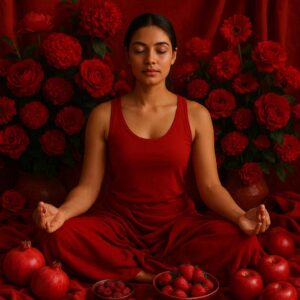
Working with Red: Meditating on the color red, using red crystals (like red jasper, garnet, or hematite), or wearing red clothing can help stabilize and energize this foundational center, encouraging spiritual awakening that is firmly rooted in physical reality.
8. Psychological and Emotional Dimensions: Passion, Anger, and Courage
Psychologically, red is a stimulant. It evokes strong emotions: love, passion, desire, but also aggression, anger, and dominance. This duality mirrors its spiritual paradox. Spiritually, passion is the fuel for devotion and the pursuit of purpose. Courage (a “red-blooded” emotion) is necessary for spiritual battles and facing one’s shadow. However, the same energetic force can manifest as uncontrolled anger (the “red mist”) or indulgent lust, which many spiritual paths warn against as attachments that hinder growth. Thus, the spiritual task with red energy is not to suppress it, but to master and direct it—transforming raw impulse into conscious willpower and divine fervor.
9. Red in Dreams and Mystical Visions
In dream analysis, red is a powerful messenger. A red object or scene often points to:
-
Vital life force, passion, or strong emotions (love, anger) that need acknowledgment.
-
A warning or call to pay attention (“seeing red flags”).
-
Issues related to survival, physical health, or foundational security.
-
A call to action or a surge of creative energy.
In mystical Christian, Sufi, and Kabbalistic visions, experiencing a “red light” or “crimson flame” is often associated with the sphere of Geburah (Severity) on the Tree of Life—representing divine judgment, strength, and the necessary force to cut away illusion. It is the refining fire of the spirit.
10. The Shadow Side: Danger, War, and Forbidden Desires
Any discussion of red’s spiritual meaning must confront its shadow. Red is the universal color of danger, warning, and stop. It symbolizes violence, war, wrath, and the fires of hell in many religious iconographies. It has been linked to sin, prostitution, and forbidden desires. This shadow aspect serves a vital spiritual function: it is the boundary marker. Just as a poisonous berry is often red, the color naturally signals “caution.” Spiritually, it reminds us that primal power, untempered by wisdom or compassion, becomes destructive. The fire that warms can also consume. The blood that gives life can also be spilled in violence. A mature spirituality acknowledges and integrates this shadow, using the energy of red with awareness and respect for its potency.
11. Rituals, Talismans, and Using Red Spiritually
How can one consciously work with red energy?
-
Altars & Meditation: Place red candles (for fire element, courage, vitality), red flowers (roses, carnations for love/devotion), or red crystals on your altar. Meditate on a red sphere at your root chakra.
-
Crystals & Stones:
-
Garnet: For revitalization, love, and strengthening the survival instinct.
-
Red Jasper: For grounding, connection to Earth, and stamina.
-
Ruby: For passionate devotion, vitality, and leadership.
-
Bloodstone: For courage, sacrifice, and cleansing the blood.
-
-
Clothing & Adornment: Wearing red can be a conscious act to boost confidence, feel protected, or embody passionate energy for a specific purpose.
-
Creative Expression: Painting, drawing, or working with red materials can help channel and understand this energy creatively.
-
Ritual Acts: Lighting a red candle before a challenging task to invoke courage, or using red ink for sigils related to strength and action.
12. Conclusion: Summarizing the Content of the Article
Red is the spiritual color of primal existence, connecting the pulse of our blood to the fire of spirit and the clay of the earth. It embodies the foundational energies of life, passion, courage, and sacred power across every major world tradition. To engage with red spiritually is to embrace the full spectrum of human experience—from rooted survival to divine fervor—while consciously directing its formidable force toward creation, protection, and conscious awakening.
13. Frequently Asked Questions (FAQs)
Q1: Is red always a positive spiritual color?
A: No. Red is a color of extreme potency, encompassing both positive and negative poles. It represents love and war, creation and destruction, sacred power and danger. Its spiritual value depends on context, intention, and application.
Q2: What does it mean if I’m constantly drawn to the color red?
A: A strong attraction to red may indicate a need for more vitality, courage, or grounding in your life. It could signal a desire to connect with your physical body, passion, or life force. It may also suggest that issues of survival, security, or power are at the forefront of your spiritual journey.
Q3: How is red different from pink spiritually?
A: While red is raw, primal energy (passion, will, survival), pink is red infused with white (love, compassion). Red is the force; pink is the force softened by unconditional love. Red is about action and foundation; pink is about emotional healing and affectionate connection.
Q4: Can wearing red affect my mood or spirituality?
A: Yes. Color psychology and many spiritual traditions hold that what we wear can affect our energy field. Wearing red can make you feel more confident, energized, and assertive. Spiritually, it can be used as a tool to cultivate those qualities or to shield your own energy.
Q5: What is the connection between red and the Root Chakra?
A: The Root Chakra (Muladhara) is associated with the color red because it governs our foundation: survival, security, grounding, and basic needs. Visualizing red or using red elements helps stabilize, energize, and balance this chakra, creating a solid base for spiritual development.