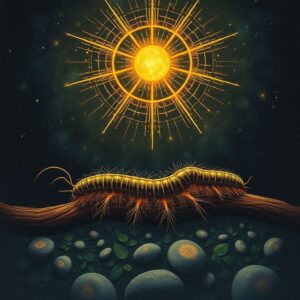
The centipede, a creature of swift, undulating motion and formidable appearance, has scuttled through the undergrowth of human consciousness for millennia. More than just a garden-dwelling arthropod, it occupies a potent and complex space in the spiritual and symbolic lexicon of cultures worldwide. To encounter a centipede, whether in the physical world or the landscape of our dreams, is to be presented with a multifaceted symbol rich with meaning. It is a creature that simultaneously evokes unease and awe, representing the raw power of the earth, the intricate workings of the subconscious, and the relentless forward momentum of life itself.
This article embarks on a detailed exploration of the centipede’s spiritual significance. We will traverse diverse cultural landscapes, from the animistic traditions of the East to the mythological tales of the ancient West, and delve into the wisdom of indigenous shamanic practices. We will decipher the messages it brings as a spirit animal and totem, unravel the enigmatic narratives of centipede dreams, and integrate its ancient symbolism into the context of our modern spiritual lives. Prepare to see this ancient arthropod not as a pest, but as a profound teacher of adaptability, resilience, and the hidden power that lies in moving through the world with purpose and precision.
1. Introduction: An Unlikely Messenger
In the quiet hum of the natural world, few creatures provoke as visceral a reaction as the centipede. Its elongated, segmented body, propelled by a seemingly countless number of legs, moves with a hypnotic, wave-like rhythm that can unsettle the uninitiated. For many, the immediate response is one of revulsion or fear—a primal reaction to its alien form and, in some species, a venomous bite. Yet, it is precisely within this space between fear and fascination that the deepest spiritual lessons often reside. The centipede challenges us to look beyond surface-level appearances, to question our instinctive aversions, and to discover the profound wisdom in what we may initially reject.
To understand the centipede spiritually is to embrace paradox. It is a ground-dweller that teaches us about elevated consciousness. It is a predator that symbolizes self-defense, not unwarranted aggression. It is a creature of the earth that can guide us through the most intricate labyrinths of our own minds. This article serves as a guide to decoding these paradoxes, inviting you to see the centipede not as a creepy-crawly, but as a powerful archetype of movement, protection, and the latent knowledge buried just beneath the surface of our everyday awareness. Its journey through the leaf litter is a mirror for our own journey through life—a path that requires agility, awareness, and the courage to navigate the dark, fertile places where true growth begins.
2. The Biological Blueprint: Understanding the Creature Behind the Symbol
Before we can fully appreciate the spiritual symbolism of the centipede, we must first understand its physical reality. Its biological traits are not arbitrary; they are the very foundation upon which its mythological and spiritual meanings are built. The centipede’s form and function are a perfect example of how nature informs spirit.
Anatomy of Movement: Legs, Segments, and Antennae
The most defining characteristic of the centipede is, of course, its multitude of legs. The name “centipede” itself derives from the Latin centum (hundred) and pes (foot), though the actual number of legs varies by species, ranging from under 20 to over 300. Each body segment typically bears one pair of legs. This anatomical structure is the source of its core spiritual lesson: coordinated movement and forward progress.
Spiritually, the many legs represent the many aspects of our lives, responsibilities, and talents that must work in harmonious unison to propel us forward. Just as the centipede’s legs operate in a perfect, wave-like sequence to navigate complex terrain, we too must learn to coordinate our mental, emotional, physical, and spiritual “legs” to move through life’s challenges with grace and efficiency. The failure of one leg does not halt the centipede; it simply adapts and continues. This is a powerful metaphor for resilience and the ability to continue our path even when parts of our life are injured or compromised.
The segmented body speaks to the layered nature of our existence and personal growth. We are not monolithic beings; we are composed of different “segments”—past experiences, present circumstances, and future aspirations. The centipede reminds us that all these parts are connected and essential for our overall movement and purpose.
Furthermore, the centipede’s long, sensitive antennae are its primary tools for navigating the world. It does not rely heavily on sight but on touch and vibration. This translates spiritually to the importance of intuition, sensitivity, and perceiving the world through means beyond the obvious. The centipede spirit encourages us to “feel our way” through situations, to trust our gut instincts, and to be attuned to the subtle energies and vibrations around us.
The Predator in the Shadows: Venom and Foraging
Centipedes are nocturnal predators. They hunt in the darkness, using their speed and venomous forcipules (a modified pair of legs acting as pincers) to subdue prey. This aspect of its nature contributes to its symbolic meanings of protection, defense, and the ability to confront shadowy or hidden threats.
The venom is not for offensive malice but for survival and sustenance. In a spiritual context, this symbolizes the power we hold to defend our boundaries, our energy, and our well-being. The centipede teaches that it is not only acceptable but necessary to have a “sting” to protect oneself from psychic or emotional predators. It embodies the idea of quiet, potent power held in reserve.
Its role as a forager in the dark, damp places of the earth connects it to the subconscious mind, the hidden realms, and the process of “digesting” decay to fuel new life. It is a master of turning detritus into energy, symbolizing our ability to transform our “shadow” aspects—our fears, traumas, and negative patterns—into sources of personal power and growth.
Biological Traits and Their Spiritual Correlations
| Biological Trait | Spiritual Meaning | Life Lesson |
|---|---|---|
| Many Legs | Coordination, multifaceted life, steady progress, resilience. | Learn to harmonize all aspects of your life (work, family, self) to move forward effectively. |
| Segmented Body | Layered existence, connection of past/present/future, flexibility. | Embrace all parts of your journey; your history is integral to your current movement. |
| Long Antennae | Intuition, sensitivity, perception beyond the physical senses. | Trust your gut feelings and learn to read the subtle energy of people and places. |
| Nournal Predation | Confronting the shadow self, protection, defense, hidden power. | It is wise and necessary to defend your personal boundaries and psychic space. |
| Venom (Forcipules) | Potent, reserved power, the ability to “sting” when threatened. | Your words and energy can be powerful tools for defense; use them wisely and justly. |
| Habitat (Dark/Damp) | Connection to the subconscious, the underworld, and transformation. | Growth often happens in the dark, fertile places of introspection and shadow work. |
3. A Tapestry of Global Symbolism: The Centipede Across Cultures
The spiritual resonance of the centipede is not confined to a single tradition. Its image and symbolism have evolved uniquely across the globe, reflecting the diverse ways in which humanity has sought to understand this enigmatic creature.
East Asian Symbolism: Luck, Wealth, and Rainbringers
In many East Asian cultures, particularly in China, the centipede is viewed as a potent symbol of good fortune, protection, and healing. Its association with the powerful earth element and its ability to overcome other venomous creatures, like snakes and spiders, earned it a reputation as a guardian against evil spirits and misfortune. Centipedes were often depicted in art and folklore as formidable opponents to dragons, further cementing their status as powerful protectors.
In Traditional Chinese Medicine (TCM), dried centipedes have been used for centuries to treat conditions like seizures, tetanus, and arthritis. This medicinal use reinforces its symbolic link to healing and the mastery over chaotic or “wind-like” illnesses.
Furthermore, in some agricultural communities, the centipede is seen as a rain-bringer. Its tendency to emerge before or after rain connects it to life-giving water and abundance. This links it symbolically to wealth and prosperity, as rain ensures a bountiful harvest. The centipede, therefore, becomes an emblem of both the protection of existing wealth and the attraction of new abundance.
African and Afro-Caribbean Lore: Wisdom, Cunning, and the Trickster
In West African folklore, particularly among the Akan and related peoples, the centipede often appears as a wise and cunning figure in Anansi the spider stories. While Anansi is the primary trickster, the centipede is frequently portrayed as one of the few creatures who can outwit him. This establishes the centipede as a symbol of intelligence, strategic thinking, and the ability to navigate complex social or political situations.
This symbolism traveled across the Atlantic with the diaspora, finding a place in Afro-Caribbean traditions like Vodou. Here, the centipede (known as gongon or mille-pattes) is associated with the loa (spirit) known as L’Clermond or others linked to the earth and the dead. It is seen as a messenger between worlds, a guardian of secrets, and a creature that can deliver justice through its bite. Its many legs are said to represent its connection to countless spiritual pathways.
Indigenous American Perspectives: The Healing Power of the Earth
For many Native American tribes, the centipede is deeply connected to the healing power of the earth. Its presence underground links it to the underworld, not as a place of damnation, but as a realm of primordial power, ancestors, and healing medicines. The centipede is seen as a keeper of ancient earth wisdom.
In some South American shamanic traditions, the centipede’s venom is symbolically associated with the power to both cause and cure disease, reflecting the shaman’s role as a master of spiritual and physical balance. The centipede spirit may be called upon in healing rituals to help “sting” out illness or to provide the shaman with the agility and perception needed to navigate the spirit world.
Ancient Greek and Egyptian Myths: Chaos, Creation, and Solar Boats
In Greek mythology, the centipede is linked to the primordial goddess Echidna, the “Mother of All Monsters,” who was half-woman, half-serpent. This connection places the centipede within the realm of chthonic (underworld) powers and the raw, untamed forces of creation.
More notably, the Greek name for centipede, hekatoncheires, was also given to three hundred-handed, fifty-headed giants who were the offspring of Gaia (Earth) and Uranus (Sky). These beings, Briareos, Cottus, and Gyges, represented the terrifying power of natural disasters like earthquakes and storms. They were eventually freed by Zeus to help him overthrow the Titans, symbolizing the harnessing of chaotic, earth-shattering power for a new world order. This myth elevates the centipede’s symbolism from a simple ground-dweller to a cosmic force of immense power that can be called upon for monumental change.
In ancient Egypt, the centipede was associated with the scorpion goddess Serket, a protector against venomous bites and stings. It was also linked to the sun god Ra. A giant centipede was believed to guide Ra’s solar barque (boat) on its nightly journey through the treacherous underworld, defending it from the serpent god Apep (Apophis), the embodiment of chaos and destruction. Here, the centipede is a solar guardian, a protector of the light itself as it passes through the darkest realms, symbolizing the ultimate triumph of order over chaos.
4. The Centipede as Spirit Animal and Totem
When an animal consistently appears in your life, whether in physical form, dreams, or through repeated imagery, it may be presenting itself as a spirit guide or totem. The centipede, as a spirit animal, carries a powerful and specific set of attributes for those it chooses to guide.
Calling of the Centipede: Are You Being Guided?
You might be under the guidance of the centipede spirit animal if:
-
You are in a period of life that requires significant adaptability and the ability to think on your feet.
-
You are feeling overwhelmed by the many “legs” or facets of your life and need to learn how to coordinate them more effectively.
-
You are delving into shadow work, exploring the hidden parts of your psyche, or uncovering buried truths.
-
You are in need of protection, especially of a psychic or spiritual nature, and feel the need to strengthen your personal boundaries.
-
You are embarking on a new, complex path that requires you to “feel your way” with intuition rather than a clear, pre-determined map.
Core Attributes of the Centipede Spirit Animal
Adaptability and Resourcefulness
The centipede spirit animal is the ultimate master of adaptation. It can squeeze through narrow crevices, navigate rocky terrain, and move with equal grace over soil, wood, and stone. If the centipede is your guide, you are being called to embrace flexibility. Life may be presenting you with unexpected twists and turns, and the medicine of the centipede teaches you to flow with these changes rather than resist them. It encourages creative problem-solving and using the resources immediately at hand to overcome obstacles.
Resilience and Overcoming Obstacles
A centipede that loses a leg will regenerate it. This profound biological ability is a core tenet of its spiritual teaching: resilience. The centipede spirit animal reminds you that you can recover from loss, injury, or setback. You have an innate capacity to heal and regenerate your spirit. It teaches you to keep moving, even if you are not at full strength, trusting that forward momentum itself is a form of healing. The path may be difficult, but you have the innate toughness to see it through.
Balance and Coordination in Life
With so many legs, balance is not an option for the centipede; it is a necessity. As a spirit guide, the centipede appears when the different segments of your life are out of sync. Perhaps your career is advancing at the expense of your health, or your social life is draining your emotional reserves. The centipede calls you to audit your life’s segments. Are all your “legs” moving in a coordinated rhythm towards your goal? It teaches the art of dynamic balance—not a static state of perfection, but a continuous process of adjustment and alignment.
The Uncovering of Hidden Truths
As a creature of the earth and the subconscious, the centipede is a master excavator. It can help you dig up buried memories, repressed emotions, and hidden talents. Its appearance often signals that it is time to bring something into the light. This process can be uncomfortable, like turning over a rock and exposing what lives beneath. However, the centipede guides you through this exploration with precision and protection. It assures you that confronting these hidden truths is the only way to achieve genuine healing and empowerment. It is the spirit of the detective, the psychologist, and the shaman, all rolled into one.
5. The Centipede in Dreams: Deciphering Nocturnal Messages
Dreams are the language of the subconscious, and the appearance of a centipede in this realm is always significant. The interpretation, however, is highly dependent on the context and the dreamer’s emotional state.
Common Centipede Dream Scenarios and Their Interpretations
-
Being Chased by a Centipede: This often represents an avoidance of a hidden truth or a nagging problem in your waking life. You are running from something you know you must eventually face—a repressed emotion, a difficult conversation, or a shadow aspect of your personality. The dream is a call to stop running and turn to confront the issue.
-
Stepping on or Killing a Centipede: This can symbolize an attempt to suppress your own power, intuition, or primal instincts. You may be trying to force a part of yourself into conformity, “killing” your adaptability or resilience to fit in. Alternatively, it could represent a victory over a hidden fear or a toxic situation.
-
A Centipede Crawling on Your Body: This is a powerful dream symbol of heightened sensitivity and awareness. The specific location is key. On the head, it could relate to intrusive thoughts or the need for mental clarity. On the back, it might point to burdens you are carrying. On the hands, it could relate to your actions or creativity. Overall, it signifies that something is “crawling under your skin” in waking life—a situation or person you are intensely sensitive to.
-
Seeing a Very Large or Giant Centipede: This amplifies the symbolism significantly. A giant centipede represents a monumental challenge, a powerful truth that is emerging, or a major life transition. It indicates that the issues at hand cannot be ignored and require all your resources and courage to navigate.
-
Observing a Centipede Moving Calmly: This is a very positive sign. It indicates that you are successfully navigating a complex situation in your life. You are using your intuition, coordinating your efforts effectively, and making steady progress, even if the path is not entirely clear.
Emotional Context: Fear, Fascination, or Indifference?
The emotional tone of the dream is the most crucial interpreter.
-
Fear and Revulsion: Points to anxiety about a complex or “creepy” situation in your waking life. You feel overwhelmed by the many moving parts and are reacting with aversion. The message is to understand the source of this fear and recognize the potential power within the situation.
-
Fascination and Curiosity: Suggests that you are ready to explore your subconscious and uncover hidden truths. You are approaching a complex problem with a healthy sense of intrigue and a willingness to learn. This is a sign of spiritual and psychological readiness.
-
Indifference: Might indicate that you are spiritually disconnected or deliberately ignoring the subtle messages from your intuition. The centipede is appearing to grab your attention, to remind you to look closer at the details of your life.
6. Esoteric and Energetic Dimensions: Kundalini and the Earth Connection
Beyond cultural myths and personal guidance, the centipede holds profound meaning in esoteric and energetic systems, particularly in relation to the Kundalini energy and the chakra system.
The Centipede and the Kundalini Serpent
In the yogic tradition, Kundalini is the primal spiritual energy, often visualized as a coiled serpent sleeping at the base of the spine. When awakened, it rises up through the central energy channel (sushumna), activating the chakras and leading to spiritual enlightenment. The centipede, with its serpentine form and multitude of legs, is a powerful symbolic representation of this rising energy.
Each pair of legs can be seen as representing the countless nadis (energy channels) that branch out from the central spine. The undulating, wave-like movement of the centipede mirrors the spiraling ascent of Kundalini. Therefore, a centipede encounter can be a powerful sign that your Kundalini energy is stirring or that you are undergoing a profound spiritual awakening that requires you to integrate this powerful force in a balanced and coordinated way. It warns that this energy, like the centipede’s venom, is potent and must be respected and channeled correctly.
A Creature of the Earth Star Chakra
While not part of the traditional seven-chakra system, many modern energy workers recognize the Earth Star Chakra. Located about twelve inches below our feet, it is our fundamental connection to the planet and the grounding force of our energy body. The centipede, as a creature that is literally one with the ground, is a perfect emblem for this chakra.
When the centipede appears, it may be signaling that your Earth Star Chakra needs attention. You may be feeling ungrounded, spacey, or disconnected from physical reality. The centipede’s medicine teaches you to root down, to draw stability and nourishment from the earth, and to ensure your spiritual aspirations are built upon a solid, practical foundation. It reminds us that before we can reach for the heavens, we must be firmly anchored to the earth.
7. Encountering a Centipede: Omens and Practical Guidance
So, what does it mean when you cross paths with a centipede in your daily life? The interpretation is nuanced, moving beyond simple “good” or “bad” omens.
Is it a Good Omen or a Bad Omen?
The centipede is generally a positive omen, but one that calls for awareness and action. It is not a passive symbol of luck like a four-leaf clover. Its appearance is an active message.
It is a “good” omen in the sense that it signals:
-
You are protected and have the inner resources to handle challenges.
-
You are on the right path, even if it’s complex and requires you to be agile.
-
A period of resourcefulness and problem-solving is at hand.
-
You are being supported in uncovering a truth that will ultimately empower you.
It could be perceived as a “warning” omen only in the sense that it asks you to pay attention. It warns you to:
-
Be mindful of the many details in a project or relationship.
-
Strengthen your personal boundaries.
-
Prepare to adapt, as change is coming.
-
Not ignore the subtle signals and your intuition.
Actionable Steps After an Encounter
-
Pause and Observe: Don’t just squash it out of fear. Acknowledge its presence. What were you thinking about just before you saw it? What is the current primary challenge in your life?
-
Assess Your Coordination: Take a mental inventory of the “segments” of your life. Are they in balance? Where is coordination lacking?
-
Trust Your Intuition: The centipede’s antennae are a reminder to hone your intuition. Practice listening to your gut feelings in the days following the encounter.
-
Ground Yourself: Spend time in nature. Walk barefoot on the earth. The centipede is a powerful grounding symbol, reminding you to connect with the stabilizing energy of the planet.
-
Face What’s Hidden: Is there a conversation you’re avoiding? An emotion you’re suppressing? The centipede encourages you to be brave and bring it into the light.
8. Conclusion: Integrating the Centipede’s Wisdom
The centipede, in its ancient, multi-legged journey, teaches us that true power lies in coordinated movement and grounded awareness. It is a symbol of resilience, reminding us that we can regenerate and continue forward after loss. As a master of the hidden realms, it guides us to uncover our deepest truths and transform our shadows into strength. By embracing the spirit of the centipede, we learn to navigate the complex terrain of our lives with agility, protection, and profound intuitive wisdom.
9. Frequently Asked Questions (FAQs)
Q1: I am terrified of centipedes. What does it mean if one is my spirit animal?
A: It is common for our most powerful spirit guides to initially evoke fear. This often indicates that the lesson they bring is one we deeply need but are resistant to. Your fear of the centipede may mirror a fear of your own complexity, your hidden power, or the “shadow” parts of yourself. Working with the centipede spirit can be a profound journey of confronting and integrating these fears, ultimately leading to greater self-mastery and empowerment.
Q2: Is a centipede in the house a bad sign?
A: Not necessarily. In many cultures, it’s a sign of protection for the household. Spiritually, it can indicate that the “hidden” aspects of your home life (family dynamics, subconscious patterns within the family) need attention. It can also be a simple reminder to ground the energy of your living space. Practically, it may seek moisture, so it can also be a nudge to check the physical health of your home environment.
Q3: What is the difference between a centipede and a millipede in spiritual meaning?
A: While both are myriapods, they have distinct energies. Centipedes are flat, fast predators with one pair of legs per segment. Millipedes are rounder, slower detritivores with two pairs of legs per segment. Spiritually, the centipede is about action, defense, and predation—navigating challenges and protecting yourself. The millipede is about digestion, recycling, and introspection—processing the “decay” in your life (old thoughts, emotions) to create fertile ground for new growth. The centipede is a warrior; the millipede is a composter.
Q4: How can I honor the centipede as my spirit animal?
A: You can honor it by:
-
Meditation: Visualize its coordinated movement when you feel scattered.
-
Symbolism: Keep an image or a small statue as a reminder of its attributes.
-
Develop Your Intuition: Practice mindfulness and trust your gut feelings.
-
Grounding Work: Regularly connect with the earth through walking, gardening, or meditation.
-
Shadow Work: Courageously journal about or explore the parts of yourself you usually keep hidden.