The five-pointed star, known universally yet understood by few, is one of humanity’s most ancient and enduring symbols. From the dusty caves of prehistoric shamans to the gleaming spires of modern sacred architecture, its simple, contiguous form has captivated the human spirit for millennia. To the untrained eye, it is a mere geometric shape, a child’s first drawing of a star in the night sky. But to the seeker, the mystic, and the scholar, it is a profound map of the cosmos, a key to the mysteries of creation, and a powerful talisman for spiritual transformation. This symbol, often called the pentagram or pentacle, is a microcosm of the universe—a symbol of the divine order, the human soul, and the sacred interplay between the two. To truly understand the pentagram is to embark on a journey through time, across cultures, and into the very heart of esoteric wisdom. It is a journey that reveals how the macrocosm is reflected in the microcosm, how the heavens are mirrored on earth, and how the human being stands as the living bridge between them.
This article will serve as your comprehensive guide, unraveling the complex tapestry of meanings woven into this deceptively simple symbol. We will explore its archaeological origins in the ancient world, decipher its sacred geometry, and unpack its powerful correspondence with the classical elements. We will illuminate its role as a potent symbol of protection and magic, confront the controversies and misunderstandings that have shrouded it in shadow, and celebrate its representation of the perfected human, the Microcosm. Finally, we will see how this ancient symbol continues to hold profound relevance in our modern spiritual quest, offering a timeless blueprint for balance, integration, and ascension.
1. Introduction: The Universal Symbol
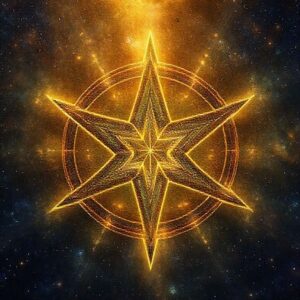
What is it about a simple, five-pointed star that has commanded such reverence, such fear, and such fascination across countless generations and disparate cultures? Its form is elementary: a single, unbroken line that twists and turns upon itself, crossing five times to create ten segments, and culminating in five distinct outward points. Yet, within this elementary design lies a universe of meaning. The pentagram is a symbol of wholeness, a representation of the complete human being—spirit incarnate in a physical body, mastering the elemental forces of nature. It is a symbol of protection because it represents order triumphing over chaos, consciousness directing the raw powers of the universe. It is a symbol of the cosmos because its inherent geometry reflects the very patterns found in nature, from the spiral of a nautilus shell to the arrangement of petals in a rose.
To begin our exploration, we must set aside modern prejudices and preconceptions. We must travel back in time to when humanity first looked to the stars and saw in their arrangements not random specks of light, but the handwriting of the gods. The pentagram’s journey is a mirror of our own spiritual evolution, and to understand it is to understand a fundamental thread in the tapestry of human consciousness.
2. Ancient Echoes: The Pentagram in Early Human History
Long before it was associated with magic or esoteric orders, the pentagram was a celestial and religious symbol. Its earliest known appearances are not in grimoires, but in the archaeological records of the world’s first civilizations.
Mesopotamia: The Planet of Ishtar
The earliest known depictions of the pentagram date back to around 3000 BCE in ancient Mesopotamia, the cradle of civilization. In the city-states of Sumer and later in Babylon, the symbol was intimately connected with celestial observation. The planet we know as Venus, the brilliant “morning star” and “evening star,” was sacred to the goddess Ishtar (or Inanna). The complex path that Venus traces in the sky over its 8-year cycle relative to Earth is a precise geometrical pattern—a pentagram.
For the Mesopotamians, this was not a coincidence. It was divine revelation. The pentagram became the cuneiform symbol for the “corner” or “angle,” and by extension, for the heavenly realms. It was used on boundary stones (kudurrus) and cylinder seals to signify royal and divine power. The goddess Ishtar herself was a complex deity associated with love, fertility, war, and the heavens; the pentagram was her celestial signature, a symbol of the cyclical nature of life, death, and rebirth as embodied by the planet’s phases.
Pythagoras and the Greeks: The Symbol of Perfection
In ancient Greece, the school of Pythagoras in the 6th century BCE adopted the pentagram as a paramount symbol of spiritual and mathematical perfection. The Pythagoreans, a mystical and philosophical society, saw the universe as being explainable through numbers and geometry. For them, the pentagram, or “pentalpha” because it can be formed by five overlapping A’s (Alpha), was the ultimate expression of this principle.
They recognized it as a symbol of health and vitality. The Greek word for “health,” υγεία (hygieia), was also associated with the number five. More profoundly, the Pythagoreans discovered the pentagram’s unique mathematical property: its connection to the Golden Ratio, or Phi (φ). Every segment in a perfectly drawn pentagram is in golden ratio proportion to the next smaller segment. This self-similar, recursive harmony was seen as a reflection of the divine order of the cosmos. To the Pythagoreans, the pentagram represented the five elements they believed constituted the world: earth, water, air, fire, and aether (spirit). It was their secret symbol of recognition and a talisman of well-being.
Other Ancient Civilizations: A Global Symbol
The pentagram’s appeal was not confined to the Mediterranean. In ancient Egypt, some scholars suggest the pentagram was found in the geometry of sacred structures, though the evidence is less direct than in Mesopotamia. The star symbol was deeply associated with the concept of the Duat (the underworld) and the star-clock decans.
In China, the philosophy of Wu Xing, or the Five Phases, is a fundamental cosmological concept describing the interactions and relationships between phenomena. These five phases—Wood, Fire, Earth, Metal, and Water—are often arranged in a circle, and their generative and destructive cycles can be perfectly mapped onto a pentagram, showing the dynamic balance of the universe. This is a powerful parallel to the Western elemental system, emerging independently and confirming the pentagram’s role as a universal symbol of interconnected natural forces.
In early Christianity, the pentagram was used to represent the Five Wounds of Christ (the wounds in his hands, feet, and side). It was a common protective symbol found on knights’ shields and armor during the Crusades, symbolizing the truth and the five senses under the guidance of divine grace. The legendary Sir Gawain, of Arthurian lore, bore a pentagram on his shield, its five points representing his five knightly virtues: generosity, courtesy, chastity, chivalry, and piety.
3. The Geometry of the Divine: Sacred Proportions and the Golden Ratio
The spiritual power of the pentagram is not merely allegorical; it is mathematical. Its geometry is a gateway to understanding what ancient mystics and modern physicists alike call the fundamental fabric of reality.
The Pentagram’s Self-Generating Nature
One of the most astonishing properties of a pentagram is its recursive, self-generating nature. If you connect the five points of a pentagram, you create a pentagon at its center. Then, if you draw diagonals inside that central pentagon, a smaller, inverted pentagram appears within it. This process can, in theory, continue infinitely, creating ever-smaller pentagrams and pentagons. This property of nesting within itself made it a powerful symbol for the Hermetic axiom, “As above, so below; as within, so without.” It represents the idea that the same patterns and laws that govern the cosmos (the macrocosm) are reflected in the individual human being and in every minute part of creation (the microcosm).
Phi (φ): The Divine Proportion Within
The driving force behind this self-similarity is the Golden Ratio, often denoted by the Greek letter Phi (φ), approximately equal to 1.618. This irrational number is found throughout nature—in the branching of trees, the spiral of galaxies, the proportions of the human body, and the arrangement of seeds in a sunflower. It is considered the most aesthetically pleasing proportion to the human eye.
Within the pentagram, the Golden Ratio is ubiquitous. The ratio of the length of a line segment of the pentagram to the next smaller segment is φ. The ratio of a diagonal of a pentagon to its side is φ. This is not an approximation; it is a geometric truth.
The Golden Ratio (φ) in the Pentagram
| Geometric Relationship | Description | Ratio (approximately) |
|---|---|---|
| AC / AB | The length of a full arm of the star compared to the length of one of the segments of the pentagon’s side. | 1.618 (φ) |
| AB / BC | The relationship between the larger and smaller segments created when the lines intersect. | 1.618 (φ) |
| Diagonal / Side of Pentagon | The ratio of the length of a diagonal line inside the pentagon to the length of the pentagon’s side. | 1.618 (φ) |
This pervasive presence of Phi elevates the pentagram from a simple symbol to a diagram of cosmic harmony. It is a visual representation of the hidden order that underlies the apparent chaos of the world. For the spiritual seeker, meditating on the geometry of the pentagram is a way to attune one’s consciousness to this fundamental, divine order.
4. The Four Elements and the Quintessence: A Symbol of Cosmic Order
Perhaps the most widespread and practical spiritual interpretation of the pentagram is its representation of the four classical elements crowned by a fifth: Spirit. This system forms the bedrock of most Western esoteric and magical traditions.
Point One: Earth – Stability and the Physical Body
The lower left point of the upright pentagram is typically assigned to Earth. This element represents the physical plane: the body, stability, foundation, fertility, material wealth, and the senses. It is the realm of the practical, the manifest, and the slow, steady growth of nature. In the human being, it corresponds to the physical vessel, health, and our connection to the natural world. A balanced Earth point grants groundedness, patience, and a healthy relationship with the material world.
Point Two: Air – Intellect and Communication
The upper right point is Air. This element governs the mind, intellect, reason, communication, logic, and knowledge. It is the realm of thought, ideas, wind, and the breath of life. In the human being, it corresponds to the conscious mind, our ability to analyze, learn, and express ourselves. A balanced Air point fosters clear thinking, objectivity, and effective communication.
Point Three: Fire – Will, Energy, and Transformation
The upper left point is Fire. This element embodies energy, passion, will, courage, transformation, and dynamic force. It is the spark of life, the driving force behind action, and the power of purification and destruction that clears the way for the new. In the human being, it corresponds to the will, our vitality, ambition, and spiritual drive. A balanced Fire point provides motivation, courage, and the ability to initiate change.
Point Four: Water – Emotion, Intuition, and the Subconscious
The upper right point is Water. This element rules emotion, intuition, the subconscious, love, compassion, and healing. It is the realm of the deep, flowing, and often hidden aspects of the psyche. It represents the tides of feeling, psychic ability, and the connection to the collective unconscious. In the human being, it corresponds to the emotional body, dreams, and empathy. A balanced Water point allows for healthy emotional expression, deep intuition, and compassion.
Point Five: Spirit (Akasha) – The Unifying Force
The topmost point, which leads the symbol, is Spirit (also called Aether or Akasha). This is the quintessence—the fifth element that is not an element at all, but the source from which the other four emerge. It represents the Divine, the Higher Self, cosmic consciousness, and the unifying force that binds all of creation together. In the human being, it corresponds to the soul or the spiritual self that transcends the physical and psychological bodies. A balanced Spirit point signifies alignment with one’s true purpose, spiritual awareness, and a sense of connection to the divine.
The Interconnectedness of All Things
The single, unbroken line that forms the pentagram is crucial. It demonstrates that these five components—Spirit, Air, Fire, Water, Earth—are not separate, isolated forces. They are inextricably linked, flowing into one another in a continuous cycle. The human being, as the Microcosm, contains all five, and spiritual growth comes from balancing and integrating them, allowing Spirit to rightfully govern the four material elements.
5. The Human Microcosm: The Pentagram as a Map of the Soul
The concept of the human as a “Microcosm” (a small universe) reflecting the “Macrocosm” (the great universe) is central to Hermeticism, Alchemy, and many mystical traditions. The pentagram serves as the perfect geometric model for this concept.
The Vitruvian Man and the Human Form
Leonardo da Vinci’s iconic “Vitruvian Man” is a study of the human proportions described by the Roman architect Vitruvius. While the figure is inscribed in a circle and a square, a pentagram can also be perfectly mapped onto the human form. With the head at the top point (Spirit), the two arms outstretched form the upper lateral points (Air and Water), and the two legs spread form the lower points (Fire and Earth). This powerful image visually asserts that the human body is a living pentagram, a temple containing the entire cosmos.
The Five Senses and the Five Wounds
As previously mentioned, the pentagram has been used to represent the five senses through which we experience the material world (sight, sound, smell, taste, touch). In a spiritual context, this signifies that our physical vessel is the instrument of our earthly journey. Conversely, in Christian mysticism, it represented the Five Wounds of Christ, transforming the symbol into one of sacrifice, redemption, and the sanctification of the physical body through spiritual suffering.
The Qabalistic Cross and the Lower Soul
In the Qabalah (Jewish mysticism and its Western esoteric offshoots), the pentagram is associated with the sephirah of Geburah (Severity) on the Tree of Life. More broadly, it can represent the five parts of the lower soul, or the five-fold nature of a human being as a composite of Nefesh (the vital soul), Ruach (the intellect/spirit), Neshamah (the higher soul), Chayah (the life force), and Yechidah (the unique, divine essence). This complex mapping further solidifies the pentagram’s role as a detailed schematic of the human spiritual anatomy.
6. The Shield of Protection: The Pentagram in Ritual and Magic
Given its representation of cosmic order and the dominion of Spirit over the elements, the pentagram naturally evolved into one of the most potent symbols of protection in the magical world.
The Banishing and Invoking Rituals of the Pentagram
In ceremonial magic traditions, such as the Hermetic Order of the Golden Dawn, the pentagram is not a static symbol but a dynamic tool of will. Practitioners perform the “Lesser Banishing Ritual of the Pentagram” (LBRP) as a daily practice to purify a space and the practitioner’s own aura. By tracing a pentagram in the air at the four cardinal directions with a finger or a ritual dagger (athame), the magician creates a protective circle. The visualization of the pentagram, usually in flaming blue light, acts as a psychic shield, banishing chaotic or negative energies and establishing a sacred, consecrated space for magical work. There are corresponding “Invoking” rituals to draw specific elemental forces into the space.
Talismans and Amulets Through the Ages
For centuries, people have worn or displayed pentagrams as amulets for protection and good health. Medieval grimoires, such as the Key of Solomon, contain intricate designs for pentacles (pentagrams often inscribed within a circle and surrounded by sacred names) to be used as talismans. These were drawn on parchment or engraved on metal disks to attract certain influences, protect against demons, or heal ailments. The circle surrounding the star symbolizes unity, eternity, and the containment and focusing of the pentagram’s power.
The Directional Quarters and Elemental Guardians
In Wicca and many Pagan traditions, the pentagram is used to “call the quarters.” When casting a circle, the practitioner will often face each direction (East, South, West, North) and draw a pentagram to invite the elemental guardians of that quarter (Air, Fire, Water, Earth, respectively) to watch over the ritual. This practice actively engages the symbolic meanings of the pentagram’s points, weaving a sacred space that is a living manifestation of the balanced cosmos the symbol represents.
7. Inversion and Misunderstanding: The Upside-Down Pentagram
No discussion of the pentagram’s spiritual meaning is complete without addressing the elephant in the room: the inverted pentagram and its association with evil and Satanism.
Historical Context of the Inverted Symbol
It is crucial to understand that the inversion of a sacred symbol to represent its opposite is a common symbolic trope. The inverted cross, for instance, was originally the symbol of St. Peter, who requested to be crucified upside down out of humility, but was later co-opted as an anti-Christian symbol. Similarly, the inverted pentagram has not always been “evil.” In some very specific esoteric contexts, such as certain degrees within Freemasonry, an inverted pentagram can represent spirit descending into matter, or the state of the initiate who has not yet achieved spiritual mastery—a symbol of the potential for growth, not of evil.
The Advent of Satanic Panic and Modern Misconceptions
The widespread association of the inverted pentagram with Satanism is largely a 20th-century phenomenon. It was popularized by the Church of Satan, founded by Anton LaVey in 1966, which adopted the symbol as a representation of the “Baphomet” sigil from Eliphas Levi’s 19th-century occult drawings. In Levi’s original depiction, the goat’s head within the inverted pentagram symbolized the “sabbat of the goat” and the carnal nature of humanity triumphing over the spiritual (as Spirit is now at the bottom). LaVeyan Satanism, being a materialist and atheistic philosophy, used this inversion to represent the rejection of spiritual dogma and the embrace of the material self.
This adoption, combined with sensationalist media and the “Satanic Panic” of the 1980s and 1990s, cemented the inverted pentagram in the popular imagination as a symbol of devil worship, black magic, and everything evil. This has caused immense difficulty for Pagans, Wiccans, and ceremonial magicians who use the upright pentagram as a positive, life-affirming symbol, often leading to prejudice and misunderstanding.
Reclaiming the Narrative: Context is Everything
For the vast majority of modern spiritual practitioners, the upright/inverted distinction is paramount. The upright pentagram, with Spirit at the apex, symbolizes the ascent of the soul, the rule of consciousness over the base elements, and spiritual enlightenment. The inverted pentagram is generally avoided as it is seen to represent the descent into materialism, the dominance of the physical appetites over the spirit, and a state of imbalance. The key takeaway is that the meaning of any symbol is dependent on the intention and tradition of the user. Context is everything.
8. The Pentagram in Modern Esoteric Traditions
The pentagram remains a vibrant and central symbol in contemporary spiritual paths.
Wicca and Neopaganism
In Wicca, the pentagram is the primary symbol of the faith, much like the cross is for Christianity or the star of David is for Judaism. It is worn as a symbol of identity and belief, typically as a pentacle (a pentagram within a circle) on a necklace. It represents the elements, the divine within nature, and the cycle of life. The circle signifies the Goddess (the feminine, encompassing principle) and the star signifies the God (the masculine, active principle), together representing sacred union and the totality of the divine.
Ceremonial Magic: The Golden Dawn and Thelema
Building on the foundations of the Golden Dawn, modern ceremonial magic orders continue to use the pentagram extensively in their rituals. In Thelema, the philosophy founded by Aleister Crowley, the pentagram rituals are core practices. Crowley also elaborated on the “Elemental Weapons” and the “Four Powers of the Sphinx,” which are directly correlated to the pentagram’s points, adding further layers of psychological and magical correspondence.
Freemasonry and Rosicrucianism
While not as publicly prominent as in Wicca, the pentagram holds significance within certain Masonic degrees, particularly in the context of the “Blazing Star,” a symbol of divine guidance and the light of reason. Rosicrucian orders (AMORC, etc.), which blend Christian mysticism with esoteric philosophy, also study the pentagram as a symbol of the perfected human and the mastery of the microcosmic forces.
9. Conclusion: The Eternal Symbol of Integration
The journey of the five-pointed star is a testament to its profound and universal resonance. From the celestial path of a planet to the secret sign of a philosopher, from the shield of a Christian knight to the central emblem of a modern nature religion, the pentagram has worn many masks. Yet, its core message remains unchanged. It is a symbol of the human condition itself: spirit embodied in matter, tasked with the sacred work of integration and balance. It teaches us that we are not separate from the cosmos, but are living, breathing microcosms of it. By striving to align our physical, emotional, mental, and energetic selves with the guidance of our higher Spirit, we enact the ultimate magic—the transformation of the self into a true and perfect reflection of the divine. The pentagram is not merely a symbol to be worn or drawn; it is a state of being to be achieved, a perpetual and dynamic dance of elements held in the graceful, unbroken line of a unified consciousness.
10. Frequently Asked Questions (FAQs)
Q1: What is the difference between a pentagram and a pentacle?
A: A pentagram refers specifically to the geometric shape of a five-pointed star, often drawn with a single, unbroken line. A pentacle is a physical object, typically a disk (made of metal, clay, wood, etc.), upon which a pentagram is inscribed. In magical practice, a pentacle is used as a tool on the altar, often to represent the element of Earth. In Wicca, the terms are often used interchangeably, especially when referring to the symbol worn as jewelry.
Q2: Does wearing a pentagram mean I’m a Satanist?
A: Absolutely not. For the overwhelming majority of people who wear it, the pentagram is a positive spiritual symbol representing the balance of elements, protection, and their faith (such as in Wicca or Paganism). The association with Satanism is a modern, and largely misunderstood, appropriation of the inverted pentagram by a specific organization. Context and the wearer’s intention define its meaning.
Q3: Why is the pentagram sometimes shown with a circle around it?
A: The circle is multifaceted in its meaning. It represents unity, wholeness, eternity, and protection. It contains and focuses the power of the pentagram, much like a sacred space or a circle cast in ritual. It can also symbolize the Divine Feminine principle, the womb of the Goddess, or the encompassing boundary of the cosmos itself.
Q4: Can I use a pentagram for protection even if I’m not part of a specific religion?
A: Yes. As a universal symbol of cosmic order and Spirit ruling over the elements, the pentagram carries an inherent energetic signature of balance and protection. You can draw one on a piece of paper and place it in your home, visualize a glowing pentagram in front of you as a shield, or wear one as a personal talisman, setting your own intention for it to be a source of protection and harmony in your life.
Q5: What does it mean to “draw” a pentagram in ritual?
A: In ceremonial magic and Wicca, practitioners use their finger or a ritual tool like an athame (dagger) to trace a pentagram in the air. This is a dynamic act of will and visualization. The pentagram is “drawn” in a specific way (e.g., starting from the top point for an “invoking” pentagram, or from a bottom point for a “banishing” one) and is visualized as a line of brilliant, fiery light. This act is used to create a sacred space, invoke or banish elemental energies, and focus the practitioner’s magical intent.
11. Additional Resources
For those wishing to delve deeper into the topics discussed, the following resources are recommended:
-
Books:
-
The Golden Bough by Sir James George Frazer (for anthropological context of symbols).
-
The Teachings of the Pythagoreans by Kenneth Sylvan Guthrie.
-
The Key of Solomon the King (Translated by S.L. MacGregor Mathers) – A primary grimoire source.
-
Modern Magick: Twelve Lessons in the High Magickal Arts by Donald Michael Kraig – A practical guide that includes the Pentagram rituals.
-
The Spiral Dance by Starhawk – A classic on modern Witchcraft and Goddess spirituality.
-
The Mystical Qabalah by Dion Fortune – For understanding the Tree of Life and its connections.
-
-
Academic & Online Resources:
-
The Internet Sacred Text Archive (sacred-texts.com) – A vast repository of public domain texts on religion, mythology, and the esoteric.
-