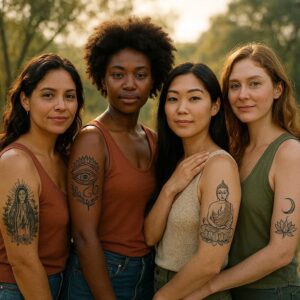
In the quiet hum of the tattoo machine, a modern-day ritual unfolds. For a growing number of women, this is not merely an act of adornment or rebellion. It is a pilgrimage to the self, a deliberate act of inscribing a sacred map onto the canvas of the body. A spiritual tattoo is a covenant between the visible and the invisible—a permanent whisper of a truth too profound to be left unmarked. It is a soul’s signature, a visual prayer, a fragment of a dream given form. This journey into the spiritual meaning of tattoos for women ventures beyond aesthetic trends into the heart of why we mark our skin: to remember, to protect, to heal, to declare, and to connect with something infinitely greater than ourselves. This article is your guide through this labyrinth of meaning, exploring the ancient symbols, elemental forces, and profound personal narratives that transform simple ink into a living, breathing testament to the feminine spirit.
Chapter 1: The Ancient Symbiosis: Woman, Spirit, and Markings
Long before tattoos became a mainstream art form, they were a sacred language. The connection between women, spirituality, and bodily markings is as old as humanity itself. From the priestesses of ancient civilizations to the indigenous healers of tribal lands, women have used tattoos as tools of power, protection, and identity.
In ancient Egypt, clay figurines and mummified remains reveal that women of status, including priestesses, bore tattoos of nets, dots, and figurative patterns. These were not random decorations; they are believed to have been permanent amulets for protection during childbirth and in the afterlife, channeling the divine energy of goddesses like Hathor. Similarly, the Ice Maiden of the Andes, a 2,500-year-old mummy, was found with tattoos on her arms and legs, symbols that likely denoted her high rank as a shaman or a spiritual leader.
Across the Pacific, the Māori women of New Zealand wore the moko kauae, a sacred chin tattoo. Each spiral and curve was a testament to their lineage, social status, and personal achievements. It was not simply applied; it was carved into the skin, a painful and transformative process that was deeply intertwined with their tapu (sacredness) and mana (spiritual power). For these women, the tattoo was the face of their soul, an unchangeable record of their identity and connection to their ancestors.
This historical context is crucial. It reminds us that the modern woman seeking a spiritual tattoo is not engaging in a fleeting trend but is participating in an ancient, cross-cultural tradition. She is reclaiming a practice where the female body is not an object to be judged, but a sacred site of spiritual expression, resilience, and story.
Chapter 2: The Spiritual Archetypes: Symbols for the Feminine Soul
The lexicon of spiritual symbols is vast, but certain motifs resonate with particular depth for the feminine journey. These archetypes speak a universal language, tapping into shared subconscious understandings of growth, protection, and inner power.
2.1 The Lotus: Rising from the Mud
Perhaps no symbol is more quintessential to spiritual tattooing than the lotus flower. Growing in muddy waters, it rises above the murky surface to bloom with remarkable beauty. This journey from darkness to light is a powerful metaphor for the human, and particularly the feminine, experience.
For a woman, a lotus tattoo can represent:
-
Resilience and Transformation: It signifies the ability to overcome challenges, trauma, or “dark” periods in life and emerge stronger, wiser, and more beautiful.
-
Purity and Spiritual Awakening: Despite its origins, the lotus remains pristine. This symbolizes the untouched, pure consciousness within, which remains untainted by life’s difficulties.
-
Fertility and Creation: In many traditions, the lotus is associated with the womb and the creative power of the universe.
-
A Specific Journey: A closed bud might represent potential, a blooming flower signifies enlightenment, and a multi-petaled lotus can represent the expansion of the soul.
A lotus tattoo is a permanent reminder that our greatest growth often comes from our most difficult struggles.
2.2 The Mandala: The Universe Within
Originating from the Sanskrit word for “circle,” the mandala is a complex, geometric design that represents the universe. In Hindu and Buddhist traditions, it is used as a tool for meditation, a visual guide to lead one from the external world to the inner sacred center.
As a tattoo, the mandala holds profound meaning:
-
Wholeness and Harmony: The circular form symbolizes the idea that life is never-ending and everything is connected.
-
Balance: The symmetrical nature of a mandala represents the balance between mind, body, and spirit, as well as the masculine and feminine energies within.
-
The Journey Inward: Creating or focusing on a mandala is a meditative process. Wearing one is a constant invitation to seek your own center, your true self, amidst the chaos of daily life.
-
Impermanence: In a beautiful paradox, the intricate and permanent nature of a mandala tattoo can also be a nod to the Buddhist concept of impermanence—a reminder to appreciate the beauty of the present moment.
2.3 The Tree of Life: Roots and Branches
A symbol found in countless cultures—from Celtic to Norse to Kabbalistic traditions—the Tree of Life is a potent image of connection, growth, and ancestry.
For a woman, a Tree of Life tattoo can symbolize:
-
Connection to All Things: Its roots dig deep into the earth, while its branches reach for the heavens. This represents a woman’s connection to the physical world and her spiritual aspirations.
-
Strength and Growth: The tree withstands storms and seasons, growing stronger over time. It signifies personal strength, resilience, and the ability to adapt and grow.
-
Family and Lineage: The branches and roots can represent one’s family tree—honoring ancestors, celebrating the present family, and symbolizing future generations.
-
Individuality and Rebirth: Each tree is unique, with its own knots and twists, just as every woman has her own unique story. The shedding of leaves and regrowth in spring symbolizes death and rebirth, cycles of renewal in one’s life.
2.4 The Hamsa and Evil Eye: Protection and Intuition
The Hamsa, an ancient talisman depicting an open right hand, is a universal sign of protection. It is known across the Middle East and North Africa, revered in Islam and Judaism alike. The hand often features an eye in the center, the “Evil Eye,” which is believed to reflect negative energy and malice.
A spiritual tattoo of the Hamsa serves as a powerful, permanent shield.
-
Protection from Negativity: It is a guard against the “evil eye”—ill-will, jealousy, or negative energy directed towards you.
-
Blessing and Power: The hand symbolizes the hand of God (or a goddess like Fatima or Miriam), offering blessings, strength, and power.
-
Intuition: The hand is a tool for feeling and sensing. A Hamsa tattoo can be a reminder to trust your intuition, to “feel” the energy around you, and to navigate the world with discernment.
2.5 The Moon and Its Phases: The Cyclical Nature of Womanhood
The moon has long been associated with the feminine divine. Its 28-day cycle mirrors the average woman’s menstrual cycle, creating a deep, intrinsic link between celestial rhythms and the female body.
A moon phase tattoo is rich with spiritual significance:
-
The Triple Goddess: The waxing, full, and waning moons represent the Maiden (youth, new beginnings), the Mother (fertility, power), and the Crone (wisdom, transition).
-
Emotional Tides and Intuition: The moon governs the tides; a moon tattoo can acknowledge the natural ebb and flow of our emotions and intuition, encouraging acceptance rather than resistance.
-
Cycles of Life: It is a reminder that all of life is cyclical—there are times of growth, fruition, release, and rest. This can be a great comfort during difficult times, a promise that “this too shall pass.”
-
The Hidden and the Revealed: The dark side of the moon represents the subconscious, dreams, and the mysteries within, while the illuminated side represents the conscious mind.
2.6 Animals as Spiritual Guides
Animal tattoos, or animal totems, connect the wearer to the specific qualities and wisdom of that creature. This practice is deeply rooted in shamanic and indigenous traditions worldwide.
| Animal Totem | Spiritual Meaning for Women | Key Attributes |
|---|---|---|
| Wolf | Intuition, Loyalty, Freedom, Wild Feminine | Strong connection to instinct, a loyal member of the pack but a fierce individual, teacher, pathfinder. |
| Owl | Wisdom, Mystery, Transition, Seeing the Truth | Ability to see what others cannot, intuition, connection to the hidden realms, messenger between worlds. |
| Butterfly | Transformation, Hope, Rebirth, Soul | Profound personal metamorphosis, emerging from a “cocoon” period with new beauty and lightness. |
| Elephant | Strength, Wisdom, Motherhood, Good Luck | Matriarchal power, fierce protection of family, long memory, dignity, and connection to ancestral knowledge. |
| Deer | Gentleness, Sensitivity, Intuition, Peace | A reminder that true strength lies in gentleness, connection to the heart, grace, and vigilance. |
| Snake | Rebirth, Healing, Transformation, Life Force | Shedding its skin symbolizes healing and renewal; represents Kundalini energy, primal life force, and wisdom. |
| Hummingbird | Joy, Resilience, Love, Lightness of Being | The ability to find sweetness in life, to travel great distances with tireless energy, a symbol of joy and hope. |
Chapter 3: The Elements Etched in Skin: Connecting to Primal Forces
Beyond specific symbols, many women feel a profound connection to the raw, primal energies of the elements. Tattoos representing Earth, Air, Fire, and Water can serve as a powerful grounding and balancing force.
-
Earth (Stability, Nurturing, Abundance): An Earth-element tattoo might depict a mountain (resilience, foundation), a lush forest (interconnection, growth), or simple, grounding patterns. It connects the wearer to the physical plane, promoting a sense of stability, security, and gratitude for the body and nature. It is the element of the nurturer, the mother.
-
Water (Emotion, Intuition, Flow): Represented by waves, the ocean, a calm lake, or flowing lines, Water tattoos honor the emotional and intuitive body. They are a reminder to “go with the flow,” to embrace the depth of our feelings, and to cleanse and release what no longer serves us. It is the element of the psychic, the healer.
-
Fire (Transformation, Passion, Purification): A flame, a sun, a phoenix, or vibrant, warm colors can symbolize the Fire element. This tattoo represents our inner spark, our creative passion, our will, and our capacity for radical transformation. Fire destroys to create anew, making it a powerful symbol for those who have overcome great trials. It is the element of the warrior, the creator.
-
Air (Intellect, Communication, Freedom): Depicted by birds in flight, feathers, clouds, or wind-swept patterns, Air tattoos connect us to the mind, to new ideas, and to the realm of spirit. They encourage clear communication, mental clarity, and a sense of freedom from limiting beliefs. It is the element of the storyteller, the visionary.
A tattoo combining these elements can represent a desire for holistic balance and a connection to the complete cycle of life.
Chapter 4: Sacred Geometry: The Blueprint of Creation
Sacred geometry is the belief that geometric patterns and ratios are the foundation of the universe. These forms are considered sacred because they are seen in everything from the molecular structure of our DNA to the spirals of distant galaxies. Tattoos based on these principles are believed to resonate with the very fabric of reality, bringing their inherent harmony and power to the wearer.
-
The Flower of Life: This complex pattern of overlapping circles is considered one of the most sacred symbols in the universe. It is said to contain the patterns of creation itself, representing the cycle of life and the interconnectedness of all things. A tattoo of the Flower of Life is a powerful statement of unity and cosmic consciousness.
-
The Seed of Life: Found at the heart of the Flower of Life, this symbol of seven interconnected circles represents the seven days of creation. It is a symbol of new beginnings, potential, and the genesis of all life.
-
The Sri Yantra: A complex interlocking of nine triangles (four pointing upward, representing the masculine, and five pointing downward, representing the feminine) surrounded by lotus petals. It is a powerful tool for meditation in Hinduism, representing the union of the divine masculine and feminine and the entire cosmic process. A Sri Yantra tattoo is a profound commitment to spiritual practice and balance.
-
Metatron’s Cube: This complex figure is derived from the Flower of Life and is said to contain all five Platonic Solids—the building blocks of the physical universe. It is often seen as a symbol of protection and a map of the light body, helping to integrate spiritual energy into physical form.
These tattoos are not just aesthetically striking; they are vibrational. They are chosen by women seeking to align their personal energy with the fundamental, harmonious laws of the cosmos.
Chapter 5: Mantras, Sanskrit, and Sacred Script: The Power of the Word
For some, the most direct spiritual connection comes through the written word. Tattooing a mantra, a powerful phrase, or a sacred symbol in its original script is a way to carry a constant prayer or affirmation.
-
Sanskrit: As the ancient liturgical language of Hinduism and Buddhism, Sanskrit is considered a vibrational language. Each character is believed to hold a specific energy. Popular Sanskrit tattoos include “Om” (the primordial sound of the universe), “So Hum” (“I am That,” signifying unity with the divine), “Sat Nam” (“Truth is my identity”), and “Aham Prema” (“I am Divine Love”).
-
Mantras and Affirmations: A personal mantra, whether in English or another language, can be a powerful tattoo. Phrases like “I am enough,” “Be here now,” “This too shall pass,” or “Trust the journey” serve as permanent, visual anchors to return to during moments of doubt or stress.
-
Runes and Ogham: Ancient alphabets like the Norse Runes or Celtic Ogham were not just for writing; each character was a sacred symbol with its own magical and divinatory meaning. A single rune, such as Algiz (protection) or Berkana (new beginnings), can be a potent, minimalist spiritual tattoo.
The act of choosing and wearing such a word is an act of embodiment. It is a declaration that this truth is now an inseparable part of you.
Chapter 6: The Ritual of Receiving: Tattooing as a Ceremony
The process of getting a spiritual tattoo can be as meaningful as the design itself. Transforming this experience from a commercial transaction into a personal ceremony deepens its spiritual impact.
-
Setting Intention: Before the appointment, spend time in meditation or journaling. Clarify your “why.” What does this symbol mean to you? What energy are you inviting in? What are you releasing? Write this intention down or hold it in your heart.
-
Creating Sacred Space: Speak with your tattoo artist beforehand. A spiritually-attuned artist will understand and respect your process. You can bring crystals, play meditative music, or diffuse essential oils in the room to alter the atmosphere.
-
Breathwork and Meditation: During the tattooing process, the pain can be used as a tool for transformation. Instead of resisting, focus on your breath. With each needle stroke, visualize your intention being sealed into your skin. Use the discomfort as a focus for meditation, releasing old energies with each exhalation.
-
Post-Tattoo Integration: The healing period is a crucial part of the ritual. As you care for your new tattoo—cleaning it, applying ointment, protecting it from the sun—see it as a period of nurturing your new intention. This is the time when the symbol integrates not just with your skin, but with your spirit.
By approaching the act with this level of consciousness, you transform the tattoo from an image you have into an experience you lived and a transformation you embody.
Chapter 7: Placement and Power: Mapping Energy on the Body
In many spiritual traditions, such as Yoga and Ayurveda, the body is seen as a map of energy centers known as chakras. The placement of a spiritual tattoo can be used to activate, balance, or protect a specific energy center.
-
Third Eye (between the eyebrows): Placement for symbols of intuition, wisdom, and spiritual sight (e.g., an eye, a moon, a small mandala).
-
Throat (neck/throat): Ideal for tattoos related to communication, truth, and self-expression (e.g., words, feathers, air symbols).
-
Heart (center of chest): The seat of love and compassion. Perfect for lotus flowers, the Tree of Life, or symbols of loved ones.
-
Sacral (lower abdomen): The center of creativity, passion, and pleasure. Water symbols, flowing designs, or fiery embers are powerful here.
-
Root (base of spine, ankles, feet): For grounding, stability, and connection to the Earth. Mountain symbols, elephants, or geometric earth-toned patterns.
-
Back/Spine: A large canvas for complex pieces like a full mandala or a spine tattoo that aligns with all the chakras.
-
Arms and Hands: For outward expression and action. Tattoos on the hands can symbolize the work you do in the world, while forearm tattoos are constant reminders you can see.
-
Ribcage: A private, intimate placement often chosen for tattoos with deeply personal, protective, or empowering meanings, held close to the core.
Choosing a placement is not just about visibility; it’s about energetically aligning your intention with the power center of your body.
Chapter 8: A Tapestry of Traditions: Cultural Spiritual Tattoos
It is of paramount importance to approach cultural tattoo traditions with the utmost respect and awareness. Many sacred symbols are part of living, breathing cultures that have endured colonialism and oppression. Adopting these symbols without understanding their context or without a right to wear them is cultural appropriation.
-
Sak Yant (Thailand/Cambodia): These are sacred geometric tattoos traditionally applied by Buddhist monks or ajarns using a long metal rod. Each Yantra design is imbued with specific blessings, protection, and power. It is a serious spiritual commitment, often involving precepts to follow.
-
Ta Moko (Māori): As mentioned, this is a sacred marker of identity. For a non-Māori person to wear these patterns is a profound disrespect.
-
Filipino Tribal Tattoos (Batok): Practiced by the Kalinga and other tribes, these tattoos are earned marks of status, bravery, and life story. The last traditional mambabatok (tattoo artist), Apo Whang-Od, has brought global attention to this dying art form.
-
Buddhist and Hindu Iconography: Images of Buddha, Hindu deities like Ganesha or Lakshmi, are deeply religious figures. Tattooing them below the waist or in a disrespectful context can be highly offensive to adherents.
If you are drawn to a symbol from a culture not your own, the spiritual path is one of deep research, humility, and, if possible, seeking permission or learning from authentic sources within that culture. The most respectful choice is often to find a universal symbol or a personal archetype that expresses a similar meaning without overstepping cultural boundaries.
Chapter 9: Designing Your Spiritual Tattoo: A Guide to Intentionality
Creating your spiritual tattoo is a journey in itself. Here is a practical guide to ensuring the final artwork is a true reflection of your spirit.
-
Look Inward, Not Just Online: Before scrolling through Pinterest, spend time in reflection. What is the core feeling, memory, or principle you want to capture? Journal about it. This is your “why.”
-
Research Symbolism Deeply: Don’t just settle for the first Google result. Understand the history, cultural context, and multiple layers of meaning behind your chosen symbol.
-
Find the Right Artist: Look for an artist whose style resonates with you and who shows respect for spiritual or custom work. Schedule a consultation to discuss your intention and ensure you have a good rapport.
-
Collaborate on the Design: Provide your artist with your ideas, references, and the story behind the tattoo. A good artist will synthesize this into a unique, beautiful design that carries your energy.
-
Sleep On It: Once you have the design, live with it for a few days. Does it still feel right? Does it evoke the feeling you intended? This pause ensures no regrets.
-
Prepare for the Ritual: Follow the steps in Chapter 6 to prepare your mind, body, and spirit for the tattooing process.
Conclusion: The Living Altar
A spiritual tattoo is a landmark on the map of your becoming. It is a declaration of survival, a whisper of the divine, a shield of personal truth. It transforms the skin into a living altar, a permanent site of reverence for the journey of the soul. In choosing to mark yourself with meaning, you do not alter your essence; you make the invisible, visible. You wear your soul on your sleeve, your back, your heart—a constant, beautiful reminder that you are a story, still being written.
Frequently Asked Questions (FAQs)
Q1: Is it disrespectful to get a spiritual symbol from a culture I wasn’t born into?
A: It can be. The key is intention, context, and respect. Using a closed, sacred practice (like Māori Ta Moko) is appropriation. Using a universal symbol (like a lotus) is generally acceptable. Always research deeply, understand the symbol’s significance, and when in doubt, choose a more personal or universal design or consult with members of that culture.
Q2: I’m worried about the pain. Can I still have a meaningful spiritual tattoo?
A: Absolutely. The pain is part of the ritual for many, but it is not a requirement for spiritual validity. You can choose a less sensitive area (like the forearm or calf), start with a small tattoo, or discuss numbing options with your artist. The intention behind the tattoo is what gives it power, not the amount of pain endured.
Q3: How do I explain the meaning of my spiritual tattoo to others?
A: You are under no obligation to explain your tattoo to anyone. It is a personal covenant. If you choose to share, you can offer a simple, concise explanation (e.g., “It’s a symbol of my strength,” or “It represents a important journey I’ve been on”). You control the narrative.
Q4: Can a tattoo really have protective or empowering energy?
A: The power lies in your belief and the intention you assign to it. A symbol acts as a psychological anchor. Every time you see your Hamsa tattoo, you are reminded of your boundaries and safety, which empowers you to act accordingly. In this way, the tattoo becomes a self-fulfilling prophecy of protection and strength.
Q5: What if my spiritual beliefs change after I get the tattoo?
A: Your tattoo is a marker of who you were at a specific moment in your journey. It is a chapter in your story, not the whole book. You can choose to see it as a beautiful reminder of your past growth, have it covered with a new symbol that reflects your current beliefs, or even have it modified. It remains a part of your history.