In the hushed, moonlit corner of a room, a solitary architect works in silent dedication. From the depths of its own being, it draws out a silken thread, weaving an intricate, geometric tapestry that glistens with morning dew. To many, this creature—the spider—inspires a visceral reaction of fear and revulsion. Its many legs, its swift, unpredictable movements, and its venomous potential have cemented its place in our collective nightmares. But to look upon the spider with only fear is to overlook one of the most ancient and profound spiritual teachers on Earth.
For millennia, across every inhabited continent, humanity has recognized the spider not as a mere pest, but as a powerful symbol of cosmic order, creative power, and the delicate balance of life and death. It is the master weaver, the storyteller, the fate-spinner, and the guardian of ancient wisdom. This article is an invitation to look past the initial startle, to peer into the center of the web and meet the eight-legged sage. We will embark on a detailed journey through myth, symbolism, and personal encounter to unravel the rich spiritual meanings of the spider. We will explore how this humble arachnid can teach us about our own creativity, our connection to the universe, and our power to weave the very fabric of our destiny.
Chapter 1: The Primordial Weaver – Spiders in Global Mythology and Folklore
The spider’s spiritual significance is not a modern New Age invention; it is woven into the very foundation of human culture. By examining the myths and legends of old, we begin to see a consistent archetype emerge—that of a powerful, creative, and often cunning force.
The Spider Woman of Native American Traditions
In the rich tapestry of Native American cosmology, Spider Woman (also known as Grandmother Spider or Spider Grandmother) is a central and revered creator deity, particularly among the Navajo, Hopi, and Pueblo peoples. She is the weaver of the world, the one who spun the cosmos into existence. In the Navajo creation story, it was Spider Woman who taught the people the sacred art of weaving, a skill that is both practical and deeply spiritual, representing the interweaving of body, mind, and spirit.
She is often depicted as a wise, benevolent grandmother figure who possesses immense power. She not only created the world but also serves as a protector and a guide for heroes, offering wisdom and saving them from peril with her silk. Her role emphasizes creativity, feminine power, and the interconnectedness of all life through the great web she wove.
Anansi the Trickster: Wisdom from West Africa and the Caribbean
From the Akan people of West Africa comes Anansi, the trickster god who most often takes the form of a spider. Anansi is a complex figure—clever, cunning, and sometimes greedy, but ultimately a bringer of wisdom and stories to humanity. He does not create the world through sheer power like Spider Woman; instead, he uses his wit to outsmart larger, stronger opponents, including the sky god Nyame, from whom he wins all the stories in the world.
The tales of Anansi, which spread to the Caribbean and the Americas via the transatlantic slave trade, are more than just entertaining fables. They are teaching tools that convey lessons about resourcefulness, the power of the underdog, and the importance of intelligence over brute force. Anansi represents the creative power of the mind and the spoken word, reminding us that our greatest asset is our ingenuity.
Arachne of Greece: The Price of Pride and the Gift of Transformation
Greek mythology offers a cautionary tale about the spider through the story of Arachne, a mortal woman of humble birth who possessed a transcendent talent for weaving. Her tapestries were so exquisite that nymphs would travel to watch her work. Filled with pride, Arachne boasted that her skill was greater than that of Athena, the goddess of wisdom and crafts. Enraged, Athena challenged Arachne to a contest.
When Athena could find no flaw in Arachne’s flawless, beautiful tapestry—a tapestry that depicted the failings of the gods—she flew into a vengeful rage and destroyed it. In despair, Arachne hanged herself. But Athena, feeling a pang of pity, transformed her into a spider, condemning her and all her descendants to hang and weave for all eternity.
The story of Arachne is rich with spiritual meaning. It speaks to the dangers of hubris and challenging the divine order. Yet, it also speaks of transformation and the immortality of art and creativity. Even in her new form, Arachne’s essence—her need to weave—remained. She became the embodiment of her own craft, a eternal reminder that our gifts are both our glory and our potential downfall if not tempered with humility.
Spiders in Eastern Philosophies: Weavers of Illusion and Patience
In Hindu philosophy, the spider is a powerful symbol for the divine. The supreme god Brahman is sometimes depicted as the spider that spins the web of the universe (Maya) from its own substance and then withdraws it back into itself. The web is the illusion of the material world, and we are the beings caught in it, forgetting our true, unified nature. The spider, therefore, represents both the creator and the creation.
In Buddhism, patience and mindful action are paramount virtues. The spider exemplifies this. It does not chase its prey frantically; it builds a perfect, patient structure and waits with stillness and awareness. Its web is a testament to the power of right effort and the importance of creating the right conditions for sustenance and success, rather than forcing outcomes.
Chapter 2: The Anatomy of Symbolism – Decoding the Spider’s Form
Every physical aspect of the spider is a repository of symbolic meaning. By understanding its anatomy, we can decode the deeper messages it carries.
The Eight Legs: A Bridge to the Mystical Octagon
The spider’s eight legs are its most distinctive feature. In numerology, the number eight is the number of infinity, balance, and cosmic order. It represents the cyclical flow of energy, the constant give and take of the universe. The eight legs can be seen as anchoring the spider to the four cardinal directions and the four intermediate directions, making it a creature perfectly balanced in the center of its world.
This connects to the concept of the medicine wheel, the eight-fold path in Buddhism, and the symbol of the octagon as a transitional shape between the square (earth) and the circle (heaven). The spider, with its eight legs, is a master navigator of both the physical and spiritual realms, a bridge between worlds.
The Spider’s Eyes: Seeing the Unseen Worlds
Most spiders have eight eyes, arranged in unique patterns. This multitude of eyes symbolizes panoramic perception, heightened awareness, and the ability to see in all directions at once. Spiritually, this translates to:
-
Clairvoyance: The ability to see the unseen, the future, or the spiritual dimensions.
-
Multi-perspective Thinking: The capacity to see a situation from many different angles, avoiding a narrow or biased view.
-
Vigilance and Protection: The spider is ever-watchful, aware of the slightest vibration in its web. As a spiritual symbol, it encourages us to be mindful of the subtle energies and vibrations in our own lives.
Venom and Fangs: The Alchemy of Shadow and Healing
The spider’s venom is a potent symbol of shadow work and transformation. Venom can paralyze and digest, but in the right context, it can also heal. Modern medicine researches spider venom for its potential in treating conditions like stroke and pain.
Spiritually, the venom represents:
-
The Power of the Shadow: The parts of ourselves we fear or reject, which, when integrated, can become a source of immense power and healing.
-
Alchemical Transformation: The process of “digesting” our painful experiences and traumas to transform them into wisdom and strength.
-
Boundaries: The fangs are a defense mechanism, reminding us that it is necessary and healthy to have boundaries and to “bite back” when our personal space is violated.
The Masterful Web: The Ultimate Symbol of Interconnectedness
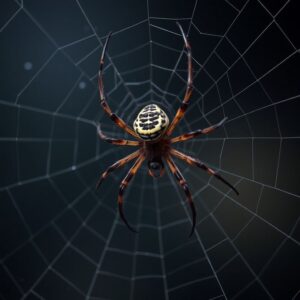
The web is the spider’s masterpiece and its most profound spiritual teaching. It is a perfect, radial mandala, a symbol of the universe itself.
-
The Center Point: The spider sitting at the center of its web represents the Self, the soul, or the divine center from which all of life emanates.
-
The Radial Threads: These are the paths of destiny, the choices, and the events that lead from the center outward and back again.
-
The Spiral Threads: These represent the cyclical nature of life—the seasons, birth, death, and rebirth.
The web teaches us that every thought, word, and action sends a ripple through the entire structure of our reality. We are all connected, and what we do to others, we ultimately do to ourselves. The spider is the conscious architect of this web, reminding us that we, too, are the weavers of our own lives.
Chapter 3: The Loom of Creation – The Spider as a Cosmic Archetype
Beyond specific myths, the spider functions as a universal archetype in the human psyche, representing fundamental creative and cosmic forces.
The Great Mother and the Weaver of Destiny
The spider is a powerful symbol of the Great Mother in her triple aspect: Maiden, Mother, and Crone.
-
The Maiden: Spins the potential of new life.
-
The Mother: Weaves the tapestry of existence, nurturing and sustaining it.
-
The Crone: Cuts the thread of life, representing death and the end of cycles, but also the wisdom that comes with it.
This archetype positions the spider as the ultimate weaver of fate, not as a punishing judge, but as the source and sustainer of life itself. She weaves the destiny of all beings, and her web is the fabric of time and space.
The Web of Wyrd: Fate, Time, and Interconnectedness
In Norse mythology, the concept of the Web of Wyrd (Ørlag) is a powerful symbol of fate. This web was woven by the Norns—the three goddesses of destiny—and connected all beings, gods, and worlds. Each person’s life was a thread in this great tapestry, and the actions of one would vibrate through the entire web, affecting all others.
The spider is the living embodiment of this concept. It does not merely live in the world; it actively weaves its world. This teaches a proactive spirituality: we are not passive victims of fate, but active participants in co-creating our reality with the divine.
Chapter 4: A Tapestry of Encounters – Spider Symbolism by Color
The color of a spider you encounter can add a specific layer of meaning to its message.
The Black Spider: Shadow Work and the Mysterious Unknown
The black spider is the most common and often the most feared, yet its message is profound. It calls you to confront your shadow self—the repressed fears, desires, and traumas you keep hidden. It is a symbol of the mysterious feminine, the void from which all creation springs. Encountering a black spider is an invitation to dive deep into your own psyche to reclaim your hidden power.
The Brown Spider: Grounding, Stability, and Connection to Earth
Brown is the color of the earth, stability, and the material world. A brown spider sighting is a gentle reminder to stay grounded. It may appear when you are feeling flighty, uncentered, or too focused on the spiritual at the expense of the physical. It encourages you to build a stable foundation for your life and to connect with nature.
The White Spider: Purity, New Beginnings, and Spiritual Blessings
White spiders are rare and carry a potent energy of purity and new beginnings. They symbolize a spiritual awakening, a cleansing of old patterns, and the blessing of a fresh start. Seeing a white spider can be a sign that you are being protected by spiritual forces and that your path is being cleared of negativity.
The Golden Spider: Solar Energy, Wealth, and High Vibrations
A golden or yellow spider is infused with the energy of the sun. It is a powerful omen of creativity at its peak, manifestation, abundance, and intellectual growth. It encourages you to tap into your personal power and to shine your light brightly. It is a sign of success, vitality, and the attraction of wealth on all levels.
Chapter 5: When the Weaver Appears – Interpreting Spider Encounters and Omens
Context is everything. Where and how you see a spider provides the crucial details for interpreting its message.
Seeing a Spider in Your Home: A Message for Your Personal World
Your home is a reflection of your inner state. A spider in your house is a direct message about your personal life, family, and inner world. It often signifies that creativity is “coming home to you.” It may be a sign to pay attention to the weaving of your family dynamics or the creation of a harmonious domestic environment.
The Spider Descending: Opportunities and Divine Intervention
When a spider descends on its silk right in front of you, it is one of the most dramatic and significant omens. The silk represents a connection from the higher realms (spirit) to the earthly realm (you). This is often interpreted as a golden opportunity descending into your life, a stroke of luck, or a direct message from the universe. Pay close attention to your thoughts and surroundings when this happens.
The Spider Ascending: Manifestation and Rising Consciousness
A spider climbing upward signifies that your efforts are paying off. Your ideas and projects are gaining traction and moving toward manifestation. It can also symbolize a rise in your own consciousness, an elevation of your thoughts and spiritual awareness.
Spider on Your Body: A Direct Personal Message
When a spider makes physical contact, the message is intensely personal and urgent. The location on your body adds further meaning:
-
On your hand: Your creative actions are blessed; pay attention to what you are “handling.”
-
On your head/hair: A powerful download of creative ideas or a need to change your thinking.
-
On your clothing: The message relates to your identity and how you present yourself to the world.
Killing a Spider: Interpreting an Act of Fear or Necessity
From a spiritual perspective, killing a spider is not “bad luck” in a superstitious sense. Rather, it is seen as severing a creative connection or rejecting a message from the universe out of fear. It may symbolize a period where you are “killing” your own creativity or ignoring the call to confront your shadow. However, sometimes it is a simple act of necessity, especially if the spider is venomous and a threat to your safety. The intention behind the act is what matters most.
Chapter 6: The Spider as a Spirit, Totem, and Power Animal
The spider can relate to a person’s spiritual life in three distinct but overlapping ways.
Spider as a Spirit Guide: Communicating with the Weaver
A spirit guide is a non-physical entity that offers wisdom and protection. If Spider is your spirit guide, you may feel a strong, lifelong connection to this archetype. You might dream of spiders, see them frequently in synchronistic ways, or feel a natural draw to their energy. This guide teaches the arts of manifestation, patience, and understanding the interconnectedness of all things.
Spider Totem Animal: Your Innate Gifts and Life Path
Your totem animal represents your core spirit and innate talents. If you have a Spider totem, you are likely a natural creator, storyteller, or artist. You understand the power of language and networks. You are likely highly sensitive to the “vibrations” of people and environments. Your life path involves learning to weave your reality consciously and understanding the profound impact of your actions.
Spider Power Animal: Invoking Energy for Specific Needs
You can call upon the energy of Spider as a power animal in specific situations. Invoke Spider when you:
-
Need a burst of creativity for a project.
-
Are building a business or social network.
-
Need to be more patient and strategic.
-
Are working on understanding your shadow self.
-
Need to see the bigger picture and how all the parts of a situation connect.
Chapter 7: The Shadow in the Web – Fear, Phobia, and Negative Perceptions
A balanced view of the spider must acknowledge its shadow aspects and the reasons for our fear.
Understanding Arachnophobia from a Spiritual Perspective
Arachnophobia, the intense fear of spiders, is one of the most common phobias. From a spiritual perspective, this is not random. It can stem from:
-
Past-Life Trauma: A traumatic event involving spiders or similar creatures in a past life.
-
Collective Unconscious: The archetype of the spider also has a dark side—the devouring mother, the weaver of traps—and this is ingrained in our species’ memory.
-
Fear of the Shadow Self: The spider represents everything we fear within ourselves: our hidden complexities, our potential for “venom,” and the parts of our psyche that feel alien and uncontrollable.
The Spider as a Harbinger of Deceit and Entrapment
In some cultural contexts, the spider web is a symbol of entrapment, deceit, and sticky situations. To dream of being caught in a web can indicate feeling trapped in a relationship, job, or cycle of negative thinking. A spider can symbolize a person in your life who is manipulative and “weaving a web” of lies. This is the inverse of the creative web; it is the web of manipulation and control.
Balancing Light and Shadow: Integrating the Spider’s Lesson
The spiritual goal is not to reject the spider’s shadow but to integrate it. The same web that can trap also provides sustenance. The same venom that can harm can also heal. By facing our fear of the spider, we face the parts of ourselves we have rejected. In doing so, we reclaim our wholeness and our full creative power.
Chapter 8: Weaving Your Own Web – Practical Applications and Meditations
The wisdom of the spider is not just for contemplation; it is for active application in our lives.
A Meditation to Connect with Spider Energy
-
Find a quiet space and sit comfortably. Close your eyes and take several deep breaths.
-
Imagine yourself in a peaceful, natural setting. In front of you, you see a beautiful, intricate spider web glistening with light.
-
At the center of the web, you see a luminous, benevolent spider. It is not frightening; it is wise and ancient.
-
In your mind, ask the spider: “What is the next thread I need to weave in the tapestry of my life?” or “What part of my web needs mending?”
-
Sit in silence and listen. You may receive an image, a word, a feeling, or a knowing.
-
Thank the spider for its wisdom. Gently bring your awareness back to your breath and open your eyes.
Creating a Personal Web of Intentions
This is a powerful ritual for manifestation.
-
You will need: A piece of paper, a pen, and some string or yarn.
-
On the paper, write your central goal or core identity (e.g., “I am a published author”) in the center.
-
From this center, draw lines outward. On each line, write a specific, actionable step that will lead to that goal (e.g., “Write 500 words daily,” “Research publishers,” “Join a writer’s group”).
-
Now, take the string and physically connect these radial lines in a spiral, weaving your own web of intention. As you weave, visualize each action leading to the fulfillment of your central goal.
-
Place your web in a sacred space where you can see it daily.
Honoring the Spider in Daily Life
-
When you see a spider in your home, instead of killing it, gently capture it and release it outside, thanking it for its message.
-
Engage in creative acts with mindfulness, seeing yourself as a weaver.
-
Practice seeing the connections between events in your life, understanding that nothing happens in isolation.
Chapter 9: A Comparative Table of Spider Symbolism
The following table provides a concise overview of the spider’s spiritual meanings across different cultures and aspects.
| Aspect / Culture | Core Symbolism | Key Lesson |
|---|---|---|
| Native American (Spider Woman) | Creation, Wisdom, Teaching, Protection | We are all connected in the great web of life. Creativity is a sacred act. |
| West African (Anansi) | Trickery, Storytelling, Intelligence, Wisdom | Use your wit and resources to overcome challenges. Stories hold power. |
| Ancient Greek (Arachne) | Supreme Skill, Hubris, Transformation | Humility is the companion to great talent. Creativity can survive transformation. |
| Hinduism (Brahman) | The Divine Creator, Maya (Illusion) | The universe is a manifestation of the divine. We are part of a greater whole. |
| General Symbolism (The Web) | Interconnectedness, Fate, Personal Reality | Your thoughts and actions create the reality you experience. |
| General Symbolism (Venom) | Shadow Work, Transformation, Healing | That which seems poisonous can, when integrated, become a source of power and healing. |
Conclusion: The Eternal Weaver
The spider is the silent architect in the corner of existence, weaving the threads of destiny.
It teaches us that we are the conscious creators of our own lives, connected to all things.
By embracing its wisdom, we learn to weave with intention, patience, and a profound understanding of the interconnected whole.
Frequently Asked Questions (FAQs)
Q1: Is seeing a spider a good omen or a bad omen?
A: It is overwhelmingly a positive omen, symbolizing creativity, opportunity, and the weaving of your fate. However, its specific meaning depends on the context, your feelings, and the type of encounter. It can sometimes warn of a “sticky situation” or the need for shadow work.
Q2: What does it mean to dream about spiders?
A: Spider dreams are profoundly symbolic. They can represent:
-
Creativity: Weaving new ideas or projects.
-
Feeling Trapped: Being caught in a web of circumstances.
-
The Feminine: Connecting with the Great Mother archetype.
-
Shadow Self: Confronting fears or hidden aspects of your personality.
-
Manipulation: Feeling that someone is “weaving a web” of deceit around you.
Q3: I have a huge fear of spiders. How can I benefit from their spiritual meaning?
A: Start gently. Begin by learning about them from a distance—read their myths and look at pictures of their beautiful webs. Acknowledge that your fear may be a spiritual signal pointing to a part of yourself you need to integrate. The very act of facing this fear, even intellectually, is a powerful step in shadow work and personal growth.
Q4: What should I do if I keep finding spiders in the same place in my house?
A: Pay close attention to the location. For example, a spider consistently in your bedroom could be a message about the need for creativity or harmony in your rest and relationships. A spider in your office might be encouraging you to “weave” a better career or business network. See it as a persistent message about that specific area of your life.
Q5: Is the “Itsy Bitsy Spider” nursery rhyme spiritually significant?
A: While not written as a spiritual allegory, it can be interpreted as one. It tells a story of perseverance. The spider (your spirit) faces a setback (the rain/washing the web away), but the sun (divine energy/opportunity) returns, and the spider climbs again. It’s a simple tale of resilience and the unwavering determination to rebuild and continue your path.