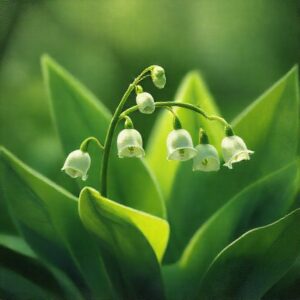
Beneath the dappled shade of springtime forests, a humble yet potent magic stirs. From a carpet of broad green leaves, slender stems rise, adorned with a row of exquisite, pearlescent bells. This is Convallaria majalis, the Lily of the Valley—a flower whose delicate beauty belies a deep and complex soul. More than just a herald of May, it is a botanical talisman, a vessel of ancient lore, and a key to understanding subtle spiritual truths. To encounter it is to hear a whisper from the divine, a gentle chime calling us back to purity, love, and the return of light after a long darkness.
This article is a grimoire of the spirit, a deep dive into the multifaceted spiritual essence of this enchanting plant. We will journey through its sacred history, decode its symbolic language across cultures, unravel its place in myth and legend, and learn how to integrate its gentle, protective, and heart-opening energy into our modern spiritual practices. Prepare to see this familiar garden flower in a radically new, luminous light.
1. Introduction: A Chime in the Silence
There is a unique quality to the Lily of the Valley that transcends its visual charm. Its intoxicating fragrance—sweet, green, and profoundly evocative—carries the very essence of renewal. It does not shout its presence like the bold rose or the sun-seeking sunflower. Instead, it whispers. It is a flower of the in-between spaces: between forest and field, between April and May, between the earthly and the ethereal. This subtlety is the source of its profound spiritual power. In a world often dominated by noise and haste, the Lily of the Valley invites us to slow down, to bend low, and to listen carefully. Its downward-facing bells seem to channel messages from a higher realm directly into the heart of the earth, and into the hearts of those attuned to its frequency. To understand this flower is to learn the language of gentle strength, of humble power, and of the quiet, unwavering return of hope.
2. A Botanical Portrait: The Delicate Vessel of Power
Before we can fully grasp its spiritual significance, we must appreciate its physical form, for in nature, spirit and matter are inextricably linked. Lily of the Valley is a perennial plant that spreads via underground rhizomes, forming vast colonies over time. This very nature speaks to its spiritual meaning of community, resilience, and the quiet, persistent spreading of influence.
Its leaves, typically two per stem, are broad, lance-shaped, and exhibit a deep, glossy green. They act as a perfect backdrop and a nurturing cradle for the flowers. Botanically, these “bells” are not single flowers but a raceme, a cluster of 5 to 15 individual, pendulous, fragrant florets. Each floret is a perfect, six-tepaled bell, most commonly pure white, though pink varieties exist. This bell shape is crucial to its symbolism—it is an instrument of sound, a receiver and amplifier of subtle vibrations. After flowering, the plant produces small, red-orange berries, which, like all parts of the plant, are highly toxic. This duality—innocent beauty concealing potent poison—is a central theme in its spiritual narrative, which we will explore in depth.
3. Echoes from the Past: Lily of the Valley in Ancient Myth and Folklore
The spiritual legacy of Lily of the Valley is woven into the fabric of human history, appearing in the sacred stories of multiple cultures.
Christian Lore: The Tears of Mary and the Ladder to Heaven
In Christian legend, the Lily of the Valley is known as “Our Lady’s Tears” or “Mary’s Tears.” The story goes that when the Virgin Mary wept at the foot of the cross during Christ’s crucifixion, her tears, upon touching the earth, were transformed into these pure, bell-shaped flowers. This origin story imbues the plant with profound connotations of maternal grief, profound sorrow, and the sanctification of tears. It symbolizes the idea that from the deepest pain can spring forth exquisite beauty and purity.
Another Christian interpretation sees the row of bells as a “Ladder to Heaven,” a celestial staircase that allows the prayers of the faithful to ascend to God, and divine blessings to descend to humanity. This reinforces its role as a mediator between the earthly and the divine realms.
Germanic and Celtic Traditions: Ostara’s Bell and the Portal to the Fae
In pre-Christian European traditions, the Lily of the Valley was sacred to Ostara, the Germanic goddess of the dawn and spring. The flower was seen as a symbol of the returning sun, the victory of light over the dark winter. Its blooming coincided with Ostara’s festival, which later influenced the traditions of Easter. It was a talisman of fertility and new beginnings.
In Celtic lore, which holds a deep reverence for the natural world as alive with spirit, the Lily of the Valley was considered a key to the realm of the Fae. Its hidden, woodland nature and enchanting scent made it a favorite of the fair folk. It was believed that the bells would ring to summon fairies to their moonlit revels. To pick the flower required permission and respect, lest one incur the wrath of its otherworldly guardians. This connects the plant to themes of enchantment, hidden worlds, and the importance of approaching the sacred with a respectful heart.
A Muse for Royals and Artists: The Flower of May Day
The flower’s association with happiness and good luck made it a favorite of European royalty. It is famously known as the favorite flower of Queen Victoria and has been a staple in royal wedding bouquets, including that of Kate Middleton, to bestow luck and happiness upon the marriage.
Since the Renaissance in France, it has been traditional to offer a sprig of Muguet (Lily of the Valley) on the first of May as a token of affection and a charm for good fortune for the coming year. This custom solidifies its status as a powerful symbol of affection, celebration, and the hopeful spirit of spring.
4. The Core Spiritual Meanings: Decoding the Symbolic Language
Having traced its historical roots, we can now distill the core spiritual meanings that have made Lily of the Valley an enduring symbol.
Purity, Chastity, and a Return to Innocence
The pristine white color of the flowers is the most immediate signal of its connection to purity. This is not a purity of naivete, but one that has been tested and refined. Like the Christian legend of Mary’s tears, it represents a purity that can exist alongside and even be born from profound sorrow. It symbolizes a cleansing of the spirit, a washing away of psychic grime, and a return to a state of inner clarity and innocence. Meditating on the image of Lily of the Valley can help to purify one’s intentions and cleanse the aura of negative attachments.
Happiness and the Sweet Return of Joy
The scent of Lily of the Valley is universally described as uplifting and joyful. Spiritually, it is a direct antidote to melancholy and despair. It carries the vibrational frequency of “the return of happiness,” much like the sun returning after a storm. It reminds us that no winter, whether in nature or in our souls, lasts forever. Keeping the flower in one’s home or using its scent in aromatherapy (through safe, synthetic recreations, as the essential oil is toxic) can act as a powerful tool to elevate the mood and attract joyful experiences.
Motherhood, Nurturing, and the Sacred Feminine
With its strong link to the Virgin Mary and its gentle, nurturing appearance, the Lily of the Valley is a potent symbol of the Divine Mother aspect of the Sacred Feminine. It represents unconditional love, protection, and the fierce, gentle strength of motherhood. The way the leaves cradle the flowering stalk is a beautiful botanical representation of this nurturing energy. It can be used in rituals or meditations aimed at healing one’s relationship with the mother archetype, connecting with one’s own nurturing instincts, or seeking comfort and protection from the Divine Mother.
Protection Against Evil and Negative Energies
Despite its delicate appearance, Lily of the Valley has long been considered a powerful protective herb. In folklore, it was planted around homes to ward off evil spirits and negative influences. Its toxic nature was seen as a deterrent to malicious entities. Spiritually, it is believed to create a subtle, high-vibrational barrier that repels lower energies, psychic attacks, and ill wishes. A dried sprig placed above a doorway or an image of the flower on an altar can serve as a gentle yet effective protective talisman.
Good Luck and a Harbinger of Prosperity
The long-standing tradition of giving Muguet on May Day for good luck is rooted in a deep spiritual belief in the plant’s ability to attract fortunate circumstances. It is seen as a magnet for abundance, not just in material wealth, but in love, health, and opportunities. Finding one in bloom was considered an omen of a prosperous and joyful season to come.
Humility and the Power of the Unseen
The flower’s downward gaze and its habit of growing in shaded, hidden places is a masterclass in spiritual humility. It does not seek the spotlight. Its power is not in domination but in gentle persuasion, not in loud proclamation but in a sweet, pervasive fragrance that fills a space without announcement. It teaches us that true spiritual strength often lies in quietude, receptivity, and the humble offering of one’s gifts without expectation of praise.
5. The Duality of Light and Shadow: A Cautionary Tale
No spiritual exploration is complete without acknowledging the shadow side. The Lily of the Valley is a perfect embodiment of nature’s duality. It is breathtakingly beautiful and fragrant, yet every part of the plant contains potent cardiac glycosides that can cause serious illness or death if ingested.
The Poison Within: A Symbol of Hidden Dangers and Necessary Boundaries
Spiritually, this toxicity is a powerful metaphor. It reminds us that not everything beautiful is safe, and not everything that appears gentle is without power. It is a lesson in discernment—the ability to appreciate beauty while respecting its potential dangers. This can be applied to situations, relationships, or even spiritual paths that may seem alluring on the surface but contain hidden toxins for the soul. The Lily of the Valley teaches us to set healthy boundaries, to admire from a respectful distance when necessary, and to integrate our own “shadow” aspects—the powerful, potentially dangerous parts of ourselves that require awareness and conscious control.
The Bittersweet Scent: Nostalgia, Loss, and the Passage of Time
Its intensely evocative scent often triggers powerful memories. For many, it is the scent of a grandmother’s garden, a lost spring, a bygone era. This connects the flower to the spiritual themes of nostalgia, the bittersweet nature of memory, and the poignant awareness of life’s fleeting beauty. It reminds us to cherish the present moment, for like the brief blooming period of the Lily of the Valley, our most precious experiences are transient.
6. Lily of the Valley in Dreams and Intuition: Messages from the Subconscious
To dream of Lily of the Valley is a significant message from your subconscious or spiritual guides. The context of the dream is key.
-
Dreaming of a Healthy, Blooming Plant: This is a powerfully positive omen. It suggests that a period of happiness, purity, and good fortune is on the horizon. It may indicate the return of joy after a difficult time, a new beginning in love or creative endeavors, or a need to embrace simplicity and innocence.
-
Dreaming of Picking the Flowers: This can symbolize that you are ready to accept the happiness and good luck being offered to you. It is an act of claiming your joy.
-
Dreaming of Wilting or Dying Lily of the Valley: This may be a warning that a source of happiness in your life is fading, or that you are neglecting your own purity and well-being. It can signal disappointment or a missed opportunity for joy.
-
Dreaming of Being Surrounded by Its Scent: This points to a deep, intuitive awakening. Your subconscious is urging you to trust your instincts and pay attention to subtle messages from the spiritual realm. The fragrance itself is the message—a reminder of love, protection, and the sweetness of life.
7. Working with Lily of the Valley Energy: A Practical Guide for the Modern Spiritual Seeker
Given its toxicity, working with Lily of the Valley’s energy requires non-physical, intentional methods. Here is how you can safely incorporate its powerful symbolism into your practice.
Creating a Sacred Space for Meditation and Prayer
Place a picture, a high-quality artificial replica, or a crystal that resonates with its energy (like Howlite or Selenite for purity) on your altar or meditation space. As you sit before it, focus on its image. Envision its pure white bells glowing with a soft, cleansing light. Breathe deeply and imagine this light filling your space and your being, washing away all impurity and confusion. You can state an intention such as, “With the gentle power of the Lily of the Valley, I cleanse this space and my spirit, making way for purity and joy.”
Using Lily of the Valley in Spellwork and Rituals
Since we cannot use the physical plant, we invoke its spirit through correspondence and intention.
Lily of the Valley Spiritual Correspondences
| Aspect | Correspondence | Use in Practice |
|---|---|---|
| Planet | Mercury, The Moon | Mercury for communication with the divine; The Moon for intuition, dreams, and the feminine. |
| Element | Air, Earth | Air for the mind, communication, and fragrance; Earth for grounding, growth, and the physical realm. |
| Crystals | Howlite, Selenite, Moonstone, Moss Agate | Howlite/Selenite for purity; Moonstone for intuition; Moss Agate for growth and new beginnings. |
| Colors | White, Green | White for purity and spirit; Green for growth, healing, and the heart chakra. |
| Symbolic Tool | Bell, Small Mirror | A bell to “ring in” new joy; a mirror to reflect and reveal truth and purity. |
For Attracting Love and Happiness
On a small piece of white paper, write down the qualities of the love or happiness you wish to attract. Place this paper on your altar alongside a white candle and a Lily of the Valley correspondence (a picture, a Howlite stone, or a small bell). Light the candle and ring the bell (if using) three times, visualizing the sound waves carrying your intention out into the universe. Say, “Like the sweet chime of the valley’s bell, may true love (or pure joy) into my life dwell.”
For Protection and Purification
Create a symbolic “protective barrier.” Take a piece of black tourmaline (for protection) and a piece of Howlite or Selenite (for Lily of the Valley’s purity). Walk the perimeter of your home, holding the stones, and visualize a soft, white light emanating from them, forming a protective dome over your space. As you do, affirm, “With the protective power of the Lily, no negativity may enter here. This space is cleansed, pure, and secure.”
For Enhancing Intuition and Psychic Abilities
Before sleep or meditation, place a Moonstone (connected to the Moon and intuition) on your third eye chakra. Gaze at an image of Lily of the Valley, focusing on its hidden, woodland nature. Ask for your dreams and meditations to be filled with clear intuitive messages from your higher self or spiritual guides. Keep a dream journal nearby.
Planting with Intention: Cultivating a Spiritual Garden
If you choose to grow Lily of the Valley in your garden, do so with great care and clear intention, especially if you have children or pets. As you plant the rhizomes, infuse the act with spiritual purpose. Hold each one in your hand and state your intention: “I plant you as a guardian of this home, a bringer of joy, and a reminder of purity. May your roots spread stability and your bells chime happiness.” This transforms the physical act of gardening into a powerful ritual of consecration.
8. Comparative Symbolism: Lily of the Valley Amongst Other Sacred Flora
Understanding its meaning is enhanced by comparing it to other spiritually significant flowers.
-
Vs. The Rose: The Rose is the queen of the garden—bold, passionate, and complex. It symbolizes romantic love in its full, sometimes thorny, glory. The Lily of the Valley is the humble maiden of the woods—representing pure, innocent, and unconditional love. It is the love of a mother, the affection of a friend, the simple joy of being.
-
Vs. The Lotus: Both symbolize purity. However, the Lotus grows from muddy water, representing spiritual ascent from the murk of material existence. The Lily of the Valley grows from the clean, shaded earth, representing a purity that is inherent, a divine essence that was always there, simply waiting to bloom.
-
Vs. The Lily (true lily): True lilies often symbolize majesty, rebirth, and fertility on a grand scale. The Lily of the Valley symbolizes a more personal, intimate, and humble form of these energies—the quiet rebirth of the individual soul, the personal happiness that returns.
9. Conclusion: The Eternal Chime
The Lily of the Valley is far more than a spring flower; it is a spiritual cipher. Its bells chime a melody of purity born from tears, of joy returning after sorrow, of a mother’s protective love, and of the humble, unseen power that shapes our world. It teaches us to find strength in gentleness, to see protection in purity, and to always remember that even in the deepest shade, a sweet and potent magic is waiting to bloom. By listening to its whisper and integrating its lessons, we can cultivate a life of greater clarity, joy, and profound spiritual connection.
10. Frequently Asked Questions (FAQs)
Q1: Is it safe to use real Lily of the Valley in spells or on my altar?
A: No, it is not safe. All parts of the plant are highly toxic if ingested and can cause skin irritation for some. It is strongly recommended to use symbolic representations only, such as high-quality images, artificial replicas, or corresponding crystals (Howlite, Selenite, Moonstone).
Q2: What does it mean if I keep seeing Lily of the Valley in unexpected places?
A: This is likely a synchronicity and a message from your spirit guides or the universe. Pay attention! It could be a powerful reminder to embrace joy in the present moment, to purify your thoughts or environment, or a sign that happiness and good luck are seeking you out. Trust your intuition to decipher the specific message for you.
Q3: Can men work with the energy of Lily of the Valley, given its strong feminine associations?
A: Absolutely. While it is connected to the Sacred Feminine, the energies of purity, joy, protection, and humility are universal. The “motherhood” aspect can be interpreted as the nurturing, protective energy that exists within all beings, regardless of gender. Any spiritual seeker can benefit from its gentle, heart-opening power.
Q4: What chakra is Lily of the Valley associated with?
A: Its pure white color and cleansing properties connect it most strongly to the Crown Chakra (Sahasrara), the center of spiritual connection and divine purity. Its association with love and the heart also links it to the Heart Chakra (Anahata), helping to heal emotional wounds and attract loving vibrations.