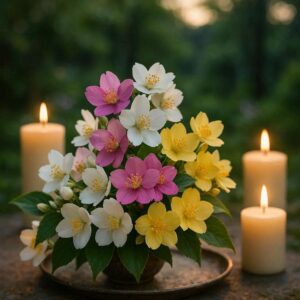
In the hushed stillness of a moonlit garden, a fragrance emerges—intoxicating, delicate, yet mysteriously potent. It wraps around the senses, not as an assault, but as a whispered invitation. This is the call of jasmine, a flower whose beauty is merely the veil for a profound spiritual legacy. Beyond its horticultural charm lies a deep, resonant symbolism that has captivated mystics, poets, healers, and lovers for millennia. Why does this simple white blossom hold such power over the human spirit? What secrets are encoded in its intoxicating scent?
The spiritual meaning of jasmine is not a single note but a complex, layered symphony. It speaks of purity that emerges from darkness, of love that transcends the physical, of prophetic dreams delivered on nocturnal breezes, and of a direct line to the divine feminine. To engage with jasmine spiritually is to engage with the moon itself: it is intuitive, emotional, deep, and powerfully transformative. This article is an immersive journey into the heart of this sacred flower. We will traverse through ancient temples and royal gardens, decode symbolic languages, and provide practical tools to harness its subtle energies. Prepare to discover why jasmine is considered not just a plant, but a spiritual companion for the soul’s journey.
2. A Botanical and Historical Prelude: More Than a Flower
Before delving into the esoteric, understanding jasmine’s earthly nature enriches its spiritual narrative. Belonging to the Oleaceae family (the olive family), the Jasminum genus comprises over 200 species of shrubs and vines, primarily native to tropical and warm temperate regions of Eurasia, Australasia, and Oceania. The most revered for fragrance are Jasminum officinale (Common Jasmine) and Jasminum sambac (Arabian Jasmine or Sampaguita).
Its name derives from the Persian “yasmin,” meaning “gift from God,” an etymology that immediately sets its spiritual tenor. From Persia, it traveled along trade routes to the rest of the Middle East, North Africa, and eventually Europe and the Americas. In every culture it touched, it was not merely adopted as a decorative plant but was ceremoniously integrated into spiritual and cultural practices. Its characteristic of blooming at night, releasing its strongest fragrance under the cover of darkness, became a central pillar of its symbolism—teaching that the most potent spiritual truths and inner luminosity often reveal themselves when we turn inward, away from the glaring sun of everyday consciousness.
3. Universal Threads: Jasmine in World Spiritual Traditions
Jasmine’s spiritual resonance is a global phenomenon. Its role across faiths and philosophies reveals universal human archetypes it has come to represent.
Sacred Offerings in Hinduism and Buddhism: In India, jasmine is intrinsically linked to devotion. Known as “Mallika,” it is a favorite offering (pushpa) to the gods, particularly Lord Vishnu and Goddess Lakshmi. Its pure white color symbolizes sattva (purity, harmony), and its fragrance is considered pleasing to the divine. Garlands of jasmine are used in worship, weddings, and festivals. In Buddhism, jasmine’s ability to remain pristine and fragrant even while growing in challenging conditions is a metaphor for the enlightened mind—pure, compassionate, and radiant amidst the suffering of samsara.
The Celestial Flower of Persia and the Islamic World: True to its Persian name (“gift from God”), jasmine in Sufi poetry symbolizes the soul’s yearning for divine union. The intoxicating scent is a metaphor for the all-pervading presence of God. It is often associated with paradise, beauty, and spiritual elegance. In many Islamic cultures, it is a symbol of hope and the sweetness of life.
Purity and Love in Christianity: While not biblically mentioned by name, white flowers like jasmine have been adopted in Christian symbolism to represent the purity of the Virgin Mary, often called the “Mystical Rose.” In the Victorian language of flowers, which carried spiritual undertones, jasmine came to signify amiability, grace, and eternal love.
Eastern Philosophies: Harmony and Grace: In Chinese culture, jasmine (茉莉, mòli) is a symbol of feminine sweetness, beauty, and deep affection. Its tea is associated with calming the spirit. In Japan, it represents grace and elegance, while in Thailand, it symbolizes maternal love and is sacred to Mother’s Day.
4. The Spiritual Symbolism Decoded: Core Meanings and Essences
The spiritual profile of jasmine is rich and multifaceted. We can distill its essence into several core meanings, each a petal in its symbolic bloom.
The Epitome of Purity and Innocence: The pristine white blossom is the most immediate symbol of spiritual and mental purity. It represents an uncorrupted soul, clarity of intention, and the innocence that comes from spiritual alignment, not naivety. It teaches the possibility of remaining unstained by negativity, much like the lotus rising from the mud.
The Magnetic Energy of Love and Sensuality: Jasmine is the flower of sacred love. It vibrates with a frequency that attracts deep, soulful connections, romance, and committed partnership. Unlike base lust, jasmine’s sensuality is moon-driven—emotional, intimate, and profoundly bonding. It opens the heart chakra, encouraging vulnerability and deep affection.
Attractor of Spiritual Wealth and Prophetic Dreams: Its association with the moon and night links it to the subconscious and the realm of intuition. Jasmine is famed for inducing vivid, prophetic, or spiritually significant dreams. Placing it near the bed or using its oil before sleep can open a channel to inner wisdom. Furthermore, its fragrance is believed to attract not just material abundance, but the deeper “wealth” of spiritual insight, peace, and fulfilled potential.
A Gateway to the Divine and Feminine Wisdom: As a “gift from God,” jasmine facilitates prayer, meditation, and communion with higher realms. It is deeply tied to the Divine Feminine—the receptive, intuitive, creative, and nurturing aspects of the universe. Working with jasmine can help balance feminine energies within all individuals, fostering compassion, creativity, and psychic receptivity.
The Emblem of Hope, Moon Magic, and Night’s Secrets: Blooming in darkness, jasmine is a natural emblem of hope—a reminder that light and fragrance can exist in the darkest hours. It is a prime tool for moon rituals, esoteric practices, and connecting with the cyclical, intuitive nature of life.
The Spiritual Portfolio of Jasmine
| Core Symbol | Spiritual Meaning | Associated Energies | Practical Applications |
|---|---|---|---|
| White Blossom | Purity, Innocence, Clarity | Cleansing, Purifying, Mental Focus | Ritual baths, space clearing, meditation for clarity |
| Night Blooming | Secrets, Intuition, The Subconscious, Hope | Lunar, Receptive, Mystical | Dream work, scrying, rituals during new/full moon |
| Intoxicating Scent | Love, Sensuality, Attraction | Magnetic, Heart-Opening, Unifying | Anointing candles/pulse points, love rituals, relationship harmony |
| Climbing Vine | Aspiration, Spiritual Growth, Connection | Upward, Linking, Supportive | Meditation on growth, rituals for achieving goals |
| “Gift from God” | Divine Connection, Sacred Offering | Elevating, Devotional, Blessed | Altar offering, prayer aid, anointing sacred tools |
5. Jasmine in Metaphysical Practice: A Toolkit for the Soul
Understanding symbolism is the first step; application is where transformation occurs. Here’s how to incorporate jasmine’s spiritual essence into your practice.
Ritual Uses: Create a spiritual bath by steeping jasmine flowers (or a few drops of pure essential oil in a carrier) to wash away negativity and attract love. Anoint candles (pink for love, white for purity, purple for spirituality) with jasmine oil to charge your intentions. Use jasmine-infused water in a spray bottle to clear and bless your sacred space or altar.
Dream Incubation and Astral Travel: Place a sachet of dried jasmine flowers under your pillow. Before sleep, apply a drop of diluted jasmine oil to your third eye or temples, stating your intention for insightful dreams. This practice can also ease the transition into conscious astral projection or lucid dreaming by calming the mind and elevating the spirit.
Meditation, Chakras, and Energy Alignment: Meditate with the scent of jasmine (via oil diffuser or flowers) to deepen your practice. It powerfully activates the Heart Chakra (Anahata), healing emotional wounds and fostering unconditional love. It also resonates with the Crown Chakra (Sahasrara), facilitating divine connection, and the Sacral Chakra (Svadhisthana), balancing creative and sensual energies.
Formulating Intentions: Be specific. Instead of “I want love,” try, “With the gentle power of jasmine, I open my heart to a loving, respectful, and joyful partnership.” Hold this intention while holding a jasmine flower or bottle of oil.
6. The Scent of Divinity: Jasmine in Aromatherapy and Vibrational Healing
The science of scent confirms spirituality’s intuition. The olfactory bulb is directly linked to the brain’s limbic system, which governs emotion and memory. Jasmine absolute is one of the most complex and expensive essences, often called the “King of Oils.” In aromatherapy, it is used to:
-
Alleviate depression and anxiety (uplifting the spirit).
-
Boost confidence (attracting vibrational abundance).
-
Soothe the nerves (creating peace for meditation).
-
Aphrodisiac effects (energizing the sacred sensual self).
Its vibration is considered high-frequency, working not just on the physical body but on the subtle energy bodies, aligning them with states of love, peace, and spiritual awareness.
7. Literary and Artistic Muse: A Cultural Archetype
From the erotic spiritualism of Sufi poet Hafiz to the romanticism of Western literature, jasmine perfumes countless works of art. It appears in paintings as a symbol of delicate beauty, in songs as a metaphor for a beloved, and in novels to set a scene of mystery or allure. This cultural embedding reinforces its archetypal role in the human psyche as a symbol of transcendent beauty and deep emotion.
8. Personal Journey: Cultivating a Relationship with Jasmine
The deepest understanding comes from direct experience. Grow a jasmine plant if your climate allows; tending it, especially at night, builds a personal bond. Sip jasmine tea mindfully, noting its effect on your mood. Wear a simple jasmine perfume or oil as a personal aura enhancer. Journal about the dreams, synchronicities, or emotional shifts you notice. Let jasmine become a personal spiritual guide.
9. Conclusion: The Everlasting Blossom
Jasmine is more than a flower; it is a spiritual technology—a key to unlocking chambers of the heart and corridors of the subconscious. Its enduring legacy across time and culture is a testament to its genuine power. It teaches us that purity can flourish in darkness, that love is a divine force, and that the most profound secrets are often whispered on the gentlest fragrance. By welcoming jasmine into your spiritual practice, you align with an ancient current of grace, love, and mystical wisdom.
10. Frequently Asked Questions (FAQs)
Q1: What is the main spiritual meaning of jasmine?
A1: Its core meanings revolve around love (spiritual and romantic), purity, prophetic dreams, and connection to the divine feminine and lunar energies. It’s a multi-purpose spiritual aid for matters of the heart and soul.
Q2: How can I use jasmine to attract love?
A2: Create a love-attraction ritual: anoint a pink candle with jasmine oil, place fresh jasmine flowers around it, and as it burns, visualize yourself giving and receiving love. Carry a jasmine flower or wear the oil as a personal fragrance to elevate your heart’s vibration.
Q3: Is jasmine associated with a specific chakra?
A3: It is most powerfully associated with the Heart Chakra (Anahata), for love and compassion, and the Crown Chakra (Sahasrara), for spiritual connection. It also balances the Sacral Chakra (Svadhisthana).
Q4: Can jasmine really affect dreams?
A4: Yes, historically and anecdotally, jasmine is renowned as a oneirogen (dream-inducing agent). Its calming, spiritually elevating scent can promote relaxation and access to the subconscious, leading to more vivid, memorable, and often insightful dreams.
Q5: What’s the difference between jasmine essential oil and absolute?
A5: Both are highly concentrated. Absolute is typically extracted with solvents and best captures the full, true fragrance of the flower, preferred for perfumery and spiritual work. Essential oil is often steam-distilled and can be less nuanced. For spiritual purposes, a high-quality absolute is recommended.