Why does the image of the dragon arise, independent and vivid, in cultures separated by vast oceans and impassable mountain ranges? From the sun-baked deserts of Mesopotamia to the mist-shrouded highlands of Wales, from the fertile river valleys of China to the ancient rainforests of the Maya, the dragon emerges as a universal constant in humanity’s mythic language. This is not a coincidence. Carl Jung would point to the dragon as a quintessential archetype of the collective unconscious—a primordial image etched into the soul of our species. It represents the raw, untamed, and overwhelming power of nature itself, a force that can provide sustenance through life-giving rains or utter devastation with volcanic fury and terrible storms. To our ancestors, the dragon was the explanation for earthquakes, eclipses, and the fertile silt left by flooding rivers. It was the ultimate symbol of the sublime—the terrifying beauty of a power so vast it transcends human understanding.
Engaging with the dragon spiritually is not merely an academic exercise in mythology; it is an invitation to confront and integrate our own immense inner power. It is a call to awaken the slumbering potential within, to harness our personal will, to seek profound wisdom, and to courageously face the shadowy, hidden parts of ourselves. The dragon’s journey is our journey: a path of transformation, challenge, and ultimate mastery.
2. The Dichotomy of the Dragon: East vs. West – A Foundational Schism
The most striking feature in the study of dragon lore is the profound divergence between Eastern and Western interpretations. This schism reflects fundamental differences in cultural worldview, the relationship between humanity and the divine, and the perception of the natural world.
The Eastern Dragon: Celestial Emperor and Benevolent Force
In the traditions of China, Japan, Korea, and Vietnam, the dragon (Long, Ryu, Yong) is a revered celestial being, a symbol of auspicious power, wisdom, and ultimate good fortune. Unlike its Western counterpart, it is almost never depicted with wings. Its ability to fly is an innate, magical quality, a sign of its divine nature. The Eastern dragon is a benevolent guardian, a bringer of rain for the crops, and an embodiment of the Yang principle—active, masculine, and celestial.
-
Symbol of Imperial Authority: The Chinese dragon was exclusively associated with the Emperor, the “Son of Heaven.” The throne was the Dragon Throne, the emperor’s face the Dragon Face, and his robes were embroidered with five-clawed dragons, a symbol forbidden to all others.
-
Nature Spirit: These dragons are rulers of weather, particularly rain, storms, and bodies of water. They reside in celestial palaces, deep lakes, rushing rivers, and oceans. They are the animating spirit of the natural world, commanding respect rather than fear.
-
Composite Symbolism: The Eastern dragon is often described as possessing the features of nine animals: the horns of a deer, the head of a camel, the eyes of a demon, the neck of a snake, the belly of a clam, the scales of a carp, the claws of an eagle, the paws of a tiger, and the ears of a cow. This composite nature signifies its all-encompassing wisdom and dominion over all creatures.
The Western Dragon: The Challenger and the Shadow Self
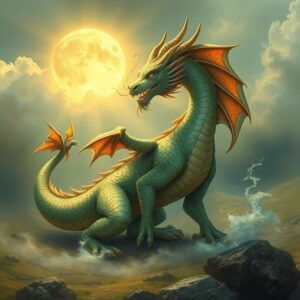
In contrast, the Western dragon, born from Mesopotamian, Greek, and Norse mythologies and later crystallized in European folklore and Christianity, is overwhelmingly a creature of chaos, evil, and greed. It is the adversary, the hoarder of treasure, the devourer of maidens, the ultimate test for the hero’s valor and faith.
-
The Christianized Devil: With the rise of Christianity, the dragon became a powerful symbol for Satan, the serpent of Eden amplified into a monstrous, fire-breathing beast. Stories of saints like St. George slaying the dragon became allegories for the triumph of good over evil, of faith over sin.
-
The Hoarder of Treasure: The Western dragon is famously depicted sleeping on a vast hoard of gold, gems, and precious artifacts. Psychologically, this represents not just greed, but the untapped potential, latent power, and unconscious knowledge that we have “hoarded” and not integrated into our conscious lives. The hero must slay the dragon to claim this treasure, symbolizing the difficult process of confronting one’s shadow to achieve self-actualization.
-
The Guardian of Thresholds: Often, the dragon guards a sacred place, a princess, or a priceless artifact. It represents the obstacle that must be overcome to reach a new level of consciousness or to claim a prize. The battle with the dragon is the ultimate initiation.
This fundamental dichotomy teaches us that the dragon’s spiritual meaning is not fixed; it is a mirror reflecting our own perception of power. Is power a benevolent force to be aligned with (East), or a destructive force to be conquered (West)? The true spiritual seeker learns that both perspectives contain a piece of the truth.
3. Anatomy of a Spirit: Symbolism of the Dragon’s Form
Every aspect of the dragon’s physical form is imbued with deep spiritual symbolism. To visualize a dragon is to assemble a tapestry of potent spiritual concepts.
-
Scales: Armor and Protection. The dragon’s impenetrable scales represent spiritual protection, resilience, and boundaries. They signify an evolved spiritual defense system that allows one to navigate challenging environments or negative influences without being harmed. Working with dragon energy can help you develop healthier energetic boundaries.
-
Wings: Ascent to the Spiritual Realm. The vast, leathery wings of the Western dragon symbolize the ability to rise above mundane circumstances, to gain a higher perspective, and to access spiritual realms and higher states of consciousness. They represent freedom, transcendence, and the power of the mind and spirit to soar.
-
Breath: The Power of Creation and Destruction. The dragon’s breath—whether it is fire, ice, or poison—is its most fearsome weapon. Spiritually, this represents the power of speech, intention, and creative force. The fire breath is the ultimate purifier, burning away the old and obsolete to make way for the new. It is the raw, unmanifested energy of the universe that can be wielded for creation or destruction.
-
Eyes: Ancient Wisdom and All-Seeing Sight. The serpentine, slit-pupiled eyes of the dragon are often described as holding ancient knowledge. They represent clairvoyance, intuition, and the ability to see through illusion and deception. To be seen by a dragon in a vision is to feel your soul being perceived in its absolute truth.
-
Claws and Talons: Grounded Power and Action. While the dragon soars, its claws are firmly planted on the earth or gripping a rocky crag. This symbolizes the necessity of grounding immense spiritual power into physical reality. The claws represent the ability to take action, to grasp opportunities, and to anchor your visions into the material world.
4. The Elemental Dragons: Connecting with the Primal Forces
One of the most powerful ways to work with dragon energy is through the lens of the four classical elements. Each element has a corresponding dragon archetype, offering a specific flavor of power and wisdom.
Fire Dragons: Purification, Passion, and Transformation
Fire Dragons are the most volatile and potent. They are catalysts for profound change. Their energy is passionate, courageous, and destructive only in the way a forest fire is—it clears the deadwood so new life can grow. Call upon Fire Dragon energy when you need to break free from stagnation, ignite your creative passion, or courageously speak your truth.
Water Dragons: Emotion, Intuition, and the Subconscious
Residing in the depths of oceans, lakes, and the human heart, Water Dragons govern the realm of emotion, intuition, and dreams. They are deeply psychic, fluid, and healing. Their energy can help you navigate deep emotional currents, unlock psychic abilities, and cleanse emotional wounds. They teach the wisdom of flow and adaptability.
Air Dragons: Intellect, Communication, and New Perspectives
Masters of the winds and storms, Air Dragons are associated with the mind, intellect, and communication. They bring new ideas, clarity of thought, and the power to manifest through the word. Working with Air Dragon energy can aid in studying, writing, public speaking, and gaining a detached, objective perspective on a challenging situation.
Earth Dragons: Stability, Abundance, and Manifestation
The oldest and most grounded of the kin, Earth Dragons slumber deep within mountains and caverns. They are the guardians of the land, of treasures, and of natural law. Their energy is slow, steady, and immensely powerful. They provide stability, help in manifesting material goals, and foster a deep, nourishing connection to the physical world and nature.
A Guide to the Elemental Dragons
| Element | Domain | Spiritual Gifts | When to Call Upon Them | Associated Crystals |
|---|---|---|---|---|
| Fire | Volcanoes, Sun, Deserts | Passion, Courage, Purification, Willpower, Transformation | Starting new ventures, breaking bad habits, boosting energy | Carnelian, Red Jasper, Fire Agate |
| Water | Oceans, Lakes, Rivers, Storms | Emotion, Intuition, Healing, Psychic Abilities, Flow | Healing emotional pain, developing intuition, creative work | Aquamarine, Blue Lace Agate, Moonstone |
| Air | Skies, Mountain Peaks, Wind | Intellect, Communication, Clarity, New Ideas, Freedom | Making decisions, studying, writing, resolving conflicts | Selenite, Amethyst, Clear Quartz |
| Earth | Mountains, Caves, Forests | Stability, Abundance, Manifestation, Patience, Grounding | Financial matters, building foundations, connecting with nature | Moss Agate, Jade, Hematite, Pyrite |
5. Dragons in World Mythology: A Tapestry of Belief
The dragon archetype manifests in uniquely cultural forms, each adding a thread to the global tapestry.
-
Asia: The Chinese Long is the archetypal Eastern dragon, a composite creature symbolizing the emperor and cosmic power. The Japanese Ryu is similar but often depicted with three claws and is more closely associated with water and Shinto deities. The Korean Yong is a powerful sky dragon, often seen holding or chasing the “Yeouiju,” a wish-granting orb of cosmic knowledge.
-
Europe: Jormungandr, the Midgard Serpent of Norse myth, is a world-encircling dragon of such immense size that it bites its own tail, symbolizing the cycle of life, death, and rebirth. The Celtic Wyvern (a two-legged, winged dragon) was often a symbol of power and territory. The Slavic Zmey was a multi-headed dragon, often three-headed, representing a formidable challenge.
-
The Americas: Quetzalcoatl, the “Feathered Serpent” of Mesoamerican cultures, is one of the most unique and profound dragon figures. It beautifully unites the serpent (earth, material world) with the quetzal bird (sky, spirit), symbolizing the elevation of consciousness, the bringing of knowledge (writing, calendars), and the sacred union of heaven and earth.
6. The Dragon as a Personal Spiritual Ally
In modern spiritual practices, the dragon is not just a mythic beast but a potent source of personal guidance.
-
Dragon as a Spirit Animal: If the dragon is your spirit animal, you are likely a person of immense power, wisdom, and potential. You are a natural leader, brimming with creativity and a strong will. The challenge is to learn to wield this power with responsibility and integrity, lest it become destructive. You are here to be a catalyst for change.
-
Dragon as a Totem Animal: A dragon totem acts as a protective emblem for a family, group, or community. It represents the collective strength, heritage, and spiritual identity of the group. Think of the dragon on a Welsh flag or a family crest.
-
Dragon as a Power Animal: You can call upon the dragon as a power animal for a specific, temporary purpose. Need courage for a presentation? Call on the Fire Dragon. Need clarity for a decision? Invoke the Air Dragon. This is a shamanic approach to accessing the archetypal energy required for a given situation.
7. Working with Dragon Energy: A Practical Guide
Connecting with dragon energy is a profound practice. Here are some foundational techniques.
-
Meditation and Visualization: Find a quiet space. Ground yourself. In your mind’s eye, journey to a landscape that resonates with the dragon you wish to connect with (a volcano for Fire, a deep ocean for Water, etc.). Visualize the dragon approaching you. Do not force it. Simply observe, feel its presence, and be open to receiving impressions, images, or feelings. You may ask a question, but more often, it is about building a relationship.
-
Dragon Invocations and Rituals: Create a sacred space. You can call upon a specific elemental dragon by using corresponding colored candles (red for Fire, blue for Water, etc.), symbols (a feather for Air, a stone for Earth), and a clear, respectful invocation spoken from the heart. For example: “Great Dragon of the [Element], keeper of [Gift], I call upon your ancient wisdom. Lend me your strength and clarity for [Purpose]. I welcome your presence in harmony and respect.”
-
Crystals and Stones: As shown in Table 1, certain crystals resonate strongly with dragon energy. Holding a piece of Carnelian or Red Jasper during meditation can help you connect with the Fire Dragon. Placing Selenite in your workspace can invite the clarity of the Air Dragon.
8. The Dragon in Dreams: Interpreting the Subconscious
Dreaming of a dragon is a significant event, pointing to powerful forces at work in your unconscious.
-
A benevolent or guiding dragon often represents the awakening of your spiritual power, a connection to deep wisdom, or the arrival of potent, positive change.
-
A threatening or chasing dragon typically symbolizes a powerful fear, an unresolved conflict, or a part of your own shadow self that you are running from. It is the “dragon” you must turn and face to claim your “treasure.”
-
Slaying a dragon signifies a major victory over your inner demons, a successful integration of your shadow, and the claiming of your personal power.
-
Flying on a dragon represents a successful mastery of your primal energies, achieving a higher state of consciousness, and a sense of spiritual freedom.
9. The Modern Dragon: Archetypes in Psychology and Pop Culture
The dragon remains as relevant today as in ancient times, having seamlessly transitioned into modern narratives.
-
Jungian Perspectives: In Jungian psychology, the dragon is a primary symbol of the Shadow—the totality of the unconscious psyche, containing both repressed weaknesses and latent strengths. The hero’s quest to slay the dragon is the ego’s journey to integrate the shadow, to make the unconscious conscious, and to become a whole, individuated Self. The dragon’s hoard is the treasure of self-knowledge and wholeness.
-
Dragons in Modern Fantasy: From Smaug’s greedy intelligence in The Hobbit to the complex, bonded relationships between dragons and riders in Anne McCaffrey’s Pern series and Game of Thrones, modern portrayals have added layers of nuance. They often explore themes of companionship, misunderstood nature, ecological balance, and the reconciliation between humanity and primal power, reflecting a more integrated, Eastern-influenced view of the dragon archetype.
10. Conclusion: The Eternal Dance of Power and Wisdom
The dragon is the timeless guardian at the threshold of our greatest potential. It is the primordial force of nature and the untamed power of our own souls. Whether we perceive it as a benevolent guide to be followed or a fearsome challenge to be overcome depends entirely on our readiness to claim our own authority. To walk with the dragon is to embark on the ultimate spiritual quest—the journey of self-mastery. It demands that we acknowledge our deepest fears, harness our creative fire, and ground our spiritual insights into tangible reality. The dragon does not give its treasure freely; it offers it to those brave enough to seek it, wise enough to understand it, and strong enough to wield it with reverence. The whisper of its wings is the call to your own awakening.
11. Frequently Asked Questions (FAQs)
Q1: Is seeing a dragon in my meditation a real thing?
A: In a spiritual context, yes. While not a physical, biological entity, the dragon is a very real archetypal energy and thought-form. Perceiving one in meditation is a powerful symbolic experience, indicating a connection to that specific frequency of power, wisdom, and elemental force. The reality of the experience lies in its profound impact on your consciousness and personal growth.
Q2: Can dragon energy be dangerous to work with?
A: Any powerful spiritual energy requires respect and responsibility. Dragon energy is raw and potent. Approaching it with arrogance, fear, or a desire for domination can lead to imbalance, manifesting as uncontrolled anger, ego inflation, or creating chaos in your life. Always approach with humility, clear intention, and a focus on harmony. Start with gentle connections, such as with Earth or Water dragons, before engaging the more volatile Fire energy.
Q3: What is the difference between a dragon and a serpent in spirituality?
A: While related, the serpent is often a more personal and grounded symbol, representing Kundalini energy, healing, and life force at the individual level. The dragon is a more cosmic, amplified version—the serpent that has grown wings and gained the power of breath (spirit). The dragon encompasses the serpent’s earthly wisdom but adds the dimensions of air, fire, and celestial power.
Q4: I’m afraid of dragons. What does this mean?
A: A fear of dragons is very common and is a reflection of the “Western” mindset confronting this archetype. It typically signifies a fear of your own personal power, a reluctance to face your shadow self, or an unconscious anxiety about the disruptive changes that embracing your full potential might bring. This fear is the first dragon to be faced and understood on your path.