Look down. At this very moment, within a few meters of where you stand, sits an empire. It is an empire of staggering complexity, unwavering discipline, and profound collective purpose. It is an empire built not by giants, but by the smallest of architects: the ant. For most, an ant is a mere speck, an incidental visitor to a picnic, a creature to be brushed away without a second thought. But to pause and truly observe is to witness a mystery that has captivated the human spirit for millennia. What if these tiny beings are not just biological automatons, but carriers of an ancient, universal wisdom? What if their ceaseless marching holds a map to the very principles of creation, community, and personal destiny?
This article embarks on a deep, exploratory journey into the spiritual meaning of ants. Moving beyond entomology, we will delve into the realm of symbol, myth, and metaphysical message. We will decode the language of their colonies, interpret their appearances in our dreams and daily paths, and unpack why cultures across time and space have revered this humble insect. From the parables of Solomon to the Dreamtime stories of Indigenous Australia, from your backyard hill to the sudden appearance of a single ant on your windowsill, there is a message waiting to be understood. This is not a superficial glance but a comprehensive excavation of meaning, spanning spiritual traditions, psychological interpretations, and practical philosophy. Prepare to see the world beneath your feet in a radically new light.
2. Ants in Ancient Mythologies and World Religions
The spiritual significance of ants is not a modern New Age conception; it is etched into the foundational texts and oral traditions of human civilization.
Abrahamic Traditions: In the Hebrew Bible’s Book of Proverbs (6:6-8), King Solomon offers one of the most direct spiritual endorsements: “Go to the ant, you sluggard; consider its ways and be wise! It has no commander, no overseer or ruler, yet it stores its provisions in summer and gathers its food at harvest.” Here, the ant is a divine metaphor for self-motivation, prudent foresight, and industriousness—a model for human ethical conduct. In some Islamic hadiths and commentaries, ants are recognized as intelligent communities that praised God, most famously in the story of Prophet Solomon (Sulayman), who heard and respected an ant’s warning to its colony to avoid his approaching army.
Hinduism and Jainism: In the vast pantheon of Hindu thought, all life is sacred, and ants are no exception. They are seen as beings with jiva (a living soul), subject to the cycles of karma and rebirth. Harming them accumulates negative karma. Their collective life is a mirror of societal duty (dharma)—each ant performing its svadharma (own duty) for the health of the whole. In Jainism, whose core principle is ahimsa (non-violence), ants are protected life forms. Monks and devout laypeople often sweep their path to avoid crushing them, seeing in them the same spark of consciousness that exists in all creatures.
Native American and Indigenous Cosmologies: Many Native American tribes view ants as sacred “Earth Indians” or first peoples. Pueblo tribes, like the Hopi, associate ants with the previous world, where beings lived underground. Ants are seen as helpers, saviors, and teachers of agriculture and storage. In the Hopi emergence myth, the Ant People (Anu Sinom) safeguarded the Hopi during their migrations between worlds, providing shelter and food, and teaching them the virtues of cooperation and perseverance in harsh environments. They symbolize humility, patience, and a deep connection to the Earth Mother.
African Spiritual Systems: In West African traditions, particularly among the Yoruba, ants (especially driver ants) are often associated with potent spiritual forces. They can symbolize relentless victory, as an army that cannot be stopped, and are sometimes invoked in rituals for protection or justified retaliation. Their ability to consume everything in their path is seen as a metaphor for divine justice or cleansing.
Greek and Celtic Lore: The ancient Greeks had a fascinating myth of origin for ants. In Thessaly, Zeus transformed a community of virtuous humans (the Myrmidons) into ants to repopulate the island of Aegina after a plague. These ant-born people, led by Achilles in the Trojan War, were famed for their loyalty, discipline, and martial cohesion. This myth directly links ant nature to human virtues. In Celtic symbolism, ants were associated with the underworld and fertility, their mounds seen as gateways to the Otherworld and repositories of earthy wisdom.
3. Core Spiritual Symbolism: Unity, Diligence, and Sacrifice
At the heart of the ant’s spiritual message lie several interlocking, universal principles.
Community and Perfect Unity (The Superorganism): The ant colony operates as a single entity, a superorganism. No single ant is the brain; the intelligence emerges from the collective. This is a powerful spiritual symbol of true unity—not uniformity, but a harmonious integration of individual roles for a goal that transcends the self. It teaches that we are not isolated beings; our strength, survival, and highest purpose are found in healthy community. It speaks to the ideals of socialism, teamwork, and the Buddhist concept of “interbeing.”
Industrious Diligence and Patience: The ant’s legendary work ethic isn’t about mindless busyness. It is purposeful, strategic, and patient. They move one grain of sand, one crumb at a time, never discouraged by the magnitude of the task. Spiritually, this is a lesson in persistence. It counsels us to break down our largest goals into small, manageable actions and to trust that consistent, patient effort—not frantic, short-lived bursts—builds cathedrals and moves mountains.
Foresight and Planning: The ant “stores its provisions in summer.” This symbolizes the spiritual necessity of foresight, resource management, and preparation. It’s a call to be mindful of our future—not from a place of fear and hoarding, but from a place of wisdom and responsibility. It applies to our spiritual practice (building a reservoir of inner peace for times of crisis), our finances, and our environmental stewardship.
Sacrifice and the Greater Good: Worker ants routinely sacrifice their personal needs, even their lives, for the security and prosperity of the queen and the colony. This represents the ultimate spiritual principle of selflessness. It is the archetype of the mother, the soldier, the healer—anyone who puts the welfare of others before their own. It challenges our modern cult of individualism, reminding us that there is profound honor and purpose in serving a cause greater than oneself.
Strength in Humility and Small Beginnings: The ant is physically small but collectively mighty. This teaches that no act of kindness, no step toward growth, is too small. It encourages us not to despise our humble beginnings or our seemingly insignificant contributions. A single ant can find a food source and mobilize an entire colony. Similarly, one idea, one prayer, one act of courage can initiate monumental change.
4. The Ant as a Spirit Animal, Totem, and Power Animal
In animistic and contemporary spiritual practices, the ant can appear as a guiding force.
If the Ant is Your Spirit Animal, you are likely a person of immense integrity, discipline, and reliability. You understand that great things are built slowly and systematically. You may thrive in roles that require organization, planning, and teamwork. The ant spirit animal arrives when you need to:
-
Get organized and focus on long-term goals.
-
Learn to cooperate more effectively with others.
-
Practice patience and trust in the process.
-
Be a dependable pillar in your family or community.
-
Develop foresight and prepare for upcoming challenges.
As a Totem Animal (an ancestral or clan symbol), the ant totem speaks of your innate connection to family, tradition, and communal history. It grants the power of endurance and a profound sense of belonging. Those with an ant totem often feel a strong duty to their lineage or community and possess a natural talent for building secure, functional systems.
Calling on the Ant as a Power Animal is done when you need an infusion of its specific energies. Before a big project, visualize the ant’s tireless diligence. When feeling weak, meditate on its ability to carry many times its own weight. To heal family strife, invoke its spirit of selfless colony loyalty.
5. Dream Interpretation: What Does It Mean to Dream of Ants?
Dreams of ants are rich in symbolic meaning, often pointing to aspects of our waking life that require attention.
| Dream Scenario | Possible Spiritual & Psychological Interpretation |
|---|---|
| Seeing a single ant | A message to pay attention to small details. A nudge to start a project with one small step. It can also symbolize a feeling of insignificance or being overlooked. |
| An army of ants marching | Your subconscious highlighting the power of collective effort. It may reflect feelings about your workplace, social circles, or societal movements. Are you part of a harmonious “colony,” or are you being swept along? |
| Ants in your house/room | Often relates to personal matters—your “inner space.” It can indicate anxieties, small irritations, or thoughts that are “crawling” around your mind. It may also signal a need for better domestic organization or boundary-setting. |
| Being bitten by ants | Small annoyances or criticisms that are “eating away” at you. Feelings of being irritated or “pestered” by minor issues or people. |
| Eating ants | A very potent symbol of integrating the ant’s qualities—hard work, community focus—into your very being. It may signify a need to “consume” these lessons. |
| A giant ant | A sign that an issue you consider “small” is actually having a major impact on your life. It’s a call to stop underestimating a problem or a strength within you. |
| Building an anthill | You are in the process of diligently building something important in your life—a career, a relationship, a skill. Trust the process. |
| Destroying an anthill | A warning against disrupting the foundations of your support system (family, community) or acting rashly to dismantle something built with care. |
6. Omens and Messages: Ant Encounters in Daily Life
When ants cross your path in waking life, consider it a potential message from the natural world.
-
A Single Ant Appears Repeatedly: This is often seen as a direct spiritual nudge. Stop. Observe. What are you neglecting that seems small? What step have you been procrastinating on? It is the universe’s way of saying, “Begin.”
-
An Ant Trail in Your Home: Beyond a pest control issue, this can be a spiritual metaphor. Where are your personal boundaries being crossed? What resources (energy, time, money) are being slowly carried away without your conscious notice? It’s a call to audit your life and fortify your “walls.”
-
Watching an Ant Colony Work: This is an invitation to meditate on community, efficiency, and purpose. Ask yourself: Am I contributing to a healthy “colony”? Is my work purposeful? It’s a lesson in biomimicry for your own projects.
-
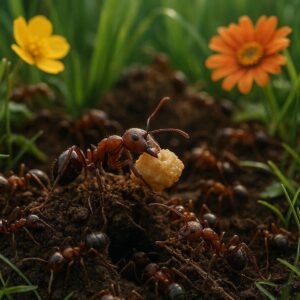
Carrying a Large Load: Witnessing an ant carry a leaf or prey much larger than itself is a powerful emblem of inner strength. It’s a message: “You are far stronger than you think. This burden, though heavy, is within your capacity to bear.”
7. The Shadow Side: Lessons in Boundaries and Overwork
The ant’s wisdom has a shadow, and acknowledging it is crucial for a balanced interpretation.
-
Relentless Toil Without Joy: The spiritual danger is becoming a spiritual workhorse—so focused on duty, planning, and labor that one forgets joy, spontaneity, and rest. The ant reminds us to work wisely, not compulsively.
-
Loss of Individuality in the Collective: An unbalanced ant energy can lead to suppressing one’s unique voice and needs for the perceived good of the group. It can manifest as codependency, fear of standing out, or blind conformity. The lesson is to serve the community while honoring the sacred individual within.
-
Inability to Receive: Worker ants are programmed to give. For humans, an ant-like imbalance can mean an inability to accept help, love, or support. True community is a cycle of giving and receiving.
-
Being “Ant-like” in a Negative Sense: Feeling small, insignificant, or easily trampled upon. This is the ant’s challenge: to teach you that your collective strength (your soul, your community) makes you mighty, even if you feel like a single, tiny being in a vast world.
8. Practical Applications: Integrating Ant Wisdom into Modern Life
How do we live this wisdom?
-
Practice Conscious Teamwork: In your next group project, consciously embody the ant. Focus not on credit, but on the seamless execution of your role for the success of the whole.
-
The “One Grain at a Time” Method: Facing a daunting task? Say to yourself, “I am an ant. I will move one grain today.” This bypasses overwhelm and harnesses the power of micro-actions.
-
Create a “Summer Store” Ritual: Periodically, “store provisions” for your future self. This could be meal-prepping, setting up automatic savings, curating a playlist for low moods, or writing yourself encouraging notes to open later.
-
Meditate on an Anthill: Spend 10 minutes quietly observing an ant colony (safely, without disturbing it). Let your mind absorb their patterns. This is a profound mindfulness exercise that grounds you and puts your problems in perspective.
-
Audit Your “Colony”: Regularly assess your core communities (family, friends, work). Are you contributing? Are your boundaries respected? Is the collective thriving? Make adjustments with ant-like purpose.
9. Conclusion: The Collective Whisper
The ant is a custodian of ancient, earthy wisdom, a living parable written in the soil. Its spiritual message is a harmonious chord of diligence, unity, foresight, and selfless contribution. It calls us away from grandiosity and toward the sacred power of small, consistent actions done in concert with others. To heed the ant is to remember that we are both the individual worker and the inseparable part of a greater Whole. It teaches that true strength is forged in community, that patience outlasts force, and that the most majestic cathedrals are built one grain of sand at a time.
10. Frequently Asked Questions (FAQs)
Q1: Is seeing a black ant different from seeing a red ant spiritually?
A: Generally, yes. In many interpretations, black ants are associated with grounding, earthly matters, hard work, and harmony. Red ants often symbolize passion, aggression, urgency, or a warning to defend your boundaries (like their more fiery, biting nature). The context of the encounter is always most important.
Q2: A line of ants came into my kitchen. Is this a bad omen?
A: Not inherently “bad.” Primarily, it’s a practical message about boundaries and resources (your food). Spiritually, it can be a powerful metaphor. Ask: What is creeping into my personal space? Where do I need to “seal cracks” in my emotional or energetic boundaries? What resources (time, energy) are being slowly depleted without my full awareness? Address the physical issue mindfully, then contemplate the symbolic one.
Q3: How do I know if the ant is my spirit animal?
A: You may feel a recurring, curious attraction to ants. You might see them frequently in meaningful ways. Their characteristics—patience, teamwork, diligence—may strongly resonate as your own or as qualities you deeply admire and need to develop. Dreams about ants are also a strong indicator. Ultimately, it’s a personal, felt connection.
Q4: What does it mean if I keep dreaming about being an ant?
A: This is a profound dream of identity. It often points to feelings about your role within a larger system (job, family, society). You may be processing feelings of being a small part of a big machine, or conversely, discovering the dignity and necessity of your specific contribution. It can also signal a need to adopt the ant’s humility and focus.
Q5: Are ants always a positive spiritual sign?
A: While largely positive, their message can be corrective. They can appear as a warning against disorganization, laziness, or failing to plan. Their “shadow” lesson warns against overwork, loss of self in the collective, or ignoring small problems until they become infestations. The message is ultimately for your growth, which isn’t always comfortable but is always valuable.