Beyond the golden treasures, the awe-inspiring pyramids, and the enigmatic gaze of the Sphinx lies the true heart of Ancient Egypt: a profound and sophisticated spiritual vision. For over three millennia, this civilization was not merely building tombs and temples; it was orchestrating a cosmic ballet, a relentless pursuit of harmony, immortality, and alignment with the divine. The spiritual meaning of Ancient Egypt offers us not a relic of a dead past, but a mirror reflecting humanity’s most enduring questions: What is the nature of the soul? What awaits us after death? How do we live in harmony with the universe and each other?
To walk the sands of Egypt spiritually is to step into a world where every aspect of life—from the flooding of the Nile to the passage of the sun—was imbued with sacred significance. It was a civilization that perceived the material and spiritual realms as intimately intertwined, where gods walked alongside humans, and where the ultimate purpose of existence was to become an “akh,” an effective, illuminated spirit. This article will serve as your guide through this labyrinth of mystical thought, unraveling the symbols, gods, rituals, and philosophies that formed the backbone of one of history’s most spiritually focused cultures. Prepare to look beyond the museum exhibits and see Egypt as the Egyptians themselves did: as a living, breathing scripture written in stone, dedicated to the eternal journey of the soul.
2. The Egyptian Cosmos: Ma’at, Isfet, and the Ordered Universe
At the core of Egyptian spirituality was the concept of Ma’at. More than just a goddess depicted with an ostrich feather, Ma’at was the fundamental principle of truth, justice, harmony, cosmic order, and balance. She represented the divine equilibrium established at the moment of creation. The opposite force was Isfet: chaos, falsehood, disorder, and injustice. The entire Egyptian worldview was framed as a perpetual, fragile struggle to uphold Ma’at against the ever-lurking forces of Isfet.
This was not an abstract philosophy. It was a practical, lived reality. The predictable flooding of the Nile was Ma’at. The reliable journey of the sun god Ra across the sky was Ma’at. The righteous rule of the Pharaoh was Ma’at. Social justice, honest dealings, and proper ritual observance were all actions that upheld Ma’at. Conversely, drought, social unrest, crime, and improper burial were manifestations of Isfet. Life was a participatory act in maintaining cosmic balance. The famous Weighing of the Heart ceremony in the afterlife was the ultimate test of one’s commitment to Ma’at. The heart (the seat of intelligence and morality) was weighed against the Feather of Ma’at. A heart in balance allowed the soul to proceed to the paradise of the Field of Reeds. A heart heavy with sin was devoured by the monster Ammit, resulting in a second, final death.
The Dualistic Framework of Egyptian Cosmology
| Concept | Representation | Manifestation in the World | Spiritual Goal |
|---|---|---|---|
| Ma’at | Goddess with ostrich feather; the feather itself | Cosmic order, truth, justice, harmony, Nile floods, solar cycle, social stability. | To live in alignment with Ma’at, resulting in societal harmony and post-mortem justification. |
| Isfet | Often unpersonified; represented by chaos serpents like Apep. | Chaos, lies, injustice, drought, illness, social strife, rebellion. | To actively combat Isfet through correct action, ritual, and upholding divine order. |
| The Cosmos | A balanced state maintained by constant effort. | The natural world and human society as a mirror of divine struggle. | To recognize one’s role in the cosmic balance and act as a sustainer of creation. |
3. The Pantheon: A Tapestry of Divine Principles
The Egyptian gods were not distant, monolithic entities but a complex, interrelated network of natural forces and spiritual principles. They could be depicted in hybrid human-animal forms, symbolizing their attributes. Understanding a few key deities is essential to grasping the spiritual landscape.
-
Ra (Re): The supreme sun god, creator and sustainer of life. His daily journey—birth at dawn, zenith at noon, descent into the underworld at dusk, and perilous rebirth each morning—was the central myth of cyclical renewal, mirroring the soul’s journey.
-
Osiris: The god of the afterlife, resurrection, and fertility. Murdered and dismembered by his brother Set (god of chaos), he was magically reassembled and revived by his sisters Isis and Nephthys, becoming the lord of the dead and the promise of eternal life. He represented triumph over death.
-
Isis: The archetypal goddess of magic, motherhood, and devotion. Her relentless quest to resurrect Osiris, coupled with her protection of her son Horus, made her the most popular and powerful goddess. She symbolized the power of love, cunning, and magical healing.
-
Thoth: The god of wisdom, writing, and the moon. He served as the divine scribe and mediator. He was believed to have given humanity the hieroglyphs—a sacred writing system that held creative power. Thoth represents the principle of divine knowledge and its transmission.
-
Anubis: The jackal-headed god of embalming and the guardian of the dead. He presided over the mummification process and the Weighing of the Heart. Anubis guided souls through the transition of death, embodying the necessary, protective rites for safe passage.
The spiritual lesson here is one of interconnectedness. The gods interacted, fought, loved, and governed different aspects of the same reality. A devotee did not typically choose one god but appealed to different deities for different needs, understanding them as facets of a divine whole.
4. The Pharaoh: The Living Bridge Between Heaven and Earth
The Pharaoh was not merely a political ruler; he was the living embodiment of Horus, the falcon-headed sky god, and upon death, he became Osiris. This divine kingship was the linchpin of Egyptian spiritual and social order. The Pharaoh’s primary duty was to be the chief priest of every temple, the ultimate performer of rituals that maintained Ma’at and ensured the gods’ favor for the entire nation.
He was the indispensable link. Through his rituals, he guaranteed the Nile’s flood, the sun’s rise, and the kingdom’s prosperity. The famous Sed Festival, or royal jubilee, was a ritual of regeneration performed after 30 years of rule to magically renew the Pharaoh’s physical and spiritual powers. The Pharaoh’s person was sacred, and his role was utterly selfless in theory—he existed for the sole purpose of mediating between humanity and the divine to preserve cosmic balance. This concept explains the staggering resources devoted to building his tomb (like the pyramids). It was not an act of vanity but a national project to ensure the eternal effectiveness of this divine bridge, securing the continued order of the universe for all Egyptians.
5. The Soul’s Anatomy: The Ka, Ba, Akh, and the Journey After Death
The Egyptians held a nuanced, multi-component view of the soul, far from a simple singular entity. This complex system reveals their deep understanding of spiritual existence.
-
The Khat: The physical body. It was essential for the afterlife, which is why it was preserved through mummification. It was the anchor for the other spiritual elements.
-
The Ka: The vital life force or spiritual double, born with an individual. It required sustenance even after death, provided by food and drink offerings at the tomb. The Ka statue in the tomb served as a backup receptacle for this force.
-
The Ba: Often depicted as a human-headed bird, the Ba was the personality, the unique characteristics that made a person themselves. It could travel between the tomb and the world of the living, but it needed to reunite with the Ka each night.
-
The Akh: The ultimate goal. The Akh was the “effective,” “illuminated,” or “transfigured” spirit—the glorified form of the deceased that resulted from the successful union of the Ka and Ba after passing the judgment in the afterlife. An Akh could interact with the gods and influence the world of the living for good.
-
The Ren: The true name, believed to hold immense power. Knowing a being’s true name granted power over it (a concept central to the myth of Isis tricking Ra).
-
The Ib: The heart, considered the seat of emotion, thought, will, and morality. It was the key actor in the judgment scene, bearing witness to one’s life.
This spiritual anatomy underscores a core belief: survival after death was not automatic, but a perilous journey requiring ritual preparation, moral integrity, and magical knowledge. The afterlife was a continuation of life on earth, but in an idealized, perfected form (the Field of Reeds).
6. The Book of the Dead: A Guidebook to the Afterlife
Misnamed by early archaeologists, what we call the “Book of the Dead” was known to Egyptians as the “Spells for Coming Forth by Day.” It was a personalized collection of spells, prayers, and incantations written on papyrus and placed in the tomb. Its purpose was practical: to guide the deceased safely through the daunting landscapes of the Duat (the underworld).
It contained maps, passwords to get past fearsome guardians, and declarations of innocence (the “Negative Confessions”) to be recited at the judgment. Crucially, it provided the spells to prevent the heart from bearing witness against its owner and to help the Ba and Ka reunite. It was a combination of travel guide, magical cheat-sheet, and moral manifesto. Its existence democratized the afterlife to some degree, offering royalty and commoners alike (who could afford a copy) the knowledge once reserved for kings, to achieve the state of Akh.
7. The Pyramids & Temples: Architecture as Spiritual Technology
Egyptian sacred architecture was not just for worship; it was a machine for spiritual interaction and a model of the cosmos.
-
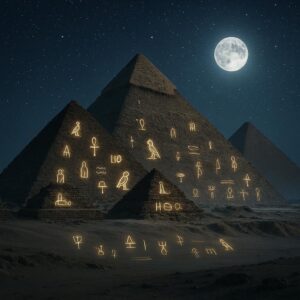
Pyramids: The Great Pyramid of Giza is the pinnacle of this concept. It was far more than a tomb. Its shape likely represented the primordial mound from which creation sprang (the Benben stone). Its aligned shafts pointed to key stars (like Orion’s Belt, associated with Osiris), designed to channel the Pharaoh’s soul directly to the imperishable circumpolar stars. The entire complex, with its valleys and causeways, recreated the journey of the sun god and facilitated the Pharaoh’s celestial ascension to become one with Ra.
-
Temples: Temples were not congregational spaces for the public. They were the literal houses of the gods, built as microcosms of the universe. The floor rose, and the ceiling lowered as one progressed inward, moving from the bright, public outer courts (the world of humans) into the dark, restricted sanctuary (the primeval waters of Nun, the state before creation). Only the Pharaoh and high priests could enter the inner sanctum to perform the daily ritual of clothing, anointing, and feeding the god’s statue, thereby sustaining the cosmic order. The columns were shaped like lotus and papyrus (symbols of Upper and Lower Egypt) holding up a star-decorated ceiling—a stone representation of the marshland that flourished on the mound of creation.
8. Sacred Symbolism: The Language of the Gods
Hieroglyphs were “the words of the gods,” and every symbol carried multiple layers of meaning.
-
The Ankh (☥): The looped cross, symbol of life, both earthly and eternal. Gods are often depicted holding it to the nostrils of a Pharaoh, giving the “breath of life.”
-
The Djed Pillar: Representing the backbone of Osiris, it stood for stability, endurance, and resurrection. Its raising was a central ritual symbolizing the triumph of order over chaos.
-
The Scarab (Khepri): The dung beetle, which rolls a ball of dung (its eggs) across the ground, was associated with the sun god Khepri, who rolled the sun across the sky. It symbolized transformation, self-generation, and rebirth.
-
The Eye of Horus (Wadjet): A powerful protective symbol. It represented the eye torn from Horus in his battle with Set, which was later restored by Thoth. It symbolized healing, wholeness, and protection.
-
The Shen Ring: A circle of rope with no beginning or end, symbolizing eternity and protection. Its elongated form became the cartouche that enclosed the Pharaoh’s name, protecting it for eternity.
9. Rituals & Magic: The Practical Application of Spiritual Knowledge
For Egyptians, ritual was reality-making. The daily temple ritual sustained the cosmos. Mummification was a ritual re-enactment of the Osiris myth, transforming the deceased into an Osiris. Magic (Heka) was a fundamental cosmic force, the energy of creation itself used by gods and, through correct spells and rites, by humans. It was not “superstition” but a sacred technology to affect change in both the physical and spiritual realms. Spells were used for healing, protection, and ensuring favorable outcomes in the afterlife. Heka was a neutral tool; its morality depended on the user’s intent, aligned with Ma’at or Isfet.
10. The Legacy: Egypt’s Spiritual Influence on the Modern World
The spiritual wisdom of Egypt never truly died. It flowed into the mystery traditions of the Greco-Roman world. Its symbols (like the pyramid and eye) found new life in Freemasonry and esoteric traditions. The concepts of judgment after death, resurrection, and a triune god (Osiris, Isis, Horus) have prompted comparative studies with later religions. In the modern New Age and metaphysical movements, Egyptian deities, symbols, and concepts of soul travel and initiation have seen a major revival. Egypt speaks to a deep, archetypal human yearning for order, meaning, and transcendence over mortality.
11. Conclusion: The Echo of Eternity
The spiritual meaning of Ancient Egypt reveals a civilization dedicated to the art of eternal living. It teaches that life is a sacred trust, a continuous practice of balancing truth against chaos, within our hearts and in our world. It offers a map of the soul’s journey, assuring us that death is a transition to be met with preparation and moral clarity. Most enduringly, it reminds us that we are part of a vast, interconnected cosmos, and our highest purpose is to contribute to its harmony—to live in Ma’at. In the silent stones of its temples and the cryptic beauty of its symbols, the echo of Egypt’s eternal quest still resonates, inviting us to remember our own divine spark and our place in the great, ordered dance of the universe.
12. Frequently Asked Questions (FAQs)
Q1: Did Egyptians actually worship animals?
A: No, they did not worship the animals themselves. They venerated the specific divine principle or attribute of a god that was symbolized by that animal. The Apis bull, for instance, was seen as a living manifestation of the god Ptah’s creative power. The animal’s behavior was observed as an omen of the god’s will.
Q2: Was Egyptian spirituality monotheistic or polytheistic?
A: It was complex and evolved. For most of its history, it was practically polytheistic, with a multitude of gods worshipped. However, there are strong strands of henotheism (worshipping one god without denying others) and monolatry (exclusive devotion to one god in a pantheon). Some theological texts, like the Memphite Theology, even suggest a underlying monistic principle where all gods are aspects of a single, primal creative force.
Q3: How can I incorporate ancient Egyptian spirituality into my modern life?
A: It’s about principles, not literal replication. You can:
-
Cultivate Ma’at by seeking balance, truth, and justice in your daily actions.
-
Study the symbols (like the Ankh or Scarab) as meditation tools for their timeless concepts of life and transformation.
-
Work with the archetypes of the gods (Isis’s nurturing, Thoth’s wisdom, Anubis’s guidance in transitions) in personal reflection or ritual.
-
Practice the core idea of seeing the sacred in the natural world—the cycles of the sun, moon, and seasons.
Q4: What is the biggest misconception about Egyptian spirituality?
A: That it was a morbid “cult of the dead.” In reality, their extensive focus on the afterlife was an expression of a profound love of life. They so cherished existence that they dedicated immense resources to ensuring its continuation in the most perfect form forever. The tomb was a “house of eternity” for an eternal life.