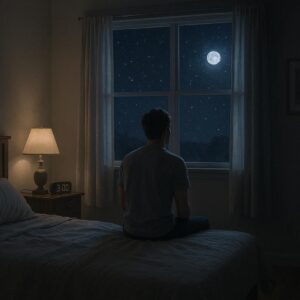
You open your eyes. The room is cloaked in a profound, velvety darkness, broken only by the faint glow of a digital clock. It reads 3:00 AM. Not 2:59, not 3:01. Precisely 3:00. A strange sense of alertness washes over you—this is not the groggy disorientation of a typical nighttime disturbance. Your mind is suddenly clear, and a peculiar stillness hangs in the air, a silence so deep it feels palpable. You are awake, utterly and completely, in the middle of what many call the “witching hour.” This experience, far from being a random sleep glitch, is a phenomenon reported by millions across cultures and spiritual traditions. It is often described not as an interruption, but as an invitation.
Is it a biological hiccup, a symptom of stress, or could it be something more? For countless individuals on a spiritual path, waking up at 3 AM consistently is interpreted as a profound sign—a sacred summons from the universe, the divine, or the deepest recesses of the soul. This article embarks on an exhaustive exploration of this mysterious occurrence. We will delve into its scientific explanations, unpack its rich tapestry of spiritual meanings across religions and mystic practices, and provide practical guidance for those who find themselves repeatedly awakened at this enigmatic hour. Prepare to journey into the night, where the veil between worlds is believed to be thinnest, and discover what message might be waiting for you in the stillness.
2. The Historical and Cultural Context of the “Witching Hour”
The term “witching hour” (typically midnight to 3 AM, with 3 AM holding a specific charge) is deeply embedded in Western folklore. It is considered a time when supernatural beings—witches, demons, and ghosts—are at the peak of their power, and spiritual activity is most potent. This belief finds its roots in Christian tradition, which inversely sanctified the hour.
The “Anti-Trinity” Hour: In Christian lore, 3 AM is considered the opposite of 3 PM, the hour of Jesus Christ’s death on the cross (“the ninth hour” in the Bible). Christ is said to have died at 3 PM, a moment of divine sacrifice and grace. Therefore, 3 AM became symbolically known as the “devil’s hour,” a time of mockery and inverse spiritual power. The number 3 is flipped from sacred to profane. This is why it often appears in horror culture as a time of dread.
Eastern Spiritual Systems: In contrast, many Eastern traditions hold this pre-dawn period in the highest esteem. In Hinduism, the time between 3 AM and 6 AM is called Brahma Muhurta, or “The Creator’s Hour.” It is considered the most sattvic (pure, harmonious) time of day, ideal for meditation, prayer, and study. The atmosphere is believed to be charged with spiritual energy, and the mind, free from daily distractions, is most receptive to higher consciousness. Similarly, in Buddhism, monks often rise for meditation long before dawn to tap into this serene and clear-minded state.
Islamic Tradition: In Islam, the last third of the night is a specially blessed time for seeking forgiveness and making personal supplications (dua). The Quran describes the righteous as those who “seek forgiveness before dawn” (Quran 3:17). The Tahajjud prayer is a voluntary night prayer performed after sleeping, often in this pre-dawn window, and is believed to be a time when God is particularly close and responsive to the believer.
This dichotomy—fear in one culture, reverence in another—sets the stage for understanding our modern interpretation. Are we waking to a presence, or to an absence? To a demonic hour, or to the Creator’s hour? The answer often lies in the feeling that accompanies the awakening and the lens through which one views the world.
3. The Science of Sleep: Circadian Rhythms and Nocturnal Awakenings
Before attributing every 3 AM wake-up to spiritual causes, it is crucial to understand the mechanics of sleep. Scientifically, waking up at night is normal. We sleep in cycles of approximately 90 minutes, moving through light sleep, deep sleep, and REM (Rapid Eye Movement) sleep. The transitions between these cycles are moments of lighter sleep where we are more prone to awakening.
-
Circadian Dip: Our core body temperature and alertness naturally dip in the middle of the night (around 2-4 AM), which can contribute to lighter sleep.
-
Stress and Cortisol: A primary culprit behind persistent awakenings is stress. When we are anxious, our bodies can secrete cortisol (the “stress hormone”) at inappropriate times. A spike in cortisol around 3 AM can jolt you into a state of alertness, often accompanied by racing thoughts about worries, responsibilities, or fears.
-
Blood Sugar: A drop in blood sugar levels during the night can trigger the release of hormones like adrenaline and cortisol, waking you up.
-
Light and Environment: External stimuli like noise, light pollution, or even a full moon (affecting ambient light) can disrupt sleep architecture.
The Scientific-Spiritual Intersection: This is where the mystery deepens. Science explains the mechanism (cortisol spike, sleep cycle transition), but not always the punctuality and consistent feeling of the 3 AM awakening. Why do so many report waking at exactly this time, not 2:45 or 3:15, with a sense of profound peace or urgent intuition rather than anxiety? It suggests that while the body’s biology may be the vehicle for the awakening, the catalyst could be something subtler—an energetic shift, a subconscious processing, or a spiritual nudge that interacts with our sensitive physiology.
4. Spiritual Traditions: 3 AM as a Sacred Time
Beyond folklore, 3 AM is a cornerstone in many esoteric and spiritual practices.
The “Vampire Hour” or “Hour of the Wolf”: In mystical traditions, 3 AM is when the veil between the physical world and the spiritual world is at its thinnest. It is a time when communication with guides, ancestors, and higher dimensions is believed to be most accessible. It’s not a time of fear, but of potential. The silence offers a blank canvas for the soul to speak and for the universe to deliver messages without the static of daily life.
Ascended Masters and Lightworkers: In New Age and contemporary spiritual circles, waking at 3 AM is often called a “lightworker’s wake-up call.” It is interpreted as a sign of spiritual awakening or acceleration—a download of light codes, an activation of higher chakras (particularly the crown and third eye), or a call to service. The belief is that benevolent spiritual beings or ascended masters are more easily able to connect with and impart wisdom to individuals during this energetically open portal.
A Time for Inner Alchemy: Alchemically, night represents the nigredo—the blackening, the stage of dissolution and introspection. The 3 AM awakening can be seen as a spontaneous entry into this state. It is a call to turn inward, to face the shadow, to die to the old self, and to begin the process of spiritual rebirth. The darkness is not an enemy, but the fertile ground from which new consciousness sprouts.
5. Psychological Perspectives: The Unconscious Mind at Night
Carl Jung’s depth psychology offers a powerful framework. Jung saw the hours of sleep as when the conscious ego relaxes its grip, allowing the unconscious—the vast reservoir of thoughts, feelings, memories, and archetypes not in our immediate awareness—to come forward.
Waking at 3 AM could be a moment when powerful material from the unconscious is breaking through to consciousness. This could be:
-
An unprocessed emotion from the day.
-
A creative insight or solution to a problem.
-
A confrontation with a shadow aspect of the personality.
-
A message from the Self (Jung’s term for the total, integrated psyche, akin to the soul).
The stillness of the night provides no distractions, forcing you to listen to this inner voice. From this perspective, the awakening is a psychic self-regulation mechanism, a built-in therapy session where the psyche attempts to rebalance and bring wholeness.
6. Common Spiritual Meanings and Messages
If you resonate with a spiritual interpretation, here are the most common meanings attributed to the 3 AM wake-up call:
| Potential Meaning | Associated Feelings & Signs | Possible Action Step |
|---|---|---|
| A Call to Meditation & Prayer | A pull toward stillness, a sense of sacred opportunity, peace. | Sit in silence, meditate, pray, or simply breathe consciously. |
| Spiritual Awakening & Activation | Tingling (especially at the crown), seeing lights or colors behind closed eyelids, a sense of expansion. | Ground yourself (walk barefoot, eat root vegetables), practice energy hygiene. |
| Message from Spirit Guides/Ancestors | A feeling of presence, receiving sudden insights or vivid memories of a loved one. | Ask for clarity before sleep, keep a dream/journal by your bed. |
| Unprocessed Emotion or Shadow Work | Anxiety, repetitive worrying thoughts, feeling haunted by a past event. | Practice journaling “brain dumps,” seek therapy, practice self-compassion. |
| A Warning or Premonition | A strong, inexplicable sense of dread or urgency about a person or situation. | Don’t panic. Use discernment. Inquire in meditation if there’s a specific action needed. |
| Psychic Development | Increased intuition, vivid dreams, sensitivity to energy and environments. | Shield your energy, practice psychic protection techniques, develop your gifts with respect. |
| A Call to Creative Action | A flood of ideas, inspiration for a project, lyrics, or solutions. | Keep a notebook by your bed to capture ideas. Don’t ignore the creative nudge. |
7. Distinguishing Spiritual Calls from Sleep Disorders
Discernment is critical. While spiritually significant, consistent nighttime awakenings can also indicate health issues. Consider consulting a doctor if you experience:
-
Gasping for air or loud snoring (signs of sleep apnea).
-
An overwhelming urge to move your legs (Restless Leg Syndrome).
-
Fatigue, mood disturbances, or impaired daytime function.
-
Panic attacks with intense physical symptoms (racing heart, sweating).
The Key Differentiator: The quality of the awakening. A spiritual nudge often comes with a clear, calm, or purposefully alert mind, even if the message is urgent. A stress or disorder-based awakening is typically accompanied by physiological anxiety, racing thoughts about mundane worries, and difficulty returning to sleep due to agitation.
8. Practices for the 3 AM Moment: Meditation, Prayer, and Journaling
Instead of fighting the awakening, try engaging with it. Here are structured practices:
-
Do Not React, Simply Notice: Your first action is to do nothing. Observe your state without judgment. Are you calm? Anxious? Inspired?
-
Conscious Breathing: Engage in 4-7-8 breathing (inhale 4, hold 7, exhale 8) to calm the nervous system and center yourself.
-
Sacred Inquiry: Silently ask, “Why have I been awakened? What is it I need to know or release?” Then listen without expectation.
-
Heart-Centered Meditation: Place a hand on your heart. Focus on feelings of gratitude or love. This high-vibration emotion can often clarify the nature of the awakening.
-
Stream-of-Consciousness Journaling: If thoughts are swirling, write them down without filter. This can extract the message from the mind’s chaos.
-
Returning to Sleep: If after 15-20 minutes no clarity comes, gently guide yourself back to sleep with a visualization of peaceful light or a simple mantra.
9. Astrological and Energetic Correlations
-
Planetary Hours: In Western esotericism, each day and night is divided into planetary “hours.” The planetary hour ruling a specific time changes daily. The pre-dawn period can sometimes fall under Mercury (communication) or Saturn (contemplation), offering another layer of interpretation.
-
Chakra System: 3 AM is frequently linked to the Third Eye (Ajna) and Crown (Sahasrara) Chakras. Awakenings may be accompanied by pressure, tingling, or activation in these areas, signaling an opening of intuition and spiritual connection.
10. Personal Testimonies and Case Studies
-
Elena, 42, Yoga Teacher: “For months, 3 AM on the dot. At first, I was frustrated. Then I started using the time for Pranayama. It transformed my practice and my life. I felt I was downloading instructions for my soul’s path.”
-
David, 38, Engineer: “It started during a period of intense stress at work. My 3 AM wake-ups were full of anxiety. Therapy helped me see it was my body forcing me to process what I was ignoring all day. It was a painful but necessary call to change my job.”
-
Priya, 29, Artist: “My most profound creative ideas come at 3 AM. I keep a sketchpad by my bed. It’s like a direct tap into the muse. The silence is my collaborator.”
11. Integrating the Nightly Awakening into Your Spiritual Path
Begin to see this not as a sleep problem, but as a potential spiritual practice. You are being given a unique, private audience with your deepest self. Document your experiences. Notice patterns. Is it around the new moon? During times of life transition? Your personal log will be the most valuable text in deciphering your unique code.
12. Conclusion
Waking up at 3 AM is a multifaceted phenomenon existing at the crossroads of biology, psychology, and spirituality. Whether it is a stress-induced cortisol spike, the unconscious mind demanding attention, or a genuine spiritual alarm clock from the universe, it carries a unified message: Pay Attention. The deepest night holds the potential for the greatest light—the light of awareness, healing, and connection. By meeting this experience not with frustration but with mindful curiosity, you open a doorway to profound self-discovery and spiritual growth.
13. Frequently Asked Questions (FAQs)
Q1: I wake up at 3 AM feeling terrified. Is this a bad spiritual sign?
A: Not necessarily. Fear often arises from the unknown or from cultural conditioning labeling this the “witching hour.” The energy is potent and can amplify underlying anxiety. Focus on grounding and calming practices before judging it as negative. If the fear is overwhelming, rule out sleep disorders and consider it may be your psyche bringing up deep-seated fears for healing.
Q2: How long will this phase of nightly awakenings last?
A: There’s no set timeline. It can last for a few nights, several months, or occur in cyclical phases throughout your life. It often coincides with periods of intense personal growth, stress, or spiritual transition. The duration usually correlates with how long it takes for you to receive, understand, and integrate the message or shift that is being presented.
Q3: Should I just look at my phone or get up if I’m awake?
A: Avoid screens. The blue light suppresses melatonin and tells your brain it’s morning, making it harder to return to sleep. If you feel alert and called to engage, use the practices mentioned (journaling, meditation) in very soft light. If you feel agitated, focus on breathwork in the dark to coax yourself back to sleep.
Q4: Is waking up at 3 AM mentioned in the Bible?
A: While not explicitly about waking up, 3 AM holds symbolic significance as the inverse of Christ’s death at 3 PM. In the Bible, important prayers and events happen during night watches (e.g., Psalm 119:62, Jesus praying in Gethsemane). Many Christians find the pre-dawn hours powerful for prayer and communion.
Q5: Can I make it stop if I don’t want a spiritual awakening?
A: If the cause is purely spiritual, ignoring the call may cause it to persist or manifest in other ways (like daytime anxiety). Addressing potential stressors, improving sleep hygiene, and engaging in gentle inquiry (“What do I need to address?”) is more effective than suppression. If it’s a medical issue, professional help is key.