From the meticulous genealogies of Genesis to the apocalyptic visions of Revelation, numbers permeate the Biblical text. They are far more than mere quantitative markers or historical footnotes. To the ancient Biblical writers, numbers possessed a qualitative, symbolic, and often theological dimension—a second layer of meaning whispering beneath the surface of the narrative. This is the realm of Biblical numerology: the study of the symbolic meaning of numbers used in Scripture. It is not a tool for divination or fortune-telling, but a hermeneutic key, a way of listening to the structural and poetic genius of the Divine Author who ordered the universe with measure, number, and weight (Wisdom 11:20).
Imagine the Bible as a grand, divinely composed symphony. The stories, laws, and prophecies are the melodies and harmonies—the immediate, audible beauty. The symbolic use of numbers, however, forms the underlying rhythm, the time signature, and the recurring motifs that give the entire work its deep, cohesive structure. Recognizing the pattern of seven in creation, the urgency of forty in testing, or the solidarity of two in witness, transforms our reading from a passive observation to an active discovery of interconnected divine truths. This article will serve as your guide to this hidden architecture, exploring the profound meanings embedded within the numbers of Scripture, from the singularity of One to the apocalyptic mystery of *666*.
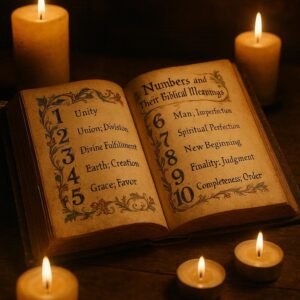
1. The Foundational Principle: One and the Many
Primary Meaning: Absolute Unity, Uniqueness, Primacy, and the Sovereignty of God.
The number one stands as the metaphysical and theological foundation of all Biblical numerology. It is the number of the undivided, the uncompounded, the supreme. Its most profound expression is in the core confession of Israel: “Hear, O Israel: The LORD our God, the LORD is one” (Deuteronomy 6:4). This Shema declares God’s absolute oneness, His uniqueness (echad), and His sovereign reign over all rivals. He is the sole source, the uncaused Cause, the indivisible Monad from whom all plurality flows.
This oneness translates into key theological concepts:
-
The Unity of God: A stark contrast to the polytheistic pantheons of surrounding nations.
-
The Unity of the Mediator: “For there is one God and one mediator between God and mankind, the man Christ Jesus” (1 Timothy 2:5).
-
The Unity of the Faith: “There is one body and one Spirit… one hope… one Lord, one faith, one baptism” (Ephesians 4:4-5).
-
Primacy and Firstness: It denotes priority. Adam was the first man. The first commandment concerns preeminent love for God. Christ is the firstborn over all creation and the firstfruits of the resurrection.
The number one constantly calls the reader away from fragmentation and idolatry (service to many “gods” or lords) to the integrated, singular worship of the One True God. It is the anchor point for all other meaning.
2. The Number of Witness and Division
Primary Meaning: Strengthening, Witness, Confirmation, Division, and Contrast.
If one speaks of unity, two introduces relationship, comparison, and the foundational principle of establishing truth. In the Biblical worldview, a matter is confirmed at the testimony of two or three witnesses (Deuteronomy 19:15; Matthew 18:16). This legal principle elevates two to the number of reliable witness and established truth. Jesus sent out his disciples two by two (Mark 6:7), providing mutual support and authoritative testimony.
Two also signifies division and distinction:
-
The two great lights (Genesis 1:16).
-
The two tables of the Law.
-
The two ways (broad and narrow, Matthew 7:13-14).
-
The two covenants (Galatians 4:24).
-
The two resurrections (life and condemnation, John 5:29).
It can represent help and companionship (a suitable helper, Ecclesiastes 4:9-12) or tension and conflict (two nations in Rebekah’s womb, Genesis 25:23). The meaning is often derived from context: are the two working in unison as witnesses, or are they in opposition, creating a dichotomy?
3. The Divine Signature: Trinity, Completeness, and Divine Encounter
Primary Meaning: Divine Completeness, Perfection, Witness, and God’s Manifest Presence.
The number three resonates with a sense of weight, completeness, and divine imprint. It is the number of divine fullness, most perfectly embodied in the triune nature of God: Father, Son, and Holy Spirit. The Biblical text is saturated with triadic patterns:
-
God’s attributes: Holy, holy, holy (Isaiah 6:3).
-
Time: Past, present, future.
-
Human constitution: Spirit, soul, and body (1 Thessalonians 5:23).
-
The threefold priestly blessing (Numbers 6:24-26).
-
Christ’s three days and nights in the heart of the earth (Matthew 12:40).
-
Peter’s threefold denial and subsequent threefold restoration (John 21:15-17).
Three often marks a complete cycle or a finished work. Jonah was in the fish three days. The Magi presented three gifts. Jesus’ earthly ministry lasted approximately three years. The resurrection on the third day signifies the completeness of God’s redemptive act—the work was fully done. In prophecy, a time, times, and half a time (Revelation 12:14) uses a threefold expression to denote a divinely ordained period. Three is the number of solid reality and divine intervention, moving beyond the simple witness of two into the realm of the supernatural and established reality.
4. Creation’s Blueprint: The World Number
Primary Meaning: Creation, the World, Universality, and Earthly Fulness.
Four is the number of the earth, the created order, and geographical completeness. It is the “world number,” a concept evident from the very first chapter of the Bible:
-
The fourth day sees the completion of the material universe with the establishing of sun, moon, and stars for seasons, days, and years.
-
There are four rivers flowing from Eden to water the earth (Genesis 2:10).
-
Four winds of heaven (Jeremiah 49:36).
-
Four corners of the earth (Isaiah 11:12).
-
Four living creatures around God’s throne, representing all created life (Revelation 4:6).
-
Four Gospels – a universal witness of Christ to the world.
This pattern denotes what is global, earthly, and structural. The New Jerusalem is a perfect cube, but its description begins with a wall with four sides and three gates on each side (twelve total), facing the four directions of the compass, inviting all nations (Revelation 21). Four speaks of systems, foundations, and the comprehensive scope of God’s creation and, often, of His judgment or salvation upon it.
5. Grace and Preparation
Primary Meaning: Grace, Favor, God’s Goodness, and Human Responsibility.
Five is the number of grace, the unmerited favor of God, often mixed with human weakness and responsibility. It is derived from four (the world) plus one (God) – God’s grace intervening in the world.
-
The Pentateuch (the five books of Moses, the Law) is the foundation of God’s gracious covenant with Israel.
-
The Tabernacle’s altar was five cubits by five cubits.
-
David chose five smooth stones to face Goliath.
-
Christ fed the 5,000 with five loaves.
-
The human body has five senses, five fingers, five toes.
It is also associated with instruction and preparation. The Book of Psalms is divided into five books, mirroring the Torah. Jesus told the parable of the Ten Virgins, where the wise and foolish were distinguished by their preparation; the number of virgins (ten) is a multiple of five, highlighting responsibility within the framework of grace.
6. The Number of Man and Imperfection
Primary Meaning: Humanity, Human Labor, Weakness, and Falling Short of God’s Perfection.
Six is unequivocally the number of man. Humanity was created on the sixth day (Genesis 1:26-31). A Hebrew slave was to serve for six years and go free in the seventh (Exodus 21:2). It represents human labor, systems, and achievements. However, because seven is the number of divine perfection and completion, six always falls short. It is one less than seven, symbolizing imperfection, incompleteness, and the inherent flaw in all human endeavor apart from God.
Human effort, no matter how grand, is stamped with this number:
-
Goliath’s height was six cubits, and he had six pieces of armor (1 Samuel 17:4-7).
-
Nebuchadnezzar’s golden image was sixty cubits high and six cubits wide (Daniel 3:1).
-
The numbered beast of Revelation is 666 (Revelation 13:18), the ultimate expression of a human, anti-God system aspiring to divinity but forever marked by the triadic failure of the number of man.
Six is not inherently evil, but it is inherently limited and flawed. It signifies the best that mankind can build on its own, which is always vulnerable to corruption and judgment.
7. Spiritual Perfection and Divine Completion
Primary Meaning: Spiritual Perfection, Completeness, Fulfillment, and Covenant.
If one number could be called the fingerprint of God in Scripture, it is seven. It is the number of divine perfection and completion. God’s creative work culminated on the seventh day, which He blessed and made holy (Genesis 2:2-3). From this foundation, seven permeates every aspect of Biblical life and ritual:
-
The seven-fold Spirit of God (Revelation 4:5).
-
Seven feasts of Israel (Leviticus 23).
-
Seven pairs of clean animals on the ark.
-
The seven churches, seven seals, seven trumpets, seven bowls in Revelation.
-
Seventy (7 x 10) elders, seventy years of exile.
-
Christ’s instruction to forgive seventy times seven (Matthew 18:22).
Seven speaks of a cycle finished, an oath sworn, a covenant fulfilled. It is the sacred number par excellence. When something occurs in sevens or a multiple of seven, it signals that the event is divinely ordered, perfectly complete, and saturated with spiritual significance. It is the antithesis of the incompleteness of six.
8. New Beginnings and Superabundance
Primary Meaning: New Beginning, Resurrection, Superabundant Grace, and Covenant Circumcision.
Eight is the number of new beginnings and resurrection. It is the number following seven (completion), thus representing the start of a new order or cycle. This symbolism is deeply tied to the Resurrection of Jesus Christ, who rose on the first day of the week, which is, symbolically, the eighth day (following the completed seven-day cycle of the previous week).
-
Circumcision, the sign of the Abrahamic covenant, was performed on the eighth day (Genesis 17:12), marking a new spiritual identity.
-
Eight souls were saved in the ark to repopulate a new world (1 Peter 3:20).
-
David was the eighth son of Jesse.
-
The Feast of Tabernacles lasted seven days, with a sacred assembly on the eighth day (Leviticus 23:36).
Eight also signifies superabundance. The miracle of the Hanukkah oil (lasting eight days) and the eight Beatitudes (Matthew 5:3-10) point to a grace that surpasses the old, complete cycle. It is the number of the new creation in Christ.
9. Finality, Judgment, and Fruit of the Spirit
Primary Meaning: Finality, Divine Judgment, The Fruit of the Spirit, and Manifestation.
Nine is the number of finality and judgment. It is 3 x 3, intensifying the perfection and completeness of three. It often denotes the bringing of a matter to its conclusion, particularly in judgment.
-
Christ died at the ninth hour (3 PM), bringing the final judgment upon sin.
-
There are nine fruits of the Spirit (Galatians 5:22-23), the complete manifestation of the Christian character.
-
The King of Israel (Jehu’s dynasty) Shallum reigned for one month in Samaria, a picture of incomplete rule.
-
In Genesis, God appears to Hagar when she is pregnant with Ishmael, a child of the flesh, not the promise.
Nine speaks of a conclusion reached, a harvest reaped, a verdict rendered. It is the number of patience fulfilled and the fullness of blessing or cursing coming to term.
10. Divine Order and Human Responsibility
Primary Meaning: Divine Order, Completeness of Law, Human Government, and Responsibility.
Ten represents divine order, completeness in human affairs, and responsibility before God. It is the basis of our decimal system and is prominent in laws and governance.
-
The Ten Commandments are the complete summary of God’s moral law.
-
The ten plagues were the complete judgment on Egypt’s gods.
-
The tithe is a tenth, acknowledging God’s sovereign ownership.
-
The ten virgins represent the collective body of professing believers responsible for readiness.
-
Daniel’s visions feature ten horns, representing the totality of worldly power arrayed against God’s people.
Ten signifies a complete set, a full measure, a test of faithfulness. It is the number of God’s orderly requirements and humanity’s accountability to meet them.
11. The Master Numbers: Twelve, Forty, and Beyond
Certain compound numbers carry profound, consistent symbolism.
Twelve (10 + 2 or 3 x 4): The number of divine governmental perfection. It combines three (divine) and four (earthly), symbolizing God’s perfect rule administered on earth.
-
Twelve tribes of Israel.
-
Twelve apostles of the Lamb.
-
Twelve gates, twelve foundations, twelve pearls in the New Jerusalem.
-
Twelve baskets of leftover fragments.
-
The woman with an issue of blood for twelve years is healed by Christ, showing His authority to restore theocracy (true divine rule) to a broken life.
Forty (4 x 10 or 5 x 8): The number of probation, testing, and transition.
-
Forty days and nights of the flood.
-
Forty years of Israel’s wilderness wandering.
-
Forty days of Moses on Sinai.
-
Forty days of Christ’s temptation.
-
Forty days from resurrection to ascension.
-
It represents a God-ordained period of trial leading to a new beginning.
Other Notable Numbers:
-
Seventy (7 x 10): Universal administration (elders, nations in Genesis 10).
-
One Hundred Twenty (40 x 3): Period of waiting or expectancy (disciples in upper room).
-
One Hundred Forty-Four (12 x 12): The ultimate perfection of God’s people (the sealed in Revelation 7).
Core Biblical Numbers at a Glance
| Number | Primary Meaning | Key Biblical Examples | Theological Theme |
|---|---|---|---|
| 1 | Unity, Primacy | “The LORD is one” (Deut. 6:4), One Mediator | God’s Sovereignty |
| 2 | Witness, Division | Two witnesses, Two by two, Two great lights | Confirmation & Contrast |
| 3 | Divine Completeness | Trinity, Resurrection on 3rd day, Holy x3 | God’s Full Presence |
| 4 | Creation, Earth | Four corners, Four living creatures, 4th day | The World System |
| 5 | Grace, Preparation | Five loaves, Pentateuch, Five wise virgins | God’s Favor & Our Response |
| 6 | Man, Imperfection | Man created on 6th day, Goliath’s armor, 666 | Human Limitation |
| 7 | Divine Perfection | Creation week, Seven seals/trumpets, Seventy | Spiritual Completion |
| 8 | New Beginning | Resurrection (8th day), Circumcision, Noah’s 8 | New Creation |
| 9 | Finality, Judgment | Ninth hour death, Fruit of the Spirit | Conclusion & Harvest |
| 10 | Divine Order | Ten Commandments, Ten plagues, Ten virgins | Law & Responsibility |
| 12 | Governmental Perfection | Twelve tribes, Twelve apostles, New Jerusalem | God’s Rule on Earth |
| 40 | Testing, Transition | Wilderness 40 years, Jesus tempted 40 days | Probation & Preparation |
12. The Enigmatic 666: The Culmination of Human Rebellion
The number 666 in Revelation 13:18 is “the number of the beast… for it is the number of a man.” It is the ultimate expression of the symbolism of six. It is a trinity of human imperfection (6-6-6): a man, a system, or an ideology that seeks to arrogate to itself divine worship and power. It is the pinnacle of human achievement in rebellion against God—seemingly powerful, unified, and persuasive, but in God’s eyes, it is a triple failure, forever falling short of the divine perfection of seven. It represents the concentrated essence of all humanistic, anti-Christ systems throughout history that promise utopia apart from God.
13. Numerology vs. Biblical Number Meaning: A Critical Distinction
It is crucial to distinguish Biblical numerology from occult numerology, gematria (assigning numerical values to letters for mystical interpretation), or seeking hidden codes. The Biblical method is literary and symbolic, not mathematical or magical. The meanings are derived from:
-
Observed Patterns: How the number is used consistently across the Biblical text.
-
Cultural Context: Understanding ancient Near Eastern perceptions of numbers.
-
Theological Consistency: The symbolism must align with the overall revelation of Scripture.
We are not to search for numbers to predict the future or find secret messages. We are to observe the patterns God has woven into His Word to appreciate its depth, coherence, and beauty.
14. Practical Application: Discerning Divine Patterns in Scripture
How can we use this knowledge?
-
Deepen Understanding: Seeing the forty years in the wilderness and forty days of Christ’s temptation connects the testing of Israel with the testing of the true Israelite, Jesus, who succeeded where they failed.
-
Appreciate Literary Beauty: Recognizing the deliberate structure of sevens in Revelation or the genealogies in Matthew (grouped in 14 generations, 2 x 7) reveals the author’s craft.
-
Avoid Misinterpretation: It guards against fanciful interpretations (e.g., calculating the date of Christ’s return based on numbers) by grounding symbolism in established Biblical usage.
Conclusion
Biblical numerology is not a secret key to unlock hidden prophecies, but a profound lens through which to appreciate the divine harmony of Scripture. From the foundational unity of One to the perfected order of Twelve, numbers form a subtle, symbolic language that underscores God’s sovereign plan, highlights human frailty, and points relentlessly to the perfect work of Christ. They reveal a text where every detail, even the numerical, is purposeful, inviting us into a deeper contemplation of the mind of the Divine Author who has ordered all things—including His Word—in perfect measure.
Frequently Asked Questions (FAQs)
Q: Is studying Biblical numerology like using astrology or fortune-telling?
A: Absolutely not. Occult numerology seeks to predict or control the future through numbers. Biblical numerology is a descriptive, not a prescriptive, study. It observes patterns God has placed in His Word to understand its themes better, not to divine hidden information about our lives.
Q: Should I start looking for special meanings in every number in the Bible?
A: Use caution. Not every instance of a number is symbolic. Many are simply literal (e.g., 1,000 soldiers). Context is king. Look for numbers that are emphasized, repeated in patterns, or connected to significant theological events (like 40, 7, 12). The symbolic meaning should flow naturally from the text and align with the rest of Scripture.
Q: What about numbers like 153 fish (John 21:11) or 666? Are they codes?
A: 666 is explicitly called a number for calculation and is tied to the symbolism of 6, as explained. Numbers like 153 have prompted much speculation (e.g., being a triangular number), but no single interpretation is definitive. It’s best to focus on the clear, established patterns (1-12, 40, 70) rather than obsessing over every specific figure.
Q: Does this mean the Biblical authors intentionally embedded these numbers?
A: Yes, the evidence is overwhelming. The structured genealogies, the deliberate counts in narratives (like the items in the Tabernacle), and the patterned visions of the prophets all indicate a conscious use of symbolic numbers as part of the ancient literary and theological tradition. The Holy Spirit inspired not just the words, but the profound structure that contains them.
Q: What is the best resource to start studying this further?
A: Begin by simply reading the Bible with new eyes, noting when numbers are repeated or emphasized. Use a good study Bible with notes. For dedicated study, consult the resources listed below.
Additional Resources for Study
-
Books:
-
Number in Scripture: Its Supernatural Design and Spiritual Significance by E.W. Bullinger (a classic, though sometimes overly meticulous work).
-
Biblical Mathematics: Keys to Scripture Numerics by Ed F. Vallowe.
-
The Mystery of Numbers by Roger S. Wiebe (a more moderate and accessible approach).
-
-
Digital Resources:
-
Blue Letter Bible (blueletterbible.org): Use their lexicons and tools to study the Hebrew and Greek words associated with numbers.
-
BibleProject (thebibleproject.com): Their podcasts and videos on Biblical themes often touch on literary patterns, including numerical ones.
-
-
Academic Articles:
-
Search journals like Journal of Biblical Literature or Tyndale Bulletin for scholarly articles on numerology in specific books (e.g., “Numerical Patterns in the Book of Revelation”).
-