In the modern world, a “house” is often viewed as a physical asset, a private sanctuary, or simply a structure for shelter. We name our homes whimsically, after geographic features, or for sentimental value. But in the pages of the Bible, the naming of a house carries a weight far beyond architecture or address. A biblical “house” is a nexus of identity, covenant, legacy, and divine encounter. It is a concept saturated with theological meaning, one that unfolds from Genesis to Revelation, tracing the very story of God’s relationship with humanity.
To speak of the “House of David” is not to describe a palace’s blueprints but to invoke a royal, messianic lineage. To reference the “House of God” is to point to the locus of divine presence and worship. To be called part of the “House of Israel” is to claim a heritage of covenant and calling. These names are spiritual DNA, architectural plans for destiny, and frameworks for understanding our place in a grand, divine narrative. This article will embark on a detailed exploration of these profound designations. We will excavate their Hebrew roots, trace their historical development, and unpack their layered meanings—theological, social, and personal. By understanding these dwellings of destiny, we gain deeper insight into the Bible’s central message and the foundational metaphors that shape faith.
2. The Concept of “Bayit”: Understanding the Hebrew Foundation
The entire biblical edifice of “house” terminology is built upon the Hebrew word בַּיִת (bayit). Its semantic range is remarkably broad, far exceeding our English equivalent. Understanding bayit is key to unlocking every subsequent “house” name.
Primary Meanings of Bayit:
-
A Physical Dwelling: This is its most basic sense—a tent (of nomads), a house (in a city), a palace (for a king), or even a cage for animals (2 Chronicles 9:25).
-
Household or Family: Bayit encompasses everyone living under one roof: the patriarch, his wives, children, servants, and even extended kin. It denotes the basic socio-economic unit of ancient Israel (e.g., “the house of Jacob”).
-
Dynasty or Lineage: This extension moves from the living family to its enduring royal or priestly line. “The house of David” means the dynasty founded by King David, including all his descendants who sat on the throne.
-
Institution or Temple: “The house of God” (Bethel) refers to the sanctuary, the place of worship and sacrifice. It can also denote a functional institution like the “house of the king” (the royal administration).
-
A Place or Realm: In a metaphorical sense, it can refer to a domain, such as Sheol being called the “house appointed for all living” (Job 30:23).
The fluidity of bayit reveals a holistic ancient worldview. The physical structure, the family unit, its ongoing legacy, and its divine purpose were inseparable. A house was not a shell for life but the very organism of life itself—its walls held together stories of past promises and future hopes.
3. The House of the Patriarchs: Foundations of Faith and Family
Before kings and temples, there were tents and altars. The narrative of the Patriarchs—Abraham, Isaac, and Jacob—establishes the prototype of the biblical “house” as a covenant community on the move.
The House of Abraham (Beit Avraham): God’s call to Abram (later Abraham) in Genesis 12 begins with a profound promise: “I will make you into a great nation… and all peoples on earth will be blessed through you.” This nation would emerge from Abraham’s “house.” Yet, for decades, this house was defined by its lack of a crucial element: an heir. The tension in Abraham’s story revolves around the building of this house—through Ishmael (human effort) or Isaac (divine promise). God’s covenant in Genesis 15 and 17 is explicitly with Abraham and his “house” after him. The sign of circumcision was applied to every male in his household, including servants, marking them as part of this covenant community. Thus, Abraham’s house was the first “house of faith,” a family defined not solely by blood but by a shared response to God’s promise.
The House of Isaac (Beit Yitzchak) and Jacob (Beit Ya’akov): The promise flowed to Isaac and then to Jacob. Jacob’s story, in particular, is one of wrestling for blessing and building a house. His name change to “Israel” (one who struggles with God) marked a turning point. His twelve sons became the progenitors of the twelve tribes. While in Egypt, the “house of Jacob” (Exodus 19:3) grew from a large family into a nation. The patriarchal houses teach us that a godly house begins with a response to divine calling, is sustained through faith amidst uncertainty, and is meant to be a vehicle for blessing the wider world.
4. The House of David: A Dynasty of Promise and Messianic Hope
If the patriarchal house was a mobile tent of promise, the House of David became its solidified, royal expression. This is arguably the most politically and theologically significant “house name” in the Hebrew Bible.
The Davidic Covenant (2 Samuel 7): The pivotal moment comes when King David, settled in his palace of cedar, desires to build a “house” (temple) for God. The prophet Nathan relays God’s breathtaking response: You will not build a house for me; instead, I will build a house for you. Here, the pun on bayit is masterful. God promises to establish David’s “house” (dynasty) forever. “Your house and your kingdom will endure forever before me; your throne will be established forever” (2 Samuel 7:16). This unconditional covenant shifted Israel’s hope onto a royal, messianic trajectory.
Characteristics of the House of David:
-
Divinely Established: Its authority came from God’s promise, not mere human succession.
-
Centered in Jerusalem: David’s conquest of Zion made it the eternal, spiritual, and political capital of the dynasty.
-
A Standard of Justice: Ideal Davidic kings were to rule with justice and righteousness, shepherding God’s people (Psalm 72).
-
The Messianic Hope: After the monarchy’s fall in 586 BC, the promise lived on. The prophets foretold a future “branch” from the stump of Jesse (David’s father) who would reign in perfect peace and justice (Isaiah 11:1-10; Jeremiah 23:5-6). This “Son of David” became the central longing of Israel.
The New Testament opens by announcing Jesus Christ as “the son of David, the son of Abraham” (Matthew 1:1), claiming He is the ultimate fulfillment of this royal house. The angel Gabriel tells Mary that God will give Jesus “the throne of his father David” (Luke 1:32-33). Thus, the House of David finds its true, eternal meaning in the person of Jesus, the King of Kings.
5. The House of God: Tabernacle, Temple, and Transcendence
While God cannot be contained, He chooses to dwell among His people. The “House of God” (Bet El) is the narrative of God making a home on earth.
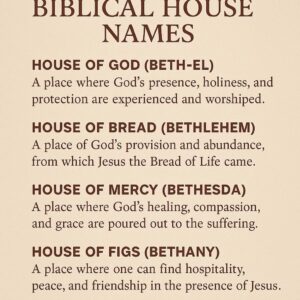
From Bethel to the Tabernacle: The term first appears when Jacob dreams of a ladder to heaven at Luz. He renames the place Bethel, declaring, “This is none other than the house of God, and this is the gate of heaven” (Genesis 28:17). It was a place of encounter. Later, under Moses, this concept became portable. The Tabernacle (mishkan, “dwelling place”) was a mobile bayit, its precise design given by God Himself (Exodus 25-31). Its structure—from the Outer Court to the Holy of Holies—taught a theology of approach, holiness, and atonement.
The Temple in Jerusalem: Solomon’s construction of the permanent Temple in Jerusalem (1 Kings 6-8) was a monumental event. Solomon acknowledged the paradox: “But will God really dwell on earth? The heavens, even the highest heaven, cannot contain you. How much less this temple I have built!” (1 Kings 8:27). Yet, God filled it with His glory (Shekinah). The Temple became the center of national worship, the pinnacle of the “House of God” in the Old Testament.
Prophetic Expansion and New Testament Fulfillment: The prophets, even while predicting the Temple’s destruction, began to expand the concept. Isaiah speaks of God’s house becoming “a house of prayer for all nations” (Isaiah 56:7). In the New Testament, Jesus shockingly applies the “temple” title to His own body (John 2:19-21). After His resurrection and the gift of the Holy Spirit at Pentecost, the “house of God” is stunningly redefined as the community of believers themselves. Paul writes, “You are… God’s building… a holy temple in the Lord… a dwelling in which God lives by his Spirit” (1 Corinthians 3:9; Ephesians 2:21-22). The physical house of stone is transcended by the spiritual house of living stones (1 Peter 2:5).
6. Houses of Clay and Spirit: Human Dwellings as Moral Parables
The Bible is replete with stories where physical houses serve as powerful metaphors for spiritual conditions.
The Wise and Foolish Builders (Matthew 7:24-27): Jesus’ parable contrasts two men building houses—one on rock, one on sand. The house represents a life. The foundation is obedience to Jesus’ words. Storms (trials, judgment) test the foundation. The wisdom is proactive: a secure life is built on the right foundation before the storm hits.
The House Swept Clean (Matthew 12:43-45): Jesus warns of an unclean spirit leaving a person (a “house”), only to return with seven worse spirits. The lesson is that spiritual reform cannot be merely negative (emptying). It must involve positive filling—with the Holy Spirit and God’s truth—or the end state is worse than the first.
The House of Simon the Pharisee (Luke 7:36-50): In this dramatic scene, a house of religious propriety becomes the stage for a shocking display of grace. Simon’s “house” (his heart and his social standing) was built on self-righteousness. The sinful woman’s act of love, welcomed by Jesus, revealed that true righteousness is received, not achieved. The house that seemed clean was empty of love; the one deemed unclean was welcomed home.
These stories teach that every human life is a “house” under construction. Its integrity depends on the foundation (faith in Christ), its resident (the Holy Spirit), and the quality of its contents (love, humility, obedience).
7. The House of Israel: A People, A Nation, A Spiritual Family
“House of Israel” (Beit Yisrael) is the comprehensive term for the covenant people. It evolves in meaning throughout Scripture.
| Era/Context | Primary Meaning of “House of Israel” | Key Scripture Example |
|---|---|---|
| Exodus & Conquest | The united nation descended from Jacob, the twelve tribes. | Exodus 40:38 – “So the cloud of the LORD was over the tabernacle by day, and fire was in the cloud by night, in the sight of all the house of Israel during all their travels.” |
| Divided Monarchy | Often refers specifically to the Northern Kingdom (10 tribes), distinct from the “House of Judah.” | 1 Kings 12:21 – “When Rehoboam arrived in Jerusalem, he mobilized the house of Judah and the tribe of Benjamin… to go to war against the house of Israel.” |
| Prophetic Literature | The whole people of God, often in a state of rebellion but subject to God’s judgment and future restoration. | Ezekiel 37:11 – “Son of man, these bones are the whole house of Israel.” |
| New Testament | The people of the Old Covenant, and by extension, the spiritual community of all believers in Jesus, the true Israel of God. | Hebrews 8:8 – “I will make a new covenant with the house of Israel and with the house of Judah.” (cf. Galatians 6:16) |
This term encapsulates the corporate identity of God’s chosen people. In the New Testament, the concept is fulfilled in the church, the “Israel of God” (Galatians 6:16), composed of both Jews and Gentiles who are united by faith in the Messiah, thus expanding the “household of God” (Ephesians 2:19).
8. Houses of Failure and Judgment: Lessons from Broken Foundations
Not all biblical houses stand as models to emulate. Some serve as sobering warnings.
The House of Eli (1 Samuel 2-4): Eli was the high priest at Shiloh. God’s judgment came upon his “house” because his sons, Hophni and Phinehas, were wicked, and “Eli failed to restrain them” (1 Samuel 3:13). The priesthood was removed from his lineage, and his house died out in a single day. The lesson is grave: spiritual privilege does not guarantee legacy. Parental and leadership failure can lead to the collapse of a house.
The House of Ahab (1 Kings 16-22, 2 Kings 9-10): Synonymous with idolatry and evil, Ahab’s house, under the influence of his wife Jezebel, promoted Baal worship and murdered the innocent (Naboth). The prophet Elijah pronounced utter destruction (1 Kings 21:20-24), which was meticulously fulfilled by Jehu. This house demonstrates how systemic sin and rejection of God’s prophets lead to inevitable and total ruin.
The House of the Proud and Violent: Proverbs repeatedly contrasts the house of the righteous with the house of the wicked. “The house of the wicked will be destroyed, but the tent of the upright will flourish” (Proverbs 14:11). “Every wise woman builds her house, but with her own hands the foolish one tears hers down” (Proverbs 14:1). These proverbs affirm that the moral and spiritual choices of the inhabitants directly determine the stability and fate of their “house.”
9. The New Testament Fulfillment: From Stone to Heart
The New Testament brings all the threads of “house” theology to a Christ-centered climax.
-
Jesus as the True Temple: As mentioned, Jesus is the final, perfect dwelling of God on earth (John 1:14, “tabernacled among us”).
-
The Church as God’s Household: Believers are no longer strangers but “fellow citizens with God’s people and also members of his household” (Ephesians 2:19). The primary metaphor shifts from a physical, ethnic house to a global, spiritual family.
-
The Believer’s Heart as a Dwelling: “Christ may dwell in your hearts through faith” (Ephesians 3:17). The ultimate “house of God” is the redeemed human spirit, indwelt by the Holy Spirit (1 Corinthians 6:19).
-
The Eternal House: 2 Corinthians 5:1 contrasts our earthly “tent” (mortal body) with “a building from God, an eternal house in heaven, not built by human hands.” This is the ultimate hope—the faithful are promised a permanent place in the Father’s house (John 14:2).
In Christ, the promise to Abraham’s house (blessing to all nations), the stability of David’s house (an eternal throne), and the holiness of God’s house (a dwelling for His presence) are all fulfilled and opened to all who believe.
10. Conclusion: The Eternal House
The biblical narrative of houses reveals a divine blueprint: from the mobile tents of patriarchs to the eternal throne of David’s Son; from a stone temple in Jerusalem to a temple of living stones across the globe. These names—House of Abraham, David, Israel, God—are not mere historical labels but living invitations. They tell us that God builds His legacy through covenant families, establishes His reign through promised kings, and makes His home not in buildings of stone, but in hearts of faith. Our lives, our families, and our communities are all “houses” under construction, called to be built on the cornerstone of Christ, inhabited by His Spirit, and destined for an eternal dwelling in the house of the Father.
11. Frequently Asked Questions (FAQs)
Q1: What is the most important “house” in the Bible?
Theologically, the “House of God” is central, as it represents God’s presence with His people. However, the “House of David” is crucial for messianic prophecy. In the New Testament, both converge in Jesus and His Church.
Q2: Does “House of Israel” always mean the same thing?
No. Its meaning shifts contextually. It can mean the entire nation, just the Northern Kingdom, the exilic community, or (in the NT) the spiritual people of God. Careful attention to the biblical book and historical context is needed.
Q3: How can I apply the “wise builder” parable to my life today?
The “rock” is hearing and obeying the teachings of Jesus (Matthew 7:24). Building your life (career, relationships, values) on the foundation of His commandments and grace ensures resilience through life’s inevitable storms.
Q4: What happened to the “House of David” after the exile?
The royal line continued genealogically but without a throne. The hope was kept alive in prophecy and in records like the genealogies in Matthew 1 and Luke 3. First-century Jews were still expecting a “Son of David” to restore the kingdom, which the New Testament claims Jesus did, though in a spiritual and eternal way first.
Q5: If God’s house is now people, not a building, why do we call church buildings “churches”?
This is a linguistic shorthand. The New Testament word ekklesia (church) always refers to the assembly of people. We call buildings “churches” because that’s where the church meets. It’s vital to remember the true, living nature of the church as God’s household.