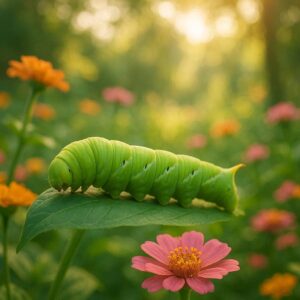
In the quiet corners of a leaf, in the deliberate, slow crawl across a garden path, exists one of nature’s most potent and eloquent spiritual teachers: the caterpillar. Unassuming in appearance, often overlooked in favor of its radiant successor, the butterfly, the caterpillar holds profound secrets to the mysteries of existence, change, and the soul’s evolution. Its very life is a narrative written in biological code, a story of radical transformation that resonates at the deepest levels of human consciousness. This article is an exclusive, comprehensive journey into the spiritual meaning of the caterpillar—a being that does not merely change but undergoes a complete dissolution and rebirth. We will delve beyond the surface-level symbol of “change” to explore the nuanced spiritual virtues it embodies: the necessity of voracious learning, the sacred patience of the pupal stage, the courage to surrender one’s entire known form, and the promise of a potential waiting to be unfurled. For anyone sensing a call to grow, to shed an old life, or to navigate a period of darkness and uncertainty, the caterpillar offers a timeless, living blueprint.
2. Universal Symbol of Transformation: The Alchemy of Becoming
The caterpillar’s spiritual significance is anchored in its breathtakingly literal metamorphosis. This process is not a simple maturation but a total annihilation of the larval form. Within the chrysalis, specialized cells called imaginal discs—which have been present but dormant all along—begin to multiply, using the nutrient soup of the dissolved caterpillar to construct an utterly new being. This is spiritual alchemy in its purest form: the base lead of earthly existence is transmuted into the golden wings of a higher state.
Key Spiritual Insights from the Metamorphosis Process:
-
Complete Surrender: The caterpillar does not “try” to become a butterfly. It instinctively enters the chrysalis and surrenders completely to a process orchestrated by a wisdom far greater than itself. Spiritually, this mirrors the necessity of surrendering our ego, our rigid identities, and our need for control to access a higher state of being.
-
The Necessity of Dissolution: Before the new can be built, the old must break down. This “dark night of the soul” or period of crisis is not a failure but a sacred and necessary phase of deconstruction. The caterpillar teaches that falling apart is often the prerequisite to coming together in a more magnificent way.
-
Latent Potential (Imaginal Discs): Perhaps the most profound spiritual metaphor. The imaginal discs represent the divine spark, the soul’s blueprint, or our highest potential that exists within us from the beginning. Our life’s experiences, even the difficult “digestive” ones, become the fuel that eventually activates this latent potential.
The Stages of Metamorphosis as a Spiritual Metaphor
| Biological Stage | Physical Process | Spiritual Correlation | Life Application |
|---|---|---|---|
| Egg | The beginning; potential laid down. | The seed of an idea, a calling, or a new phase of life. Soul’s incarnation. | A nascent dream, a feeling of being “pregnant” with possibility. |
| Caterpillar (Larva) | Voracious feeding and growth. | The phase of gathering experiences, learning, consuming knowledge, and building foundational resources. The “human, doing” stage. | Pursuing education, building skills, exploring the world, sometimes feeling “hungry” for more. |
| Chrysalis (Pupa) | Complete dissolution and reorganization. | The sacred pause. Surrender, introspection, prayer, meditation. The “dark night of the soul” where old forms die so new ones can emerge. | A period of illness, loss, sabbatical, deep therapy, or spiritual retreat. |
| Butterfly (Imago) | Emergence and flight. | The awakened state, spiritual liberation, expressing one’s true purpose and beauty. Sharing your gifts with the world. | Stepping into a new career, expressing creativity, living with authenticity and joy. |
3. Patience & Divine Timing: The Spiritual Virtue of the Cocoon Stage
Our fast-paced, results-driven culture often pathologizes stillness. The caterpillar’s pupal stage is a powerful counter-narrative. Encased, hidden from view, and seemingly inert, the most miraculous work is happening. This stage symbolizes the spiritual principles of patience, trust, and divine timing.
The caterpillar does not rush its transformation. It does not peek out early because it feels restless. It rests in the certainty of the process. Spiritually, this teaches us to honor our own periods of incubation. These are times when outward action may be futile or even counterproductive. Instead, we are called to internal work: processing emotions, integrating lessons, and simply being. The cocoon is a spiritual womb, a protected space where the soul recalibrates. Impatience here is a form of distrust—in the process, in the universe, and in oneself. The caterpillar’s wisdom urges us to embrace these quiet, hidden seasons as fertile ground for the most profound growth, trusting that our emergence will be perfectly timed.
4. The Caterpillar in World Mythologies and Spiritual Traditions
The caterpillar’s symbolism is woven into the spiritual fabric of cultures worldwide, often as a creature of the earth that holds the promise of the sky.
-
Native American Traditions: Many tribes see the caterpillar as a symbol of good luck and transformation. Some Navajo stories view them as prophets of rain, connecting them to fertility and the cycles of nature. As earth-bound creatures, they are also seen as connectors to the grounding energy of the Mother Earth.
-
Celtic and European Folklore: Often called “woolly bears” or similar names, caterpillars were sometimes used in weather prediction based on the width of their bands. This links them to intuition, reading natural signs, and hidden knowledge. Their connection to the coming butterfly also tied them to the soul, and in some tales, they were seen as carriers of dreams or messages from the fairy realm.
-
Asian Philosophies: In Chinese symbolism, the insect world is often connected to longevity, rebirth, and happiness. The caterpillar’s patient journey aligns with Taoist principles of wu wei (effortless action) and following the natural way. Its transformation is a perfect illustration of the constant state of flux (yin and yang) that governs all life.
-
Christian and Jewish Mysticism: While the butterfly is a clear symbol of resurrection, the caterpillar represents the earthly, mortal life—the necessary state of being that must be “transfigured.” It symbolizes the soul before enlightenment, engaged in the sometimes slow, humble work of spiritual growth and preparation.
-
Ancient Mesoamerican Cultures: The Aztecs associated butterflies with the souls of fallen warriors and the goddess of fertility. The caterpillar, as the precursor, would have been seen as the vessel containing that potent soul-force, undergoing its necessary earthly preparation.
5. Spiritual Lessons from the Caterpillar’s Lifecycle
Each phase of the caterpillar’s existence offers discrete, potent spiritual lessons:
-
The Lesson of the Egg: Potential and Destiny. The egg represents pure potential. It is the divine idea of you, your soul’s contract. This stage asks: What is waiting to be born in you? What is your latent purpose?
-
The Lesson of the Feeding Larva: Conscious Consumption. The caterpillar’s primary job is to eat. This translates spiritually to: What are you feeding your mind, heart, and spirit? Are you consuming nourishing “leaves” of knowledge, positive relationships, and uplifting experiences, or are you feeding on toxic mental and emotional patterns? This stage emphasizes discernment and the building of inner resources.
-
The Lesson of Molting: Releasing Outgrown Selves. To grow, a caterpillar must shed its exoskeleton multiple times. This is a powerful metaphor for shedding outgrown identities, beliefs, and habits. Spiritually, it teaches that growth can be uncomfortable and requires releasing the very structure that once protected us.
-
The Lesson of the Chrysalis: Sacred Surrender. Here, the caterpillar ceases all doing and enters a state of pure being. It is the ultimate act of faith. The spiritual lesson is clear: Transformation requires a pause. You must stop crawling to learn how to fly. This is the stage of meditation, deep prayer, and trusting the unseen process.
-
The Lesson of Emergence: The Struggle is Necessary. The newly formed butterfly must struggle to free itself from the chrysalis. This struggle forces fluid into its wings, strengthening them for flight. Aided “struggle” creates weakness. Spiritually, our challenges, our efforts to break free from limitations, are what give us the strength to fully embody our new selves.
6. The Caterpillar as a Spirit Animal, Totem, and Power Animal
If the caterpillar persistently appears in your life—in reality, dreams, or art—it may be a guiding spirit.
-
Caterpillar as a Spirit Guide: It arrives when you are in a phase of preparation and gathering. It advises you to focus on your immediate next steps, to nourish yourself thoroughly, and to be patient with the larger process. It says, “Your time of flight will come, but now is the time to eat the leaf before you.”
-
Caterpillar Totem: Those with a caterpillar totem are often life-long learners, curious, methodical, and grounded. They understand that great achievements are built on a series of small, consistent actions. They may have a knack for being in the right place at the right time for their own growth and possess deep, often hidden, creative potential that will manifest later in life.
-
Caterpillar Power Animal: Call upon the energy of the caterpillar when you need to: focus on gradual progress, practice patience during a waiting period, consciously “consume” information for a project, or find the courage to shed an old skin (habit, job, relationship). Its power is the power of deliberate, transformative process.
7. Encountering Caterpillars: Omens, Dreams, and Synchronicity
A real-life encounter is often a moment of synchronicity. It can be a nudge to ask: What in my life is in a state of slow but steady transformation? Am I honoring my need to prepare and grow? It is almost always a positive omen, signaling that you are on a path of growth, even if it feels slow.
In dreams, a caterpillar can symbolize:
-
A nascent idea or project in its early stages.
-
Feelings of being “in process” or not yet fully expressed.
-
A need to pay attention to the fundamentals (health, resources, basic knowledge).
-
An aspect of yourself that feels vulnerable or earth-bound but is destined for beauty.
Seeing many caterpillars might indicate a collective period of growth or preparation in your community or family.
8. Practical Applications: Integrating Caterpillar Wisdom into Daily Life
How do we live by caterpillar wisdom?
-
Honor Your “Feeding” Phase: Dedicate time to learning, reading, taking a course, or gathering experiences without immediate pressure to produce a result. Be a voracious learner in your field of interest.
-
Create a “Chrysalis” Space: Designate a physical or temporal space for quiet reflection. This could be a meditation corner, a journaling practice, or a digital detox. Allow yourself to simply be without agenda.
-
Practice Conscious Shedding: Identify one belief, habit, or commitment that no longer serves you. Consciously “molt” it. This could be as simple as decluttering your closet (a physical shedding) or setting a boundary (an emotional shedding).
-
Trust the Timeline: When feeling impatient, affirm: “I am in my process. I trust the timing of my own unfolding.” Replace anxiety with curiosity about what is forming within you during the wait.
-
Look for Your Imaginal Discs: Reflect on your innate gifts and deepest joys—those aspects that feel like your “true self.” These are your imaginal discs. Nourish them, even in small ways.
9. Conclusion: Embracing Your Own Metamorphosis
The caterpillar’s journey is a masterclass in faith, patience, and radical change. It teaches that true transformation is not a cosmetic adjustment but a holy unraveling and rebirth. From its deliberate crawl to its sacred surrender in the chrysalis, it offers a map for our own spiritual evolution. By embracing its lessons—conscious consumption, honoring stillness, and courageously shedding the old—we align ourselves with the intelligent, transformative pulse of the universe itself. Your current form is not your final form. Trust the process, honor each stage, and prepare for the wings that are already, in ways unseen, beginning to form.
10. Frequently Asked Questions (FAQs)
Q1: Is seeing a caterpillar a good omen?
A: Generally, yes. It is widely considered a positive sign of ongoing personal transformation, good luck, and the importance of patience and preparation on your current path.
Q2: What does it mean if I dream about a caterpillar?
A: Dreams of caterpillars often relate to early-stage growth, potential, and the need for patience. It may highlight an area of your life that is developing slowly or remind you to focus on foundational learning and self-care.
Q3: What’s the difference between the spiritual meaning of a caterpillar and a butterfly?
A: They represent different stages of the same process. The caterpillar symbolizes the journey: preparation, patience, grounding, and the courage to transform. The butterfly symbolizes the outcome: joy, freedom, spiritual ascension, and the full expression of beauty. You need the lessons of both.
Q4: How can I apply caterpillar wisdom when I’m feeling “stuck” in life?
A: The caterpillar redefines “stuck.” Its chrysalis appears as a state of stuckness, but it is actually a state of intense, hidden activity. Reframe your “stuck” period as a chrysalis phase. Ask: “What inner reorganization might be happening? What do I need to surrender to right now?” Focus on inner work rather than forced external action.
Q5: Can the caterpillar be a symbol for a community or society?
A: Absolutely. A community may be in a “caterpillar” stage—gathering resources, having important conversations, and building new structures before a collective leap forward. It emphasizes that societal change, too, requires a phase of grounded preparation and shared learning.