Life moves fast. It is easy to get caught up in the daily grind. We focus on what we lack rather than what we have. The simple act of counting your blessings can shift your entire perspective. It turns chaos into peace. It transforms anxiety into hope.
For centuries, the King James Version (KJV) of the Bible has offered comfort to those seeking solace. Its poetic language and profound truths resonate deeply with the human heart. When we talk about “counting our blessings,” we are tapping into a biblical principle that is as old as Scripture itself.
In this guide, we will explore the most meaningful “Count Your Blessings Bible Verse KJV” passages. We will look at why gratitude matters to God. We will also provide practical ways to make giving thanks a daily habit.
Let us embark on this journey together. Let us open our Bibles and learn to number our days, that we may apply our hearts unto wisdom.
What Does It Mean to “Count Your Blessings”?
Before we dive into specific verses, we need to understand the concept. Counting your blessings is more than just saying “thank you.” It is an active, intentional practice.
The Heart of Gratitude
When we count our blessings, we shift our focus from ourselves to God. We acknowledge that every good gift comes from Him. The Bible teaches us that gratitude is not optional. It is a command.
Consider the alternative. When we do not count our blessings, we become grumblers. The Israelites in the wilderness forgot God’s miracles. They complained about food and water. This lack of gratitude cost them dearly.
Counting your blessings is an act of warfare against discontentment. It reminds us of God’s faithfulness in the past. This gives us confidence for the future.
The Hymn That Started It All
You might recognize the phrase from the beloved hymn, “Count Your Blessings,” written by Johnson Oatman Jr. in 1897. The chorus is iconic:
“Count your blessings, name them one by one;
Count your blessings, see what God hath done!”
This hymn was inspired directly by Scripture. It encourages us to look beyond our burdens. When we are tempted to complain, we should instead reflect on God’s goodness. This simple act brings victory and peace.
The Core Verse: Psalm 68:19 (KJV)
While many verses touch on gratitude, one stands out as the definitive “Count Your Blessings Bible Verse KJV.”
“Blessed be the Lord, who daily loadeth us with benefits, even the God of our salvation. Selah.” — Psalm 68:19 (KJV)
Let us break this down.
“Daily Loadeth Us with Benefits”
This phrasing is beautiful. God does not just give us a blessing once a week. He daily loads us. Imagine a wagon being loaded with gifts. It piles higher and higher. That is how God treats us.
Every morning, mercy is new. Every evening, grace is sufficient. The air we breathe, the food on our table, the hope of salvation—these are heavy benefits. They are so numerous we cannot count them all.
The Significance of “Selah”
The word “Selah” appears often in the Psalms. Scholars believe it is a musical or liturgical marker. It likely means “pause” or “think about that.”
God places a “Selah” right after this verse. He wants us to stop. He wants us to meditate on the truth that He loads us with benefits. When you read this verse, pause. Reflect on your own life. What benefits has He loaded you with today?
Old Testament Foundations of Blessing
The Old Testament is rich with calls to remember God’s works. The Israelites were constantly told to look back and give thanks.
1 Chronicles 16:8 (KJV)
“Give thanks unto the LORD, call upon his name, make known his deeds among the people.”
David wrote this when the Ark of the Covenant was brought to Jerusalem. It was a moment of celebration. David understood that thanks must be public. When we count our blessings, we should share them. It encourages others and glorifies God.
Deuteronomy 8:10 (KJV)
“When thou hast eaten and art full, then thou shalt bless the LORD thy God for the good land which he hath given thee.”
Moses warned the people against forgetting God in times of prosperity. It is easy to pray when we are in need. But when we are full, we often become proud. This verse commands us to bless God specifically after we have eaten. It connects our daily bread to the Divine Provider.
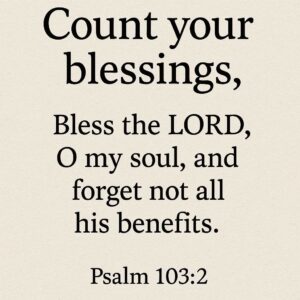
Psalm 103:1-2 (KJV)
“Bless the LORD, O my soul: and all that is within me, bless his holy name. Bless the LORD, O my soul, and forget not all his benefits.”
This is perhaps the most direct call to count blessings in the Old Testament. David speaks to his own soul. He commands himself to remember.
He lists the benefits in the following verses:
-
Forgiveness of iniquities.
-
Healing of diseases.
-
Redemption from destruction.
-
Crowned with lovingkindness.
-
Satisfied with good things.
David forces himself to count. He moves from general praise to specific remembrance.
New Testament Teachings on Thanksgiving
The New Testament continues this theme. Jesus and the Apostles modeled a life of gratitude.
Ephesians 5:20 (KJV)
“Giving thanks always for all things unto God and the Father in the name of our Lord Jesus Christ.”
This is a high standard. It says “always” and “for all things.” Paul wrote this from a prison cell. He was not in a comfortable situation. Yet, he commanded the church to give thanks.
This does not mean we thank God for evil. Rather, it means we trust God in all things. We thank Him for His presence in the storm. We thank Him for the strength He gives us to endure.
Philippians 4:6-7 (KJV)
“Be careful for nothing; but in every thing by prayer and supplication with thanksgiving let your requests be made known unto God. And the peace of God, which passeth all understanding, shall keep your hearts and minds through Christ Jesus.”
Here is the practical antidote to anxiety. “Be careful” means “be anxious.” How do we fight anxiety? We pray. But we pray with thanksgiving.
When we present our requests, we should already be thanking God for the answer. This combination of prayer and gratitude triggers supernatural peace. That peace acts as a guard. It protects our hearts and minds.
Colossians 3:15 (KJV)
“And let the peace of God rule in your hearts, to the which also ye are called in one body; and be ye thankful.”
Peace and thanks are linked. When we are thankful, peace rules. When we are ungrateful, chaos rules. Paul urges the church to let gratitude be the umpire in their hearts. It settles disputes. It calms fears.
Top “Count Your Blessings” Verses (KJV) in a Table
To help you easily reference these truths, here is a handy table. Keep it in your Bible or journal.
| Scripture Reference | Key Phrase (KJV) | Theme of Blessing |
|---|---|---|
| Psalm 68:19 | “Who daily loadeth us with benefits” | Daily Provision |
| Psalm 103:2 | “Forget not all his benefits” | Remembrance |
| Ephesians 1:3 | “Who hath blessed us with all spiritual blessings” | Spiritual Wealth |
| James 1:17 | “Every good gift and every perfect gift is from above” | Source of Gifts |
| Lamentations 3:22-23 | “His mercies… are new every morning” | Fresh Grace |
| 1 Thessalonians 5:18 | “In every thing give thanks” | God’s Will |
| Psalm 136:1 | “His mercy endureth for ever.” | Enduring Love |
| 2 Corinthians 9:8 | “God is able to make all grace abound toward you” | Abundance |
| Psalm 9:1 | “I will shew forth all thy marvellous works.” | Testimony |
Practical Ways to Count Your Blessings Daily
Knowing the verses is one thing. Living them out is another. Here are practical, down-to-earth methods to apply the “Count Your Blessings Bible Verse KJV” principle.
Keep a Gratitude Journal
This is the most direct application. Get a notebook. Every morning or evening, write down three to five things you are thankful for.
Do not just write “family” or “job.” Be specific.
-
Thank You for the encouraging text from my friend today.
-
Thank You for the strength to finish that difficult project.
-
Thank You for the warm sunshine on my walk.
Writing them down makes them real. It creates a record of God’s faithfulness. On hard days, you can look back and see how God has “loaded you with benefits.”
The “First Thought” Rule
Train your mind to be grateful the moment you wake up. Before you check your phone or get out of bed, think of one thing.
-
Thank You for the breath in my lungs.
-
Thank You for a safe night’s sleep.
This sets the tone for the entire day. It aligns your heart with God before the world rushes in.
Verbalize Your Thanks at Meals
We often rush through grace before meals. Slow down. Instead of a quick, mumbled prayer, take a moment. Actually thank God for the specific food on the table. Thank Him for the hands that grew it and prepared it.
If you are with family, invite each person to share one blessing before you eat. This turns a routine task into a worship experience.
Use Visual Reminders
Place sticky notes around your house. Put one on your bathroom mirror that says “Count Your Blessings.” Put another on your computer monitor.
Every time you see them, pause. Say a quick prayer of thanks. These visual cues interrupt negative thought patterns. They redirect your mind to gratitude.
The “Blessings Jar”
Get a jar and some slips of paper. Throughout the year, whenever something good happens, write it down and put it in the jar. It could be a answered prayer, a financial provision, or a happy memory.
On New Year’s Eve or a difficult day, empty the jar and read them all. You will be amazed at how God has moved.
Why Gratitude is Essential for Believers
Gratitude is not just a nice idea. It is foundational to the Christian life. It impacts our relationship with God and our mental health.
It Humble Us
Counting blessings reminds us that we are not self-sufficient. Everything we have is a gift. This includes our talents, our health, and our salvation. When we acknowledge this, we walk in humility. God resists the proud but gives grace to the humble.
It Strengthens Our Faith
When we count past blessings, we build faith for future trials. We remember that God provided before. He will provide again. The Bible is full of “memorials.” The Israelites stacked stones to remember God’s miracles. Your gratitude journal is your stack of stones.
It Transforms Our Perspective
Gratitude and worry cannot coexist. They are mutually exclusive. When you focus on what you have, you have less time to focus on what you lack. This doesn’t mean problems disappear. It means they are seen in the light of God’s goodness. The problems shrink. God grows.
A Deeper Look at James 1:17 (KJV)
“Every good gift and every perfect gift is from above, and cometh down from the Father of lights, with whom is no variableness, neither shadow of turning.”
This verse is a cornerstone of counting blessings.
The Source of All Good
James leaves no room for doubt. Nothing good originates with us or with luck. It all comes “from above.” When you recognize a blessing, you are recognizing the Father’s hand.
The Consistency of God
The verse describes God as the “Father of lights.” Unlike the sun, moon, and stars that shift and cast shadows, God never changes. He is perfectly consistent.
This means His giving nature is consistent. He does not have good days and bad days. He is always the source of perfect gifts. You can count on His goodness, today and forever.
Finding Blessings in Difficult Times
Counting blessings is easy when life is good. But what about when it is hard? What about when you are sick, lonely, or grieving?
The Sacrifice of Praise
The Bible talks about the “sacrifice of praise” (Hebrews 13:15). A sacrifice costs you something. When you thank God in the storm, it costs you your pride and your pain. It is an act of pure faith.
You are essentially saying, “God, I do not understand this situation, but I trust You. I trust that You are still good.”
Paul and Silas in Prison
In Acts 16, Paul and Silas were beaten and thrown into the inner prison. Their feet were in stocks. At midnight, they prayed and sang praises to God.
They were not singing because of their circumstances. They were singing despite them. They chose to count their blessings in the dark. What happened? God moved. An earthquake shook the prison. The doors opened.
Our gratitude in hard times has power. It invites God’s presence and breaks chains.
Verses for the Valley
When you are struggling, cling to these promises:
-
Psalm 34:1: “I will bless the LORD at all times: his praise shall continually be in my mouth.” (The phrase “at all times” includes the bad times).
-
Habakkuk 3:17-18: “Although the fig tree shall not blossom, neither shall fruit be in the vines… Yet I will rejoice in the LORD.” (This is the ultimate act of counting blessings when everything is stripped away).
How to Teach Children to Count Their Blessings
Gratitude should be cultivated from a young age. Children who learn to count their blessings grow into happier, more resilient adults.
Make it a Game
At dinner, go around the table and play “Highs and Lows.” Each person shares the best part of their day (a blessing) and the hardest part (a prayer request). This teaches kids to identify God’s goodness even on tough days.
The “Thank You” Walk
Go for a walk with your child. Challenge them to say “thank You, God” for everything they see.
-
Thank You for the blue sky.
-
Thank You for the dog across the street.
-
Thank You for the dandelions.
This turns a mundane activity into a prayer walk.
Bedtime Blessings
When you tuck your child in, ask them, “What was one good thing that happened today?” If they struggle, prompt them. “Was it the cookie at lunch? The game at recess?” Then, pray together, specifically thanking God for those things.
Important Note for Readers
As you embark on this journey of counting your blessings, please remember this: Gratitude is a practice, not a feeling.
There will be days when you do not feel thankful. Do it anyway. The feeling often follows the action. You might not feel like listing your blessings, but when you start writing, the Holy Spirit will bring them to mind.
Also, do not compare your blessings to others. Comparison is the thief of joy. Your journey is unique. God’s provision for you is tailored perfectly to your needs. Look at your own plate. Count what is on it. You will find it is more than enough.
The Blessing of Scripture Itself
Finally, let us not forget our greatest blessing: the Word of God. The fact that we have a Bible in our own language is a gift.
“Thy words were found, and I did eat them; and thy word was unto me the joy and rejoicing of mine heart.” — Jeremiah 15:16 (KJV)
Jeremiah called God’s words the “joy” of his heart. The Scripture itself is a benefit we can count. It guides us. It corrects us. It comforts us.
When you study the “Count Your Blessings Bible Verse KJV” passages, remember that the very page they are written on is a blessing. The freedom to read it is a blessing. The Spirit who illuminates it is the ultimate blessing.
Frequently Asked Questions (FAQ)
1. What is the main Bible verse about counting your blessings?
While several verses touch on the theme, Psalm 68:19 (KJV) is the most direct: “Blessed be the Lord, who daily loadeth us with benefits, even the God of our salvation. Selah.” It perfectly captures the idea of God constantly giving us gifts.
2. Does the phrase “count your blessings” actually appear in the Bible?
No, the exact phrase “count your blessings” does not appear in the King James Version of the Bible. The concept became famous through the hymn “Count Your Blessings,” which was inspired by biblical principles found in verses like Psalm 103:2.
3. How can I start counting my blessings biblically?
Start with a simple prayer journal. Every day, write down specific things you are thankful for. Use Psalm 103:1-2 as a model, where David commands his soul to remember all of God’s benefits. Be specific and look for God’s hand in both big and small moments.
4. Why is it important to give thanks “in everything”?
1 Thessalonians 5:18 (KJV) commands us to give thanks “in every thing.” This is important because it acknowledges God’s sovereignty and goodness, regardless of our circumstances. It shifts our focus from our problems to our Provider and invites the peace of God into our hearts (Philippians 4:6-7).
5. What are some “benefits” of God that I should not forget?
Psalm 103:3-5 lists several key benefits: forgiveness of sins, healing from diseases, redemption from destruction, being crowned with lovingkindness, and satisfaction with good things. Beyond these, daily benefits include provision, protection, family, and the hope of salvation.
Additional Resource
To deepen your study on this topic, we highly recommend using online tools to compare different translations or to listen to the Psalms.
-
BibleGateway.com: This is an excellent, free resource. You can quickly search for any verse mentioned in this article. You can also read the Psalms in the KJV and compare them with modern translations like the NIV or ESV for a broader understanding.
-
Hymnary.org: Visit this site to read the full lyrics of “Count Your Blessings” by Johnson Oatman Jr. Seeing the entire hymn can provide further devotional insight into the scriptural basis of the song.
Conclusion
Counting your blessings is a life-changing discipline. It is rooted in the timeless truth of the King James Bible. From the daily benefits described in Psalm 68:19 to the call for perpetual thanks in Ephesians 5:20, Scripture is clear: gratitude glorifies God and enriches our souls.
By forgetting not His benefits, we guard our hearts against anxiety. We build a legacy of faith. We join the Psalmist in saying, “Bless the LORD, O my soul.”