Have you ever felt overwhelmed by a task, a calling, or a season of rebuilding in your life? You’re not alone. The ancient prophet Zechariah ministered to a people who felt exactly that way. Returning from exile, they faced the monumental, discouraging work of rebuilding their temple and their community. It’s into this context of shattered dreams and weary hands that God delivered one of the most encouraging visions in all of Scripture: the vision of a golden lampstand and two olive trees.
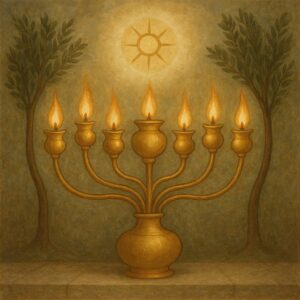
This image, especially the biblical meaning seven lamps in Zechariah 4, is not a mere historical artifact. It is a timeless blueprint for how God accomplishes His work in the world and in our lives. It moves us from a mindset of human striving to one of Spirit-empowered grace. Let’s explore this powerful vision together and discover its profound relevance for us today.
Understanding the Context: A People in Need of Hope
Before we delve into the symbols, we must stand in the shoes of Zechariah’s audience. It’s approximately 520 BC. A remnant of Israelites has returned to Jerusalem from Babylonian captivity, filled with hope to restore their nation. They laid the foundation for a new temple, but opposition and apathy quickly set in. The project stalled for nearly two decades. The work seemed impossible, the people were weak, and the future looked dim.
The prophet Zechariah’s primary role was not to predict distant futures but to encourage the present community. His series of eight night visions, found in chapters 1-6, are God’s spiritual stimulus package. They are designed to lift the people’s eyes from their ruined circumstances to God’s sovereign plan and inexhaustible power. The fourth vision, in chapter 4, is the dramatic centerpiece.
The Vision: A Detailed Look at Zechariah 4:1-14
The chapter opens with the angelic interpreter rousing Zechariah as if from a spiritual stupor: “Then the angel who talked with me returned and woke me up, like someone awakened from sleep” (Zechariah 4:1). What follows is a description of staggering beauty and complexity:
“He asked me, ‘What do you see?’ I answered, ‘I see a solid gold lampstand with a bowl at the top and seven lamps on it, with seven channels to the lamps. Also there are two olive trees by it, one on the right of the bowl and the other on its left.’” (Zechariah 4:2-3, NIV)
Zechariah is perplexed and admits he does not understand. The angel then begins to interpret, weaving together the vision’s imagery with direct messages for Zerubbabel, the governor leading the rebuilding effort. The core message is a divine shout of encouragement: “Not by might nor by power, but by my Spirit,’ says the Lord Almighty.” (Zechariah 4:6).
This verse is the skeleton key to the entire vision. The seven lamps, the bowl, the channels, and the olive trees all serve to illustrate how God’s Spirit works to accomplish His purposes against all odds.
Decoding the Symbols: What Do the Seven Lamps Represent?
The biblical meaning seven lamps in Zechariah 4 is deeply rooted in Old Testament symbolism but carries a revolutionary new message.
The Golden Lampstand (Menorah): Israel’s Calling
The centerpiece is a solid gold lampstand (Hebrew: menorah). This immediately recalled the seven-branched lampstand that stood in the tabernacle and later the temple (Exodus 25:31-40). That lampstand symbolized Israel’s calling to be a light to the nations, fueled by the oil of God’s presence. Its presence in the vision signals that God’s purpose for His people—to be a light—remains unextinguished, even after exile.
The Seven Lamps: The Perfect and Complete Work of God’s Spirit
The number seven in the Bible consistently symbolizes completion, perfection, and divine fullness. The seven lamps, therefore, are not just a source of light; they represent the perfect, complete, and all-sufficient operation of the Holy Spirit. Unlike the temple menorah which needed human priests to refill it daily, this visionary lampstand has a self-replenishing system. The light doesn’t flicker due to human neglect; it burns continuously by God’s provision.
Key Meaning: The seven lamps signify that the light of God’s truth, guidance, and presence will shine fully and unfailingly upon the rebuilding work and the community, not because of their perfection, but because of His faithful Spirit.
The Bowl and the Seven Channels: Constant and Direct Supply
Above the lampstand is a bowl (or reservoir) that constantly feeds oil directly to each of the seven lamps through seven channels or pipes. This is a critical design difference from the old menorah. It depicts a grace-based system.
-
The Bowl: Represents the abundant, constant supply of the Holy Spirit.
-
The Seven Channels: Emphasize a direct, unobstructed, and complete line of supply from God’s abundance to the point of need (the lamps).
This imagery answers the unspoken fear of the people: “We don’t have enough resources, energy, or longevity to finish.” God’s response is the vision of an automatic, heavenly supply chain. The work (the burning light) continues as long as it is connected to the source.
The Two Olive Trees: The Dual Source of Anointing
Now come the most mysterious elements: two olive trees, one on each side of the lampstand, feeding their oil directly into the bowl (Zechariah 4:12). The angel identifies them as “the two who are anointed to serve the Lord of all the earth” (Zechariah 4:14).
In the immediate historical context, these are Zerubbabel the governor (the political leader) and Joshua the high priest (the religious leader). They are the “twin channels” of God’s authority through whom His Spirit flows to nurture the community.
Deeper Symbolism: Olive trees produce oil, a consistent biblical symbol for the Holy Spirit (used for anointing kings, priests, and prophets). These two trees, standing in royal and priestly offices, represent God’s chosen means of mediating His Spirit to His people. They point to the perfect union of kingly and priestly roles that would ultimately be fulfilled in Jesus Christ.
The Central Message: “Not by Might, Nor by Power”
The entire vision is engineered to deliver one explosive, liberating truth. When Zechariah sees the impossible mountain of opposition before Zerubbabel, God interrupts:
“So he said to me, ‘This is the word of the Lord to Zerubbabel: “Not by might nor by power, but by my Spirit,” says the Lord Almighty.’” (Zechariah 4:6)
This is the theological heart of the passage. Let’s break down what God is not saying and what He is saying.
| Symbol | Component | Meaning in Zechariah’s Time | Broader Spiritual Meaning |
|---|---|---|---|
| Golden Lampstand | The main structure | Israel’s enduring calling to be God’s light | God’s people/church as a light-bearing community |
| Seven Lamps | The light sources | The complete, perfect light of God’s favor & truth on the work | The full, sufficient operation of the Holy Spirit |
| The Bowl | The reservoir above | The abundant, constant supply of God’s grace | The unlimited resource of God’s Spirit and grace |
| Seven Channels | Pipes from bowl to lamps | Direct, unimpeded provision from God to the need | Individual and corporate channels of God’s grace |
| Two Olive Trees | Source of oil | Zerubbabel (King) & Joshua (Priest) | The royal and priestly ministries; ultimately Christ |
| Continuous Oil Flow | The system’s function | God’s work would be sustained by His Spirit, not man | The Christian life is sustained by grace, not works |
The Message for Zerubbabel (and for Us): “You will not finish this temple by mobilizing a bigger army (‘might’) or by your own leadership prowess (‘power’). You will finish it because my Spirit—symbolized by this self-replenishing lampstand—will enable it. Your job is not to generate the power, but to channel it through faithful obedience.”
Practical Application for Today’s Reader
The vision of the seven lamps in Zechariah 4 is not just ancient history. It’s a masterclass in living a Spirit-empowered life. Here’s how its truths apply today.
1. For Times of Rebuilding and Restoration
Are you rebuilding after a personal loss, a career setback, or a broken relationship? The vision teaches:
-
The outcome depends on God’s Spirit, not your emotional strength. Connect to the Bowl.
-
Small, faithful beginnings are celebrated by God (Zechariah 4:10 – “Who dares despise the day of small things?”).
-
The final stone will be set by grace (Zechariah 4:7 – “He will bring out the capstone to shouts of ‘God bless it! God bless it!’”).
2. For Understanding Our Role as a Light
As individuals and as the Church, we are called to be a light (Matthew 5:14-16). The Zechariah 4 model shows us:
-
Our light is derivative. We don’t manufacture our own “oil.” We shine only as we are connected to the continuous supply of the Holy Spirit through prayer, Scripture, and communion with God.
-
Our light is designed for completeness. The seven lamps imply God’s desire for His light to shine in all areas of life—family, work, community—without deficiency.
3. For Embracing a Grace-Based Life
The lampstand’s automatic feed system is a picture of grace versus works.
-
Works-based mentality: “I must constantly strive to refill myself to keep my light burning.”
-
Grace-based reality: “My role is to stay connected to the bowl. God is responsible for the steady supply that keeps the light burning.” This lifts the burden of performance and replaces it with the peace of dependency.
The Prophetic Fulfillment: From Zerubbabel to Jesus Christ
While the vision had immediate meaning for Zerubbabel, the Bible reveals its ultimate fulfillment in Jesus.
-
The Perfect Lampstand: Jesus declared, “I am the light of the world” (John 8:12). He is the ultimate, perfect light to which the menorah pointed.
-
The Two Anointed Ones (Olive Trees): Jesus perfectly combines the two anointed offices of King (descendant of Zerubbabel, Matthew 1:12-13) and High Priest (Hebrews 4:14). He is the sole, sufficient source of the Spirit.
-
The Continuous Supply: After His ascension, Jesus poured out the Holy Spirit on the Church (Acts 2:33), establishing the new covenant reality where every believer has direct access to the “bowl” of God’s Spirit (John 7:37-39).
The Book of Revelation revisits this imagery, describing “two witnesses” as “the two olive trees and the two lampstands that stand before the Lord of the earth” (Revelation 11:4), showing the enduring pattern of God’s testimony being empowered by His Spirit through chosen witnesses.
Helpful Summary: The Symbolism of Zechariah’s Vision
| Symbol | Component | Meaning in Zechariah’s Time | Broader Spiritual Meaning |
|---|---|---|---|
| Golden Lampstand | The main structure | Israel’s enduring calling to be God’s light | God’s people/church as a light-bearing community |
| Seven Lamps | The light sources | The complete, perfect light of God’s favor & truth on the work | The full, sufficient operation of the Holy Spirit |
| The Bowl | The reservoir above | The abundant, constant supply of God’s grace | The unlimited resource of God’s Spirit and grace |
| Seven Channels | Pipes from bowl to lamps | Direct, unimpeded provision from God to the need | Individual and corporate channels of God’s grace |
| Two Olive Trees | Source of oil | Zerubbabel (King) & Joshua (Priest) | The royal and priestly ministries; ultimately Christ |
| Continuous Oil Flow | The system’s function | God’s work would be sustained by His Spirit, not man | The Christian life is sustained by grace, not works |
Important Note for Readers: When studying symbolic visions like Zechariah 4, always seek the primary meaning for the original audience first. This guards against fanciful or subjective interpretations. The application for us flows from that solid historical foundation, showing how God’s unchanging character and principles work in our lives today.
Conclusion
The vision of the seven lamps in Zechariah 4 is a divine masterpiece of encouragement. It transforms our perspective from feeling overwhelmed by mountainous tasks to resting in the limitless supply of God’s Spirit. It reminds us that our calling is not to strive in human might but to abide in divine power, to be faithful channels through which the oil of God’s grace flows to bring His light to a waiting world. The work is His, the power is His, and the victory—symbolized by the final capstone—will be celebrated as His gift.
In summary: Zechariah’s vision reveals that God accomplishes His redemptive work through the perfect and complete power of His Spirit, not human strength. The seven lamps symbolize this divine, self-replenishing provision that turns our small obediences into lasting monuments of grace. Ultimately, this pattern finds its fulfillment in Jesus Christ, our perfect King and Priest, who empowers us to be lights in the world.
Frequently Asked Questions (FAQ)
Q1: Are the “seven lamps” the same as the “seven spirits of God” mentioned in Revelation?
While both use the number seven to symbolize perfection and fullness, they are not identical. The seven lamps in Zechariah 4 are part of a symbolic vision illustrating the Spirit’s work in empowering God’s people for a task. The “seven spirits of God” in Revelation (e.g., 4:5) is a figurative depiction of the Holy Spirit in His multifaceted, complete ministry throughout the earth. They point to the same divine Person but in different illustrative contexts.
Q2: What is the main lesson for a Christian today from this passage?
The core lesson is the principle of Spirit-dependent living. In any endeavor—parenting, serving in church, overcoming sin, or pursuing your vocation—success is defined not by frantic effort (“might and power”) but by faithful reliance on the continuous supply of the Holy Spirit (“by my Spirit”). It’s an invitation to exchange anxiety for abiding.
Q3: Who are the “two anointed ones” in a modern sense?
In its original context, they were Zerubbabel and Joshua. Prophetically, they point to Jesus Christ, who alone perfectly holds both offices. In a derivative sense, this pattern can be seen wherever God raises up leadership that combines governmental/practical leadership (like a king) with spiritual/shepherd leadership (like a priest) to serve His people. It emphasizes the need for both practical and spiritual oversight in God’s work.
Q4: Why is the number seven so significant in this vision?
In biblical numerology, seven is the number of covenant completion and divine perfection (seen in the seven days of creation). The seven lamps, fed by seven channels, signify that the enabling light and power God provides for His work is total, sufficient, and lacking nothing. It is a complete package of divine grace for the task at hand.
Additional Resources
For those wishing to delve deeper into the rich world of Zechariah’s prophecies and their relevance, we recommend exploring reputable biblical commentaries or study Bibles. A great place to start is with an overview of the Post-Exilic Prophets (Haggai, Zechariah, Malachi) to better understand the historical and spiritual landscape of Zechariah’s ministry. You can find excellent, free resources from theological institutions like The Gospel Coalition’s Book Overviews or BibleProject’s video on Zechariah, which provide accessible and insightful introductions.