Stones are more than just rocks scattered across the biblical landscape. From Genesis to Revelation, they serve as silent yet powerful witnesses to God’s covenants, judgments, promises, and character. Understanding the biblical meaning of stones opens up a deeper layer of spiritual symbolism, revealing how God uses the most steadfast elements of creation to teach eternal truths. This guide will explore the multifaceted roles stones play in Scripture, providing you with a lasting reference on this foundational topic.
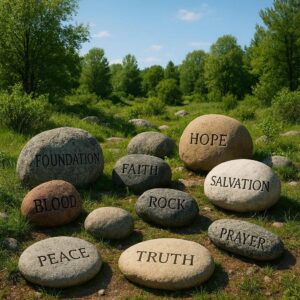
The Foundation: Stones as Symbols of Permanence and Witness
In the ancient world, stone was the ultimate symbol of durability. Unlike wood, it doesn’t rot. Unlike clay, it doesn’t crumble easily. The biblical authors leaned into this natural symbolism, using stones to represent things that are meant to last.
A cornerstone of this imagery is the concept of stones as “witnesses.” In a time before video recording or written contracts, a physical, enduring object could serve as a legal witness to an agreement or a monumental event. The most famous example is the heap of stones Jacob and Laban built in Gilead.
“Jacob said to his relatives, ‘Gather some stones.’ So they took stones and piled them in a heap, and they ate there by the heap. Laban called it Jegar Sahadutha, and Jacob called it Galeed. Laban said, ‘This heap is a witness between you and me today.’ Therefore it was named Galeed.” – Genesis 31:46-48 (NIV)
This pile of stones was a tangible, long-lasting boundary marker and a testimony to their covenant of non-aggression. It was a silent but permanent reminder of their sworn promise.
Altars of Stone: The Place of Meeting and Sacrifice
From Noah to Abraham, Isaac, Jacob, Moses, and Elijah, building an altar of uncut stones was a primary act of worship, sacrifice, and memorial.
-
Natural and Humble: God specifically instructed that altars be made of natural, uncut stones (Exodus 20:25). This prevented the vanity of human craftsmanship from intruding on a holy space and emphasized that access to God was based on His terms, not human artistry.
-
A Place of Encounter: These stone altars marked the very spots where God revealed Himself—Bethel (House of God), Sinai, Carmel. They became geographic prayer points, remembered for generations.
-
A Memorial of Provision: After crossing the Jordan River on dry ground, Joshua commanded one man from each of the twelve tribes to take a stone from the riverbed.
“These stones are to be a memorial to the people of Israel forever.” – Joshua 4:7 (NIV)
The heap at Gilgal was a physical teaching tool for parents to tell their children about the day God held back the waters.
Precious Stones: Beauty, Authority, and Heavenly Reality
Beyond common fieldstones, the Bible is rich with references to precious gems and jewels. These stones symbolize God’s beauty, sovereignty, and the glorious reality of His presence.
The Priestly Breastplate: Stones of Identity and Intercession
The high priest’s breastplate (Hebrew: Hoshen) contained twelve precious stones, each engraved with the name of one of the tribes of Israel (Exodus 28:15-21).
| Stone (Traditional Interpretation) | Tribe Represented | Potential Symbolic Meaning |
|---|---|---|
| Ruby/Carnelian | Reuben | Firstborn, dignity, sacrifice (Gen. 49:3-4) |
| Topaz | Simeon | Strength in unity, judgment tempered |
| Emerald/Carbuncle | Levi | Priesthood, service, divine calling |
| Turquoise | Judah | Leadership, praise, the lineage of kings |
| Sapphire | Issachar | Understanding of times, heavenly wisdom |
| Diamond/Jacinth | Zebulun | Prosperity through commerce, brightness |
| Amethyst | Dan | Justice, discernment, royal purple |
| Beryl | Naphtali | Eloquence, beautiful words |
| Onyx | Joseph | Fruitfulness, inheritance, remembrance |
| Jasper | Benjamin | Protection, ferocious loyalty |
| Chrysolite | Gad | Good fortune, resilience in battle |
| Jacinth | Asher | Blessedness, riches, pleasure |
This wasn’t merely decorative jewelry. It was a profound spiritual reality: When the high priest entered God’s presence, he carried the identity and destiny of the entire nation on his heart, represented by these stones. It was a picture of intercession and beloved belonging.
The New Jerusalem: Stones of Glory and Foundation
The prophetic vision of heaven culminates in a city built of precious stones. The foundation stones of the New Jerusalem’s wall are adorned with twelve majestic gems (Revelation 21:19-20). This imagery connects directly back to the priestly breastplate, suggesting that the people of God (the tribes) are now the very foundation and beauty of God’s eternal dwelling place. The street of the city is pure gold, like transparent glass, but its foundations are these glorious, multi-hued stones—a community of redeemed souls from every nation, tribe, and tongue.
Symbolic and Prophetic Stones in Scripture
Stones often appear in key narratives and prophecies with deep symbolic weight.
-
The Rejected Stone: Psalm 118:22 declares, “The stone the builders rejected has become the cornerstone.” Jesus applied this prophecy directly to Himself (Matthew 21:42). The religious leaders (the builders) rejected Him, but God exalted Him as the most essential, load-bearing stone of His entire redemptive plan.
-
The Living Stone and Spiritual House: The Apostle Peter expands this metaphor to all believers.
“As you come to him, the living Stone—rejected by humans but chosen by God and precious to him—you also, like living stones, are being built into a spiritual house.” – 1 Peter 2:4-5 (NIV)
This is a radical shift: from cold, inanimate rocks to living stones, indwelt by the Spirit, being joined together to form God’s temple on earth. -
The White Stone: In Revelation 2:17, Jesus promises the overcomer “a white stone with a new name written on it, known only to the one who receives it.” In Roman courts, a white stone signified acquittal. In games, it was a token of victory. This is a deeply personal symbol of new identity, complete forgiveness, intimate relationship, and victorious reward from Christ Himself.
-
Stones of Judgment and Stumbling: Stones could also symbolize God’s law and judgment. The tablets of the Ten Commandments were written on stone (Exodus 31:18). For those who reject Him, Jesus becomes a “stone of stumbling and a rock of offense” (Romans 9:32-33).
Practical Lessons for Today’s Believers
The biblical meaning of stones isn’t just historical archaeology; it offers powerful lessons for our faith journey.
-
We Are Meant to Be Memorials: Like the stones at Gilgal, our lives should tell a story. When people interact with us, do they “see” and “hear” a testimony of God’s faithfulness, provision, and power?
-
We Are Part of a Greater Structure: No living stone is an island. We are designed to be fitted together with other believers. Our individual strength and beauty find their ultimate purpose in being part of God’s spiritual house.
-
Our Foundation is Everything: Building our lives on the shifting sand of cultural trends or personal opinion leads to collapse. Jesus, the rejected cornerstone, is the only eternally secure foundation (Matthew 7:24-27).
-
We Carry Each Other on Our Hearts: Like the high priest’s breastplate, we are called to bear one another’s burdens in prayer and love, carrying the concerns and identities of our spiritual family before God.
Important Note for Readers:
While studying gemstones in the Bible can be fascinating, avoid the modern trend of ascribing magical or universal “powers” to specific stones (e.g., “amethyst always means peace”). Biblical symbolism is richer and more context-dependent. The meaning flows from the story and God’s instruction, not from an inherent energy in the mineral itself.
FAQ: Common Questions About Stones in the Bible
Q: What is the most important stone in the Bible?
A: While many are significant, the most theologically crucial is Jesus Christ as the Cornerstone. He is the reference point for all other stone symbolism—the foundation, the rejected one made chief, and the source of our identity as living stones.
Q: Should Christians wear jewelry with biblical gemstones for protection or blessing?
A: The Bible does not prescribe or promise spiritual power or protection through wearing specific stones. The priest’s breastplate was for a specific, mediatory office. Our focus should be on the spiritual realities the stones pointed to: our identity in Christ, our priestly intercession, and the beauty of holiness, not on the objects themselves as talismans.
Q: What does it mean that we are ‘living stones’ (1 Peter 2:5)?
A: It means that through faith in Christ, we are transformed from spiritually dead objects into vibrant, Spirit-filled beings. We are being actively shaped and joined together with other believers to form the dwelling place of God on earth—the Church. It emphasizes community, purpose, and divine construction.
Q: Why did Jesus say “let him who is without sin cast the first stone” (John 8:7)?
A: In this confrontation, the religious leaders were using the law about stoning adulterers (from Deuteronomy 22) as a trap, not out of justice. Jesus’ statement masterfully upheld the law’s seriousness while exposing the hypocrisy and sinful hearts of the accusers. He redirected the focus from condemnation to conviction and mercy.
Conclusion
From simple memorials to glorious foundations, the biblical meaning of stones weaves a consistent theme: God uses the enduring, foundational elements of His creation to mark His faithfulness, reveal His beauty, and build His eternal kingdom. They point us to Christ, the cornerstone, and invite us to take our place as living stones in His spiritual house.
Additional Resource:
For a deeper dive into the historical and cultural background of biblical materials, consider exploring the Archaeology Bible Articles from the Biblical Archaeology Society. (Note: This is an external resource for academic enrichment.)