When we explore the treasures of Scripture, certain elements carry a weight far beyond their physical properties. Myrrh is one such substance—a fragrant resin that weaves a powerful thread from Genesis to Revelation. More than just an ancient perfume, its biblical meaning is a complex tapestry of suffering, sanctification, and stunning redemption. This guide will journey through the pages of the Bible to uncover why myrrh was considered fit for kings, priests, prophets, and ultimately, the Messiah Himself.
What is Myrrh? A Botanical and Historical Primer
Before we delve into its spiritual significance, let’s understand what myrrh actually is. Myrrh is a aromatic resin, a sticky, gum-like substance, that comes from the Commiphora tree, specifically species like Commiphora myrrha. These small, thorny trees are native to the arid regions of the Arabian Peninsula and Northeast Africa.
How was it harvested? Harvesters would make deliberate cuts in the tree’s bark, causing the sap to ooze out. This sap would harden into reddish-brown tears or lumps. These “tears” were then collected and could be used in various forms:
-
Powdered: For incense or medicinal mixes.
-
Infused in Oil: To create sacred anointing oils or perfumes.
-
Solid: Often transported as a valuable commodity for trade.
Its scent is earthy, warm, slightly sweet, and subtly medicinal—a far cry from the floral perfumes popular today. In the ancient world, this unique aroma made it worth its weight in gold.
Myrrh in the Ancient World: A Commodity of Kings
Myrrh wasn’t unique to Israel. It was a cornerstone of ancient economies, celebrated by Egyptian, Greek, and Roman cultures alike.
-
Egypt: Used extensively in embalming rituals and religious ceremonies.
-
General Use: A primary component in incense, perfumes, medicines for wounds and digestion, and as a fumigant.
Its extreme value is highlighted in biblical accounts where it is listed among gifts of gold and frankincense, and where it is used to anoint the Tabernacle and its priests.
Myrrh in the Hebrew Scriptures (Old Testament): Consecration and Beauty
The first appearances of myrrh in the Bible set the stage for its sacred role. It is never portrayed as ordinary; it is always an agent of holiness, intimacy, and purification.
The Sacred Anointing Oil: Myrrh as a Consecrator
One of the most significant uses of myrrh is in the formula for the holy anointing oil, given by God directly to Moses.
Exodus 30:22-25 (ESV): “Moreover, the Lord said to Moses, ‘Take the finest spices: of liquid myrrh 500 shekels, and of sweet-smelling cinnamon half as much, that is, 250, and 250 of aromatic cane, and 500 of cassia, according to the shekel of the sanctuary, and a hin of olive oil. And you shall make of these a sacred anointing oil blended as by the perfumer; it shall be a holy anointing oil.'”
This oil was used to sanctify—to set apart as holy—the objects and people dedicated to God’s service.
| Object/Person Anointed | Biblical Significance of Myrrh’s Role |
|---|---|
| The Tabernacle & its Furnishings (Exodus 30:26-28) | The very space where God would dwell among His people was infused with the scent of myrrh. It transformed a tent of goat skins into a holy sanctuary. |
| Aaron and his Sons (Exodus 30:30) | The priests who mediated between God and Israel were marked by myrrh. It signified their purification and readiness for sacred duty. |
| Kings of Israel (e.g., 1 Samuel 10:1, 1 Kings 1:39) | While the specific formula is not always detailed, anointing with oil (often associated with costly spices) symbolized divine selection and authority. |
Key Symbolism Here: Myrrh represents being set apart for God’s purpose. Its application marked a transition from the common to the sacred.
The Love Poetry of Solomon: Myrrh as Intimacy and Adoration
In the Song of Solomon, myrrh takes on a deeply personal and romantic dimension. Its fragrance is a marker of intimate love and yearning.
Song of Solomon 1:13: “My beloved is to me a sachet of myrrh that lies between my breasts.”
Song of Solomon 5:5: “I arose to open to my beloved, and my hands dripped with liquid myrrh, my fingers with liquid myrrh, on the handles of the bolt.”
Here, myrrh is:
-
A personal perfume of the bride.
-
A symbol of the beloved’s presence.
-
An emblem of closeness, desire, and preciousness.
This imagery connects myrrh not only to sacred ritual but to the very model of divine love for His people. It’s a fragrance of chosen intimacy.
The Poignant Prophecy of Psalm 45
A crucial Messianic prophecy explicitly links myrrh to a coming king, foreshadowing its New Testament significance.
Psalm 45:8: “All your robes are fragrant with myrrh and aloes and cassia; from palaces adorned with ivory the music of the strings makes you glad.”
This psalm, celebrating a royal wedding, is interpreted as pointing to the Messiah. The king’s garments are perfumed with myrrh, suggesting his nobility, virtue, and divine favor. This verse creates a direct symbolic line from the anointed kings of old to the ultimate Anointed One (Messiah/Christ).
Myrrh in the New Testament: Fulfillment and Sacrifice
The New Testament narratives bring the symbolic threads of myrrh to their ultimate and sometimes heartbreaking fulfillment. Its meaning deepens to encompass both the majesty and the suffering of Jesus Christ.
The Gift of the Magi: Myrrh for a King
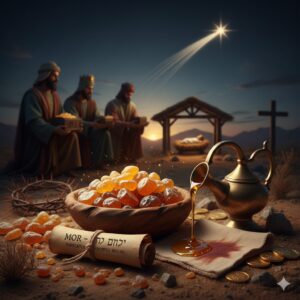
The most famous biblical association with myrrh is its presentation to the child Jesus by the Wise Men.
Matthew 2:11: “And going into the house, they saw the child with Mary his mother, and they fell down and worshiped him. Then, opening their treasures, they offered him gifts, gold and frankincense and myrrh.”
Each gift was profoundly prophetic:
-
Gold: For a King.
-
Frankincense: For a Priest (used in temple incense).
-
Myrrh: For a Savior who would suffer and die.
Even at His birth, Jesus was recognized not just as a monarch, but as one whose mission would involve sacrifice. Myrrh, used in embalming, foreshadowed the death He would die for humanity. This gift signaled that the Messiah had come to conquer through suffering.
The Offer at the Cross: Myrrh as an Opiate of Suffering
At the climax of Jesus’ earthly suffering, myrrh appears again, offered as a form of mercy.
Mark 15:23: “And they offered him wine mixed with myrrh, but he did not take it.”
This mixture was a mild analgesic, a pain-deadener often given to crucifixion victims out of a form of pity. Jesus’ refusal to drink it is significant. He chose to experience the full, unmitigated agony of the cross consciously and deliberately. He fully embraced the cup of suffering the Father had given Him (Matthew 26:39).
The Preparation for Burial: Myrrh as Honorable Love
After Jesus’ death, myrrh plays its final, tender role, fulfilling the prophetic symbolism born at His cradle.
John 19:39-40: “Nicodemus also, who earlier had come to Jesus by night, came bringing a mixture of myrrh and aloes, about seventy-five pounds in weight. So they took the body of Jesus and bound it in linen cloths with the spices, as is the burial custom of the Jews.”
Note for Readers: Seventy-five pounds is an extravagant, kingly amount. It reflects not only devotion but a recognition of Jesus’ supreme worth. Nicodemus and Joseph of Arimathea, once secret followers, now publicly honor Him with a burial fit for a sovereign.
This act completes the circle:
-
Birth: Myrrh given, foreshadowing death.
-
Death: Myrrh refused, embracing full suffering.
-
Burial: Myrrh applied in abundance, honoring the sacrifice and signaling a hope that defied mere human understanding.
The Symbolic Layers: What Does Myrrh Ultimately Represent?
Pulling together its biblical journey, we can distill the core symbolic meanings of myrrh:
-
Sacrifice and Suffering: Its primary association with death, embalming, and the crucifixion makes it a clear symbol of Christ’s atoning sacrifice. It represents the bitter cost of redemption.
-
Consecration and Holiness: As a key ingredient in the holy anointing oil, it symbolizes being set apart, purified, and made ready for God’s service.
-
Love and Intimacy: In the Song of Solomon, it becomes a fragrance of deep, personal love—reflecting both human marital love and God’s devoted love for His people.
-
Prophetic Recognition: The Magi’s gift shows it as a substance that points to the true identity and mission of Jesus as the suffering Messiah.
-
Honor and Worth: The extravagant amount used at Jesus’ burial signifies His immense value and the honor due to Him.
A Comparative Table: Myrrh and Frankincense in the Bible
These two prized resins are often paired but carry distinct meanings.
| Aspect | Myrrh | Frankincense |
|---|---|---|
| Primary Source | Commiphora tree (wounded bark) | Boswellia tree (tapped bark) |
| Symbolic Focus | Death, Sacrifice, Suffering | Prayer, Deity, Resurrection |
| Key Old Testament Use | Sacred Anointing Oil (Exodus 30) | Sacred Incense (Exodus 30) |
| Key New Testament Scene | Gift at Jesus’ birth & burial preparation | Gift at Jesus’ birth (with gold & myrrh) |
| Representation of Christ | His humanity, suffering, and atoning death | His divinity, righteousness, and intercession |
| Fragrance Note | Earthy, warm, bitter, medicinal | Sweet, citrusy, woody, elevating |
Together, they present a complete picture of Christ: the Frankincense of His divine priesthood and the Myrrh of His human sacrifice.
Myrrh in Christian Tradition and Personal Reflection
Beyond its biblical pages, myrrh has maintained a place in Christian practice and thought.
-
Liturgical Use: In some church traditions, myrrh is still used in incense, particularly during solemn seasons like Lent, connecting worship to the memory of Christ’s passion.
-
A Symbol for the Believer’s Life: The symbolism of myrrh invites personal application. It asks believers:
-
Are we willing to be “set apart” and consecrated for God’s use?
-
Do we recognize that following Christ involves sharing in both the fragrance of His love and the reality of suffering (Philippians 3:10)?
-
Do we offer our lives as a costly offering of worship to Him?
-
Conclusion
The biblical meaning of myrrh is a profound narrative in resin and fragrance. It begins as a sacred consecrator in the Tabernacle, weaves through poetry as a scent of intimate love, arrives prophetically at the manger, is refused at the cross, and is lavished in abundance at the tomb. Myrrh unmistakably symbolizes suffering and death, yet within the story of Jesus, that death becomes the doorway to life, making its scent forever one of sacred sacrifice and redemptive love.
Frequently Asked Questions (FAQ)
Q: Is myrrh still used today?
A: Yes, though less commonly. It is used in some traditional medicines, high-end perfumery (often as a base note), and in the incense of certain Christian and other religious traditions.
Q: Why was myrrh so valuable in the Bible?
A: Its value came from its scarcity (from specific remote trees), labor-intensive harvesting, unique and long-lasting fragrance, and versatile uses in sacred rites, medicine, and daily life as a perfume and preservative.
Q: What is the difference between myrrh and frankincense spiritually?
A: While both are holy substances, myrrh typically points to death, sacrifice, and suffering (Christ’s humanity). Frankincense typically points to prayer, divinity, and resurrection (Christ’s deity). They are complementary truths.
Q: Did the gift of myrrh foreshadow Jesus’ death?
A: Absolutely. As a substance used to embalm the dead, it was a prophetic gift acknowledging that this newborn king’s mission would involve a sacrificial death for His people.
Q: Can myrrh symbolize anything positive if it’s linked to death?
A: Yes. In the Christian context, Christ’s death was not an end but the means to victory over sin and death. Therefore, myrrh ultimately symbolizes redemptive love, priceless worth, and the beauty of a life sacrificed for others.
Additional Resources
For those wishing to explore the historical and cultural background of biblical spices further, a reliable scholarly resource is the Oxford Encyclopedia of the Bible and Archaeology, which provides detailed entries on ancient trade, botany, and ritual use.