The pages of the Bible introduce us to many names—some representing hope, salvation, and divine love, and others symbolizing profound rebellion and evil. Among the latter, few are as chilling and enigmatic as Molech. This name echoes through the Old Testament, often in hushed tones of horror and stern condemnation. But who, or what, was Molech? Moving beyond simple caricatures of a “bad god,” the biblical meaning of Molech is a complex tapestry of idolatry, forbidden rituals, and a stark spiritual warning that resonates through history. This comprehensive guide will explore every facet of Molech, from its historical roots and archaeological clues to its profound theological significance, helping you understand why this ancient deity remains a powerful symbol of ultimate compromise.
Who Was Molech in the Bible?
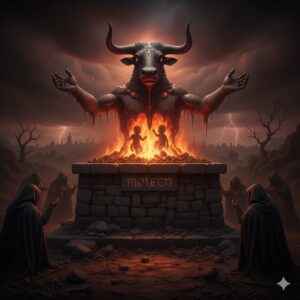
In the biblical text, Molech (also spelled Molek, Milcom, or Malcam) is not presented as a mythical being or a mere superstition. He is depicted as a very real, specific deity whose worship involved a deliberate and catastrophic breach of covenant with the God of Israel. The core of Molech’s identity in Scripture is tied to one abhorrent practice: child sacrifice.
The name “Molech” itself is believed by many scholars to derive from the Hebrew root mlk, which often means “king.” Some propose that “Molech” was not the god’s proper name, but a title—the king—or even a ritual term. Intriguingly, the same consonants (*M-L-K*) can be pointed with the vowels from the Hebrew word for “shame” (boshet), resulting in “Molech” as a derisive pun, labeling him “the shameful king” or “the abomination of a king.” This linguistic jab reflects the biblical authors’ utter contempt for this idol.
The Nature of the Ritual: Passing Through the Fire
The primary phrase associated with Molech worship is “to pass children through the fire” (or “to make them pass over”). This is not metaphorical language. Leviticus 18:21 commands, “You shall not give any of your children to offer them to Molech, and so profane the name of your God: I am the Lord.”
This act represented the ultimate offering—surrendering one’s future, one’s most precious possession, to secure favor, fertility, or prosperity from a demanding deity. It was the absolute inversion of God’s command to cherish and protect life (Genesis 9:5-6). The practice was not an impulsive act of desperation but a formalized, ritualized abomination that occurred at specific high places, like the Topheth in the Valley of Hinnom near Jerusalem.
Molech in Key Biblical Passages
To grasp the full biblical meaning of Molech, we must examine the specific contexts in which he appears. The prohibitions and condemnations are sweeping and leave no room for ambiguity.
The Legal Prohibitions: A Clear Boundary
The Law of Moses explicitly and repeatedly forbids any association with Molech.
-
Leviticus 18:21: Establishes the foundational prohibition, linking it directly to profaning God’s holy name.
-
Leviticus 20:1-5: Escalates the warning, prescribing the death penalty for anyone who gives their offspring to Molech. It states that God Himself will “set my face against that man… and will cut him off from among his people.” The text also condemns the community for “closing their eyes” to the practice.
-
Deuteronomy 18:10: In a list of detestable occult practices, it forbids anyone who “burns his son or his daughter as an offering,” a clear reference to the Molech ritual.
These laws weren’t arbitrary. They served as a protective fence, separating Israel from the Canaanite religious practices of the land they were entering. Worship of Molech was a direct betrayal of the covenant, which was based on life, blessing, and faithful love.
The Historical Accounts: Warnings Ignored
Tragically, despite these severe laws, the worship of Molech seeped into Israelite and Judahite society, particularly during times of political decline and syncretism.
-
The Kings of Judah: Several kings are explicitly condemned for facilitating or participating in Molech worship.
-
Solomon (1 Kings 11:7): In his later years, influenced by his foreign wives, Solomon built “a high place for Chemosh the abomination of Moab, and for Molech the abomination of the Ammonites.” This act of compromise planted a seed of idolatry that would bear bitter fruit.
-
Ahaz (2 Kings 16:3) and Manasseh (2 Kings 21:6): These two kings of Judah are specifically noted for making their own sons “pass through the fire,” with Manasseh’s sins cited as a primary reason for Judah’s eventual exile.
-
-
The Valley of Hinnom (Topheth): This location south of Jerusalem became the infamous center of Molech worship in Judah. King Josiah, during his great reforms, defiled the Topheth “so that no one might burn his son or his daughter as an offering to Molech” (2 Kings 23:10). The valley’s Hebrew name, Ge Hinnom (Gehenna), later became the symbolic term for the place of final judgment—hell.
The Prophetic Condemnation: God’s Outrage
The prophets spoke with fiery indignation against this practice, revealing God’s perspective.
-
Jeremiah 7:30-31: “For the sons of Judah have done evil in my sight… they have built the high places of Topheth… to burn their sons and their daughters in the fire—which I did not command, nor did it come into my mind.”
-
Jeremiah 19:4-5: God pronounces disaster on Jerusalem because the people “have filled this place with the blood of innocents, and have built the high places of Baal to burn their sons in the fire as burnt offerings to Baal.”
-
Ezekiel 16:20-21: In an allegory of Jerusalem’s unfaithfulness, God says, “You took your sons and your daughters, whom you had borne to me, and these you sacrificed to them to be devoured… in the slaughter of my children?”
These passages emphasize that child sacrifice was not just a “different religious practice”; it was an unspeakable evil that repulsed the very heart of God, who identifies Himself as a Father (Jeremiah 31:9).
Historical & Archaeological Context: Molech Beyond the Bible
Was Molech worship a real historical practice, or just biblical polemic? Archaeology and extra-biblical sources confirm its grim reality in the Phoenician and Canaanite-Punic world.
The Ammonite Connection: Milcom and Molech
The Bible often associates Molech with the Ammonites (1 Kings 11:5, 7). The national god of Ammon was Milcom (or Milkom), whose name also shares the mlk root. It is highly likely that “Molech” is a reference to Milcom, or that the term mlk referred to a type of sacrificial ritual offered to him and other gods like the Phoenician Baal Hammon.
Carthaginian Evidence: The Molchomor
The most startling archaeological evidence comes from the Phoenician colony of Carthage. In tophet burial grounds, thousands of urns have been found containing the charred bones of infants and young animals. Stelae inscriptions use the term mlk (or molchomor) to describe these sacrifices, often vowed in exchange for divine favor. This practice continued for centuries, corroborating the biblical descriptions of a formalized, institutional ritual.
A Comparative Table: Molech vs. Yahweh
This table clarifies the radical dichotomy presented in the Bible:
| Aspect | Worship of Yahweh | Worship of Molech |
|---|---|---|
| Core Demand | Faith, obedience, love, and justice (Micah 6:8). | The ultimate sacrifice: the life of one’s child. |
| Nature of God | Life-giver, protector, covenant-keeping Father. | A consuming, insatiable, and tyrannical deity. |
| Purpose of Ritual | Communion, atonement (through substitutionary animal sacrifice), thanksgiving. | To appease, manipulate, or secure material blessing. |
| View of Children | A heritage and blessing from the Lord (Psalm 127:3). | A currency to be spent for personal or national gain. |
| Ethical Foundation | Sanctity of life, care for the vulnerable. | Utilitarian valuation of life, exploitation of the weak. |
The Theological Significance and Modern Relevance
The biblical meaning of Molech is not merely a historical footnote. It carries enduring theological weight and a sobering warning for any era.
1. The Ultimate Idolatry: Giving What Is Most Precious
Molech represents the logical end of all idolatry. Idolatry is giving something created the worship due only to the Creator. Molech worship demanded the ultimate created gift—a human life, one’s own child. It is a stark parable showing that idols always demand more than they give, ultimately consuming their devotees.
Important Note: This principle extends metaphorically. Any pursuit—be it career, wealth, power, or ideology—that “consumes” our children’s future, their well-being, or their faith can function as a modern “Molech.”
2. The Character of God: A Stark Contrast
The condemnation of Molech throws the character of Yahweh into brilliant relief. The God of Israel does not desire child sacrifice. In the Abraham and Isaac story (Genesis 22), God provides a ram as a substitute—a direct contrast to Molech. This theme culminates in the Gospel, where God gives His own Son as a sacrifice for us, not because He demands our death, but to conquer death and give us life (John 3:16).
3. A Warning Against Syncretism and Compromise
Molech worship rarely entered Israel as a outright rejection of Yahweh. It crept in through syncretism—the blending of worship of Yahweh with pagan practices. Solomon likely rationalized building high places as diplomatic gestures. Others may have viewed offering a child as the “ultimate guarantee” of blessing, just to be safe. The Bible condemns this spiritual adultery without mercy.
Practical Lessons for Readers Today
-
Vigilance in Priorities: What “firstborn” in your life (your time, resources, ultimate loyalty) might you be tempted to offer to the “idols” of success, approval, or comfort?
-
Protecting the Vulnerable: The biblical defense of the innocent is a direct rejection of the Molech spirit. This has clear applications in advocating for the unborn, the poor, and the oppressed.
-
The Nature of True Worship: God desires mercy, not meaningless (or cruel) ritual (Hosea 6:6). Our worship is to be a living sacrifice of our whole selves (Romans 12:1), not the sacrifice of others.
Conclusion
The biblical meaning of Molech reveals an ancient idol whose worship centered on the abomination of child sacrifice, representing the ultimate betrayal of God’s covenant. Historical and archaeological evidence confirms this practice, grounding the biblical narrative in reality. Theologically, Molech serves as the ultimate contrast to the life-giving God of Israel, highlighting the dangers of idolatry and syncretism. Its enduring warning calls for vigilance in protecting the vulnerable and ensuring our worship is directed solely to the God who gives, rather than demands, ultimate sacrifice.
Frequently Asked Questions (FAQ)
Q: Was Molech a real demon or just an idol?
A: The Bible treats Molech as a real spiritual entity behind the idol (Leviticus 20:1-5 speaks of “playing the harlot after Molech”). In 1 Corinthians 10:20, Paul states that pagan sacrifices are offered to demons. Molech is understood as a demonic power that deceived people into horrific acts.
Q: Is the “passing through the fire” always literal?
A: In the context of Molech, the consistent testimony of Scripture, history, and archaeology points to literal child sacrifice. However, the phrase could also be used more broadly to describe dedication to idolatrous practices in general.
Q: How did the worship of Molech actually work?
A: Based on biblical and Carthaginian evidence, it likely involved a vow made during distress (e.g., war, infertility). A ritual fire was lit in a bronze idol (which may have been heated). The child was then placed in the idol’s arms or into the fire below as an offering to secure the deity’s favor.
Q: What is the connection between Molech and modern issues?
A: While not a direct equivalence, the spirit of Molech—sacrificing the vulnerable (especially children) for personal, social, or economic gain—is seen as a spiritual pattern behind practices like systemic abortion, child exploitation, and ideologies that demand absolute ideological allegiance from the young.
Additional Resources
For further scholarly study on the historical and archaeological context of Molech and child sacrifice in the ancient Near East, consider exploring resources from the American Schools of Oriental Research (ASOR). Their publications and archives often feature the latest research on topics like the Topheth and Carthaginian mlk sacrifices. You can begin your search at their public resource library: https://www.asor.org/resources/ (Note: This is a legitimate academic organization, not a commercial or ideological site).