When we encounter the name Jacob in the Bible, we meet more than just a historical patriarch. We encounter a story that defines the very identity of a nation and lays bare the profound dynamics of human struggle, divine election, and transformative grace. The biblical meaning of Jacob is not a simple definition; it is a rich tapestry woven from his name’s etymology, his tumultuous life narrative, and his ultimate redemption. This journey from “heel-grabber” and deceiver to “Israel,” the one who wrestles with God, offers timeless insights into human nature and the patient, shaping hand of God. This comprehensive guide will explore the depths of Jacob’s story, uncovering the layers of meaning that make him one of the Bible’s most compelling and relatable figures.
The Literal Meaning and Etymology of the Name “Jacob”
To understand the biblical meaning of Jacob, we must start at the very beginning: his name.
-
Hebrew Origin: The name Jacob (יַעֲקֹב – Yaʿaqov) derives from the Hebrew root עקב (‘qb), which relates to the heel.
-
Literal Translation: It literally means “he grasps the heel” or “he supplants.” In the ancient Near Eastern context, grasping someone’s heel was an idiom for tripping them up or overthrowing them.
This name was prophetic, given at birth during a dramatic entry into the world. Jacob was born holding onto the heel of his twin brother, Esau (Genesis 25:26). This single act named his early life—a relentless striving to gain advantage, to secure for himself what was not initially his.
“And after that came his brother out, and his hand took hold on Esau’s heel; and his name was called Jacob.” – Genesis 25:26 (KJV)
This foundational meaning sets the stage for a life characterized by struggle for position and blessing.
Jacob in the Patriarchal Narrative: A Life in Three Acts
Jacob’s story is the longest and most detailed of the biblical patriarchs. We can view it as a three-act drama that traces his transformation.
Act 1: The Striver – Deception and Flight (Genesis 25-28)
In his youth, Jacob lives up to his name. He first trades a meal for his famished brother’s birthright (Genesis 25:29-34). Later, at his mother Rebekah’s urging, he deceives his blind father, Isaac, by impersonating Esau to steal the patriarchal blessing (Genesis 27). This act of deception fractures the family, forcing Jacob to flee for his life from Esau’s wrath. His journey begins not as a noble quest, but as a desperate escape.
Act 2: The Sojourner – Discipline and Formation (Genesis 29-31)
Jacob finds refuge with his uncle Laban in Haran. Here, the deceiver is deceived. He works seven years to marry Rachel, only to be tricked into marrying her older sister, Leah first (Genesis 29:15-25). He endures twenty years of Laban’s changing wages and manipulation. During this period, Jacob learns hard lessons about fairness, labor, and providence. He also marries, fathers twelve sons and a daughter, and amasses great wealth. This act is God’s refining fire, where Jacob’s self-reliance is systematically challenged.
Act 3: The Wrestler – Crisis and Transformation (Genesis 32-35)
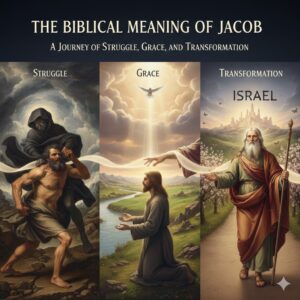
Returning to Canaan, Jacob faces his greatest fear: a reunion with Esau. On the night before their meeting, utterly alone and terrified, Jacob encounters a mysterious “man” who wrestles with him until daybreak (Genesis 32:22-32). Jacob refuses to let go, demanding a blessing. In this pivotal moment, his name is changed.
-
Jacob (Supplanter) is renamed Israel (He strives with God or God strives).
-
The Blessing: He receives the blessing he sought, not through cunning, but through persistent, desperate struggle. He also bears a physical reminder—a dislocated hip—signifying his reliance on God.
This transformation is confirmed when he meets Esau not with scheming, but with humility and grace. The striver becomes a prince with God.
Key Themes in the Story of Jacob
The narrative of Jacob is a powerhouse of theological and human themes that contribute to its deep meaning.
-
Divine Election and Sovereignty: Jacob’s story underscores that God’s choices are not based on human merit. He was chosen over the older Esau before birth (Malachi 1:2-3; Romans 9:10-13), highlighting that God’s purposes unfold through His grace, not our inherent righteousness.
-
The Struggle for Blessing: Jacob’s entire life revolves around obtaining and securing blessing—the birthright, Isaac’s blessing, Laban’s flocks, and finally God’s blessing at the Jabbok. His story shows both the wrong (deceptive) and right (persistent) ways to seek divine favor.
-
Transformation and Identity Change: The shift from Jacob to Israel is the core of his biblical meaning. It represents the journey from a identity defined by human striving to one defined by a transformative encounter with God.
-
Grace and Providence: Despite Jacob’s flaws, God remains faithfully present. The Bethel dream (Genesis 28:10-17), where Jacob sees a ladder to heaven, is a unilateral promise of protection and faithfulness, given to a sleeping, undeserving fugitive.
Jacob’s Legacy: The Twelve Tribes of Israel
Jacob’s personal transformation has a national consequence. His twelve sons—Reuben, Simeon, Levi, Judah, Dan, Naphtali, Gad, Asher, Issachar, Zebulun, Joseph, and Benjamin—became the progenitors of the Twelve Tribes of Israel. The nation itself bears his new name, Israel. His final blessings and prophecies over his sons in Genesis 49 shape the future character and destiny of each tribe, with the royal scepter prophesied to remain with Judah—a key messianic link.
Jacob in the New Testament
The New Testament authors reference Jacob to illustrate important spiritual truths.
-
Example of Faith: Despite his flaws, Jacob is listed in the “Hall of Faith” (Hebrews 11:21), commended for blessing Joseph’s sons in his final act of faith.
-
Illustration of God’s Purpose: Paul uses the election of Jacob over Esau to explain God’s sovereign choice (Romans 9:10-13).
-
Symbol of Authentic Encounter: Jesus references “the God of Abraham, Isaac, and Jacob” (Matthew 22:32), grounding faith in the personal, covenantal God who transforms lives.
Comparative Table: Jacob vs. Israel
| Aspect | Jacob (יַעֲקֹב) | Israel (יִשְׂרָאֵל) |
|---|---|---|
| Meaning | “Supplanter” or “Heel-Grabber” | “He strives/prevails with God” or “God strives” |
| Primary Trait | Human cunning, self-reliance, deception | Perseverance, reliance on God, transformed character |
| Relationship | Strives against men (Esau, Laban) for gain | Strives with God for blessing |
| Outcome | Fleeing, fear, familial discord | Reconciliation, peace, founding a nation |
| Spiritual State | Operating in the flesh | Transformed by grace and encounter |
Practical Lessons from Jacob’s Life for Modern Readers
Jacob’s story is not just ancient history; it is a mirror. Here are key takeaways:
-
God Uses Imperfect People: Your mistakes and flawed character do not disqualify you from God’s purposes.
-
Struggle Can Be Sacred: Your deepest crises, those “dark nights of the soul,” can become the very place where you encounter God and receive a new identity.
-
Blessing Comes Through Grace, Not Guile: Manipulation and deceit create chaos and separation. True blessing is received through humility, persistence, and faith.
-
Transformation is Possible: No one is locked into their worst tendencies. A genuine encounter with God can change your very name and destiny.
Important Note: While Jacob’s story showcases God’s grace, it does not romanticize his sins. The narrative honestly portrays the painful consequences of his deception—family estrangement, years in exile, and personal turmoil. His story is one of redemption from sin, not an endorsement of it.
Frequently Asked Questions (FAQ)
Q1: Why did God love Jacob and hate Esau (Malachi 1:2-3, Romans 9:13)?
A: This language speaks of divine election for a role in salvation history, not personal emotional hatred. In the context of covenantal purpose, God chose Jacob (the younger) to carry the Abrahamic promise, demonstrating that His plan operates by His sovereign grace, not human tradition or merit. The “hatred” toward Esau is a Hebrew idiom meaning “loved less” or “chosen for a lesser role” (compare Genesis 29:30-31).
Q2: Was Jacob right to deceive his father for the blessing?
A: No. The Bible consistently portrays deception as sinful. The blessing was rightfully his by God’s prophecy (Genesis 25:23), but his method was wrong. The story shows him trying to fulfill God’s will through sinful means, which led to severe consequences. God’s promise was secured despite Jacob’s deceit, not because of it.
Q3: What is the significance of Jacob’s wrestling match?
A: It is the turning point of his life. Physically, it represents his lifelong spiritual struggle. Theologically, it shows that prevailing with God comes through clinging to Him in desperate dependence, not through personal strength. The new name “Israel” marks his new identity as one shaped by this encounter.
Q4: How is Jacob connected to Jesus?
A: Jacob is in the direct genealogical line of Jesus (Matthew 1:2). Furthermore, Jesus is the ultimate fulfillment of the blessings promised to Abraham, Isaac, and Jacob. The ladder Jacob saw at Bethel, connecting heaven and earth, is seen as a foreshadowing of Christ, who is the true mediator between God and man (John 1:51).
Conclusion
The biblical meaning of Jacob is a profound narrative of identity, struggle, and grace. It traces the journey from a man defined by cunning self-interest to a nation defined by a transformative encounter with God. His story assures us that our past does not dictate our future in God’s hands, and that our deepest struggles can become the birthplace of our truest blessing. Jacob’s legacy endures as a timeless testament to the power of God to redeem and rename even the most unlikely of individuals.
Additional Resources
For a deeper academic and theological study on the Patriarchs, including Jacob, consider exploring resources from reputable theological institutions. A valuable public domain resource is the commentary series available through The Bible Hub (https://biblehub.com/commentaries/), which provides access to a wide range of historical and modern commentaries on the Book of Genesis.