Have you ever wondered why certain numbers echo so powerfully through the pages of the Bible? While numbers like 7, 12, and 40 often capture our attention, the number one hundred carries a weight and a promise all its own. It’s more than just a figure; it’s a symbol woven into the very fabric of God’s covenant and His promises to humanity.
The biblical meaning of hundred is deeply associated with fullness, divine promise, and the blessing of abundance. It often represents a complete, God-given measure, a milestone of faithfulness, and the fruitful outcome of patience and obedience. From the patriarchs to the parables of Jesus, the appearance of one hundred points toward a culmination, a reward, or a season of flourishing under God’s hand.
In this guide, we will journey through Scripture to uncover the rich layers of meaning behind this significant number. We’ll explore its role in stories of covenant, its prophetic significance, and what it can mean for our understanding of God’s character and His plans.
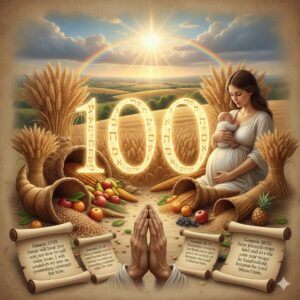
Understanding Numbers in Biblical Context
Before we delve specifically into the meaning of one hundred, it’s crucial to grasp how the Bible uses numbers. Biblical numerology isn’t about superstition or fortune-telling. Instead, numbers often serve as symbolic tools to convey spiritual truths, highlight patterns in God’s work, and emphasize theological messages.
-
Symbolic, Not Just Quantitative: Often, a number’s symbolic value is as important as its literal count. For instance, “seventy times seven” speaks to limitless forgiveness, not just 490 instances.
-
Patterns of God’s Order: Numbers reveal God’s orderly nature. The repetition of numbers like 7 (completeness) and 12 (governmental perfection) shows a divine design.
-
A Cultural and Historical Lens: Understanding the historical context—like the value of a flock or the significance of an age—helps us appreciate the weight a number like 100 would have carried for the original audience.
With this framework, the prominence of one hundred comes into clearer focus. It frequently marks a point of transition from promise to possession, from waiting to fulfillment.
The Symbolism of One Hundred in Scripture
At its core, the number one hundred in the Bible symbolizes fullness, abundance, and the complete fulfillment of a promise. It is ten multiplied by ten, amplifying the sense of completeness associated with the number ten (representing divine order and human responsibility). Thus, one hundred often signifies a full, divine measure.
This symbolism manifests in several key themes:
-
Covenant and Promise: It is a number attached to God’s covenant blessings, particularly regarding offspring and inheritance.
-
Harvest and Fruitfulness: It appears in agricultural contexts as an ideal, supernatural yield.
-
Sacrifice and Dedication: It marks the quantity of offerings, representing total devotion.
-
Longevity and a Full Life: Reaching one hundred years is presented as a blessed, complete lifespan, especially in the context of God’s covenant.
Key Biblical Instances and Their Meanings
Let’s examine specific passages where this number carries profound significance.
The Covenant with Abraham: The Promise of Progeny
The story of Abraham is foundational, and the number one hundred is central to its tension and triumph.
“Then Abram fell on his face, and God talked with him, saying: ‘As for Me, behold, My covenant is with you, and you shall be a father of many nations. No longer shall your name be called Abram, but your name shall be Abraham; for I have made you a father of many nations. I will make you exceedingly fruitful, and I will make nations of you, and kings shall come from you.'” – Genesis 17:3-6 (NKJV)
This divine promise was made when Abraham was ninety-nine years old and his wife Sarah was ninety. The sheer impossibility of a couple nearing one hundred years old bearing a child underscores a powerful truth: God’s promises are fulfilled not by human capability but by divine power. The birth of Isaac to a centenarian father shattered natural limits, establishing that the covenant lineage was a miraculous work of God. Here, one hundred symbolizes the God who brings life from barrenness and fulfills His word against all odds.
The Parable of the Sower: The Ultimate Yield
In Jesus’ teachings, the number one hundred takes on a spiritual dimension concerning the fruitfulness of a receptive heart.
“But others fell on good ground and yielded a crop: some a hundredfold, some sixty, some thirty.” – Matthew 13:8 (NKJV)
In this famous parable, Jesus describes different responses to the message of the Kingdom. The “good ground” represents a heart that understands and accepts the Word. The yields—thirty, sixty, and a hundredfold—indicate varying degrees of fruitfulness. A hundredfold return was considered an exceptional, even miraculous, harvest. It represents the maximum, God-blessed productivity of a life fully surrendered to God’s Word. It’s the ideal outcome, symbolizing abundant spiritual fruit from a faithful life.
The Offering of Dedication
The number one hundred also appears in contexts of worship and sacrifice, signifying a complete and generous offering.
-
In the dedication of the Tabernacle, leaders brought offerings that included “ten gold dishes full of incense” and “one hundred and thirty shekels of silver” (Numbers 7). While not all elements are one hundred, the large, round numbers signify totality in giving.
-
The concept of the tithe (a tenth) is amplified when considering yields of one hundredfold, representing the full amount from which God’s portion is given.
Comparative Table: The Number 100 vs. Other Significant Biblical Numbers
| Number | Primary Symbolism | Key Example | Relation to 100 |
|---|---|---|---|
| 7 | Divine Completeness, Perfection | God rested on the 7th day (Gen 2:2) | 100 extends this idea to covenant blessing and abundance. |
| 12 | Governmental Perfection, God’s People | 12 Tribes of Israel, 12 Apostles | 100 is more focused on measure of blessing; 12 on structure. |
| 40 | Testing, Trial, Probation | Israel’s 40 years in the wilderness (Deut 8:2) | 100 often follows a period of testing as a blessing. |
| 10 | Divine Order, Human Responsibility | The Ten Commandments (Exodus 20) | 100 is 10 x 10, intensifying the meaning of completeness. |
| 100 | Fullness of Blessing, Promise Fulfilled | Abraham at 100, Parable of the Sower | The focus is on abundant harvest and covenant fulfillment. |
The Prophetic and Eschatological Dimension
The symbolism of one hundred also points toward future fulfillment, particularly in the concept of the Kingdom Age.
The Promise of Longevity: Isaiah’s prophetic vision of the new creation includes a remarkable note about age:
“No more shall an infant from there live but a few days, nor an old man who has not fulfilled his days; for the child shall die one hundred years old, but the sinner being one hundred years old shall be accursed.” – Isaiah 65:20 (NKJV)
Here, living to one hundred years is depicted as the new norm, a sign of the restored order, peace, and blessing in God’s future kingdom. It symbolizes a return to the fullness of life as God originally intended, free from the curse of premature death.
Practical Applications for Readers Today
What does the biblical meaning of one hundred mean for us in a modern context? It’s not a magic number to claim, but a powerful spiritual symbol.
-
A Reminder of God’s Faithfulness: Just as God was faithful to His covenant with a 100-year-old Abraham, He is faithful to His promises in our lives, even when fulfillment seems impossible.
-
An Encouragement to Fruitfulness: The parable of the sower invites us to cultivate a heart that aims for a “hundredfold” yield—a life maximally productive in love, kindness, and good works.
-
A Call to Complete Dedication: It challenges us to consider what it means to offer God our “full measure”—our complete trust, resources, and devotion.
Important Note for Readers: Biblical numerology is a tool for deeper understanding, not a code to be cracked for predicting the future. The primary focus should always be on the person and character of God to whom the numbers point, not on the numbers themselves.
A Deeper Look: One Hundred in the Life of Isaac and the Law of Restitution
The principle of fullness associated with one hundred is further illustrated in the Law of Moses. In the law of restitution, if someone defrauded another, they were to repay far more than what was taken.
“If a man steals an ox or a sheep, and slaughters it or sells it, he shall restore five oxen for an ox and four sheep for a sheep.”… “For any kind of trespass, he shall pay double.” – Exodus 22:1, 9 (paraphrased)
While not always one hundred percent, the principle of multiple-fold restoration echoes the theme of abundant, complete justice. It reflects a God who doesn’t merely replace loss but overwhelms it with His principle of restoration, a theme culminantly seen in the life of Jesus.
Furthermore, Isaac, the child of promise born to Abraham at one hundred, himself “reaped in the same year a hundredfold; and the LORD blessed him” (Genesis 26:12). This shows the continuation of the covenant blessing of abundance to the next generation, grounded in God’s faithfulness.
Conclusion
The biblical meaning of hundred resonates as a profound symbol of God’s complete provision and the fulfillment of His covenant promises. From the birth of Isaac against all odds to the promise of abundant spiritual harvest and a future of restored longevity, this number points us toward a God of abundance who brings life, fruitfulness, and completion. It invites us to trust in His perfect timing and to cultivate lives that yield a full measure for His glory.
Frequently Asked Questions (FAQ)
Q: Does the number 100 have a secret or magical meaning in the Bible?
A: No. The significance is symbolic and theological, not magical or secretive. It’s used to emphasize God’s nature and the completeness of His actions, not for divination.
Q: Should Christians look for the number 100 in their daily lives as a sign from God?
A: The Bible encourages us to seek God’s will through His Word, prayer, and wise counsel, not through seeking out numerical signs. While God can use anything, focusing on numbers can lead to superstition and distract from a steady relationship with Christ.
Q: What is the difference between the numbers 100 and 1000 in the Bible?
A: One thousand often amplifies the idea of one hundred, representing an even greater, multitude-sized completeness or a very long period (e.g., “a thousand generations”). It speaks to vastness and grandeur in God’s blessing and sovereignty.
Q: Is living to 100 years a specific biblical promise for believers today?
A: Isaiah 65:20 is a specific prophecy for a future millennial kingdom. While long life is generally presented as a blessing in Proverbs, it is not an unconditional promise for every believer in the present age.
Additional Resources
For a deeper study on biblical numbers and their symbolism, consider exploring reputable theological resources or commentaries. A helpful starting point for online study is the Blue Letter Bible, which provides access to various translations, lexicons, and commentaries for free.