For centuries, the number 666 has been shrouded in mystery, fear, and sensationalism. From Hollywood thrillers to conspiracy theories, it’s often presented as the ultimate symbol of pure evil. But what does the Bible actually say? The true Biblical meaning of 666 is far more nuanced and historically rooted than popular culture suggests. This guide will take you on a deep dive into the scriptural source, exploring its context, intended message for its original audience, and the various ways scholars have understood it across time. Our goal is to replace anxiety with understanding, separating fact from fiction.
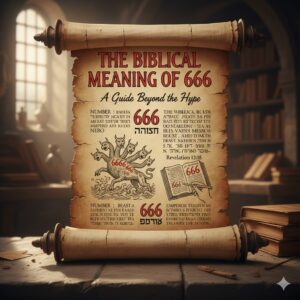
The Source: Revelation 13:18 in Context
To understand 666, we must first visit its only biblical appearance. It’s found in the Book of Revelation, specifically chapter 13, verse 18. This verse concludes a chapter describing two terrifying “beasts.”
-
The First Beast rises from the sea, wielding great power and authority, and blasphemes against God. It represents a tyrannical political power.
-
The Second Beast rises from the earth, performing deceptive miracles and forcing people to worship the first beast. It represents a corrupting religious or ideological power.
This second beast, often called the “false prophet,” enforces a mark on all people: “on their right hand or on their forehead.” Without this mark, no one can buy or sell. Then comes the pivotal verse:
“This calls for wisdom: let the one who has understanding calculate the number of the beast, for it is the number of a man, and his number is 666.”
– Revelation 13:18 (ESV)
This is the sole biblical source. Immediately, the text itself gives us crucial clues: this requires wisdom and understanding, and it is the number of a man.
Why the Book of Revelation Uses Symbolism
Revelation is an apocalyptic text, a genre that uses vivid, symbolic imagery to convey spiritual truths and hope to people under persecution. Its first verse states it was “signified” (communicated by signs) to its author, John. Numbers, animals, colors, and seals are all part of this symbolic language. Seeing 666 as a literal, future barcode or chip misses the literary style. For its first readers, it was a coded message of immediate relevance.
Historical & Scholarly Interpretations of 666
The key to decoding 666 lies in a practice called gematria, where letters have numerical values. In Hebrew, Greek, and Latin, numbers were written with letters of the alphabet. So, any word or name had a corresponding sum.
The most historically compelling interpretation points directly to the world of the first-century church: the Roman Empire and its emperors.
The Nero Caesar Theory
Many scholars consider this the most likely original meaning. The first readers of Revelation were suffering under Roman persecution. The emperor Nero (A.D. 54-68) was infamous for his brutality against Christians. He was seen as the archetype of an evil, beastly ruler.
When we write “Nero Caesar” in Hebrew letters (נרון קסר), and calculate their value:
-
נ (Nun) = 50
-
ר (Resh) = 200
-
ו (Vav) = 6
-
נ (Nun) = 50
-
ק (Qoph) = 100
-
س (Samekh) = 60
-
ר (Resh) = 200
-
Total = 666
This fits powerfully. It identifies the “beast” as the oppressive Roman system embodied in a specific, known tyrant. It was a cryptic way for John to criticize the empire without facing immediate retribution. Some early manuscripts even list the number as 616, which corresponds to the Latin spelling of “Nero Caesar,” providing further evidence for this theory.
Other Historical Perspectives
-
Generic Imperial Evil: Beyond Nero, 666 may symbolize the recurring nature of oppressive, God-opposing worldly power throughout history—any system or leader that demands ultimate allegiance.
-
Symbolic Imperfection: In biblical numerology, the number 7 represents divine completion and perfection (7 days of creation, 7 churches, 7 seals). The number 6, falling one short of seven, can symbolize human imperfection, failure, or rebellion against God. The triple repetition (666) intensifies this, representing the ultimate human system arrogantly trying to achieve perfection without God—a trinity of evil imitating the Holy Trinity.
666 vs. Common Myths and Misconceptions
Popular culture has created a dense fog of fear around this number. Let’s clear the air.
| Popular Myth | Biblical & Historical Reality |
|---|---|
| The “Mark of the Beast” is a futuristic microchip or barcode. | The “mark” is presented as a spiritual/ideological allegiance to the beastly system, contrasted with the “seal of God” on the foreheads of the faithful (Rev. 7:3). Its primary function was social-economic coercion. |
| Seeing 666 anywhere is a bad omen or sign of the devil. | The Bible does not teach that the number itself is magical or inherently evil. It is a symbol pointing to a specific concept: rebellious human power. |
| It is exclusively about a single end-times Antichrist figure. | While many see an ultimate fulfillment, the original context strongly suggests it first referred to a contemporary political reality for the persecuted church. |
| Christians should fear this number. | Revelation’s core message is one of hope and victory for those who remain faithful. Focusing on fear of a number misses the book’s exhortation to conquer through faith (Rev. 21:7). |
A Crucial Note on Fear and Discernment
If reading about 666 causes you anxiety, remember: the purpose of Scripture is to bring wisdom and peace, not terror. The entire narrative arc of the Bible ends with God’s triumph over evil. Becoming overly focused on identifying the “beast” in every era can lead to paranoia and a neglect of the Bible’s central commands: to love God and love our neighbors.
The Mark vs. The Seal: A Biblical Contrast
Revelation doesn’t just present the “mark of the beast”; it offers its powerful opposite.
The Mark of the Beast (Revelation 13:16-17)
-
Origin: From the beast/false prophet.
-
Purpose: To control commerce and enforce worship of the beast.
-
Result: Spiritual bondage and ultimate judgment.
-
Location: On the right hand or forehead.
The Seal of God (Revelation 7:2-3)
-
Origin: From the living God.
-
Purpose: To denote God’s ownership and protection of His servants.
-
Result: Spiritual security and ultimate salvation.
-
Location: On the forehead.
This contrast is key. The biblical concern is not about a physical mark, but about whose you are—to which power you pledge your ultimate loyalty. The “forehead” symbolizes your mind and allegiance, the “hand” your actions and work.
Numerology in the Bible: A Quick Reference
To better understand 666, it helps to see how numbers function symbolically in Scripture:
-
7: Completion, Perfection, Divine Fullness (e.g., 7 days of creation).
-
6: Human imperfection, falling short of God’s ideal (e.g., man created on the 6th day).
-
12: Divine Government and God’s People (e.g., 12 tribes of Israel, 12 apostles).
-
3: Divine Completeness (the Trinity).
-
4: The Created World (e.g., 4 corners of the earth, 4 seasons).
-
40: Testing, Trial, or Probation (e.g., 40 days in the wilderness, 40 years in the desert).
Seeing 666 as an intensified, “trinity” of human imperfection (6-6-6) fits coherently within this symbolic framework.
Practical Takeaways for Modern Readers
What does the biblical meaning of 666 mean for us today?
-
Discernment Over Fear: The call for “wisdom” is primary. We are to critically evaluate the powers and systems in our world that demand our absolute loyalty—be they political, ideological, economic, or cultural.
-
Allegiance is Key: The central question is: What do you worship? Where do you place your ultimate trust for security and identity? The Christian answer is meant to be God alone.
-
Hope is the Anchor: Revelation was written to comfort the suffering, not terrify the comfortable. It assures believers that despite present evil, God’s justice and redemption will prevail.
Important Note: If you are struggling with fear related to end-times prophecies, consider engaging in a balanced study of Revelation with a focus on its hopeful conclusions (Revelation 21-22), and perhaps discuss it with a knowledgeable pastor or spiritual guide.
Conclusion
The biblical meaning of 666 is not a cryptic code for modern technology, but a first-century symbol of imperial oppression and human rebellion against God, most likely pointing to Nero Caesar. It serves as a timeless warning against giving ultimate allegiance to any worldly power or system. By understanding its historical context and symbolic language, we can move beyond sensationalism to grasp its true message: a call to discernment, faithful allegiance to God, and the assurance of His ultimate victory.
Frequently Asked Questions (FAQ)
Q: Should I be worried if I see the number 666 in daily life (e.g., a receipt, license plate)?
A: No. The Bible does not teach that the number itself is a curse or a personal sign. Such occurrences are coincidences. The biblical concern is spiritual allegiance, not numerical superstition.
Q: Is the “Mark of the Beast” here today?
A: Most mainstream theological views (historicist, preterist, idealist) see the “mark” as a symbolic representation of complicity with oppressive systems throughout history, not a single, identifiable physical object in the present. Futurist interpretations differ, but even they typically place it in a specific, future tribulation context.
Q: What about the variant number 616 found in some ancient manuscripts?
A: This is strong evidence for the “Nero Caesar” interpretation. 616 corresponds to the gematria for “Nero Caesar” when spelled in Latin, suggesting early Christians understood it as a cryptic reference to the emperor.
Q: How can I apply the lesson of 666 today?
A: By regularly examining where you place your ultimate trust. Is it in political parties, financial security, national identity, or a charismatic leader? The call is to ensure God is the foundation of your identity and hope.
Additional Resources for Deeper Study
-
Book: Revelation for Everyone by N.T. Wright. A highly accessible and insightful commentary that places Revelation in its historical context.
-
Online Course: “The Apocalypse: Controversies & Meaning in the Book of Revelation” from The Yale Divinity School on YouTube or Coursera.
-
Article Library: Explore the in-depth articles on biblical scholarship and interpretation at the Bible Project. (Their video on “Day of the Lord” and series on “Apocalyptic” literature are excellent starting points).