In the silent sanctuary of a tattoo studio, the gentle hum of the needle becomes a modern-day instrument of devotion. Here, a sacred script is not penned on parchment but inscribed upon the living canvas of human skin. This is the realm of biblical meaning tattoos—a profound intersection of ancient faith and contemporary expression. Once viewed with skepticism within many religious circles, the art of tattooing has undergone a significant transformation, emerging for many believers as a powerful, personal testament to their spiritual journey. This article ventures beyond mere cataloging of popular designs. It seeks to excavate the deep theological soil from which these symbols grow, grapple with the complex ethical debates they inspire, and honor the deeply personal narratives they represent. From the stark prohibition in Leviticus to the triumphant imagery of Revelation, we will explore how the eternal Word inspires indelible marks, transforming the body into a walking archive of faith, hope, and divine encounter.
2. The Leviticus Dilemma: Interpreting the Famous Prohibition
No discussion on biblical tattoos can begin without addressing the elephant in the room: Leviticus 19:28. The verse, in many English translations, states unequivocally: “Do not cut your bodies for the dead or put tattoo marks on yourselves. I am the Lord.” For centuries, this single commandment formed the bedrock of Christian and Jewish opposition to tattooing. To understand its place today, we must engage in responsible hermeneutics—the art and science of biblical interpretation.
The command is nestled within the Holiness Code (Leviticus 17-26), a series of laws given to set the nation of Israel apart from the surrounding Canaanite, Egyptian, and Mesopotamian cultures. These neighboring peoples practiced ritual cutting and tattooing as part of pagan mourning rites (for the dead) and as permanent dedications to their deities (e.g., the cult of the Egyptian goddess Hathor). The prohibition, therefore, was primarily cultic and contextual. Its core intent was to prevent assimilation into idolatrous practices and to maintain a distinct communal identity centered on Yahweh.
Key interpretive considerations include:
-
Covenantal Context: The law was part of the Mosaic Covenant, specifically for the nation of Israel as a theocratic state. Christian theology generally holds that ceremonial and civil aspects of this law were fulfilled in Christ.
-
New Testament Lens: The New Testament shifts the focus from external, physical markers of purity to internal, spiritual transformation. The “mark” of a Christian is not ink in skin but the fruit of the Spirit (Galatians 5:22-23) and the inward circumcision of the heart (Romans 2:29).
-
Intent and Principle: The enduring principle is the rejection of idolatry and practices associated with spiritual death. A modern tattoo intended as an act of worship to Christ or a reminder of His promises operates from a fundamentally different heart posture than the rituals Leviticus condemns.
For many contemporary believers, this careful exegesis allows them to reconcile their faith with their ink, viewing their tattoos not as a violation of an ancient cultic law but as a fulfillment of the call to bear witness to the living God.
3. A Historical Tapestry: Marks of Identity from Antiquity to Today
The human desire to mark the skin with meaningful symbols predates written history. Within the biblical narrative and the broader ancient world, marks on the body served complex roles.
-
Ancient Near East: As noted, pagan tribes used tattoos in idol worship. In Egypt, tattoos on women may have denoted status, religious devotion, or served a therapeutic purpose.
-
Biblical Marks of Covenant and Ownership: While not “tattoos” in the modern sense, permanent marks held significance.
-
The Mark of Cain (Genesis 4:15): A protective sign from God, demonstrating that judgment belongs to Him.
-
The Blood on the Doorposts (Exodus 12:13): A temporary but saving mark identifying the households of Israel.
-
The Frontlets between the Eyes (Exodus 13:9, 16): A metaphorical mark, later taken literally in phylacteries, symbolizing the internalization of God’s law.
-
The Prophetic Sign of the Tau (Ezekiel 9:4): The mark (Hebrew Tav, like an ‘X’ or cross) on the foreheads of the faithful in Jerusalem to spare them from judgment.
-
The Seals in Revelation: The 144,000 are sealed on their foreheads (Revelation 7:3), and followers of the Beast receive his mark (Revelation 13:16-17). These are spiritual seals denoting ownership and allegiance.
-
-
Early Christian and Coptic Traditions: Evidence suggests some early Christian sects, particularly in Egypt and among Coptic pilgrims, may have received small tattoos (often a cross or the Chi-Rho symbol) as marks of pilgrimage or devotion, especially following the Edict of Milan when overt symbols were safer.
-
The Modern Renaissance: For much of the subsequent Christian era in the West, tattooing was largely taboo. Its resurgence in the late 20th and 21st centuries, moving from subculture to mainstream, has provided a new context for believers. Today’s biblical tattoos are less about communal rite and more about personal testimony—a visible, permanent integration of one’s faith story into one’s personal identity.
4. Theological Foundations: Covenant, Witness, and Remembrance
Beyond navigating prohibitions, the decision to get a biblical tattoo can be rooted in positive theological concepts.
-
Covenant Remembrance: The Bible is replete with commands to remember God’s acts (Deuteronomy 8:2). Stones were piled up (Joshua 4:7), feasts instituted (Passover), and psalms written to serve as memorials. For many, a tattoo functions as a personal “Ebenezer” stone (1 Samuel 7:12), a permanent reminder of a specific moment of deliverance, grace, or commitment. It answers the silent prayer: “Lest I forget.”
-
External Witness: In the Great Commission (Matthew 28:19-20), believers are called to be witnesses. A tattoo can serve as a conversation starter. A visible cross or verse can prompt questions from strangers, opening doors for testimony that might otherwise remain closed. It is a passive yet potent form of evangelism, declaring one’s allegiance before a word is spoken.
-
Identity in Christ: New Testament letters speak profoundly of the believer’s new identity—being “in Christ,” a “new creation” (2 Corinthians 5:17). A tattoo can be a tangible, external symbol of this internal, spiritual reality. It is a declaration: “I am not my own; I was bought with a price” (1 Corinthians 6:19-20).
-
The Body as Temple: The argument against tattoos often cites 1 Corinthians 6:19, that the body is a “temple of the Holy Spirit.” Proponents, however, argue that beautifying a temple with meaningful, God-honoring art is consistent with the concept. Just as Solomon’s temple was adorned with intricate carvings of cherubim, palm trees, and flowers (1 Kings 6:29), the living temple can be adorned with symbols of faith.
5. Symbolism Decoded: A Lexicon of Biblical Imagery in Ink
This section delves into the meanings behind the most potent symbols, moving beyond cliché to their rich scriptural roots.
The Cross: From Instrument of Shame to Symbol of Victory
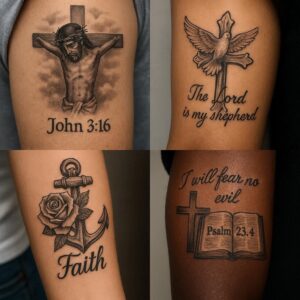
The cross is the central symbol of Christianity, but its tattoo representations vary widely.
-
The Latin Cross: The simplest form, representing the instrument of Christ’s sacrifice.
-
The Crucifix: Features the corpus (body of Christ), emphasizing His suffering and atoning death.
-
The Empty Cross / Resurrection Cross: Emphasizes the victory over death and the risen Christ.
-
The Celtic Cross: Combines the cross with a circle, representing eternity, the unity of God’s love, or the halo of Christ.
-
The Anchor Cross: Merges the cross with the shape of an anchor, symbolizing hope (Hebrews 6:19) firmly secured in Christ.
The Fish (Ichthus): A Covert Creed
An ancient acrostic: Iēsous Christos Theou Yios Sōtēr (Jesus Christ, God’s Son, Savior). For early Christians under persecution, a simple sketch of a fish identified safe houses and fellow believers. Today, it remains a humble, profound symbol of core belief.
The Lion of Judah: Majesty and Messianic Promise
Rooted in Genesis 49:9-10 and proclaimed in Revelation 5:5, this symbol combines ferocity, royalty, and the triumphant lineage of Jesus. It appeals as a symbol of courage, strength, and the conquering nature of Christ.
Scriptures in Skin: Word-for-Word Ink
Popular verses become personal mantras inked permanently.
-
Philippians 4:13 (“I can do all things…”): A declaration of strength through Christ.
-
Jeremiah 29:11 (“For I know the plans I have for you…”): A reminder of God’s providence.
-
Psalm 23: A whole psalm, or select phrases, invoking God’s guidance and comfort.
-
Isaiah 41:10 (“Do not fear…”): A permanent antidote to anxiety.
The font, language (original Greek/Hebrew, Latin Vulgate, or native tongue), and accompanying imagery personalize the text.
Divine Geometry: The Trinity Knot, Metatron’s Cube, and the Flower of Life
While not explicitly biblical, these geometric patterns resonate with theological concepts.
-
Trinity Knot (Triquetra): Three interlocked vesicae piscis shapes, perfectly symbolizing the three-in-oneness of the Father, Son, and Holy Spirit—co-equal, co-eternal, inseparable.
-
Metatron’s Cube & The Flower of Life: Found in sacred geometry, these interconnected patterns are seen by some as reflections of the divine blueprint of creation, the underlying order and intelligence of God’s design.
Celestial Bodies: Stars, Moons, and God’s Promise to Abraham
A simple star can recall God’s promise to make Abraham’s descendants “as numerous as the stars” (Genesis 15:5)—a symbol of faith, heritage, and divine promise. The moon and stars together can evoke Psalm 8:3-4, inspiring awe at God’s creation and His mindfulness of humanity.
Flora and Fauna: The Lily, the Olive Branch, the Dove, and the Lamb
-
Lily: Symbolizes purity, reliance on God’s provision (“Consider the lilies…” Matthew 6:28), and the resurrection.
-
Olive Branch / Olive Tree: Represents peace, reconciliation with God (Genesis 8:11), and spiritual vitality (Psalm 52:8, Romans 11:17-24).
-
Dove: The universal symbol of the Holy Spirit (Matthew 3:16), peace, and new creation.
-
Lamb: Represents Jesus as the sacrificial “Lamb of God” (John 1:29) and the believer’s gentle dependence on the Shepherd.
6. The Psychology of Permanent Faith: Why Believers Choose Biblical Tattoos
The decision is rarely purely aesthetic. It is deeply psychological and spiritual.
-
Marking Transformation: A tattoo can commemorate a “before and after” moment—conversion, recovery from addiction, survival of trauma, or a profound spiritual renewal. It externalizes an internal change.
-
Carrying Reminders: In times of doubt, struggle, or pain, the tattoo serves as a tangible, un-ignorable reminder of truth, much like a wearable scripture.
-
Claiming Ownership of the Body: For some who have experienced bodily trauma, abuse, or illness, choosing to adorn the body with a beautiful, meaningful symbol can be an act of reclamation and healing, declaring the body as under God’s authority and grace.
-
Creating a Legacy of Faith: Family tattoos (matching crosses, a shared verse) create a visible bond and a spiritual heritage passed across generations.
7. Navigating Design: Placement, Aesthetics, and Personalization
A biblically meaningful tattoo should also be well-executed art. Key considerations include:
-
Collaboration with the Artist: Finding an artist who respects the subject matter and can translate spiritual concepts into beautiful art is crucial. Bring reference images and be clear about symbolism.
-
Placement: Is the tattoo for public witness (forearm, calf) or private devotion (ribs, chest)? Consider professional and social contexts.
-
Style: Choices range from hyper-realistic to traditional, watercolor to blackwork, fine line to illustrative. The style should complement the symbol’s meaning (e.g., delicate script for a verse, bold lines for a lion).
-
Integration: Many designs blend multiple elements: a verse wrapping around a cross, a landscape illustrating Psalm 23, a lion resting with a lamb.
8. Ethical and Spiritual Considerations for the Christian
Despite theological freedom, wisdom and discernment are required.
-
Motivation Examination: Is the motive pride, trend-following, or a genuine desire for remembrance and witness? Heart posture matters to God more than the ink (1 Samuel 16:7).
-
Stumbling Blocks: Paul’s principle in 1 Corinthians 8 applies. If a tattoo (or its location) would cause a fellow believer with a stricter conscience to stumble, love calls for consideration and potentially choosing a less visible placement.
-
Cultural Sensitivity: Some symbols may have different meanings in other cultures. Research is key to avoid unintended messages.
-
Church Community: Reactions will vary. Be prepared to give a gentle, reasoned answer for your hope (and your ink) with respect (1 Peter 3:15).
9. Global and Cultural Perspectives on Religious Tattoos
Biblical tattoos exist in a global context of religious skin art.
-
Coptic Christians: Maintain a living tradition of pilgrimage tattoos from the Church of the Holy Sepulchre in Jerusalem.
-
Filipino Devotional Tattoos: In the Philippines, Pasyon tattoos commemorating Holy Week devotion blend Catholic and indigenous traditions.
-
Contrast with Buddhist Sak Yant or Islamic Views: Unlike the Buddhist blessing-tattoos of Southeast Asia or the clear prohibition in mainstream Islam, the Christian position is uniquely interpretative, sitting between a specific Old Testament law and a New Testament theology of grace and heart-led worship.
10. Conclusion: A Personal Testament
Biblical meaning tattoos reside in the sacred space where personal narrative intersects with eternal truth. They are not commandments but potential testimonies; not required for salvation but chosen as markers of it. From grappling with Leviticus to embracing the cross, the journey to faith-inspired ink is as unique as the individual wearing it. Ultimately, these permanent marks serve as humble, earthly reminders of a grace that is both indelible and eternally transformative—a story written not just on skin, but upon the heart.
11. Frequently Asked Questions (FAQs)
Q1: Is it a sin for a Christian to get a tattoo?
A: There is no unanimous consensus. Most mainstream Christian denominations do not explicitly prohibit it. The interpretation of Leviticus 19:28 is key. Many theologians and believers conclude that in the context of the New Covenant, the prohibition was against idolatrous pagan practices, not against all tattoos. The decision is considered a matter of Christian liberty and personal conscience, guided by the Holy Spirit and Scriptural principles.
Q2: What are some of the most popular Bible verses for tattoos?
A: Popular choices include Philippians 4:13 (strength in Christ), Jeremiah 29:11 (God’s plans), Isaiah 41:10 (do not fear), Psalm 23 (the Lord as shepherd), Romans 8:28 (all things work for good), and Joshua 1:9 (be strong and courageous). The “best” verse is always the one most personally meaningful to the individual.
Q3: I’m considering a biblical tattoo. What should I think about first?
A: Carefully examine your motivation. Research the symbol or verse thoroughly in its scriptural context. Pray for guidance. Choose a design and artist thoughtfully. Consider placement regarding your career, community, and family. Be prepared to explain its meaning lovingly to those who ask or question.
Q4: How do I find a tattoo artist who can do a good job with a religious design?
A: Look at artist portfolios online (Instagram is a primary platform). Seek artists whose style matches your vision (e.g., fine line for script, realism for portraits). Don’t hesitate to ask if they have experience with religious or symbolic work. A good artist will listen to your story and collaborate to create meaningful art.
Q5: What if I regret my biblical tattoo later in my faith journey?
A: Faith is a journey, and a tattoo can mark a specific moment on that path. Even if theology deepens or changes, the tattoo can remain a testament to where you were at that time—a milestone of grace. If regret is significant, cover-up or laser removal are options, but many choose to view the tattoo as part of their ongoing story of growth.