Imagine a language older than the written word, a theology painted in pigment and carved in stone. Long before universal literacy, the stories, doctrines, and mysteries of the Bible were communicated not just from the pulpit, but from the walls of catacombs, the stained glass of cathedrals, and the canvases of genius. This is the realm of biblical drawing and art with deep meaning—a realm where every color, gesture, animal, and object is a deliberate word in a silent sermon. This article is an invitation to become fluent in this visual language. We will journey from the symbolic fish scratched by persecuted early Christians to the breathtaking psychological depth of Renaissance frescoes, into the raw, questioning expressions of modern interpretations. To engage with this art is not merely to look at Bible stories; it is to witness faith, doubt, hope, and revelation made visible, offering a transformative lens through which to understand one of the most foundational texts of human civilization.
-
Comparative Analysis of Key Biblical Scenes in Art
| Biblical Scene | Common Symbolic Elements | Medieval Depiction (e.g., Giotto) | Renaissance Depiction (e.g., Da Vinci) | Modern Depiction (e.g., Chagall) |
|---|---|---|---|---|
| The Annunciation | Lily (purity), Dove (Holy Spirit), Book (prophecy), Blue (heavenly). | Hierarchical, symbolic space. Mary often on a throne. Emphasis on her role as Theotokos. | Naturalistic perspective. Psychological moment of surprise or acceptance. Domestic setting. | Dreamlike, floating figures. Colors convey emotion over realism. Focus on spiritual awe. |
| The Crucifixion | Skull (Golgotha), blood into chalice (Eucharist), broken temple veil, contrasting figures. | Iconic, symmetrical. Focus on Christ’s triumph over death, often with open eyes. | High realism of suffering. Anatomical accuracy. Focus on human sacrifice and grief. | Often deconstructed. May omit figures, use abstract shapes or bold colors to express anguish universally. |
| The Last Supper | Chalice & bread (Eucharist), water basin (betrayal hand-wash), specific seating (John at Christ’s breast). | Linear, symbolic. Figures often identical, Judas separated. | Deep perspective, individualized apostles, dramatic reaction to “one will betray me.” | May focus on isolation, modern dress, or the meal as a universal symbol of community and betrayal. |
1. The Foundation: Why Art Became the Bible’s First Translator
In an age where Bibles are ubiquitous and literacy is widespread, it’s easy to forget that for over a millennium, the primary encounter most Christians had with biblical narrative was visual. The Church, with pedagogical wisdom, embraced art as its most potent tool.
The Pedagogical Imperative: Pope Gregory the Great (c. 540–604) famously defended religious images, stating that they functioned as “the Bible of the illiterate” (libri pauperum). A complex story like the Fall of Man or the Passion of Christ could be instantly communicated and remembered through a single, powerful image on a wall or in a window. Scenes were arranged typologically—placing Old Testament “prefigurations” (like Isaac’s sacrifice) next to their New Testament fulfillments (Christ’s crucifixion)—to teach sophisticated theological concepts visually.
Theology in Color and Form: How does one depict the Holy Spirit, the concept of the Trinity, or the dual nature of Christ as fully God and fully man? Texts can philosophize; art must visualize. Artists developed a rich symbolic lexicon (detailed in the next section) to tackle these mysteries. The use of a mandorla (almond-shaped aura) to indicate divine glory, or specific colors to denote Christ’s divinity (gold) or humanity (red), turned abstract doctrine into tangible form.
A Devotional Bridge: Beyond instruction, art served a profound devotional purpose. A meticulously painted icon was believed to be a conduit to the holy person it represented. Gazing upon a detailed scene of the Lamentation invited the viewer to empathize with Mary’s sorrow, deepening personal piety and emotional connection to the sacred story. Art made the distant biblical past present and immediate.
2. The Lexicon of the Divine: A Guide to Core Symbolic Elements
To “read” biblical art is to understand its alphabet of symbols. These are not decorative choices; they are integral to the meaning.
-
The Symbolic Menagerie:
-
Lamb (Agnus Dei): The ultimate symbol of Christ’s sacrificial death. Often shown with a banner of victory, representing his resurrection.
-
Fish (Ichthys): An early Christian acrostic for “Jesus Christ, Son of God, Savior.” A secret sign of identity during persecution.
-
Dove: Universally represents the Holy Spirit, especially at Christ’s baptism. Also symbolizes peace and the soul.
-
Lion: A multivalent symbol. Can represent Christ (“Lion of Judah”) or Satan (“prowling lion”). Context is key.
-
Pelican: In medieval belief, the pelican fed its young with its own blood, making it a perfect symbol for Christ’s Eucharist.
-
Serpent/Dragon: Evil, Satan, sin. Often shown under the foot of Mary or a saint.
-
-
Botanical Theology:
-
Tree of Knowledge vs. Tree of Life: The former, often a fig tree, represents the Fall. The latter, re-accessed through Christ, appears in Paradise scenes and as the cross itself.
-
Vine & Wheat: Direct Eucharistic symbols. Christ said, “I am the vine” (John 15:5); wheat is ground to make the bread of communion.
-
Lily: Purity, associated with the Virgin Mary at the Annunciation.
-
Rose: A symbol of martyrdom (red) or divine love.
-
-
Colors as Doctrine:
-
Gold: The divine, the celestial, unchanging truth. Used for halos and backgrounds.
-
Blue: Heavenly grace, divinity. In Marian robes, it signifies she is “clothed with the sun.”
-
Red: Dual meaning. The blood of Christ (sacrifice, love) and the red robes of martyrs, but also can signify evil or worldly power.
-
White: Purity, resurrection, triumph.
-
Green: Hope, regeneration, the everlasting life of the faithful.
-
Purple: Royalty (Christ as King) and penance.
-
3. Epochs of Revelation: A Historical Journey Through Biblical Art
The interpretation of biblical themes has evolved dramatically with cultural and theological shifts.
-
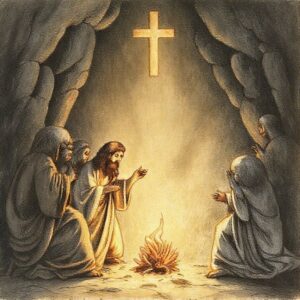
Early Christian & Catacomb Art: In the hidden catacombs of Rome, art was simple and hopeful. Frescoes of Jonah and the whale symbolized resurrection; the Good Shepherd represented salvation; the orant (praying figure) symbolized the faithful soul. It was art of community and hope under threat.
-
Byzantine & Iconographic Tradition: Following the codification of Christian doctrine, icons became central. They are not portraits but “windows into heaven,” following strict canonical rules to preserve theological accuracy. The flat, gold-backgrounded, frontal figures with elongated proportions emphasize the spiritual, non-worldly reality of the sacred. The Iconoclastic Controversy (8th-9th centuries) was a fierce battle over the very legitimacy of images, ultimately cementing their theological importance in the East.
-
The Medieval Manuscript: Monks spent years illuminating manuscripts like the Book of Kells. Pages teemed with intricate, often fantastical illustrations. Initial capitals bloomed into narrative scenes. This was art as an act of devotion in itself, a glorification of the Word made beautiful.
-
The Renaissance Revolution: A seismic shift. Inspired by humanism and classical antiquity, artists like Masaccio, Leonardo, and Michelangelo placed biblical figures in believable, three-dimensional space. They studied anatomy, emotion, and the natural world. The divine was now expressed through perfect human form. The focus moved from symbolic representation to psychological drama and idealized beauty, reflecting a new confidence in human potential within God’s creation.
-
Baroque Drama: In response to the Protestant Reformation (which often rejected religious imagery), the Catholic Counter-Reformation urged art that was emotionally direct, dramatic, and accessible. Caravaggio placed sacred events in dark Roman taverns with ordinary people as models, using stark tenebrism (light/shadow) to spotlight the spiritual moment. Bernini’s sculptures were theatrical and dynamic, aiming to stir the viewer’s faith viscerally.
-
Modern & Contemporary Explorations: The Age of Enlightenment, scientific advancement, and secularization led to more personal, critical, and often existential engagements with biblical themes. Artists like Gauguin, Van Gogh, and Rouault used bold color and form to express spiritual yearning. Post-WWII artists like Bacon, Sutherland, and Chagall depicted biblical agony and trauma in response to the horrors of the century. Today, artists from diverse cultures use biblical imagery to address issues of identity, justice, and post-colonialism, often deconstructing traditional narratives to find new, challenging meanings.
9. Conclusion
Biblical art is a living conversation across centuries, where pigments and lines become profound theology. From the cryptic symbols in catacombs to the monumental questions on modern canvases, it challenges us not just to see a story, but to perceive its meaning. To learn this visual language is to gain a richer, more visceral understanding of faith, narrative, and the human struggle with the divine—a testament to the enduring power of image to illuminate word.
10. Frequently Asked Questions (FAQs)
Q1: Isn’t creating images of God or biblical figures forbidden by the Second Commandment?
A: This has been a central debate. Judaism and Islam generally maintain a strict aniconic position. Christianity historically interpreted the commandment as prohibiting idolatry (worshiping the image itself), not religious imagery used for veneration or instruction. The 7th Ecumenical Council (787 AD) definitively endorsed the use of icons, distinguishing between latria (worship due to God alone) and dulia (veneration given to saints and icons).
Q2: Why do Old Testament figures sometimes have halos in Christian art?
A: This is an example of typology. Figures like Moses, Abraham, or David are seen as “types” or foreshadowings of Christ. Giving them halos is a visual way to indicate their righteousness and their role within the Christian narrative of salvation history, not because they were considered divine.
Q3: How can I start to analyze and understand the symbolism in a biblical painting?
A: Start with the four key questions: 1) What is the narrative moment? Identify the specific scene. 2) Who are the figures and what are their attributes? Look for halos, specific objects (keys=Peter, sword=Paul). 3) What symbols are present? Analyze animals, plants, colors, and gestures. 4) What is the historical context? Knowing if it’s a Renaissance or Baroque piece, for instance, guides your interpretation of its goals.
Q4: Are there significant differences between Catholic and Protestant biblical art?
A: Historically, yes. Following the Reformation, many Protestant traditions (especially Reformed/Calvinist) drastically reduced or simplified religious art in churches, emphasizing the preached word. Catholic and Lutheran traditions continued to embrace elaborate art for instruction and devotion. Protestant art, when it existed, often focused more on narrative clarity and less on the veneration of saints or Mary.