In our modern world, we are surrounded by a constant flood of information. From the moment we wake up and check our phones to the time we turn off the TV at night, our eyes and ears are being fed a steady diet of images, sounds, and messages.
Some of this input is good. It uplifts us, teaches us, and brings us joy. But let’s be honest—a lot of it isn’t. We see things that make us anxious, envious, or afraid. We hear gossip, negativity, and lies. It can feel overwhelming, can’t it?
This is where ancient wisdom steps in to help us with a modern problem. The Bible has a lot to say about what we allow into our lives through our senses. The concept of guarding your eyes and ears isn’t about hiding from the world. It’s about being intentional. It’s about building a healthy filter for your mind and spirit.
Think of your heart and mind like a garden. What you see and hear are the seeds you plant. If you plant good seeds, you’ll grow something beautiful. If you constantly plant weeds, you’ll end up with a mess.
This article is here to walk with you through what the Bible says about protecting that garden. We’ll look at specific verses, break down what they mean, and talk about how to apply them to your life today.
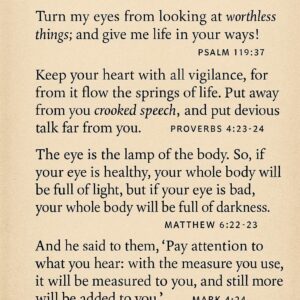
Why Is It Important to Guard Your Senses?
Before we dive into specific verses, let’s talk about the “why.” Why does it matter what we watch, listen to, or look at?
The simple answer is that our senses are the gateway to our hearts. Everything we experience enters through our eyes and ears and settles deep within us. It shapes our thoughts, our desires, and eventually, our actions.
Important Note: This isn’t about living in fear or judging others. It’s about self-care. Just as you would protect your physical body from harm, it’s wise to protect your inner world from things that can damage your peace, your faith, and your joy.
When we constantly expose ourselves to violence, immorality, or negativity, it desensitizes us. What once shocked us becomes normal. What once made us sad no longer moves us. Guarding your eyes and ears is a way of staying sensitive, healthy, and aligned with the person you truly want to be.
Key Bible Verses About Guarding Your Eyes
Let’s start with the eyes. They are often the first point of contact with the world. The Bible speaks directly to the power of sight and the need for intentionality.
The Core Principle: Job’s Covenant
One of the most powerful examples of guarding the eyes comes from the Old Testament. A man named Job, known for his faithfulness, made a radical decision.
“I made a covenant with my eyes not to look lustfully at a young woman.” — Job 31:1 (NIV)
This verse is incredibly practical. Job didn’t just try harder not to think bad thoughts. He went to the source. He made an agreement, a promise, with his own eyes.
What this means for us today:
This is about being proactive. It’s deciding before you are in a difficult situation what you will and will not look at. It could apply to:
-
Scrolling on social media.
-
Watching movies or TV shows.
-
How you interact with people you find attractive.
-
Comparing yourself to others online.
Making a “covenant with your eyes” means setting boundaries for yourself so you don’t have to rely on willpower in the heat of the moment.
The Teaching of Jesus: Light and Darkness
Jesus Himself taught about the connection between the eye and the inner self. He used simple, powerful imagery that anyone can understand.
“The eye is the lamp of the body. If your eyes are healthy, your whole body will be full of light. But if your eyes are unhealthy, your whole body will be full of darkness. If then the light within you is darkness, how great is that darkness!” — Matthew 6:22-23 (NIV)
Think of your eye as a window. When the glass is clean, light floods the room, and you can see clearly. When the glass is dirty, cracked, or covered up, the room stays dark.
Breaking it down:
-
Healthy Eyes: This implies focus and generosity. It means looking at the world, at others, and at your circumstances with a perspective of faith and gratitude.
-
Unhealthy Eyes: In the original language, this can also mean “stingy” or “grudging.” It’s a perspective of envy, lust, greed, or negativity.
If you constantly look at things with a critical, lustful, or envious eye, that darkness fills your heart. Guarding your eyes, then, is about keeping that window clean so your whole being can be full of light.
The Prayer for Focus: Psalm 119
The longest chapter in the Bible is a love song to God’s wisdom. In it, the writer asks for practical help in staying on the right path.
“Turn my eyes away from worthless things; preserve my life according to your word.” — Psalm 119:37 (NIV)
I love this verse because it’s a prayer. It’s an admission that we can’t always do this on our own. We need help.
-
“Worthless things”: This can mean many things. It’s the time-wasting content, the mindless scrolling, the things that offer no value but just eat up our time and attention.
-
“Preserve my life”: This shows the connection. Looking at worthless things doesn’t just waste time; it drains our life and energy. Focusing on what is good and true preserves us—it keeps us healthy and whole.
This verse gives us a simple prayer we can use any time: “God, help me to look away from things that don’t matter, so I can focus on things that lead to a full life.”
Key Bible Verses About Guarding Your Ears
While the eyes are powerful, the ears are just as important. What we listen to—the conversations we absorb, the music, the news, the voices we give our attention to—shapes our thinking just as much as images.
The Wisdom of Listening: Proverbs
The book of Proverbs is packed with practical advice, and it has a lot to say about being careful with what you hear.
“The wise in heart accept commands, but a chattering fool comes to ruin.” — Proverbs 10:8 (NIV)
This verse contrasts two types of people. The wise person is ready to listen, especially to good advice and instruction. The fool, on the other hand, is too busy talking (or listening to the wrong things) and ends up in trouble.
Practical Application:
-
Be selective about advice. Not every opinion deserves space in your head. Listen to people who are wise, kind, and have your best interests at heart.
-
Watch out for “chatter.” This is the constant background noise of gossip, complaints, and negativity. It’s easy to get drawn into it, but it rarely leads to anything good.
Guarding Against Gossip
One of the most destructive things we can “hear” is gossip. The Bible warns against it frequently because it damages relationships and poisons the heart.
“A perverse person stirs up conflict, and a gossip separates close friends.” — Proverbs 16:28 (NIV)
Gossip is powerful. It has the ability to destroy trust and break apart even the strongest friendships. Guarding your ears means not only refusing to spread gossip but also refusing to listen to it.
When someone comes to you with a story about someone else, ask yourself:
-
Is it true?
-
Is it kind?
-
Is it necessary?
If the answer to any of these is “no,” the wisest thing you can do is gently stop the conversation or change the subject. Listening to gossip makes you a part of the problem.
Being Doers, Not Just Hearers
It’s not enough to just hear good things. The Bible challenges us to go a step further.
“Do not merely listen to the word, and so deceive yourselves. Do what it says.” — James 1:22 (NIV)
This is a crucial point. You can guard your ears by listening to sermons, podcasts, and worship music all day long. That’s good! But if you don’t act on what you hear, it doesn’t change you.
Guarding your ears isn’t just about filtering out the bad. It’s also about actively taking in the good and letting it transform how you live. It’s about moving from being a consumer of information to being a person who puts love into practice.
What to Look For (And What to Avoid)
So, we know we should guard our eyes and ears. But what does that look like practically? The Apostle Paul gives us a fantastic checklist in his letter to the Philippians.
“Finally, brothers and sisters, whatever is true, whatever is noble, whatever is right, whatever is pure, whatever is lovely, whatever is admirable—if anything is excellent or praiseworthy—think about such things.” — Philippians 4:8 (NIV)
This verse is like a filter for your mind. Before you watch a video, dive into a conversation, or listen to a podcast, you can run it through this list.
| The Filter | Questions to Ask Yourself |
|---|---|
| Is it TRUE? | Is this accurate and honest, or is it misleading and full of lies? |
| Is it NOBLE? | Is it worthy of respect? Does it have dignity, or is it cheap and degrading? |
| Is it RIGHT? | Does it align with goodness and integrity? |
| Is it PURE? | Is it morally clean? Does it leave you feeling good or dirty inside? |
| Is it LOVELY? | Does it inspire thoughts of beauty, peace, and love? |
| Is it ADMIRABLE? | Is it reputable and having a good reputation? |
| Is it EXCELLENT? | Is it of high quality? Does it have value? |
| Is it PRAISEWORTHY? | Is it something you could be glad about, something that is commendable? |
This isn’t about being unrealistic. It’s about being intentional. You have a choice in what you dwell on. This verse encourages you to actively choose the good stuff.
A Practical Guide to Guarding Your Senses Today
Okay, this is all great information, but how do we actually do this in 2024? We live in a world that is constantly screaming for our attention. Here is a simple, practical guide to help you apply these Bible verses to your daily life.
1. Audit Your Inputs
Take a few minutes to think about what you regularly see and hear.
-
Social Media: Who do you follow? Do their posts make you feel inspired or drained? Envious or grateful? Unfollow or mute accounts that consistently bring negativity.
-
Music and Podcasts: What are you listening to in the car or while you work? Does the message of the music align with the person you want to be? Are the podcasts filling your mind with useful information or just noise?
-
TV and Movies: What shows are you watching? Are they just mindless entertainment, or are they exposing you to themes that make you uncomfortable?
2. Set Boundaries
You don’t have to be a passive consumer. You are in charge of your own life.
-
Create a “No-Go” List: Be honest with yourself about what triggers negative thoughts, envy, or lust for you. Decide ahead of time to avoid those specific things.
-
Use Technology Wisely: Use apps to limit your time on certain sites. Turn off notifications for apps that constantly pull you into negativity.
-
Schedule “Input-Free” Time: Have times in your day where you unplug completely. No screens, no podcasts, no music. Just silence, or the sounds of the real world around you. This helps you reset and hear your own thoughts again.
3. Replace the Bad with the Good
Remember the garden analogy. If you just try to pull out the weeds, the ground will be empty and the weeds will grow back. You have to plant good seeds.
-
Curate a “Good List”: Find podcasts, musicians, and authors who speak life and truth.
-
Get into Nature: Look at the real world. Notice the trees, the sky, the details. It’s a great way to cleanse your eyes from screens.
-
Memorize Scripture: Hide good words in your heart. When a negative thought or image pops into your head, you have something true and pure to push it out.
The Role of Community
Guarding your eyes and ears doesn’t have to be a solo mission. In fact, it’s much easier when you have friends to help you.
“As iron sharpens iron, so one person sharpens another.” — Proverbs 27:17 (NIV)
Find a friend, a small group, or a mentor you trust. Be honest with them about your struggles. Ask them to help keep you accountable.
-
Check-in regularly: Ask each other, “How are you doing with what you’re watching? How is your thought life?”
-
Share recommendations: Tell each other about the good, uplifting content you’ve found.
-
Confess and pray: If you slip up and find yourself dwelling on something you shouldn’t, don’t hide in shame. Talk about it, pray about it, and move on together.
Having someone in your corner makes the journey so much easier. They can offer perspective when you’ve lost it and encourage you when you’re feeling weak.
The Goal: A Pure Heart
All of these verses and practical tips point to one ultimate goal: a pure heart. Guarding your eyes and ears isn’t about following a bunch of strict rules. It’s about protecting the core of who you are.
“Above all else, guard your heart, for everything you do flows from it.” — Proverbs 4:23 (NIV)
Your heart is the wellspring of your life. Your actions, your words, your character—it all flows from what’s inside you. By guarding the doors of your eyes and ears, you are protecting that wellspring. You are ensuring that what flows out of you is clean, refreshing, and life-giving, both to yourself and to those around you.
Conclusion
In a noisy and distracting world, the ancient wisdom of the Bible offers a clear path to peace. By guarding our eyes and ears, we protect our hearts from negativity and fill our lives with light, truth, and goodness.
Frequently Asked Questions (FAQ)
1. Does this mean I can’t watch movies or listen to music?
Not at all. It means being selective. It’s about asking yourself whether the content you’re consuming is helping you become the person you want to be or pulling you away from that. Moderation and intentionality are key.
2. What if I accidentally see something I shouldn’t have?
Don’t panic. We live in a world where accidental exposure happens. The key is what you do next. Don’t dwell on it. Look away immediately, and if you can, replace that image with something good—a Bible verse, a happy memory, or just focusing on your surroundings.
3. How do I guard my ears without being rude to someone who wants to gossip?
You can be kind and firm at the same time. You could say something like, “I’m not sure we should be talking about this. How can we pray for them instead?” or “I’d rather not get into that. How has your week been otherwise?” This gently changes the subject without starting a conflict.
4. Is it a sin to watch the news?
Watching the news itself isn’t a sin. It’s important to be aware of the world. However, if watching the news constantly fills you with fear, anxiety, or anger, it might be wise to limit your exposure. Ask yourself if it’s making you more informed or just more afraid.