In our fast-paced world, finding time for deep, meaningful Bible study can feel like a challenge. We often rush through our daily readings, trying to cover too much ground, and end up retaining very little. This is where the simple yet profound practice of focusing on a “bible verse of the week” comes in.
This isn’t about speed-reading through scripture. It is about slowing down, savoring, and absorbing the living Word of God. By dedicating seven days to a single verse, you allow its truth to move from your head to your heart, transforming your thoughts, actions, and spirit.
In this guide, we will explore why this practice is so powerful, how to choose your weekly verse, creative ways to meditate on it, and how to apply its wisdom to your everyday life. Whether you are a new believer or have walked with God for decades, this method can breathe new life into your quiet time.
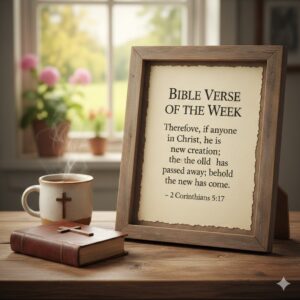
Why Focus on One Verse a Week?
The Bible is not a book to be merely read; it is a book to be lived. The “bible verse of the week” practice is rooted in the ancient Christian tradition of lectio divina (divine reading), but it is adapted for modern life. Here’s why it is so effective:
-
Deeper Understanding: When you sit with one verse for a week, you move beyond a surface-level reading. You begin to notice nuances in the language, explore the historical context, and discover connections to other parts of the Bible that you would have missed in a quick reading.
-
Improved Memorization: Repetition is the key to memorization. Seeing, saying, and writing a verse repeatedly throughout the week will naturally commit it to memory. Hiding God’s word in your heart (Psalm 119:11) gives you a ready source of strength and wisdom for any situation.
-
Practical Application: It is difficult to apply a broad chapter to your life in a concrete way. A single verse, however, provides a sharp, clear focus. You can ask yourself specific questions all week: “How does this verse change how I treat my family?” or “What would it look like to live out this truth at work today?”
-
Reduced Overwhelm: Let’s be honest, knowing where to start in the Bible can be intimidating. Focusing on just one verse removes the pressure. It makes daily devotionals feel accessible and achievable, even on your busiest days.
-
Greater Peace and Focus: In a world of constant noise, focusing on a single, God-breathed thought acts as an anchor for your soul. It centers your mind and sets a peaceful, intentional tone for the entire week.
How to Choose Your Bible Verse of the Week
One of the most common questions is, “How do I pick a verse?” There is no single right way, but here are several effective methods to help you select the perfect focus for the week ahead.
1. Follow a Church or Sermon Theme
If your pastor preaches from a specific passage on Sunday, pick one key verse from that sermon to study for the rest of the week. This reinforces what you learned corporately and allows you to go deeper on your own.
2. Use a Thematic Reading Plan
Many websites and apps offer reading plans focused on specific topics like anxiety, gratitude, parenting, or purpose. Each day might have a reading, but you can simply take the verse from Day 1 and make it your focus for the entire week before moving on.
3. Let It Find You During Your Daily Reading
As you read your Bible normally (maybe a chapter a day), a particular verse will often “jump out” at you. It might resonate with something you are going through, answer a question you’ve been praying about, or simply stir your heart. That is a perfect candidate for your verse of the week.
4. Address a Current Life Situation
Are you feeling anxious? Look for verses about peace (like Philippians 4:6-7). Are you facing a difficult decision? Seek wisdom in Proverbs or James. Let the Holy Spirit use your current circumstances to guide you to a scripture that speaks directly to your need.
5. Draw from a List of Favorites
If you are just starting, it can be helpful to work through a list of foundational scriptures. Here is a table of some powerful verses to get you started, categorized by theme:
| Theme | Bible Verse of the Week | Why It’s Powerful |
|---|---|---|
| God’s Love | Jeremiah 31:3 “I have loved you with an everlasting love…” |
It reminds us that God’s love is not conditional or temporary, but eternal and secure. |
| Peace | Isaiah 26:3 “You will keep in perfect peace those whose minds are steadfast, because they trust in you.” |
It connects our inner peace directly to the focus of our thoughts and our trust in God. |
| Guidance | Proverbs 3:5-6 “Trust in the Lord with all your heart and lean not on your own understanding…” |
A classic verse that releases us from the pressure of having to figure everything out on our own. |
| Strength | Philippians 4:13 “I can do all this through him who gives me strength.” |
A powerful reminder that our ability comes from Christ, empowering us for every task He sets before us. |
| Identity | Ephesians 2:10 “For we are God’s handiwork, created in Christ Jesus to do good works…” |
It establishes our identity as a masterpiece created with a divine purpose. |
| Faith | Hebrews 11:1 “Now faith is confidence in what we hope for and assurance about what we do not see.” |
It provides a clear, powerful definition of what faith truly is. |
A Practical Guide to Studying Your Verse
Once you have your verse, the real work—and the real blessing—begins. Don’t just read it once and forget about it. Use this daily framework to dig deep.
Day 1: Observation (What Does It Say?)
-
Write it down: On a notecard or in a journal, write the verse carefully. Writing helps with memorization and focus.
-
Read it aloud: Hear the words. Pay attention to the rhythm and the emphasis.
-
Identify key words: What are the most important words in the verse? Circle them. Look them up in a concordance or a Bible dictionary to understand their original meaning in Hebrew or Greek. (Free resources like Blue Letter Bible are excellent for this).
-
Consider the context: Read the verses before and after your chosen verse. What is happening in the story? Who is speaking? Who is the audience?
Day 2: Interpretation (What Does It Mean?)
-
Read it in different translations: How does the NIV, ESV, NLT, or The Message version phrase this same idea? This can shed new light on the meaning.
-
Use a study Bible: Look at the footnotes in a study Bible (like the ESV Study Bible or NIV Study Bible) for historical and theological insights.
-
Ask “Why?”: Why did the author include this? Why would this have been important to the original readers?
-
Summarize in your own words: Write a one-sentence summary of what you believe the core meaning of the verse is.
Day 3: Connection (What Does It Mean for Me?)
-
Read it in a personalized way: Insert your name into the verse. For example, “For I, the Lord your God, hold [Your Name]‘s right hand…” (Isaiah 41:13).
-
Identify parallels: Does this verse remind you of another story or verse in the Bible? Use a concordance or a cross-reference tool in your Bible to find connections.
-
Consider the character of God: What does this verse teach you about God’s nature? Is it His love, His justice, His mercy, or His power?
-
Journal your thoughts: Start writing about what this verse stirs in you. Does it bring comfort, conviction, hope, or challenge?
Day 4: Application (How Will I Live It Out?)
This is the most crucial step. It’s where the Bible comes alive.
-
Ask specific questions:
-
Is there a command to obey? (e.g., “Love your neighbor.”)
-
Is there a promise to claim? (e.g., “I will never leave you.”)
-
Is there a sin to avoid? (e.g., “Do not be anxious.”)
-
Is there an example to follow? (e.g., Jesus withdrawing to pray.)
-
-
Identify one concrete action: Based on the verse, what is one specific thing you can do this week? For example, if your verse is about kindness, your action could be to intentionally encourage a coworker who seems down.
Day 5: Prayer (Talking to God About It)
-
Turn the verse into a prayer: Use the words of the scripture to shape your conversation with God.
-
Example: If your verse is Psalm 23:1 (“The Lord is my shepherd; I shall not want.”), your prayer could be, “Lord, thank you for being my Shepherd. Help me to trust your guidance today and to find my complete satisfaction in you, not in the things of this world.”
-
-
Ask for help: Pray specifically for the strength and wisdom to live out the application you identified on Day 4.
-
Listen: Spend a few moments in silence, allowing God to speak to your heart through the verse you have been meditating on.
Weekend: Reflection and Celebration
-
Recite from memory: Try to write or say the verse without looking.
-
Share it: Tell a friend or family member about your verse of the week and what you learned. Teaching someone else is one of the best ways to solidify your own understanding.
-
Give thanks: Thank God for what He has taught you through His Word this week.
Creative Ways to Keep Your Verse Front and Center
The challenge isn’t studying the verse; it’s keeping it on your mind throughout the chaos of the day. Here are some creative and practical ideas to help you meditate on your “bible verse of the week” constantly.
-
The Classic Notecard: Write the verse on a notecard and tape it to your bathroom mirror, your car dashboard, or your computer monitor.
-
Digital Reminders: Set a daily alarm on your phone for a specific time (e.g., lunchtime) with the verse as the notification label. Use it as your phone’s lock screen wallpaper.
-
Artistic Expression: Spend a few minutes doodling, drawing, or hand-lettering the verse in a journal. The creative process helps embed the words in your memory.
-
Incorporate It into Your Routine:
-
Morning Coffee: Read it while you wait for your coffee to brew.
-
Commute: If you take public transport, read it on your phone. If you drive, listen to an audio version of the verse or a song inspired by it.
-
Household Chores: Repeat the verse to yourself while washing dishes or folding laundry.
-
-
Set It to Music: Find a worship song based on your verse. Music has a unique way of lodging truth deep within our souls.
Important Note for the Journey:
Be gracious with yourself. There will be weeks where you miss a day, or where the verse doesn’t seem to “hit” you the way you hoped. That is perfectly okay. The goal is not perfection, but presence. The simple act of returning to the verse, even briefly, is a victory. Don’t let the perfect be the enemy of the good. Some weeks will feel profound, and others will feel like simple maintenance. Both are valuable.
Additional Resources for Your Study
To truly make this practice a cornerstone of your spiritual life, it helps to have the right tools. You don’t need a theological library, but a few key resources can make your study richer and more enjoyable.
-
A Good Study Bible: This is the single best investment you can make. It includes the biblical text along with maps, charts, book introductions, and thousands of explanatory notes right on the same page. The ESV Study Bible and the NIV Zondervan Study Bible are both highly recommended.
-
A Concordance: This is an index of all the words in the Bible. If you want to find other verses that use the word “grace” or “hope,” a concordance (like Strong’s Exhaustive Concordance) is invaluable. Many are available for free online.
-
A Journal: A simple notebook dedicated to your “bible verse of the week” journey is a powerful tool. It becomes a personal record of what God has taught you over time. Looking back through old entries can be a huge encouragement during difficult seasons.
-
Reliable Websites:
-
BibleGateway.com: A fantastic resource for quickly reading a verse in dozens of different translations.
-
BlueLetterBible.org: An in-depth study tool that provides free access to Strong’s Concordance numbers and original Greek and Hebrew definitions.
-
Frequently Asked Questions (FAQ)
Q: What if I miss a few days? Do I have to start over?
A: Absolutely not! Just pick up where you left off. If it’s Thursday and you haven’t looked at your verse since Monday, simply re-read it and continue with the “day” you’re on, or just spend time reflecting on it without worrying about the daily structure. Grace, not legalism.
Q: Can I do this with my family or small group?
A: Yes, this is a wonderful group practice. Choose a verse together on Sunday. During the week, you can text each other insights you’ve had. Then, when you meet again, you can share what God taught each of you. It creates a powerful sense of unity and shared growth.
Q: What is the difference between this and my daily devotional book?
A: A devotional book gives you someone else’s thoughts on a passage. This practice forces you to engage directly with the text and hear from God for yourself. It turns you from a passive consumer into an active participant. They can certainly complement each other, but this practice builds your own “study muscles.”
Q: I’m not a writer. Do I have to journal?
A: Not at all! Journaling is just one tool. You can draw, pray the verse, discuss it with a friend, or simply think about it while you walk. Do what works best for how God made you.
Q: How long should I spend each day?
A: This can be as flexible as you need it to be. Some days you might have 20 minutes for deep study; other days you might only have 2 minutes to read the verse and whisper a quick prayer. The consistency of returning to it is more important than the duration.
Conclusion
The practice of focusing on a “bible verse of the week” is a gentle yet powerful discipline. It slows us down in a world that never stops, and it opens our hearts to the still, small voice of God. It transforms scripture from ancient text into living truth, shaping our character and guiding our steps.
By committing to this simple rhythm, you are not just acquiring biblical knowledge; you are cultivating a deeper, more intimate relationship with the Author of life itself. One verse, one week, one step at a time.
Additional Resource: Link
For a curated list of verses to get you started, you can visit the Bible Gateway Verse of the Day page. While it’s a daily verse, you can easily take that verse and use it for your weekly study.
Click here to visit Bible Gateway