Few stories in the Bible are as dramatic, challenging, or theologically significant as the account of Abraham sacrificing his son, Isaac. It is a narrative that evokes strong emotions—confusion, horror, and ultimately, awe. For centuries, scholars, theologians, and everyday readers have grappled with this passage, trying to understand its deep meaning.
If you are looking for the specific bible verse of abraham sacrificing his son, you have come to the right place. This guide will walk you through the entire story, step by step. We will explore not just the scripture itself, but the context surrounding it, the themes it presents, and why it remains a cornerstone of faith for millions of people today.
Whether you are a student, a curious reader, or someone seeking to deepen your spiritual understanding, this comprehensive guide is designed to be friendly, clear, and reliable. Let’s dive into one of the most profound stories ever told.
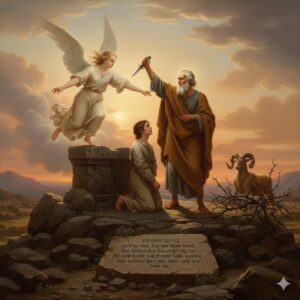
Where to Find the Story: The Specific Bible Verse of Abraham Sacrificing His Son
Before we analyze the story, it’s important to know exactly where to find it. The entire account is not just a single verse, but a powerful narrative spanning several chapters.
-
Primary Location: The Book of Genesis, Chapter 22.
-
Key Verses: Genesis 22:1-19.
This passage is often referred to by Jews as the Akedah, or “The Binding of Isaac.” It is read in synagogues during Rosh Hashanah, the Jewish New Year. For Christians, it is seen as a profound foreshadowing of God the Father sacrificing His own Son, Jesus.
To give you a clear roadmap, here are the key moments in the narrative, broken down by verse:
-
The Test Announced: Genesis 22:1-2
-
Abraham’s Obedient Journey: Genesis 22:3-8
-
The Climax on the Mountain: Genesis 22:9-12
-
The Provision of the Ram: Genesis 22:13-14
-
The Reaffirmation of the Promise: Genesis 22:15-19
Important Note: It is crucial to read the story in its entirety to grasp its full weight. Pulling just one verse out of context can lead to misunderstanding. The power is in the whole sequence of events.
Breaking Down the Story: A Verse-by-Verse Context
To truly understand this story, we need to walk in Abraham’s footsteps. Let’s break down the narrative into its core parts and explore what is happening.
The Shocking Command (Genesis 22:1-2)
The story begins with a simple, yet loaded, phrase: “Some time later God tested Abraham.”
It is vital to note the word “tested.” The Bible is clear that God does not tempt anyone to sin (James 1:13). This was a test of Abraham’s faith, loyalty, and trust. It was designed to refine his character and prove the depth of his commitment.
Then comes the command, and it is nothing short of earth-shattering.
Genesis 22:2 (NIV): “Then God said, ‘Take your son, your only son, whom you love—Isaac—and go to the region of Moriah. Sacrifice him there as a burnt offering on a mountain I will show you.'”
Let’s look at the language God uses. He doesn’t just say “your son.” He piles on the descriptive phrases:
-
“Your son” : This establishes the personal, intimate relationship.
-
“Your only son” : While Abraham had another son, Ishmael, Isaac was the son of the promise, the unique heir.
-
“Whom you love” : God acknowledges the deep, paternal love Abraham has for this child.
-
“Isaac” : He names him, making the command incredibly personal.
This command would have been incomprehensible. Isaac was the child Abraham and Sarah had waited for their entire lives. He was the living, breathing proof of God’s covenant. And now, God was asking Abraham to give him back in the most brutal way imaginable: as a human sacrifice, a practice abhorrent to God and the surrounding cultures.
The Quiet Journey of Faith (Genesis 22:3-8)
How does Abraham respond to this impossible request? He doesn’t argue, bargain, or even tell Sarah. The very next verse shows his immediate obedience.
Genesis 22:3 (NIV): “Early the next morning Abraham got up and loaded his donkey. He took with him two of his servants and his son Isaac. When he had cut enough wood for the burnt offering, he set out for the place God had told him about.”
The text emphasizes the early morning. There was no delay. Abraham’s faith moved into action immediately. He prepares everything needed for a sacrifice—the wood, the fire, the knife—and begins the three-day journey to Mount Moriah.
This journey is a powerful image of faith in action. For three days, Abraham had time to think, to doubt, to turn back. Yet he kept walking.
The dialogue between father and son during the final leg of the journey is incredibly poignant.
Genesis 22:7-8 (NIV): “Isaac spoke up and said to his father Abraham, ‘Father?’
‘Yes, my son?’ Abraham replied.
‘The fire and wood are here,’ Isaac said, ‘but where is the lamb for the burnt offering?’
Abraham answered, ‘God himself will provide the lamb for the burnt offering, my son.’ And the two of them went on together.”
Isaac’s question is perfectly logical. He had been part of worship before. He knew something was missing. Abraham’s answer is a masterpiece of faith. It is a statement of trust, a prophecy, and a hope all wrapped into one. He doesn’t tell Isaac the truth. He simply declares his belief that God will provide. “God himself will provide.”
The Ultimate Test on Mount Moriah (Genesis 22:9-12)
They arrive at the place God had chosen. What happens next is described in stark, simple language, which makes it even more powerful.
Genesis 22:9-10 (NIV): “When they reached the place God had told him about, Abraham built an altar there and arranged the wood on it. He bound his son Isaac and laid him on the altar, on top of the wood. Then he reached out his hand and took the knife to slay his son.”
Imagine the scene. An old man, building an altar. His son, likely a strong young man, allowing himself to be bound. Tradition suggests Isaac was not a small child, but a youth capable of carrying the wood for the sacrifice. His submission is also a powerful act of faith and trust in his father and in his father’s God.
Just as Abraham raises the knife, the tension reaches its peak. An angel of the Lord calls out from heaven.
Genesis 22:11-12 (NIV): “Abraham! Abraham!”
“Here I am,” he replied.
“Do not lay a hand on the boy,” he said. “Do not do anything to him. Now I know that you fear God, because you have not withheld from me your son, your only son.”
At the very last second, God intervenes. The test is complete. Abraham had proven that he loved and feared God more than anything else in the world, even his own precious, promised son. The phrase “now I know” is for our benefit, showing the outcome of the test.
The Ram in the Thicket: God Provides (Genesis 13-14)
After the intense climax, the story moves to its resolution.
Genesis 22:13-14 (NIV): “Abraham looked up and there in a thicket he saw a ram caught by its horns. He went over and took the ram and sacrificed it as a burnt offering instead of his son. So Abraham called that place The Lord Will Provide. And to this day it is said, ‘On the mountain of the Lord it will be provided.'”
Abraham’s prophetic word to Isaac, “God himself will provide,” comes true. God provides a substitute sacrifice. This moment is central to the entire story. It teaches that God is a provider, and He does not desire human sacrifice. The ram becomes the offering, and Isaac is spared.
Abraham names the place Jehovah-Jireh, which means “The Lord Will Provide.” It becomes a memorial, a physical reminder of God’s faithfulness.
The Promise is Confirmed (Genesis 22:15-19)
The angel of the Lord calls to Abraham a second time. This time, it is not to stop him, but to reaffirm and expand the covenant God made with him earlier.
Genesis 22:15-18 (NIV): “The angel of the Lord called to Abraham from heaven a second time and said, ‘I swear by myself, declares the Lord, that because you have done this and have not withheld your son, your only son, I will surely bless you and make your descendants as numerous as the stars in the sky and as the sand on the seashore. Your descendants will take possession of the cities of their enemies, and through your offspring all nations on earth will be blessed, because you have obeyed me.'”
Because of Abraham’s obedience, God confirms His promises with an oath. The promise of countless descendants and that through his “offspring” (or seed) all nations will be blessed, is now irrevocably sealed.
The story ends with Abraham returning to his servants and going home to Beersheba. We are not told if he ever shared this experience with Sarah. The focus remains squarely on Abraham and his walk with God.
Understanding the “Why”: Key Themes and Meanings
Now that we have walked through the story, let’s step back and look at the bigger picture. Why is this story so important? What are the key themes we can take away from this incredible passage?
A Test of Faith, Not a Demand for Sacrifice
This is perhaps the most important thing to understand. The story is not about God desiring human sacrifice. The entire Bible speaks against that practice. Instead, it is a test of Abraham’s heart.
-
The Priority of Love: Was Abraham’s love for God greater than his love for the gift God had given him (Isaac)? The test proved that it was.
-
Faith in the Promise: The writer of Hebrews gives us incredible insight into Abraham’s mindset during these three days.
Hebrews 11:17-19 (NIV): “By faith Abraham, when God tested him, offered Isaac as a sacrifice. He who had embraced the promises was about to sacrifice his one and only son, even though God had said to him, ‘It is through Isaac that your offspring will be reckoned.’ Abraham reasoned that God could even raise the dead, and so in a manner of speaking he did receive Isaac back from death.”
This changes everything! Abraham believed that even if he went through with the sacrifice, God was powerful enough to raise Isaac from the dead. He trusted not just in God’s command, but in God’s character and His power to fulfill His promises, no matter what.
Foreshadowing the Sacrifice of Jesus
For Christian readers, the parallels between this story and the crucifixion of Jesus are striking and undeniable. It is seen as a beautiful and powerful foreshadowing of what God the Father would do for humanity.
| The Story of Isaac | The Story of Jesus |
|---|---|
| The father (Abraham) offers his beloved, only son. | God the Father offers His beloved, only Son (John 3:16). |
| Isaac carries the wood for his own sacrifice up the mountain. | Jesus carries the cross (the wood) for His own sacrifice. |
| The journey takes three days. | Jesus was in the tomb for three days. |
| Isaac is a willing participant, submitting to his father. | Jesus is the willing sacrifice, submitting to the Father’s will (Luke 22:42). |
| God provides a ram as a substitute, and Isaac is spared. | Jesus is the “Lamb of God” (John 1:29), the substitute for the sins of the world. No one is spared; He dies in our place. |
This typology—where Old Testament events, people, or institutions prefigure Christ—is central to how many Christians read the Bible. In this story, they see the heart of the Gospel: a Father who does not withhold His Son, and a Son who willingly obeys.
Obedience and Blessing
The story clearly links obedience to blessing. Because Abraham obeyed, God reaffirmed His covenant. This doesn’t mean that obedience earns us salvation or forces God’s hand. Rather, it shows that obedience is the pathway to experiencing the fullness of God’s promises. When we trust and obey, we position ourselves to receive all that God has for us.
The Principle of Jehovah-Jireh: The Lord Will Provide
Abraham’s name for the mountain has become one of the most beloved names for God in the Bible. Jehovah-Jireh means “The Lord Who Sees” or “The Lord Will Provide.”
This story teaches us that:
-
God sees our need.
-
God’s provision often comes at the last moment, testing our faith.
-
God’s provision is perfect and timely, just as the ram was right there when Abraham needed it.
-
Sometimes, God’s provision involves a substitute. He provided a ram for Isaac, and for humanity, He provided Jesus.
Addressing Difficult Questions and Common Misconceptions
This story is not easy. It raises some very tough questions. Let’s address a few of them honestly and realistically.
How Could God Ask Such a Horrible Thing?
This is the question that troubles most readers. It’s a valid and important question. As mentioned earlier, the key is to understand the context and the outcome.
-
It Was a Test: God never intended for Abraham to actually kill Isaac. His intention was to test Abraham’s heart to the absolute limit and to reveal the depth of his faith, both to Abraham himself and to us as readers.
-
God Abhors Human Sacrifice: Throughout the rest of the Old Testament, God explicitly and repeatedly forbids the practice of child sacrifice (Deuteronomy 12:31, Jeremiah 19:5). This story, ending with God providing a substitute, serves as a powerful rejection of the pagan practice.
-
The End Justified the Means? No, this isn’t about the end justifying the means. It’s about God using a controlled, specific test to teach an eternal truth about faith, provision, and His own character. He stopped Abraham before any harm was done.
What Was Isaac Thinking?
The Bible is silent on Isaac’s internal thoughts, which leaves room for reflection and tradition. We can make some reasonable inferences.
-
He was old enough to carry the wood, so he was likely a teenager or young man.
-
He was strong enough to resist his elderly father, yet he allowed himself to be bound.
-
His submission suggests a profound trust in his father. He had seen Abraham’s faithfulness all his life.
Isaac is not a passive victim. In the Jewish tradition, he is seen as a willing participant, a young man who also trusted God. He becomes a link in the chain of the covenant, and this experience likely shaped his own faith for the rest of his life.
Does This Story Mean We Have to Give Up Everything We Love?
In a spiritual sense, yes. This story is a powerful metaphor for the cost of discipleship. It asks the question: Is there anything in your life that you love more than God? Is there anything you are holding onto so tightly that you would struggle to give it up if He asked?
It doesn’t mean God will ask for a literal sacrifice of a child. But He does ask us to surrender our idols—those things we prioritize above Him. It could be a relationship, a career, a dream, or even a sense of security. The test on Mount Moriah asks us to lay those things on the altar, trusting that God is good and that He will provide.
Practical Lessons for Modern Readers
This ancient story is not just a historical account; it is packed with practical wisdom for our lives today. Here are some lessons we can apply.
1. Listen for God’s Voice, Even When It’s Difficult
Abraham recognized God’s voice and obeyed, even though the command was painful. In our noisy world, we need to cultivate the habit of listening for God’s guidance through prayer, scripture, and wise counsel. It might not always be what we want to hear, but it is always for our ultimate good.
2. Obedience Often Requires Immediate Action
Abraham didn’t wait. He got up early the next morning. When we sense God leading us to do something, procrastination can lead to doubt. Taking that first step of obedience, even a small one, can build our faith and get the journey started.
3. The Journey of Faith Can Be a Long One
The obedience didn’t end with the first step. Abraham had to keep walking for three days. Often, after we make a big decision for God, there is a period of waiting. That waiting is part of the test. It’s where our faith is refined. Don’t give up during the journey.
4. Be Honest with God and Others
We see a beautiful, simple honesty between Abraham and Isaac. When we are going through a difficult time, we don’t have to pretend everything is fine. We can share our burdens with trusted friends or family, and we can always be brutally honest with God in our prayers.
5. Trust That God Will Provide
This is the grand finale of the story. When we walk in obedience, even when we don’t understand the path, we can trust that God sees us and will provide for our needs. He may not provide in the way we expect, but His provision will be perfect and timely. He is still Jehovah-Jireh today.
Frequently Asked Questions (FAQ)
Here are some of the most common questions people have about this Bible story.
Q: What is the main Bible verse for Abraham sacrificing his son?
A: The main passage is Genesis 22:1-19. The most pivotal verses are often considered to be verse 2 (the command), verse 8 (Abraham’s statement of faith), and verses 11-12 (the angel’s intervention).
Q: Why did God ask Abraham to sacrifice Isaac?
A: God asked Abraham to sacrifice Isaac as a test of faith (Genesis 22:1). It was to prove that Abraham loved and trusted God above all else, even above the precious son of the promise. God stopped Abraham before he harmed Isaac, showing He did not desire human sacrifice.
Q: How old was Isaac when Abraham was going to sacrifice him?
A: The Bible does not give Isaac’s exact age, but based on the context of the surrounding chapters, many scholars believe he was a teenager or a young man, strong enough to carry the wood for the burnt offering up the mountain.
Q: What does “Jehovah-Jireh” mean?
A: “Jehovah-Jireh” is the name Abraham gave to the place where God provided the ram as a substitute for Isaac (Genesis 22:14). It means “The Lord Will Provide” or “The Lord Will See to it.”
Q: How does this story point to Jesus?
A: Christians see this story as a powerful foreshadowing of God’s sacrifice of His own Son, Jesus. Key parallels include: a beloved father offering his only son, the son carrying the wood for his own sacrifice, and the concept of a substitute (the ram for Isaac, Jesus for us).
Additional Resources for Further Study
If you want to dive even deeper into this incredible story, here are some resources you might find helpful:
-
Bible Project Video: Watch their excellent animated overview of the book of Genesis, which covers this story in its literary context.
-
Commentaries: For a more academic study, look for commentaries on the book of Genesis by authors like Derek Kidner or Gordon Wenham.
-
Sermons: Many sermons on this passage are available online from trusted pastors and teachers like Tim Keller or Charles Spurgeon. Searching for “The Binding of Isaac” or “Genesis 22 sermon” will yield many results.
-
Your Own Study: The most important resource is your own Bible. Read the passage in a few different translations (like the NIV, ESV, and NLT) to get a fuller sense of the language. Pray and ask for wisdom as you read.
Link Recommendation: For a deeper look at the life of Abraham, you can read the preceding chapters in Genesis (chapters 12-21) to understand the full context of the covenant and the long wait for Isaac’s birth.
Conclusion
The story found in the bible verse of abraham sacrificing his son is much more than an ancient historical account. It is a profound exploration of faith, obedience, and the character of God. We see a man willing to trust God against all logic, and a God who provides a substitute, reaffirms His promises, and reveals His heart. Ultimately, it is a story that points us toward the ultimate provision of a Son who would not be spared, so that we could be brought into a relationship with God. It remains a powerful and challenging invitation to trust the Provider with everything we hold dear.