The air grows crisp, lights twinkle on houses, and familiar carols fill the stores. For many, Christmas is a time of family, generosity, and tradition. But have you ever stopped to wonder where the original story comes from? The heart of the holiday isn’t found under a tree, but in the pages of the Bible.
If you are looking for the true bible verse of Christmas, you are looking for the foundation of hope itself. It’s more than just one verse; it’s a beautiful tapestry of prophecy and promise woven throughout Scripture. This guide is designed to be your friendly, comprehensive companion to those sacred texts. We’ll walk through the ancient predictions, the miraculous birth narratives, and the profound meaning behind it all.
Whether you are preparing a family devotion, writing a card, or simply want to reconnect with the reason for the season, you are in the right place. Let’s turn the pages together and discover the timeless story of Christmas.
Understanding the Christmas Story in the Bible
First, it is helpful to know where to look. The specific stories about the birth of Jesus are found in only two of the four Gospels: Matthew and Luke. Think of them as two different camera angles on the same incredible event.
-
The Gospel of Matthew tells the story from Joseph’s perspective. It focuses on his crisis of faith, the angel’s reassurance, and the fulfillment of Old Testament prophecy. Matthew also includes the famous visit of the Magi (the Wise Men).
-
The Gospel of Luke gives us the details from Mary’s viewpoint. We hear her conversation with the angel Gabriel, her beautiful song of praise (the Magnificat), and the humble circumstances of the birth in Bethlehem, including the shepherds’ visit.
These two accounts complement each other perfectly, giving us a full, rich picture of the nativity. There are no other historical records from that time that describe the event, which makes these biblical accounts the primary and most treasured source for the bible verse of Christmas.
Important Note: The Gospels of Mark and John do not contain a nativity story. Mark starts with Jesus as an adult, and John begins with the eternal, spiritual existence of Christ (“In the beginning was the Word…”).
The Main Bible Verses of Christmas: The Nativity Narratives
Let’s dive into the heart of the matter. These are the passages you will want to read aloud on Christmas Eve or reflect upon during the Advent season. We have broken them down for easy reading.
The Announcement to Mary (The Annunciation)
*(Found in Luke 1:26-38)*
This is where the story truly begins. An angel named Gabriel appears to a young woman in the small town of Nazareth.
Luke 1:30-33 (NIV)
But the angel said to her, “Do not be afraid, Mary; you have found favor with God. You will conceive and give birth to a son, and you are to call him Jesus. He will be great and will be called the Son of the Most High. The Lord God will give him the throne of his father David, and he will reign over Jacob’s descendants forever; his kingdom will never end.”
Mary’s response is a model of faith and humility. When she questions how this can be, since she is a virgin, the angel explains it will be a work of the Holy Spirit. Her final words are powerful:
Luke 1:38 (NIV)
“I am the Lord’s servant,” Mary answered. “May your word to me be fulfilled.”
Joseph’s Dream
*(Found in Matthew 1:18-25)*
Imagine Joseph’s confusion and heartbreak. He was engaged to Mary, and now she was pregnant. He planned to quietly end the engagement to spare her public disgrace. But God intervened in a dream.
Matthew 1:20-21 (NIV)
But after he had considered this, an angel of the Lord appeared to him in a dream and said, “Joseph son of David, do not be afraid to take Mary home as your wife, because what is conceived in her is from the Holy Spirit. She will give birth to a son, and you are to give him the name Jesus, because he will save his people from their sins.”
This moment is crucial. It shows that Jesus’ birth was not just a miracle for Mary, but a test of faith for Joseph, too. His obedience paved the way for the holy family. This passage directly connects the name Jesus (which means “The Lord saves”) with his divine mission.
The Birth of Jesus
*(Found in Luke 2:1-7)*
The setting is humble, not royal. A decree from Emperor Augustus sends everyone to their ancestral towns. Joseph, being of the house of David, travels to Bethlehem with a very pregnant Mary. The scene is familiar, yet always moving.
Luke 2:4-7 (NIV)
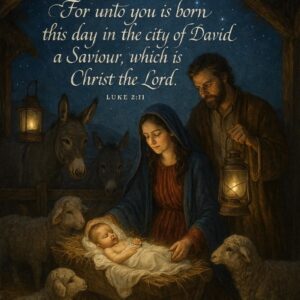
So Joseph also went up from the town of Nazareth in Galilee to Judea, to Bethlehem the town of David, because he belonged to the house and line of David. He went there to register with Mary, who was pledged to be married to him and was expecting a child. While they were there, the time came for the baby to be born, and she gave birth to her firstborn, a son. She wrapped him in cloths and placed him in a manger, because there was no guest room available for them.
This is the most famous bible verse of Christmas. The image of the newborn King lying in a feeding trough, because there was no room for his parents in the inn, is a powerful symbol of his humility and his mission to identify with the lowly.
The Shepherds and the Angelic Announcement
*(Found in Luke 2:8-20)*
Who were the first to hear the news? Not the priests in Jerusalem or the royalty in their palaces, but shepherds keeping watch over their flocks at night. This is a beautiful reminder that the good news of great joy is for everyone.
Luke 2:10-12 (NIV)
But the angel said to them, “Do not be afraid. I bring you good news that will cause great joy for all the people. Today in the town of David a Savior has been born to you; he is the Messiah, the Lord. This will be a sign to you: You will find a baby wrapped in cloths and lying in a manger.”
Suddenly, the sky filled with a vast choir of angels, praising God. After they left, the shepherds didn’t hesitate. They ran to Bethlehem to see this thing that had happened. They became the first evangelists, spreading the word about what they had seen and heard.
The Visit of the Magi (Wise Men)
*(Found in Matthew 2:1-12)*
While the shepherds represent the humble of Israel, the Magi represent the nations of the world coming to worship Jesus. They were likely scholars or astrologers from the East who saw a special star, a sign that the king of the Jews had been born.
Matthew 2:10-11 (NIV)
When they saw the star, they were overjoyed. On coming to the house, they saw the child with his mother Mary, and they bowed down and worshiped him. Then they opened their treasures and presented him with gifts of gold, frankincense and myrrh.
A Quick Note on Timing: Many people place the Magi at the manger with the shepherds, but the Bible suggests otherwise. In Matthew 2:11, they enter a “house,” not a stable, and Jesus is referred to as a “child” (paidion in Greek), not a “baby” (brephos). Their visit likely occurred when Jesus was up to two years old.
The Prophetic Bible Verses of Christmas (Old Testament)
The New Testament story didn’t happen in a vacuum. Hundreds, and even thousands, of years before Jesus was born, God spoke through prophets, preparing the way. These prophecies are the earliest bible verse of Christmas passages, building anticipation for the coming Messiah.
Here is a comparison table of key prophecies and their fulfillment.
| Prophecy (Old Testament) | The Promise | Fulfillment (New Testament) |
|---|---|---|
| Isaiah 7:14 | “Therefore the Lord himself will give you a sign: The virgin will conceive and give birth to a son, and will call him Immanuel.” (Immanuel means “God with us.”) | Matthew 1:22-23 confirms that Jesus’ birth from the Virgin Mary fulfilled this prophecy. He is God dwelling among us. |
| Micah 5:2 | “But you, Bethlehem Ephrathah, though you are small among the clans of Judah, out of you will come for me one who will be ruler over Israel, whose origins are from of old, from ancient times.” | Matthew 2:1 & Luke 2:4-7 place the birth of Jesus squarely in Bethlehem, fulfilling the prophecy of the Messiah’s birthplace. |
| Isaiah 9:6-7 | “For to us a child is born, to us a son is given, and the government will be on his shoulders. And he will be called Wonderful Counselor, Mighty God, Everlasting Father, Prince of Peace.” | This verse, often read at Christmas, describes the divine nature and royal authority of the coming child, which Christians believe is fulfilled in Jesus. |
| Isaiah 11:1 | “A shoot will come up from the stump of Jesse; from his roots a Branch will bear fruit.” (Jesse was King David’s father.) | Matthew 1:1 & Luke 3:23-32 trace Jesus’ genealogy back to David and Jesse, confirming his royal lineage. |
| Numbers 24:17 | “A star will come out of Jacob; a scepter will rise out of Israel.” | Many Christians see this as a prophecy of the star that guided the Magi to Jesus, the King of the Jews, in Matthew 2:2. |
The Deeper Meaning: Why These Verses Matter
Reading the bible verse of Christmas is wonderful, but understanding why they matter is what changes lives. These verses are packed with deep truths.
1. God Keeps His Promises
The entire Christmas story is a testament to God’s faithfulness. He made promises to Abraham, to David, and through the prophets. For centuries, his people waited. And then, “when the set time had fully come, God sent his Son” (Galatians 4:4). This gives us immense hope that the promises God has made to us today are just as certain.
2. Humility and Reversal of Worldly Values
Think about the cast of characters: a poor teenager, a humble carpenter, outcast shepherds, and foreign astrologers. The King of Kings was not born in a palace, but in a stable. He didn’t arrive with an army, but as a vulnerable baby. This shows us that God’s kingdom operates on a different set of values. He lifts up the humble and draws near to the lowly.
3. The Purpose: Salvation
The angel didn’t just tell Joseph to name the baby Jesus for no reason. It was a direct statement of purpose: “…because he will save his people from their sins” (Matthew 1:21). Christmas is not just a nice story about a baby. It is the entry point of the Savior into the world. The manger is meaningless without the cross. Jesus was born so that he could ultimately die and rise again, bridging the gap between humanity and God.
4. “God With Us”
The name Immanuel is a beautiful summary of the entire gospel. God is no longer a distant figure. In Jesus, he experienced hunger, tiredness, joy, and sorrow. He knows what it is like to be human. Christmas is the celebration of God stepping into our messy world to be with us.
Key Characters in the Christmas Story
To fully appreciate the bible verse of Christmas, it helps to know the people involved. Each one played a vital role.
-
Mary: A young woman of faith, chosen to be the mother of Jesus. Her willingness to accept God’s plan, despite the personal cost, is an inspiring example of surrender.
-
Joseph: A righteous and compassionate man. He showed incredible trust by obeying the angel’s message and protecting Mary and Jesus, even when it was socially difficult.
-
Jesus: The central figure. The Son of God, whose birth is the climax of God’s redemptive plan. The entire story revolves around him.
-
Gabriel: The angel sent by God to deliver the most important messages: first to Zechariah (about John the Baptist) and then to Mary. He is God’s messenger.
-
The Shepherds: Ordinary, working-class men. They represent the common people, the poor, and the outcasts who are the first to receive the good news and respond with joy.
-
The Magi (Wise Men): Scholars from a foreign land. They represent the entire Gentile world coming to worship Jesus. Their journey shows that seeking the truth leads to the King.
How to Use This Guide During the Christmas Season
This information is most powerful when it is put into practice. Here are a few simple, friendly ideas to help you and your family engage with the bible verse of Christmas this year.
-
Start an Advent Reading Plan: Instead of just reading one verse on Christmas morning, read a passage each day leading up to December 25th. You can start with the prophecies in Isaiah and work your way through the Gospels.
-
Create a Family Tradition: On Christmas Eve, gather the family and read the story from Luke 2. You can even have family members take turns playing the parts of the narrator, angels, and shepherds.
-
Write It in a Card: When you send a Christmas card, include a short verse like Luke 2:11 or Isaiah 9:6. It’s a simple way to share the true reason for your hope and joy.
-
Reflect with Journaling: Take one verse each week, like “Do not be afraid” (Luke 2:10) or “Immanuel—God with us” (Matthew 1:23), and write about what it means for your life right now.
-
Focus on the Names: Spend time reflecting on the names given to Jesus in the Christmas story: Savior, Messiah, Lord, Immanuel, Wonderful Counselor, Mighty God, Everlasting Father, Prince of Peace. Each one reveals a different aspect of his character.
Bringing the Story to Life: A Visual Summary
To help you visualize the timeline and the key elements of the bible verse of Christmas, here is a simple summary table. It connects the main events with their scriptural references.
| Event | Bible Reference (Main Verses) | Key Theme |
|---|---|---|
| The Prophecy | Isaiah 7:14, Micah 5:2 | God’s plan announced long ago. |
| The Announcement to Mary | Luke 1:26-38 | Faith and surrender. |
| The Dream of Joseph | Matthew 1:18-25 | Obedience and trust. |
| The Journey to Bethlehem | Luke 2:1-5 | God’s sovereignty over history. |
| The Birth of Jesus | Luke 2:6-7 | Humility and incarnation. |
| The Angels and Shepherds | Luke 2:8-20 | Good news for all people. |
| The Visit of the Magi | Matthew 2:1-12 | Worship and recognition of the King. |
Frequently Asked Questions (FAQ)
Here are some common questions people have about the biblical account of Christmas.
1. What is the most famous Bible verse for Christmas?
While many are cherished, Luke 2:11 is arguably the most famous: “Today in the town of David a Savior has been born to you; he is the Messiah, the Lord.” It succinctly states the identity and purpose of the baby Jesus.
2. Where in the Bible is the Christmas story?
The main accounts are found in the first two chapters of the Gospel of Matthew (Matthew 1-2) and the first two chapters of the Gospel of Luke (Luke 1-2).
3. Is the story of Christmas historically accurate?
Christians believe these accounts are divinely inspired and historically reliable. While external historical records from that specific time are scarce, the details mentioned (like the census under Quirinius and the reign of Herod the Great) align with what historians know about the period. The primary source and foundation of faith remain the biblical texts themselves.
4. Why are there two different Christmas stories in the Bible?
Matthew and Luke wrote to different audiences with different purposes. Matthew wrote to a Jewish audience to show that Jesus was the promised King from David’s line. Luke, a physician and historian, wrote a detailed, orderly account for a wider, Gentile audience. Together, they provide a complete and harmonious picture.
5. What is the best Bible verse to put on a Christmas card?
Short and hopeful verses work best. Great options include:
-
Luke 2:14: “Glory to God in the highest heaven, and on earth peace to those on whom his favor rests.”
-
Isaiah 9:6: “For to us a child is born, to us a son is given…”
-
Matthew 1:23: “…they will call him Immanuel” (which means “God with us”).
6. Do the Bible verses mention three wise men?
No, the Bible never specifies the number of Magi. The tradition of three comes from the three gifts they presented: gold, frankincense, and myrrh.
Additional Resource
For a deeper dive into understanding the cultural and historical context of the New Testament, you might find the resources at Bible Gateway incredibly helpful. You can read different translations and access study notes to enrich your understanding of the bible verse of Christmas.
Conclusion
The bible verse of Christmas offers us a timeless story of hope, humility, and divine love. From the ancient prophecies to the angelic announcements, these scriptures reveal the fulfillment of God’s promise to send a Savior. They invite us to look beyond the secular trappings of the season and find the profound truth at its heart: that God came to be with us, in the person of Jesus Christ.