Have you ever stopped to think about everything you have? Not just your phone or your car, but your time, your ability to learn, your energy, and even the planet we live on. If you believe in God, it is easy to see these things not as random occurrences, but as gifts.
This is where the concept of stewardship comes in. It is a big word that simply means taking care of what belongs to someone else. As Christians, we believe that everything ultimately belongs to God. We are just the managers.
Finding a bible verse of being good stewards is easy because the Bible is full of them. But understanding how to live them out? That is the journey we are going to take together today.
This guide will walk you through the most important scriptures on stewardship. We will look at what they mean for your money, your schedule, your abilities, and your relationships. Let’s dive in and learn how to manage God’s gifts wisely.
What Does “Stewardship” Really Mean in the Bible?
Before we look at specific verses, we need to understand the job description. In ancient times, a steward was a person who managed a master’s household. They didn’t own the property, the money, or the food. They were just in charge of it.
The Bible picks up on this idea to describe our relationship with God. We are put in charge of His creation, His resources, and His mission.
The Foundation: The Earth is the Lord’s
To be a good steward, you must first acknowledge who owns it all. If you think you are the owner, you will cling tightly to everything. But if you know you are just a manager, you will hold things with an open hand.
Psalm 24:1 (NIV)
“The earth is the LORD’s, and everything in it, the world, and all who live in it.”
This verse sets the stage. It removes the illusion of ownership. Your house, your career, your intelligence, and your family are all on loan from God. This isn’t meant to make you feel poor; it is meant to free you from the pressure of having to control it all. You are simply the caretaker.
Top Bible Verses of Being Good Stewards with Money
Money is often the first thing we think of when we hear the word “stewardship.” Why? Because it is tangible. We can see it, spend it, and save it. How we handle our finances is a direct reflection of our spiritual health. Jesus talked about money more than he talked about heaven and hell because he knew it was a competitor for our hearts.
The Parable of the Talents (Matthew 25:14-30)
This is perhaps the most famous bible verse of being good stewards (though it is actually a long story). A master goes on a journey and entrusts his property to three servants. To one he gives five bags of gold, to another two bags, and to another one bag.
-
The first two servants invest the money and double it.
-
The third servant, out of fear, digs a hole and buries the money.
When the master returns, he praises the first two: “Well done, good and faithful servant! You have been faithful with a few things; I will put you in charge of many things” (Matthew 25:21).
But he calls the third servant wicked and lazy.
What this means for you:
God cares about what you do with what you are given. He doesn’t expect the person with two bags to make five. He expects you to invest what you have. This applies to money, but also to your skills. Don’t bury your resources out of fear. Take risks for the Kingdom.
The Generous Giver (2 Corinthians 9:6-7)
This passage changes the way we look at giving. It moves it from a cold duty to a warm privilege.
2 Corinthians 9:7 (NLT)
“You must each decide in your heart how much to give. And don’t give reluctantly or in response to pressure. For God loves a person who gives cheerfully.”
God isn’t a heavenly tax collector. He doesn’t want your tithe if you are giving it with a scowl on your face. He wants a cheerful giver. This means stewardship is about the attitude of the heart, not just the amount of the check.
Honoring God with Wealth (Proverbs 3:9-10)
The book of Proverbs is full of wisdom, and it gets straight to the point regarding our resources.
Proverbs 3:9 (NIV)
“Honor the Lord with your wealth, with the firstfruits of all your crops.”
The key word here is “firstfruits.” It means the first and the best, not the leftovers. In the ancient world, if you gave God the last bit of your harvest after you had eaten your fill, you weren’t honoring Him. You were giving Him your trash. Being a good steward means prioritizing God in your budget, not hoping there is something left at the end of the month.
Bible Verses on Being Good Stewards of the Earth
Stewardship isn’t just about what is in your bank account. God put Adam in the Garden of Eden with a specific job: to work it and take care of it. We have a responsibility to the planet.
Dominion vs. Domination (Genesis 1:28)
This verse is often misunderstood. God tells humanity to “fill the earth and subdue it; rule over the fish in the sea and the birds in the sky.”
“Rule” in the ancient Hebrew context didn’t mean to exploit or destroy. It meant to rule as a shepherd king would—with care, protection, and for the benefit of the ruled. A good king takes care of his land so it can flourish.
The Land is Mine (Leviticus 25:23)
God reminds the Israelites that even the land of Israel isn’t truly theirs.
Leviticus 25:23 (NIV)
“The land must not be sold permanently, because the land is mine and you reside in my land as foreigners and strangers.”
If you view yourself as a foreigner or a guest in God’s world, you will treat it with respect. You don’t trash a hotel room, and you shouldn’t trash the planet. This is a powerful call to environmental responsibility rooted in scripture.
Stewardship of Time and Talents
You might not have a lot of money. You might not own land. But you have 24 hours in a day, and you have unique abilities. These are also resources to be managed.
Making the Most of Every Opportunity (Ephesians 5:15-16)
Paul urges the church in Ephesus to be smart with their time.
Ephesians 5:15-16 (NLT)
“So be careful how you live. Don’t live like fools, but like those who are wise. Make the most of every opportunity in these evil days.”
Time is the one resource that is perfectly equal. Everyone gets the same amount. But it is also non-renewable. You can never get a second back. Being a good steward of time means prioritizing what matters. It means putting down the phone to pray, or turning off the TV to spend time with your family.
Using Your Gifts to Serve Others (1 Peter 4:10)
This verse is the blueprint for using your talents.
1 Peter 4:10 (NIV)
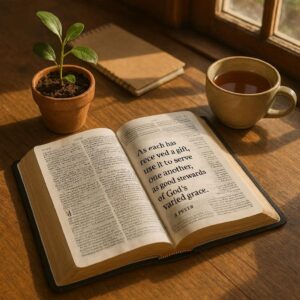
“Each of you should use whatever gift you have received to serve others, as faithful stewards of God’s grace in its various forms.”
Notice the purpose of the gift: it is to serve others. Your ability to cook isn’t just for your own stomach; it is to comfort a sick neighbor. Your knack for organization isn’t just for your closet; it is to help plan a church event. When you use your talents to help others, you are stewarding God’s grace.
Stewardship of the Body and Mind
The New Testament introduces a radical idea: your body isn’t just a vessel for your soul; it is a temple for the Holy Spirit. This elevates how we treat our physical and mental health.
Your Body is a Temple (1 Corinthians 6:19-20)
Paul confronts the church in Corinth about sexual immorality, but the principle applies to all aspects of physical health.
1 Corinthians 6:19-20 (NLT)
“Don’t you realize that your body is the temple of the Holy Spirit, who lives in you and was given to you by God? You do not belong to yourself, for God bought you with a high price. So you must honor God with your body.”
You were bought with a price—the sacrifice of Jesus. Therefore, you belong to God. Being a good steward means taking care of the “temple.” This includes rest, exercise, healthy eating, and avoiding things that harm the body.
Taking Every Thought Captive (2 Corinthians 10:5)
Stewardship of the mind is often overlooked. We live in a media-saturated world, and we have a responsibility to guard what we let in.
2 Corinthians 10:5 (NIV)
“We demolish arguments and every pretension that sets itself up against the knowledge of God, and we take captive every thought to make it obedient to Christ.”
This is mental stewardship. It means monitoring the thoughts you dwell on. Are they anxious? Angry? Impure? As a steward, you have the authority, through Christ, to kick those thoughts out and replace them with truth.
A Comparative Look at Stewardship
To make the concept of stewardship even clearer, let’s look at how a steward (a manager) differs from an owner.
| Area of Life | The Owner Mentality | The Steward Mentality | Key Bible Verse |
|---|---|---|---|
| Money | “It’s my money. I earned it. I’ll spend it how I want.” | “This is God’s money. How can I use it to bless others and further His Kingdom?” | Malachi 3:10 |
| Time | “I need to squeeze every second of pleasure out of my free time.” | “How can I invest my time today in things that have eternal value?” | Psalm 90:12 |
| Talents | “I’m just a amateur/hobbyist. My skills aren’t that important.” | “God gave me this ability. How can I develop it and use it to serve?” | Romans 12:6-8 |
| The Earth | “Resources are here for me to consume. It’s about convenience.” | “I am a caretaker of this planet for the next generation.” | Genesis 2:15 |
| The Body | “I can do what I want with my body. It’s my life.” | “My body is the temple of the Holy Spirit. I will honor God with it.” | 1 Corinthians 6:19-20 |
How to Apply These Verses Today
Reading these bible verse of being good stewards is the first step. Living them out is the real challenge. Here is a practical list to help you apply these truths starting today.
-
Take an Inventory: Sit down with a notebook. List your resources: income, skills, free time, physical health, and spiritual gifts. Just write down what you have.
-
Ask the Right Question: Instead of asking “How much should I give to God?”, ask “How much of God’s money should I keep for myself?” This small shift changes everything.
-
Audit Your Time: For one week, track how you spend your time. Look for “holes” where time was wasted. Schedule your priorities (prayer, family, rest) first.
-
Develop Your Gift: Is there a talent you have buried? Take a class, join a team at church, or practice a skill. Investing in your talent is an act of stewardship.
-
Practice Contentment: Stewardship isn’t just about managing abundance; it’s about managing scarcity. Learning to be content with what you have frees you from the stress of always wanting more (Philippians 4:11-13).
Important Note: Being a good steward is not about earning God’s favor. You cannot manage your way into heaven. Grace is a free gift. Stewardship is simply our loving response to a God who has already given us everything. It is about living out the gratitude we feel for the ultimate gift—salvation.
The Heart of a Faithful Steward
At the end of the day, God isn’t looking for perfect managers. He is looking for faithful ones. He knows we will drop the ball sometimes. We will waste time. We will spend money foolishly. We will neglect our health.
But the goal is to cultivate a heart that wants to please the Master. When you love the Owner, taking care of the property becomes a joy, not a burden.
Luke 16:10 (NIV)
“Whoever can be trusted with very little can also be trusted with much, and whoever is dishonest with very little will also be dishonest with much.”
This verse shows us that stewardship is a test of character. How you handle the small things (your daily schedule, your monthly budget) determines whether God can trust you with the big things (true spiritual riches).
Conclusion
Exploring the bible verse of being good stewards reveals a powerful truth: God has entrusted us with incredible resources. From the money in our wallets to the talents in our hands and the planet beneath our feet, everything is a gift to be managed for His glory. By adopting a steward mentality, we find freedom from the grip of materialism and purpose in our daily lives.
Frequently Asked Questions (FAQ)
1. What is the main Bible verse for stewardship?
While many verses cover the topic, 1 Peter 4:10 is a central verse: “Each of you should use whatever gift you have received to serve others, as faithful stewards of God’s grace in its various forms.” It summarizes the “why” and “how” of stewardship.
2. Is tithing (giving 10%) still required for Christians?
Tithing is an Old Testament principle (Malachi 3:10). In the New Testament, the standard is higher, not lower. Believers are called to be cheerful, generous givers (2 Corinthians 9:7). For many, 10% is a helpful starting point, but the goal is a heart of generosity that goes beyond a specific percentage.
3. How can I be a good steward if I am in debt?
Being in debt doesn’t disqualify you from stewardship. In fact, it makes wisdom even more critical. Focus on being a good steward of what you do have. Create a budget, cut unnecessary expenses, and use any extra income to pay down debt. Proverbs 22:7 says the borrower is slave to the lender; good stewardship involves working towards freedom.
4. Does being a good steward mean I can’t enjoy my money?
Absolutely not! God created all things for us to enjoy (1 Timothy 6:17). The problem isn’t enjoyment; it’s hoarding or wasting. A steward enjoys the Master’s possessions, but they do so with gratitude and moderation, always ready to share.
5. What is the difference between a steward and a servant?
A servant simply does what they are told. A steward is given authority and responsibility over the master’s property. As believers, we are both: servants in our obedience, and stewards in our management of God’s resources.